
Understanding how social security retirement benefits are calculated comes down to four steps: the Social Security Administration (SSA) picks your 35 highest-earning years, indexes each one for inflation, averages them into an Average Indexed Monthly Earnings (AIME) figure, then runs that number through a progressive formula to produce your Primary Insurance Amount (PIA). Your claiming age adjusts the result up or down. Updated for 2026.
That is the whole method, and it is worth understanding by hand, because almost every surprising number people see on a statement traces back to one of those four steps.
Table of Contents
- How Social Security Retirement Benefits Are Calculated
- The Four Main Parts of a Social Security Benefit
- How Your Average Indexed Earnings Are Determined
- Work Credits and Eligibility
- The Primary Insurance Amount Formula
- How the AEP Formula Works
- Maximum, Minimum, and Special Benefit Rules
- How Claiming Age Changes the Payment
- How Cost-of-Living Adjustments Affect the Payment
- Other Factors That May Change the Final Amount
- A Simple Social Security Calculation Example
- How social security retirement benefits are calculated in one worked example
- How to Check Your Official Benefit Estimate
- Frequently Asked Questions
- Can Social Security be calculated from my full career earnings?
- Does claiming at 70 always produce the largest benefit?
- Why did my Social Security estimate change?
- Is Social Security based on inflation-adjusted earnings?
- Are Social Security benefits taxable?
- Is Social Security based on my last 5 years of work?
- Conclusion: What to Check First
How Social Security Retirement Benefits Are Calculated

Here is the sequence the SSA itself uses, condensed into four steps.
- Select the work. The SSA finds the 35 years in your record with the highest indexed earnings. Every other year is dropped from the average.
- Index each year. Each year’s earnings is adjusted upward for economy-wide wage growth up to the current year, so a 1985 dollar is not compared directly against a 2020s dollar.
- Average into an AIME. The indexed amounts are summed and divided by 420 months, producing your Average Indexed Monthly Earnings.
- Run the formula. The AIME goes through a progressive calculation with two bend points to produce the PIA, your benefit at full retirement age, before any adjustment for the age you claim.
The formulas and the thresholds change from year to year, so treat any worked example below as an illustration of the method rather than an official estimate.
The Four Main Parts of a Social Security Benefit
A retirement payment is not one calculation. It is a base amount, adjusted by age, adjusted for inflation over time, and sometimes reduced by other rules. These components do not apply identically to everyone.
| Component | What it does | Applies to |
|---|---|---|
| Retirement insurance component | Converts your AIME into a monthly payment at full retirement age | Anyone with enough credits to claim |
| Delayed retirement credits | Adds a percentage for each year you wait past full retirement age | Only those who claim after full retirement age |
| Cost-of-living adjustments | Raises the payment each year in line with measured inflation | Anyone already receiving benefits |
| Special rules after benefits start | Covers deductions such as the retirement earnings test and recovery of overpayments | Claimants who return to work or owe an overpayment |
Keep these separate when you read an official statement. A figure labeled as the primary insurance amount is not yet the check that arrives in your account.
How Your Average Indexed Earnings Are Determined
Indexing is the step most people get wrong, and it is the reason a mid-career earner’s early salary looks enormous until you adjust it. The SSA divides your earnings in each year by the national average wage index for that year, then scales the result up to current wage levels.
A $20,000 salary in 1982 and a $60,000 salary in 2026 are not comparable raw numbers. Indexed, the older salary rises substantially because average wages moved a long way in four decades.
Once each year is indexed, the SSA keeps only the 35 highest. A year with no covered earnings becomes a zero in the record, and a zero cannot be excluded. Someone who worked 20 years carries 15 zeros, and those zeros sit permanently inside the average.
| Illustrative earnings history | Indexed average | AIME | PIA at full retirement age |
|---|---|---|---|
| 20 years of work, indexed earnings around 50,000 | 1,000,000 total | 2,381 | 1,508 |
| Five zero-earning years plus 30 working years | 1,050,000 total | 2,500 | 1,546 |
| 30 working years, indexed average 45,000 | 1,350,000 total | 3,214 | 1,774 |
| Full 35 years, indexed average 48,000 | 1,680,000 total | 4,000 | 2,026 |
| Full 35 years, indexed average 90,000 | 3,150,000 total | 7,500 | 3,146 |
All figures in this table are illustrative, in current dollars, and rounded. Notice how the jump from a partial career to a full one is large, and how the gap narrows as indexed earnings rise, because the formula replaces a smaller share of higher earners’ pre-retirement income.
Work Credits and Eligibility
Eligibility and amount are two separate questions. You need 40 credits to claim a retirement benefit, roughly ten years of covered work, and the size of the payment is set by the AIME and the formula.
A credit is earned for each roughly $1,600 of covered earnings in a year, up to a maximum of four credits per year. Wages above the annual taxable maximum, currently 184,500 for 2026, earn no additional credits, so high earners top out at four credits just like everyone else.
Credits are a gate, not a sizing mechanism. A worker who earned a modest wage for ten years qualifies for a benefit, and it can be quite small.
| Situation | Qualifies? | Notes |
|---|---|---|
| Ten or more years of covered work | Yes, generally | 40 credits reached |
| Fewer than 10 years of covered work | No retirement benefit | Benefits generally require 40 credits |
| 20 years of covered work | Yes | 15 zero years reduce the average |
| Earnings above the taxable maximum | Yes | No extra credits above the cap |
| Non-covered work, such as some public sector roles | Depends | Alternative coverage rules may apply |
The Primary Insurance Amount Formula
The PIA is the progressive formula at the center of the calculation, and it deliberately pays a higher share of a lower earner’s indexed career average. The SSA publishes the parameters for each year, and the ones in force for 2026 are the values used here.
| Parameter | Value for the current year |
|---|---|
| First bend point | 1,286 |
| Second bend point | 7,749 |
| Percentage of AIME below the first bend point | 90% |
| Percentage from the first to the second bend point | 32% |
| Percentage above the second bend point | 15% |
| Annual taxable maximum | 184,500 |
| Most recent cost-of-living adjustment | 2.8% |
Dollar figures are shown in current dollars. The SSA recalculates bend points annually, so anything you read from an older article is out of date.
How the AEP Formula Works
The AEP, or average indexed monthly earnings, feeds three bands. Ninety percent of the first 1,286 is the replacement of the first slice. Thirty-two percent applies to everything between the two bend points, which is where the benefit grows most quickly. Fifteen percent applies above 7,749.
Using an AIME of 4,000 as a purely illustrative figure:
| Band | Portion of AIME | Rate | Result |
|---|---|---|---|
| First bend point and below | 1,286 | 90% | 1,157.40 |
| Between the bend points | 2,714 | 32% | 868.48 |
| Above the second bend point | 0 | 15% | 0.00 |
| Primary Insurance Amount at full retirement age | 4,000 | — | 2,025.88 |
This is an arithmetic demonstration, not an official benefit estimate. An actual figure comes from the SSA, using that person’s exact record and the parameters in force for the year the benefit starts.
Maximum, Minimum, and Special Benefit Rules
The top of the formula is capped. The maximum retirement benefit applies to a worker with the maximum allowable earnings in every indexed year of a full career, and the SSA adjusts that maximum automatically for beneficiaries who claim after certain ages. Very few people reach it.
At the other end sits the special minimum benefit, reserved for certain people whose work histories were long but earnings were low, often under a disability or a caregiving interruption. Qualifying is not automatic and depends on specific statutory rules.
Formally, the PIA as recorded in a worker’s file is the amount payable at full retirement age, calculated with the parameters for that birth year. It is a starting figure for comparison, not a payment schedule.
How Claiming Age Changes the Payment
Claiming age is the adjustment applied to the PIA, and it is the largest lever most people control. Claiming early costs a percentage for every month early. Waiting past full retirement age earns a credit for every month waited, up to age 70.
Full retirement age is 66 for people born from 1943 through 1954, then rises by two months per birth year for those born from 1955 to 1959, and settles at 67 for anyone born in 1960 or later.
| Claiming age | Effect on the PIA | Main trade-off |
|---|---|---|
| 62 | Largest reduction available | More years of payments, smaller check |
| Between 62 and full retirement age | Reduction shrinks as the age rises | Delay recovers part of the cut |
| Full retirement age | PIA unchanged | No adjustment in either direction |
| After full retirement age to 70 | Credit of 2/3 of 1% per month, about 8% a year | Fewer years of payments, larger check |
| 70 and older | No further increase | Age 70 caps the credit |
The early reduction starts at 5/9 of 1% per month for the first 36 months before full retirement age, then drops to 5/12 of 1% per month. For a worker with a full retirement age of 67, that means a cut of roughly 30% when claiming at 62.
How Cost-of-Living Adjustments Affect the Payment
A cost-of-living adjustment, or COLA, raises benefits once a year based on the Consumer Price Index for Urban Wage Earners and Clerical Workers, the index used to track the cost of goods and services for this group of workers. The most recent annual adjustment was 2.8% for 2026.
Two details trip people up. A first-time benefit payment is not adjusted, because COLA changes apply from the December payment onward, and Medicare Part B premiums are often deducted from the deposit, which can make the deposited amount smaller even though the gross benefit grew.
COLA adjustments are separate from the indexing applied to your earnings history. Indexing happens once, before your AIME is computed. COLA happens annually, after benefits begin.
Other Factors That May Change the Final Amount
Beyond the core four steps, a number of rules can move the number that finally lands in your account.
- Annual taxable maximum. Earnings above 184,500 in 2026 are not counted for benefit purposes, so late-career raises at the very top do not add to the record.
- Retirement earnings test. In the year benefits start, 1 is withheld for every 2 of earnings above 24,480, and 1 for every 3 above 65,160. The test applies in the claiming year only.
- Spousal and survivor benefits. A spouse or survivor may claim an auxiliary benefit based on the higher-earner record, including the two-b benefit, which is the larger of the two retirement insurance amounts.
- Government offsets. Certain benefits can be withheld to repay debts owed to federal agencies.
- Tax withholding and Medicare premiums. Withholding can be selected after benefits begin, and Part B premiums are deducted.
- Overpayments. Reported earnings errors or benefits paid to someone not entitled to them can be recovered.
On taxation: retirement benefits themselves are not taxed as ordinary wages, and a portion may be treated by the IRS as taxable income based on combined income, filing status, and other rules. Specific thresholds are set each year, so check current IRS guidance or a qualified tax professional about your situation.
A Simple Social Security Calculation Example
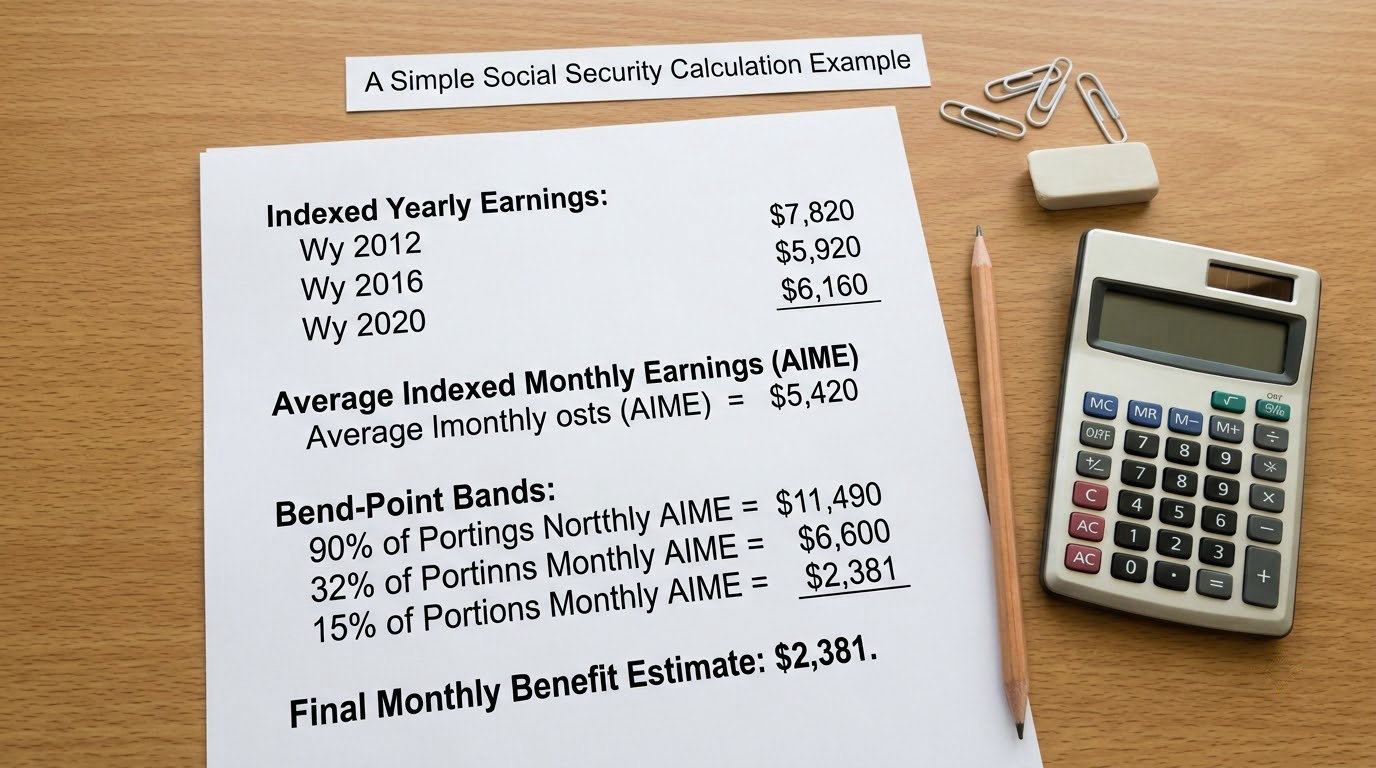
How social security retirement benefits are calculated in one worked example
Take an illustrative worker who claims at full retirement age 67, with these indexed earnings spread across 35 years. The five largest years are shown in full and the remaining 30 years are grouped, so the total still equals the underlying record.
| Indexed year or group | Indexed earnings |
|---|---|
| Highest indexed year | 86,000 |
| Second year | 81,000 |
| Third year | 74,500 |
| Fourth year | 68,000 |
| Fifth year | 62,000 |
| Remaining 30 indexed years combined | 1,308,500 |
| Total indexed earnings | 1,680,000 |
Dividing by 420 months gives an AIME of 4,000. The bend-point calculation then produces a PIA of 2,025.88, which rounds to about 2,026 at full retirement age.
Now change one variable. Claiming at 62 instead, with a full retirement age of 67, means 60 months early. The reduction is 36 months at 5/9 of 1% plus 24 months at 5/12 of 1%, which works out to about a 30% cut, leaving roughly 1,351 a month in this illustration.
If the same worker waited to 70, the delayed credits would add about 24% to the PIA, and the growth would then continue at 2.8% a year through subsequent annual adjustments.
| Stage | Illustrative amount | What changed |
|---|---|---|
| Total indexed earnings | 1,680,000 | Start of the calculation |
| AIME | 4,000 | Indexed total divided by 420 months |
| PIA at full retirement age 67 | 2,026 | Bend-point formula applied |
| Claiming at 62 | 1,351 | Early reduction of about 30% |
| Claiming at 70 | 2,512 | Delayed credits of about 24% |
| After two years of 2.8% adjustments | 2,654 | Annual cost-of-living adjustment |
Every figure above is illustrative and rounded. Benefit years, bend points, maximum amounts, and entitlement rules come from the official record, so use these numbers to follow the method rather than to predict a payment.
For readers asking what a target monthly benefit requires, the same arithmetic runs in reverse. Reaching about 3,000 at full retirement age takes an AIME near 7,045, or roughly 84,500 in indexed earnings across 35 years. Reaching about 5,000 takes an AIME far above the second bend point, around 19,580, or about 235,000 in indexed earnings, and that level runs against the annual taxable maximum.
How to Check Your Official Benefit Estimate
Any hand calculation is a sanity check, not a decision. Four steps give you the real number.
- Pull your earnings record from the official my Social Security account and read every year of reported wages. Members on retirement forums stress that a missing or misreported W-2 can permanently lower a benefit, and the fix is far easier before you claim.
- Check that you have enough credits and that any years you expect to show as zeros are correct.
- Use the SSA benefit estimator with that verified record to see the amounts at age 62, at full retirement age, and at 70.
- Compare the three scenarios, and note that different calculators return different figures because each applies different assumptions and sometimes different year parameters. Where two disagree, the SSA figure wins.
Never publish account-specific information found in a public forum thread, and treat any third-party estimate as a starting point rather than an official amount.
Frequently Asked Questions
Can Social Security be calculated from my full career earnings?
No. The formula generally uses the 35 years of indexed earnings with the highest values, not a straight total of everything you ever earned. Years with little or no covered earnings stay in the record as zeros, and they drag the average down. Two people with identical lifetime totals can receive very different monthly amounts because of which years those totals came from. Only the official SSA estimate uses your actual record.
Does claiming at 70 always produce the largest benefit?
Age 70 produces the largest monthly retirement insurance amount for someone who otherwise qualifies, because delayed credits stop there. It does not produce the largest lifetime total. The financially preferable age depends on life expectancy, health, a spouse’s benefit, other income, and how long benefits must last. Delayed claiming also raises the survivor benefit a spouse or estate inherits. Rules change over time, so treat this as methodology rather than a recommendation.
Why did my Social Security estimate change?
An estimate moves when the underlying record moves. Updated or corrected earnings change indexed amounts, which change the AIME, which changes the PIA. Annual wage limits, new bend points, an updated maximum benefit, filing history, and changes in auxiliary entitlement such as spousal benefits can all shift the figure. Individuals sometimes see a change simply from an annual recalculation even without filing a new claim. Recheck your earnings record first.
Is Social Security based on inflation-adjusted earnings?
Two different adjustments are easy to confuse. Before the AIME is calculated, the SSA indexes each of your earning years for economy-wide wage growth so that a dollar from one era is comparable to a dollar from another. Separately, once benefits are being paid, they receive an annual cost-of-living adjustment tied to the cost-of-living index. The first happens once, at calculation. The second happens every year after that.
Are Social Security benefits taxable?
Partly, in many cases. The IRS may treat a portion of retirement benefits as taxable federal income, and the amount depends on combined income, filing status, and other rules. Up to a maximum share of the benefit can be included. You can choose withholding once benefits begin. Thresholds are set each year, so for an individual tax situation consult a qualified tax professional rather than relying on a general explanation.
Is Social Security based on my last 5 years of work?
No. This is the most common misunderstanding by a wide margin. The calculation uses your 35 highest years of indexed earnings across your entire record, not the most recent years and not the most recent five. A career break in your thirties or forties can therefore lower a benefit permanently, because those zero years enter the average and cannot be removed. Check your earnings record and confirm the years the SSA is using.
Conclusion: What to Check First
Check your official earnings record first, then run the SSA estimator. Everything else is arithmetic on top of that record, and an error there quietly lowers every number you see afterward.
Once you know how social security retirement benefits are calculated, the four steps make comparing claiming scenarios straightforward: hold the AIME fixed, change the claiming age, then apply the annual adjustment for each year the benefit is paid. You can also spot a figure that cannot be right, because an illustration and an official estimate look very different.
Thresholds, bend points, and testing rules are set annually and change over time, so this is an explanation of the method rather than personal financial advice. For a number you plan on, go to the official estimate and treat everything else as a check.