
A 401(k) rollover moves your retirement savings out of a former employer’s plan and into an IRA or a new employer’s plan, usually without taxes or penalties. The cleanest method is a direct, trustee-to-trustee transfer, where the old plan sends the money straight to the new account and it never passes through your hands.
You need one whenever you change jobs, get laid off, or retire and your old plan will not let you keep contributing. Forgetting an old 401(k) is common, and so is rolling it the wrong way and paying a bill you did not have to pay.
Table of Contents
- What Is a 401(k) Rollover?
- How Does a 401(k) Rollover Work?
- What Is the Difference Between a Direct Rollover and an Indirect Rollover?
- Can You Roll Over a 401(k) Into an IRA?
- Can You Roll Over a 401(k) Into Another Employer’s 401(k)?
- What Happens to Money That Is Not Rolled Over?
- What Documents and Information Do You Need?
- Common 401(k) Rollover Mistakes to Avoid
- Frequently Asked Questions
- Is there a downside to rolling over a 401k?
- How long do you have to rollover your 401k after leaving a job?
- Are there any fees when rolling over a 401k?
- How do I roll over a 401k without paying taxes?
- What is the safest thing to roll your 401k into?
- Can I roll over a 401k if I still have a loan?
- Conclusion
What Is a 401(k) Rollover?
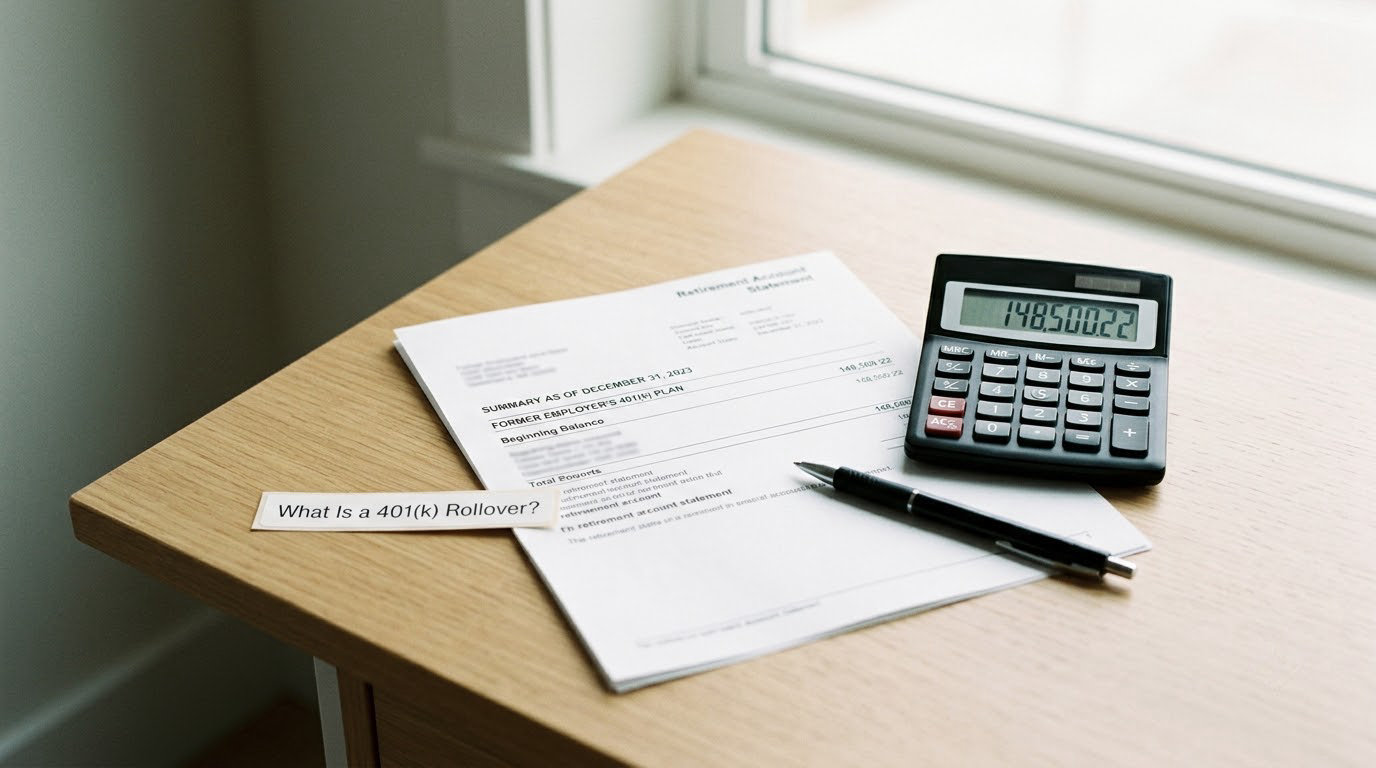
A rollover is moving a retirement account you no longer contribute to somewhere you can still control. The account itself is not closed and destroyed. The balance is relocated, usually within a few weeks, and the money keeps its tax-deferred status.
The difference between moving money and taking it out matters more than anything else on this page. A rollover keeps the money inside the retirement system. A withdrawal takes it out, and the IRS treats that as income in the year you receive it.
Four destinations exist for an old 401(k):
- Leave it in the former employer’s plan, if the plan permits and your balance is above the plan’s threshold.
- Roll it into a new employer’s 401(k), if that plan accepts rollovers.
- Roll it into a Traditional IRA or Roth IRA, which you control no matter where you work next.
- Cash it out, which is the only option that triggers taxes and possible penalties.
Plenty of experienced savers on Bogleheads and r/personalfinance describe rolling money to an old employer as fine when the plan is cheap and the new job offers nothing. The trouble starts when people assume a rollover is required. It is not. Small leftover balances often sit untouched for years because nobody wants the paperwork.
How Does a 401(k) Rollover Work?

A direct rollover works in four moves: you pick a destination, you open that account if it does not exist, you tell the old plan administrator where to send the money, and you choose what to hold once it arrives.
Step one is the decision, and it is the only step that takes real thought. Compare fees and investment options across your old plan, the new plan and an IRA before you sign anything.
Step two is paperwork. Ask the new custodian for its rollover form, which usually asks for the old plan’s name, the administrator’s address, your account or plan number, and the distribution reason marked as a direct rollover. Marking the reason correctly is what keeps the check from being made payable to you.
Step three is where you hand that form to the old plan administrator. The form can typically be submitted by mail, through an online portal, or by fax. Plan administrators are the least responsive party in this process, so ask for a written estimate of the payout date and follow up if it passes.
Step four is investing. The money usually lands as cash in a money market or settlement fund inside the new account, and it stays invested at almost nothing until you choose. One widely cited Vanguard study found that roughly a third of people who rolled over in 2015 still had the money sitting in cash seven years later. That is the quietest way to lose a decade.
Some plans now support auto-portability, which lets a recordkeeper move a small balance from your old employer straight to a new one without a paper check. If your old plan offers it, ask before starting a manual rollover.
What Is the Difference Between a Direct Rollover and an Indirect Rollover?
A direct rollover never puts the money in your bank account, so nothing is withheld and no deadline starts. An indirect rollover pays you first and gives you 60 days from the date you receive the check to redeposit the money, with 20 percent already withheld against your taxes.
| Factor | Direct rollover | Indirect (60-day) rollover |
|---|---|---|
| Who moves the money | The old plan sends it to the new custodian | The plan pays you, you redeposit it |
| Do you see the cash | No | Yes, minus 20 percent withheld |
| Deadline | None | 60 days from receipt |
| If you miss the deadline | Nothing happens | That portion becomes a taxable distribution, with 20 percent due within 30 days |
| Best for | Almost everyone | Rare cases where a check payable to you is genuinely required |
The 20 percent is not extra tax. It is a prepayment against what you would owe, so the refund arrives months later, at your marginal rate minus the 20 percent already taken. If the deadline passes, the withheld 20 percent still has to be paid to the IRS within 30 days even if you then put the rest into an IRA.
One more trap shows up when you roll a pre-tax 401(k) into a Roth IRA, which is a taxable conversion. If you hold other IRA money that is pre-tax, the IRS applies the pro-rata rule across your total traditional, SEP and SIMPLE IRA balances. A 20,000 dollar conversion can be taxed entirely as ordinary income if you also hold 100,000 dollars of deductible IRA money.
Can You Roll Over a 401(k) Into an IRA?
Yes, and this is the most common destination. A pre-tax 401(k) balance rolls into a Traditional IRA without tax. A Roth 401(k) balance rolls into a Roth IRA without tax, and the money is qualified, so it does not restart the five-year waiting period for Roth IRA withdrawals.
Getting a cash balance is not the same as getting a contribution. A rollover IRA is not opened with new money, and making one does not give you a new 4,000 dollar contribution limit each year. It also removes the annual contribution deadline as a constraint, which is why people use it to catch up on backdoor Roth conversions.
Company shares are the exception. If your old plan holds employer stock, the IRS taxes net unrealized appreciation, the gain above your cost basis, at ordinary rates with no rollover deferral. You can roll over the value, but you cannot roll over the tax on that appreciation. Shares of a large employer held for years can carry a six-figure tax bill, so get advice before touching that money.
Teachers and nonprofit employees usually have a 403(b) instead. The mechanics are nearly identical, and a 457(b) plan, which many government and nonprofit employers offer, has no early withdrawal penalty at all if you leave the employer before 59 and a half.
Can You Roll Over a 401(k) Into Another Employer’s 401(k)?
You can, but the new plan has to agree. Most plans accept rollovers only from other qualified plans and IRAs, never from another 401(k) into a personal rollover IRA, so check the new plan’s document or ask HR directly.
Two mechanics cause most problems. Some plans accept only cash and require you to wait until the money arrives before you can invest it, which leaves you sitting in a money market fund for a few weeks. Other plans accept an in-kind transfer, where funds move directly between investment options without going to cash, and those are worth requesting because they cut both the timing gap and the reinvestment risk.
After-tax contributions create another wrinkle. Traditional, Roth and after-tax balances in the same plan are usually kept in separate accounts, and a receiving plan may not accept after-tax money at all. Employer money you have not vested in cannot be rolled over, and an outstanding 401(k) loan balance has to be handled separately, usually repaid or offset against the distribution.
Once you are separated from an employer, you also lose rights the old plan could no longer offer: contributions, the ability to change investments freely, loans, and in-service withdrawals. You keep your vested balance and your right to roll it over.
What Happens to Money That Is Not Rolled Over?
Do nothing and most plans do nothing kind. A plan can force a distribution when your balance drops below the plan’s threshold, often 5,000 dollars, and if you ignore the check it can be cashed out or moved to a default investment in a retirement-age-targeted fund. Either outcome can cost you money.
A forced payout is a taxable distribution. With 20 percent withheld, your 40,000 dollar balance puts 8,000 dollars in tax withholding and 4,000 dollars in early withdrawal penalty in your hands at most, all due for the year with no offsetting gain. If the 60-day rule lapses, that withheld 20 percent must be paid to the IRS within 30 days even if you redeposit everything else.
Plans also reclaim small vested balances. If you leave a company with an incomplete, non-vested account, the employer keeps it, but fully vested balances are protected by federal law and must be handled either by a payout or a transfer to an eligible retirement plan. The exception is a small cash-out when the employer pays you and withholds the appropriate taxes, which is why many administrators say “no legal action required” on the notice.
What Documents and Information Do You Need?
Gather these before you contact anyone, and the whole process gets shorter:
- Your most recent quarterly statement, with the plan name, the plan number, and the administrator’s address on it.
- The name and phone number of the plan administrator, which is the company that administers the plan, not necessarily your old employer.
- A distribution request form from the old plan, available on its website or from HR.
- The new custodian’s rollover form, plus your new account number.
- The breakdown of your balance by source, separating pre-tax, Roth and after-tax dollars, usually on the statement or the plan’s website.
- Your beneficiary information, kept with your financial documents.
- Your loan balance and vesting schedule, if either exists on the account.
Missing the balance-by-source breakdown is what causes surprises, especially when a Roth portion gets sent to a Traditional IRA. Ask for it before you request the distribution rather than after the money has moved.
Common 401(k) Rollover Mistakes to Avoid
Rolling a paycheck over instead of a distribution. A payroll 401(k) contains ongoing salary deferrals, and they are not eligible for a rollover. Only balances from a terminated or former employer can move.
Missing the 60-day deadline on an indirect rollover. The clock starts the day the check clears your account, not the day you request it, and the deadline does not extend for weekends or holidays. Requests made in December are the most common failure.
Letting the money sit in cash. The single most expensive mistake is often the one where nothing went wrong at all. Pick your investments before the money lands, or set up a target date fund on day one.
Cashing a check made payable to you. If a direct rollover check arrives in your name, the old plan has not completed a direct transfer, and cashing it starts a 60-day clock you may not know about. Send it back and ask for a new check payable to the custodian.
Using a rollover that is really a scam. Ads pushing gold, silver, precious metals and other high-fee “retirement” investments into rollovers are a persistent pattern, and the Department of Labor has warned about it. A legitimate rollover costs the plan nothing to move and the new custodian usually charges nothing either.
Giving up the rule of 55. If you are 55 or older and leave a job, you can generally take your old plan money out without the 10 percent penalty. That access does not follow you into an IRA, where the age 59 and a half penalty applies. A small backdoor Roth IRA is the usual workaround.
Checking the fee comparison before you transfer. Ask what the old plan charges, what an IRA at a low-cost provider would charge, and what the receiving plan charges. Fidelity, Vanguard and Charles Schwab are commonly named in forums as places people compare against, and their IRA share classes are among the cheapest options available. That is a comparison, not an endorsement.
Getting a written number for the payout date and following up when it passes. A direct transfer commonly takes a few weeks, and many administrators will not estimate on the phone. A written confirmation is worth more than another call.
Frequently Asked Questions
Is there a downside to rolling over a 401k?
The main trade-off is flexibility. A 401(k) lets you borrow against the balance before retirement, offers larger contribution limits and sometimes holds company shares or annuity options an IRA cannot. An IRA usually has cheaper funds, no employer influence over your investment menu, and portable creditor protection. If your new job offers a strong match, leaving the old balance there can also be sensible.
How long do you have to rollover your 401k after leaving a job?
With a direct, trustee-to-trustee transfer there is no deadline at all, because you never receive the money. The 60-day rule only applies to an indirect rollover, where the check is made payable to you. You then have 60 days from the date you received it to redeposit all or part of it into an eligible retirement account. Miss that window and the distribution becomes taxable.
Are there any fees when rolling over a 401k?
A direct rollover normally costs nothing. The old plan does not charge for moving the balance, and most IRA custodians accept a direct transfer free. Costs show up later as expense ratios on the funds you buy, and the old plan’s fees disappear only if you actually move the money. Compare expense ratios, any administrative charges and any advisory fee before you decide.
How do I roll over a 401k without paying taxes?
Ask for a direct, trustee-to-trustee transfer, and in writing request a direct rollover rather than a distribution to you. That way no money is withheld and no tax year is triggered. Moving a pre-tax 401(k) into a Traditional IRA, or a Roth 401(k) into a Roth IRA, keeps everything tax-deferred. Rolling pre-tax money into a Roth IRA is a conversion and is taxable.
What is the safest thing to roll your 401k into?
For most people moving a pre-tax balance, a Traditional IRA at a low-cost provider gives the widest investment choice, low fees and control that no employer can change. A Roth IRA is the natural destination for Roth 401(k) money, and the funds become qualified with no five-year wait. A new employer’s plan wins when it offers a generous match, cheap funds or useful plan features.
Can I roll over a 401k if I still have a loan?
Usually, but the loan has to be dealt with first. Most plans require you to repay the loan before the distribution is issued, or they offset the balance against it, which can be taxable. A few plans permit a rollover while the loan is outstanding and simply exclude the loan portion. Ask the plan administrator in writing whether the loan is repaid, offset or excluded.
Conclusion
Start by calling the plan administrator listed on your most recent statement and asking for the direct rollover form. Open the destination account first, compare fees and investment options while you wait, and request a direct trustee-to-trustee transfer in writing so no money ever reaches your bank account.
Then pick your investments before the transfer lands, keep the confirmation paperwork until the money is invested, and treat any unsolicited pitch to move a 401(k) into gold, metals or high-fee “retirement” investments as a warning sign. Rules and rates vary by plan and change over time, so this is general information rather than tax or financial advice.