
How Medicaid eligibility is determined comes down to two decisions your state makes: which eligibility group you belong to, and whether your income and resources fall under that group’s limits. There is no single national answer, because each state administers the program under a federal floor and sets its own thresholds, rules and paperwork.
That last point is where most confusion starts. Two people with the same income can get opposite decisions in two neighboring states, and the same person can be turned down for a reason that would not have applied in a different eligibility group. Knowing which group you are in, and which financial test that group uses, explains nearly every approval, denial and surprise termination you will run into.
Last updated: October 2026. Rules and dollar thresholds change; always confirm your numbers with your state Medicaid agency.
Table of Contents
- How Medicaid Eligibility Is Determined
- What the state checks, in order
- Which Medicaid Program May Cover You?
- How Income and Household Size Are Counted
- How Age, Disability, and Health Needs Affect Eligibility
- How Pregnancy and Parenthood Are Considered
- How Immigration Status Affects the Application
- What Other Factors Can Change the Decision?
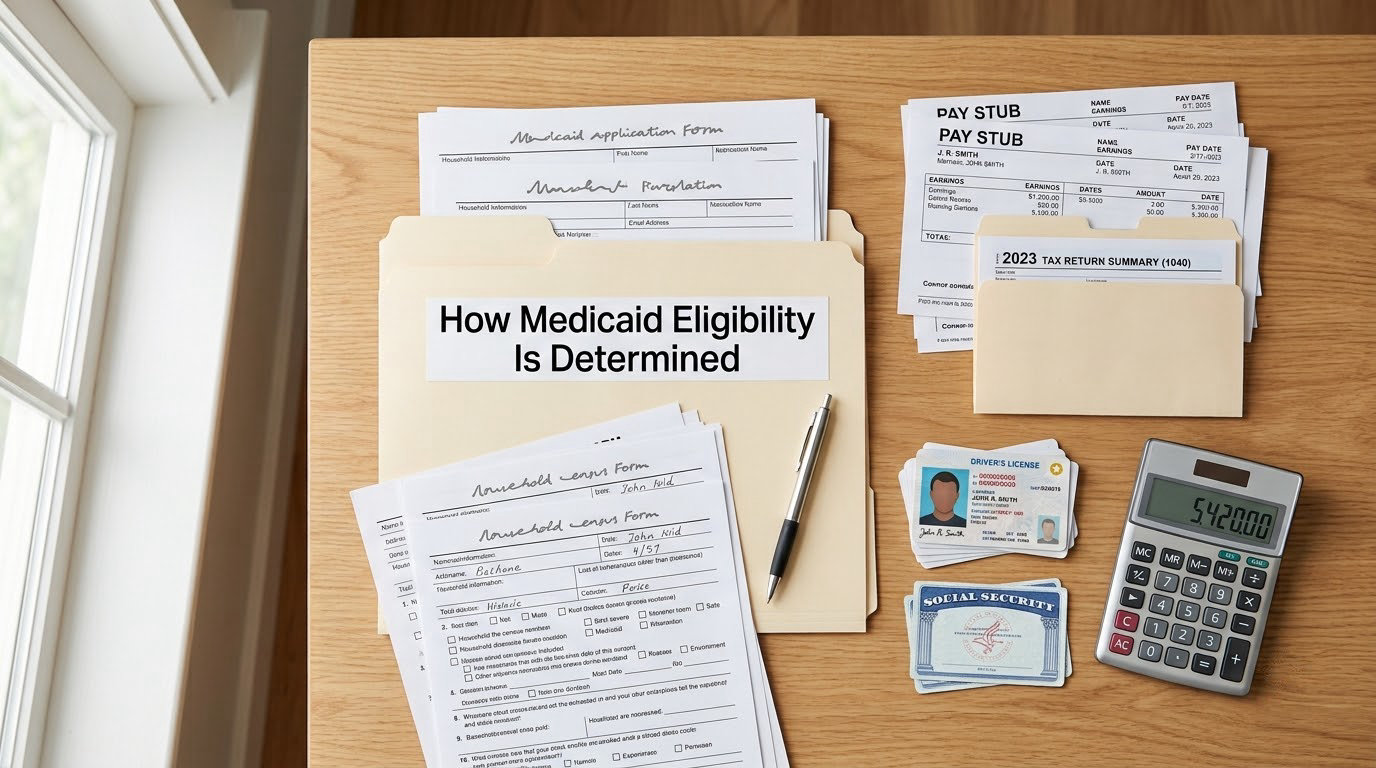
- What Documents and Information Do You Need?
- How to Apply for Medicaid
- How to Appeal a Medicaid Eligibility Decision
- Frequently Asked Questions
- What is the highest income to qualify for Medicaid?
- How does Medicaid verify eligibility?
- How much money can I have in savings and still get Medicaid?
- Does Medicaid count my house and my car?
- Can I qualify for Medicaid if I have a job?
- Do I have to be poor to get Medicaid?
- What to Do First
How Medicaid Eligibility Is Determined
The federal government sets the floor. Congress wrote the rules, and the Centers for Medicare & Medicaid Services enforces them through 42 CFR Parts 435 and 436, which spell out who states must cover and how they must count income and resources. States then write a state plan that describes how they will do it.
Your state Medicaid agency is the party that actually decides your case. A caseworker or an automated system places you in an eligibility group, applies that group’s financial test, checks your answers against other data the state already holds, and issues a written determination. No one in Washington approves your application, and no other state’s answer travels with you.
What the state checks, in order
The state works through a short pipeline: you apply, the application is matched against federal and state records, documents are requested if the electronic match is incomplete, you are placed in an eligibility group, the group’s limits are applied, and a notice goes out telling you what you qualified under and how to challenge it. Because the match comes before the paperwork request, many applicants never send documents at all.
Which Medicaid Program May Cover You?
Your eligibility group, not your raw income, determines which test you face. The state should place you in the group with the most generous limit that fits your situation, so if you are pregnant or disabled, do not assume the plain adult test was used.
- Children qualify at much higher income levels, usually well above the adult threshold, and many are covered through CHIP rather than Medicaid.
- Pregnant people are typically covered at a substantially higher income percentage than other adults.
- Parents and caretaker relatives are tested against a lower threshold than the adult group in most states.
- Adults 19 to 64 with no children are the group most affected by the expansion decision. In expansion states the limit is tied to 138% of the federal poverty level; in non-expansion states the limit for childless adults is far lower and often restrictive or absent.
- Older adults, people who are blind, and people with disabilities are tested on both income and countable resources, and this is the pathway that funds long-term services and supports.
Children’s coverage is handled through Medicaid and CHIP together, and the two programs are run as a single seamless application in most states, so you apply once either way.
How Income and Household Size Are Counted
For most adults under 65, states use modified adjusted gross income, the same income definition used for Marketplace tax credits, with a standard disregard built in. The practical consequence is that your Medicaid income is not your take-home pay, and the calculation follows tax rules, not the way a budget would look at your bank account.
Household size drives the number. In Medicaid’s version of MAGI, tax dependents such as your children are generally counted even if they do not live with you, and a parent claimed as a dependent by their child can sometimes be counted in the child’s household. That last rule surprises a lot of applicants. Who counts in the household changes the limit, so errors here produce denials that look inexplicable on the notice.
The reference point is the federal poverty level, published by HHS in January each year. The dollar figures update with it, and every income percentage a state uses is recalculated against the new guidelines. Because the cutoffs are percentages rather than fixed amounts, a raise can move you over the line within a single year even though nothing about your household changed.
Aged, blind and disabled applicants are not tested this way. That group uses a different income test with a personal income allowance for basic needs, and a resource limit set by the state. People who are in this category, or helping someone apply, should read this with a benefits attorney rather than a calculator.
How Age, Disability, and Health Needs Affect Eligibility
Being blind, disabled, or over a certain age opens a pathway with its own tests, and it can be more generous than the adult pathway for people whose income sits just above the limit. States also run their own disability determinations for Medicaid that can cover people the Social Security Administration has denied, because the two programs use different standards.
Needing help with daily living can matter as much as diagnosis. If you need nursing facility care or want to live at home instead, states use home and community-based services waivers, and a functional assessment decides whether you qualify rather than a diagnosis alone. Qualifying for the waiver also triggers a review of the resources used to pay for care, including a look-back period and possible transfer penalties in many states.
If you are already on Medicare, Medicaid can pay the premiums and cost-sharing Medicare leaves behind. That combination is often called dual eligibility, and it is worth asking about if you are over 65 and on a fixed income.
How Pregnancy and Parenthood Are Considered
Pregnancy opens a much higher income limit than the standard adult test, and most states have removed the caps that used to sit on it. Coverage extends through the postpartum period, and newborn coverage is generally automatic when the baby is born to a mother who already had Medicaid, though you should still add the child to your household so the paperwork matches reality.
Parents of minor children are judged on a separate test from childless adults, and states differ widely on where that line sits. In non-expansion states this is the most common reason a working parent is denied: income that would have qualified in an expansion state is far above the parent threshold here.
How Immigration Status Affects the Application
Federal law bars federal Medicaid funding for certain people who arrived within the last five years, and for some other recent immigrants. This is about who the federal government will pay for, not about citizenship rules as most people assume them.
There are important exceptions. Children and pregnant people are covered regardless of the five-year bar, and anyone who qualifies can receive emergency Medicaid, which pays for an urgent medical need regardless of status. States may also fund coverage for people the federal rule excludes, and the state-funded programs vary widely, so the answer genuinely differs in every state.
What Other Factors Can Change the Decision?
Other coverage counts. If you have access to an employer plan or Marketplace coverage, that affects whether Medicaid pays, and telling the state about a plan you dropped is part of reporting a change. File a change with your state rather than waiting, because the state may already know through data matching and a gap in communication is the reason behind a lot of denials.
Resources matter in some groups but not others. Most adults under 65 in the adult pathway are tested on income only, with no asset test, which surprises applicants who have been told for years that there is a savings limit. The aged, blind and disabled pathway does apply countable resource limits, and states exclude certain property from the count, commonly the equity in a primary home, one vehicle, and a list of personal items whose treatment varies.
How and when you lose coverage is its own factor. Most terminations during the post-pandemic unwinding were procedural, not financial: the renewal packet went unanswered, or it arrived at an old address. Coverage can also end because eligibility for the group you qualified under changed, such as a pregnancy ending, without any change in your income at all.
What Documents and Information Do You Need?
Have these ready before you start. Most states will verify much of it electronically and only ask for what the match did not confirm, but a complete application gets decided faster.
- Social Security number, or proof you do not have one
- Date of birth and full legal names for everyone in the household
- Proof of identity, such as a driver’s license, state ID or passport
- Citizenship or immigration documents, where applicable
- Proof of state residence, which can be a lease, utility bill or landlord statement
- Recent pay stubs, a benefits award letter, or self-employment records for each income source
- Social Security, SSI or SSDI award letters, if you receive any
- Medical records or a doctor’s statement if you are applying on a disability or long-term-care basis
Two habits shorten the process more than anything else: list every dollar of income including fluctuating and self-employment income, and answer the household questions about who lives with you and who is claimed as a dependent. Every disagreement in forum threads and calls to state hotlines traces back to one of those two items.
How to Apply for Medicaid
- Find your state agency. Use the state Medicaid agency directory on medicaid.gov, or start from HealthCare.gov and pick Medicaid, which routes you to the right application.
- Apply through your state’s channel. Most states use one combined application for Medicaid, CHIP and Marketplace coverage, and some offer a short screening tool first.
- Create an account and report the household. Include everyone who is in your tax household and anyone the rules let you claim, even if they do not live with you.
- Answer the group questions carefully. Pregnancy, disability, blindness and recent job loss all open better limits, and a wrong answer here can put you in the wrong group.
- Respond fast to any document request. The state sends a notice listing exactly what it needs and a due date, and missing that deadline is a leading cause of termination.
- Wait for the determination notice. It names the group you qualified under, how your income was counted, when coverage starts and how to appeal.
Renewals mostly happen on the state’s schedule, and many are completed without you doing anything: the state can check its own data, find you still qualify, and renew you automatically. That is called an ex parte renewal, and it only works if your contact details and address are current. Coverage can also be granted retroactively, so if you were uninsured while the application was pending, ask the agency about a retroactive date.
How to Appeal a Medicaid Eligibility Decision
A denial is not the last word. Every adverse determination comes with a notice that states the reason, the decision date and your right to a reconsideration and a fair hearing, and the clock on requesting review is generally 90 days from the date on the notice. Coverage commonly continues during review, but you have to ask; do not assume it.
- Read the reason code. Write down the exact code and wording, because you will need to argue against that specific reason.
- Request a reconsideration with the agency if the decision was wrong or based on facts you did not report. Attach pay stubs, award letters or proof of residency.
- Request a fair hearing if the reconsideration does not fix it. Hearings are free, and you may bring a representative, including a legal aid attorney or an approved advocate.
- Ask for your file before the hearing. The record shows exactly what data the state used, and it is how people find out that an adult child’s income or a cleared deposit was counted.
- Check for a managed care appeal separately if a decision concerns a denial of services from your health plan rather than your Medicaid eligibility. That is a different process with its own deadline.
If the reason on your notice does not match your circumstances, say so in writing and ask how the decision was reached. Reason codes get misapplied, and a correction is often faster than any other part of an appeal.
Frequently Asked Questions
What is the highest income to qualify for Medicaid?
It depends on your group and your state. In expansion states, most adults under 65 qualify up to 138% of the federal poverty level, and children, pregnant people, older adults and people with disabilities are tested against much higher percentages. Non-expansion states set far lower limits for childless adults. Because the federal poverty level changes every January, the dollar figure changes too, so check your state agency for the current number.
How does Medicaid verify eligibility?
States start with what you report on the application, then match it against data they already hold, including federal tax records, Social Security records and wage records. Where the match is complete and consistent, no documents are requested. Where it is not, the state sends a list of what it needs. Some states renew cases automatically using their own data, known as an ex parte renewal, so many people never mail anything in.
How much money can I have in savings and still get Medicaid?
For most adults under 65 in the adult pathway, there is no asset test at all, only an income test. Asset limits mainly apply to older adults, people who are blind, and people with disabilities, and the number is set by each state rather than federally. States commonly exclude the equity in a primary home, one vehicle, and certain personal property from the count. If you are in that older or disabled pathway, ask your agency for your own state’s figure.
Does Medicaid count my house and my car?
Usually not. In the aged, blind and disabled pathway, most states exclude the equity in your primary residence and exempt one vehicle outright, with rules for a second vehicle that vary. Personal belongings, household goods and often one burial plot are excluded as well. None of this matters if you are testing under the adult income pathway, where there is no resource test. The exact list belongs to your state, so ask for it in writing.
Can I qualify for Medicaid if I have a job?
Yes. Having income, even a full-time job or a small business, does not disqualify you. Medicaid is means-tested, so what matters is whether that income falls under the limit for your eligibility group after the standard disregard. Self-employed applicants usually report net profit rather than gross receipts, and income that fluctuates month to month is averaged according to state rules. Tell the agency about the job rather than leaving it off, since they can find it anyway.
Do I have to be poor to get Medicaid?
Not in the way most people picture it. Medicaid is aimed at people with very low or no income, but it also covers people with high medical needs and modest means, which is how seniors needing long-term care and people with disabilities qualify. The program is also paired with Medicare for some beneficiaries, with Medicaid paying the premiums and cost-sharing Medicare does not cover. That combination, called dual eligibility, is worth asking about if you are 65 or older.
What to Do First
Start by identifying your state Medicaid agency through the directory on medicaid.gov, then work out which eligibility group you actually fall in. Pregnancy, disability, blindness, or caring for a child all change the test that applies to you, and being in the wrong group is the single most common reason a case is decided against you.
Gather your household composition and every dollar of income before you start the application, answer the group questions deliberately rather than quickly, and keep your address and phone number current so renewals do not fail in the mail. If you have already been denied, request the reconsideration and hearing listed on your notice within the deadline printed on it, and ask for your case file.
This is general information about how a government program works, not advice about your situation. Rules, thresholds and covered services differ by state and change over time, so verify everything with your state Medicaid agency. For questions about assets, trusts, long-term care planning or a denial you believe was mishandled, talk to a benefits attorney or your local legal aid office.
Sources: Medicaid.gov, the Centers for Medicare & Medicaid Services, 42 CFR Parts 435 and 436, and the federal poverty level guidelines published by the U.S. Department of Health and Human Services.