
An escrow account is a secure account held by a neutral third party that keeps money or documents until a specific condition is met. Money goes in, sits there while both sides meet the terms of an agreement, and comes out only when the person or company running the escrow authorizes the release.
In a home sale, that condition is the closing. In a marketplace sale, it might be your confirming that an item arrived as described. In a rental, it might be the day you hand back the keys. The mechanics are the same each time, whoever the parties are. Here is how an escrow account works from the first deposit to the final release.
This is general educational information about how escrow functions. Legal definitions, licensing rules and fee structures differ by country, state and provider, so check the rules where you live and the terms of your specific agreement.
Last reviewed for accuracy in 2026.
Table of Contents
- How an Escrow Account Works Step by Step
- What Is an Escrow Account?
- Who Can Hold Money in Escrow?
- Banks and credit unions
- Licensed escrow and title companies
- Online marketplaces
- Attorneys and law firms
- Courts and government agencies
- Platform payment systems
- How to check who is actually holding your money
- What Happens During the Escrow Process?
- Step 1: Open the account and review the instructions
- Step 2: Deposit funds into the account
- Step 3: Funds are held securely while conditions are met
- Step 4: Release the payment
- Step 5: Close the account
- What Can You Buy or Sell with Escrow?
- How Much Does an Escrow Account Cost?
- How to Tell an Escrow Service Is Legitimate
- What Are the Main Protections and Risks?
- Frequently Asked Questions
- Does an escrow account guarantee that a transaction is safe?
- Can the buyer or seller be the same person or company that holds the money?
- How long does money usually stay in an escrow account?
- What happens if the buyer and seller have a dispute?
- How can I verify that an escrow provider is legitimate?
- Conclusion
How an Escrow Account Works Step by Step
The short version: a buyer or lender deposits funds, the escrow agent holds them, the conditions in the contract are satisfied or fail, and the agent releases the money to whoever the contract says gets it. Nothing moves in between without a trigger.
- Choose an authorized provider. That is usually a bank, a credit union, a licensed escrow or title company, a court or government agency, an attorney, or an escrow service built into a marketplace.
- Open the account using an agreement or service contract that names the parties, the amount, the conditions and the fee.
- Read the instructions before sending anything. Check the account name, the payment method, and who is entitled to the funds when conditions are met.
- Deposit the funds. The deposit comes from the buyer, from both parties, or from a lender collecting monthly amounts.
- Verify completion of the conditions. Inspection passed, goods delivered, title cleared, walkthrough done, or the bill came due.
- Authorize the release. The escrow agent pays out according to the agreement and sends a receipt or closing statement to both sides.
- Close the account once everything has been disbursed and no further conditions remain.
One thing worth sorting out early: escrow comes in two broad shapes. A standalone account is a service you open yourself and the agent holds your money until you say so. An embedded service is the same idea built into something else, like a marketplace checkout, a bank wire desk, a court process or a government bond program. The vocabulary changes, the logic does not.
What Is an Escrow Account?
Escrow is an arrangement where one party gives money or documents to a neutral third party to hold until something specific happens. The third party has no stake in whether you are happy with the deal. That neutrality is the whole point.
Picture a house sale. The buyer hands over earnest money, a deposit that shows good faith, and the escrow agent holds it. The agent also holds the signed contract, the deed and other paperwork. If the inspection fails and the contract lets the buyer walk, the money goes back. If everything goes through, the agent records the sale and sends the seller their proceeds, after the agreed amounts are taken out.
The same shape shows up far from real estate:
- A used car. Buyer and seller agree on a price through a platform that holds the payment until the vehicle is collected and the title transfers.
- An online marketplace order. The payment sits with the platform, and the seller is paid after delivery is confirmed.
- A freelance project. A client funds a milestone; the escrow service releases the tranche when the agreed deliverable is accepted.
What escrow does not do is worth saying plainly. It does not make an underlying contract enforceable in court, and it does not tell you the other side is honest. It holds funds against stated conditions. If those conditions are vague, or if you never checked who the provider really is, escrow adds paperwork rather than safety.
Who Can Hold Money in Escrow?
Several kinds of provider act as the neutral custodian, and the differences matter when something goes wrong.
Banks and credit unions
A bank will often act as escrow agent for a real estate transaction in exchange for a fee. Some banks also offer escrow-like services for document custody or vehicle purchases. Deposits in insured accounts may carry deposit insurance depending on the account structure, which is a real advantage in some arrangements.
Licensed escrow and title companies
In the United States, escrow and title companies are typically licensed or regulated at the state level. They handle the money and the documents for a closing, then disburse. Membership in a state escrow association is a useful signal, and so is a clean record with the state regulator.
Online marketplaces
Large platforms run their own escrow as part of checkout, including vehicle marketplaces, auction sites and ticket resellers. The protection is convenient, though it is bound by the platform’s rules and its dispute process rather than by an independent statute. Read the terms, since they set the clock on how long you have to raise a problem.
Attorneys and law firms
A real estate attorney or a firm acting for both sides can hold funds as part of a closing. This is common in states with lower transaction volumes and in complex deals. The attorney is bound by professional rules that include keeping client funds separate.
Courts and government agencies
Court escrow accounts hold disputed sums or deposits ordered by a judge. Government agencies run escrow for tax sales, land settlements, unclaimed property and bonded work on public contracts. These are procedural, and release follows the order or the statute, not a negotiation between two buyers.
Platform payment systems
Payment processors and business-to-business platforms offer escrow-style holds: the money is captured, held and only paid out after a delivery condition is met. These are contracts with the platform. They are useful, but they are not the same as a licensed escrow company.
How to check who is actually holding your money
Look up the provider’s legal name, not its marketing name. Search the regulator’s register in your state or country. Call a number you find yourself rather than one in a message. Confirm the provider appears on documents signed by a party you already trust, such as your closing attorney or your bank. If you cannot get that answer in plain terms, pause before transferring anything.
What Happens During the Escrow Process?
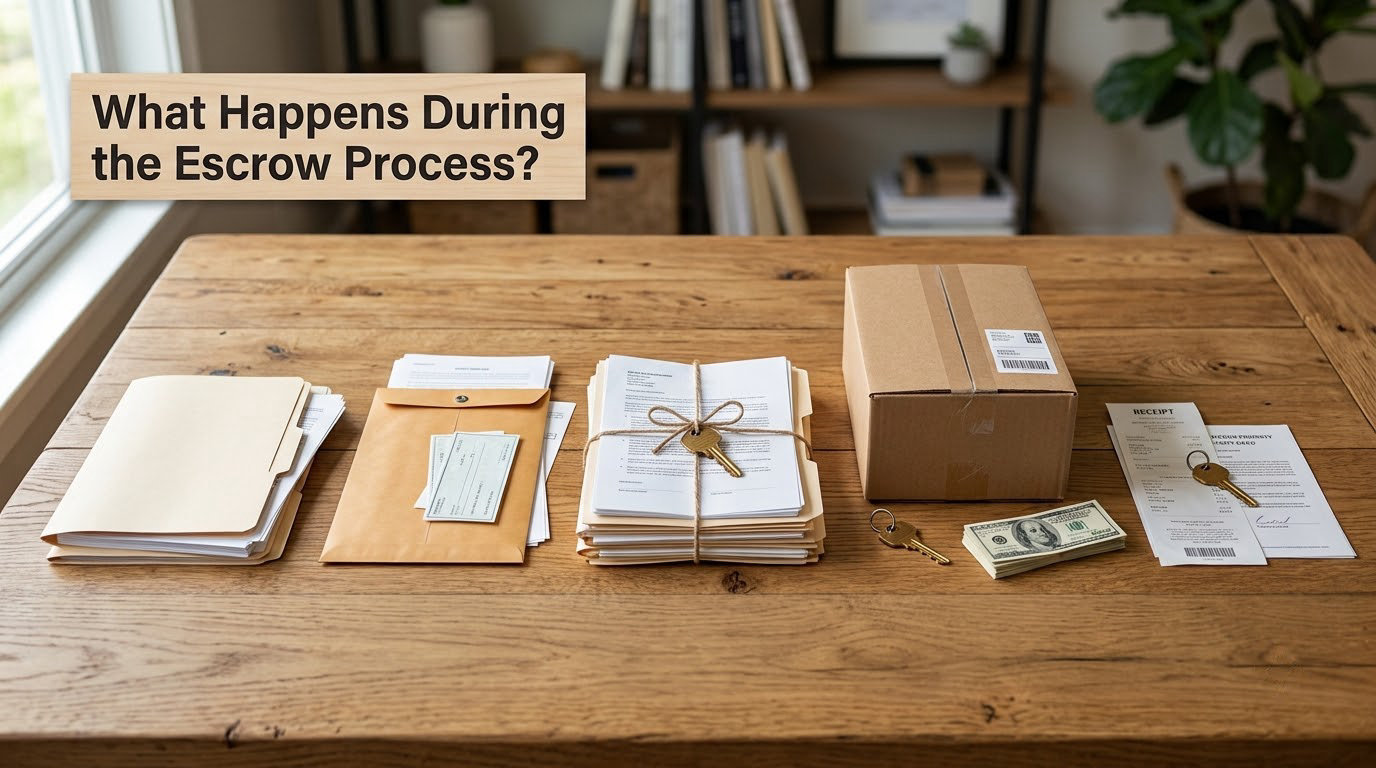
The sequence below is the common shape. The exact order depends on the contract and on the law that applies, so treat it as a map rather than a script.
Step 1: Open the account and review the instructions
The provider issues account details and an agreement. You confirm the account name, the parties, the fee, the conditions for release and what happens if the deal collapses. Reading this stage takes ten minutes and prevents most of the problems people later complain about.
Step 2: Deposit funds into the account
The deposit is the trigger. In a home sale it is typically earnest money, often a small percentage of the price. In a rental it may be a deposit plus the first month’s rent. In a marketplace sale the payment is captured when the order is placed. Some providers deduct the fee at deposit, others at release. Check.
Step 3: Funds are held securely while conditions are met
This is where an escrow account works as intended: the money stays put and the work happens. Inspections, title searches, deliveries and walkthroughs occur during this window. The balance often rises and falls through the period because money goes in while conditions are pending, which looks odd to anyone expecting an account to sit still.
Step 4: Release the payment
Once the conditions are satisfied, the provider pays out. Money goes to the seller, the vendor or the party named in the agreement, minus the agreed costs. You should get a receipt, a closing statement or a disbursement record showing who was paid and when. Keep it.
Step 5: Close the account
When every obligation is satisfied, the account is closed. Any leftover balance is returned according to the agreement. In mortgage escrow, by contrast, the account stays open for years, because it is collecting money for the taxes and insurance that keep arriving.
What Can You Buy or Sell with Escrow?
Escrow shows up wherever both sides want a neutral custodian. The table below covers the most common uses and what changes at release.
| Common use | What is held | When it is released |
|---|---|---|
| Home purchase | Earnest money, then documents including the deed | At closing, to the seller and the parties named on the settlement statement |
| Vehicle sale | The payment | After delivery and title transfer are confirmed |
| Online marketplace order | The payment, sometimes the item’s tracking | To the seller after delivery is confirmed, or refunded if it is not |
| Freelance or contract work | Milestone funds or a retainer | Per tranche, when the deliverable is accepted |
| Domain names and digital assets | The payment | After the transfer of the asset is recorded |
| Equipment and machinery | The payment and inspection reports | On delivery and acceptance of condition |
| Rental agreement | Security deposit, sometimes first rent | Returned after the tenancy ends and damage is settled |
| Court or government matter | Disputed sums or ordered deposits | Per the court order or the governing rule |
Some of these use a proper escrow service. Others use a payment hold inside a platform, which works similarly but answers to that platform’s terms.
How Much Does an Escrow Account Cost?
There is no single price for escrow. The total depends on the provider type, the transaction size, the country and state, and how long the money is held. Read the fee schedule before you open the account rather than discovering it at release.
The charges you may encounter:
- Setup or account opening. A flat fee for establishing the account and the agreement.
- Transaction or service fee. The largest line on a real estate escrow, sometimes charged per thousand dollars of the purchase price.
- Verification fees. Identity checks, title searches and document authentication.
- Storage and disbursement fees. For holding documents, or for making payments out of the account.
- Wire or transfer charges. Paid to the bank or provider moving the money, and they can be flat or percentage based.
- Cancellation or early closure fees. If the deal ends before release.
Who pays depends on the deal. In many real estate transactions the escrow fee is split between buyer and seller, and custom splits are common in some states. On a marketplace sale the seller usually absorbs the fee because it comes out of their proceeds. Rental deposits often carry no fee at all if the deposit sits in a separate account rather than a licensed escrow.
Banks, marketplace programs and specialist companies price the service differently because they carry different costs. A regulated company costs more to run than a platform feature, and that difference shows up in the fee. Cheapest is not automatically the right pick here.
How to Tell an Escrow Service Is Legitimate
Escrow fraud exists, and it follows a predictable script: a buyer or seller contacts you directly, quotes a deal you never advertised, and asks for money to be sent to an account or moved off-platform for a fee. Work through this checklist before sending anything.
- Find the provider’s legal name and search the licensing or registration register in your state or country.
- Use the provider’s official website that you typed yourself. Do not follow a link from a message.
- Confirm the provider is named on documents signed by a party you already trust, such as your attorney, closing agent or bank.
- Call a number you looked up independently to confirm any change to payment instructions. Never rely on email alone for a change of account details.
- Read the service agreement and check what triggers release, what the fee is and who the neutral party is.
- Ask for a written receipt for every deposit and every release.
- Keep the paper trail, including the agreement, receipts and any messages about payment details.
Warning signs: a fee demanded before any service is performed, pressure to move quickly, a guarantee of profit, an offer far better than anything you listed, instructions to pay a third party or to split a transaction to avoid a rule, and a license number that does not check out. If anyone asks you to pay a stranger to release your own money, stop there.
What Are the Main Protections and Risks?
What escrow gives you:
- Neutral custody. The money sits with someone who is not the buyer or the seller.
- Document control. Signed contracts, deeds and titles are held and released together, so paperwork follows the money.
- Less direct contact between parties. Money moves through the provider, which reduces the surface for pressure and fraud.
- A traceable process. Deposits, conditions and disbursements are recorded, which is valuable if a dispute comes later.
- On-time bills in mortgage escrow. Taxes and insurance get paid when due, avoiding a tax lien or a lapsed policy.
Where it falls short:
- Conditions can be vague. Escrow enforces what the contract says, not what you hoped it said.
- It does not guarantee a good outcome. A fraudulent seller can still deliver a faulty item if the inspection condition was weak.
- Identity checks are imperfect. Some providers verify more than others.
- Disputes still happen, and resolving one can mean fees, weeks of delay or legal action.
- Funds sit idle, and in mortgage escrow any interest generally belongs to the servicer under standard agreements, not to you.
- Wrong instructions lose money. A verified call about payment details is the cheapest protection available.
That last point is why the agreement matters more than the service. Write down what counts as completion, who confirms it, how long you have to raise a problem, and what happens if the deal ends early. Those four sentences decide how an escrow account works when nobody is being reasonable.
Frequently Asked Questions
Does an escrow account guarantee that a transaction is safe?
No. Escrow holds money and documents against stated conditions, so it protects both sides while the deal is pending. It does not verify that the goods are genuine, it does not make the contract enforceable, and it does not stop a dishonest party from acting badly. Safety still depends on due diligence, clear contract terms and a verified provider.
Can the buyer or seller be the same person or company that holds the money?
Not in any arrangement that works. The point of escrow is a neutral custodian, so the buyer and seller must not also be the escrow agent. A real estate attorney holding funds for both parties is a recognized exception in some jurisdictions, because professional rules require the funds to be kept separate and accounted for. Ask who the neutral party is and what rules bind them.
How long does money usually stay in an escrow account?
For a single transaction, usually from deposit until the conditions are met, which is often a few weeks and sometimes a few months. Rental deposits stay for the length of the tenancy. A mortgage escrow account for property taxes and insurance is different: it stays open for as long as the loan does, collecting a share of each annual bill every month and paying it when it falls due.
What happens if the buyer and seller have a dispute?
It depends on what the agreement says and which condition failed. If the provider can settle it from the documents, it releases or returns the money accordingly. Anything contested is usually resolved through the contract’s dispute process, a mediation clause or a court, which can take weeks and cost money. That is why clear release conditions and deadlines are written down at the start rather than argued about later.
How can I verify that an escrow provider is legitimate?
Check the legal name against your state or national licensing register, type the official website address yourself, and confirm the provider appears on documents signed by a party you already trust. Call a number you looked up independently to confirm payment instructions, especially if details changed by email. Ask for a written agreement and a receipt for every deposit and release. Unverifiable licenses and upfront fee demands are red flags.
Conclusion
Escrow works because a neutral third party holds the money until written conditions are met, and releases it only afterwards. The account can be a bank, a title company, a marketplace, an attorney or a court, and what it costs and how long it runs depend on the deal and the law where you are.
Before you transfer anything, do four things: write down the conditions that trigger release, choose a provider you can verify on a regulator’s register, confirm any payment instructions by phone using a number you looked up yourself, and keep every receipt and agreement. If the transaction is complicated or the amount is significant, a lawyer or a financial professional can tell you whether escrow is even the right tool.