Resetting a tripped circuit breaker takes about a minute. Find the breaker sitting between the OFF and ON positions in your electrical panel, push it firmly all the way to OFF, wait a few seconds, then push it to ON until it clicks and stays there. If it snaps back off on its own, leave it off and call a licensed electrician rather than trying again.
Most trips are boring: a space heater and the vacuum cleaner on the same circuit, a microwave kicking on with the coffee maker, a hair dryer in a bathroom with a GFCI outlet. That is good news, because the reset fixes the symptom and the unplugged appliance fixes the cause. The resets I would not keep repeating are the ones that happen with nothing plugged in, or the ones that come back the second you turn the power on.
Nobody should ever remove a panel cover, touch a wire, or test a breaker with a screwdriver. Everything below assumes the panel door is the only thing you open.
Table of Contents
- What You Need
- Step-by-Step: How to Reset a Tripped Circuit Breaker
- Step 1: Check for an Overload or Short Circuit
- Step 2: Find the Tripped Circuit Breaker
- Step 3: Switch the Breaker Fully Off
- Step 4: Reset the Breaker to the ON Position
- Step 5: Restore Loads Gradually
- Common Mistakes to Avoid
- Resetting a tripped circuit breaker again and again
- Resetting with wet hands
- Reaching inside the panel
- Plugging everything back in at once
- Ignoring heat, buzzing or a burning smell
- Bypassing the breaker
- Frequently Asked Questions
- Is it safe to reset a tripped circuit breaker myself?
- How long should I leave a breaker off before resetting it?
- What is the most common cause of a tripped circuit breaker?
- Do tripped breakers reset themselves?
- Are GFCI and AFCI breakers reset the same way as standard ones?
- When should I stop resetting and call a licensed electrician?
- Conclusion
What You Need
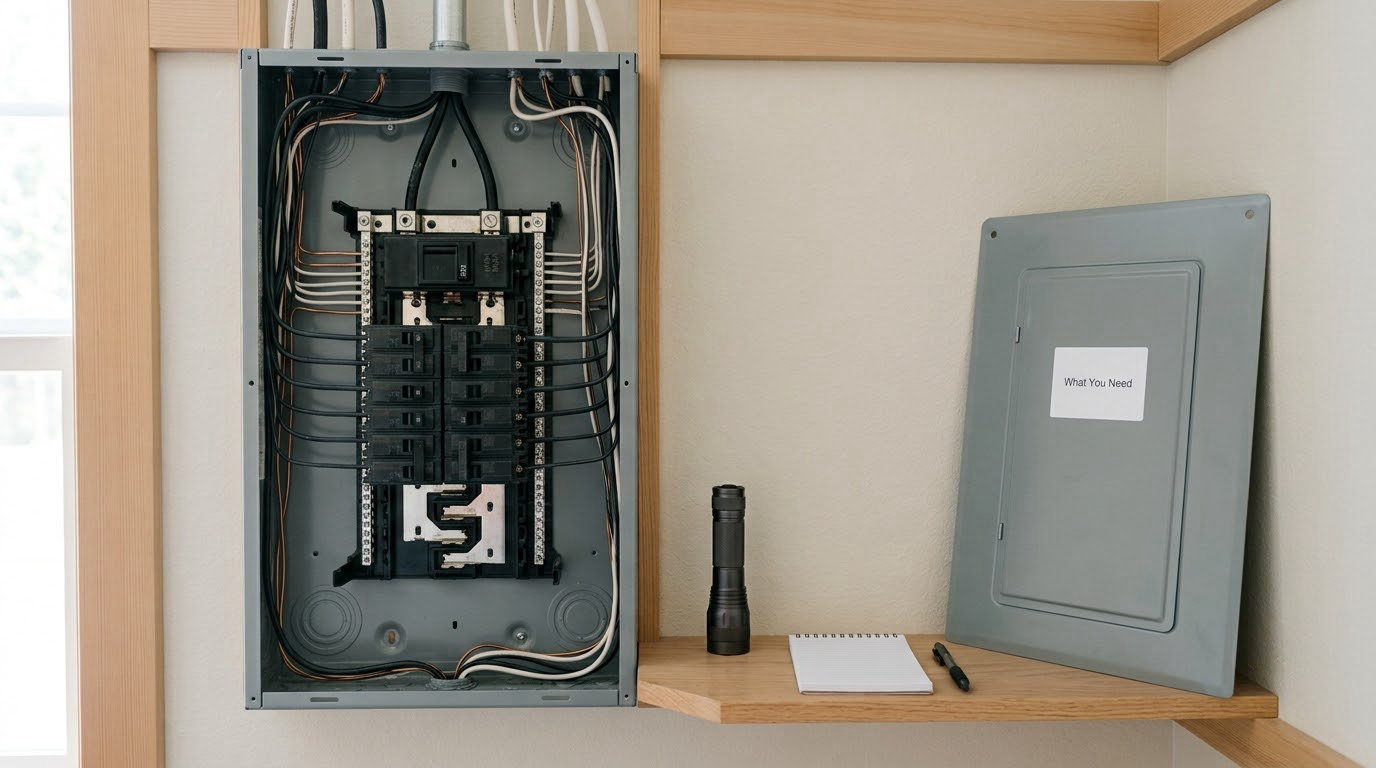
No tools. That is the part most people get wrong. A tripped breaker is reset with your hand, not a wrench, and if you are reaching for anything metal you have already gone past the safe part of this job.
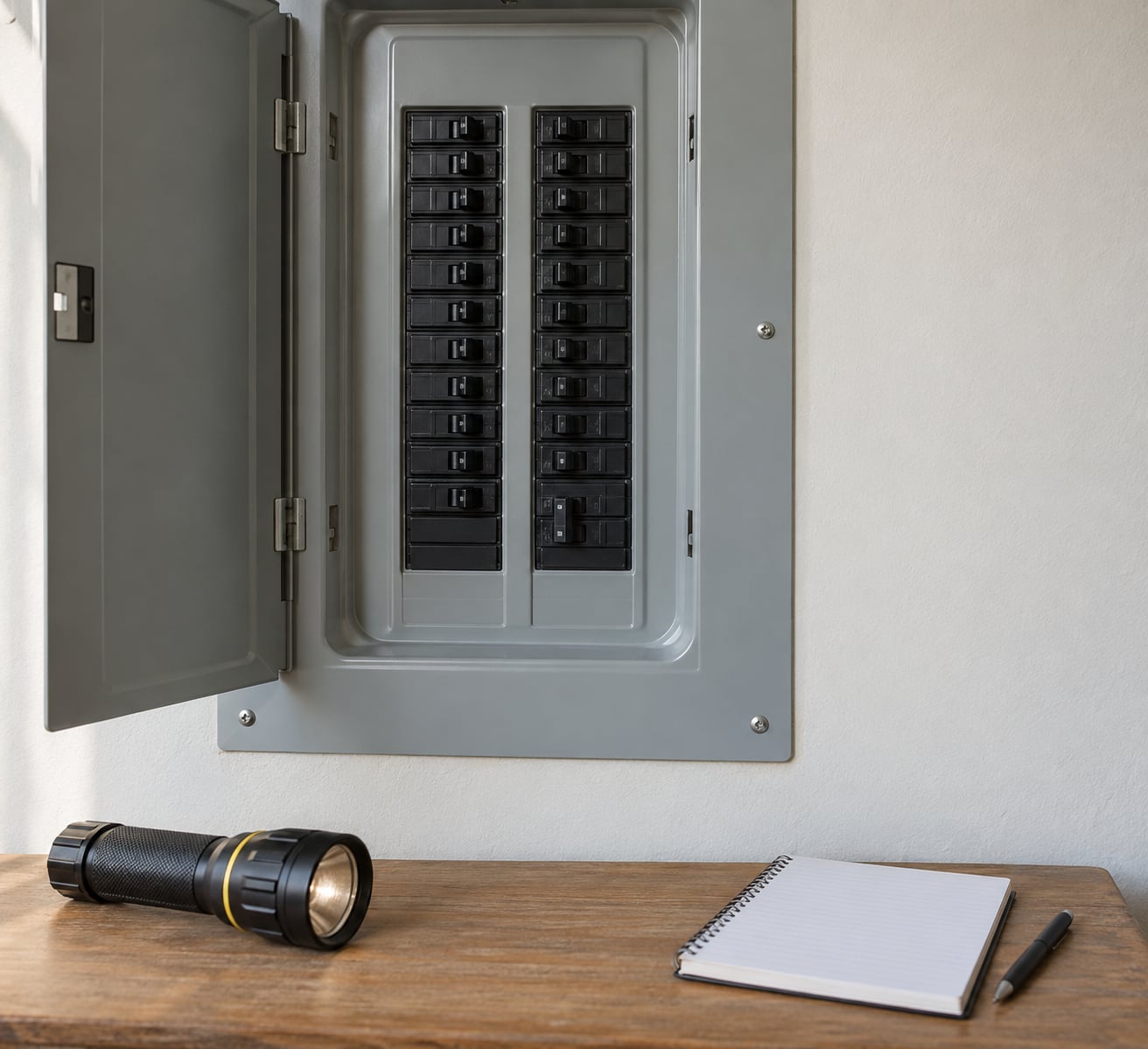
- A flashlight or headlamp. Breaker labels are small, faded and often printed in a different color than everything around them. A phone flashlight works in a pinch, but a headlamp frees both hands.
- Dry hands and dry feet. Damp skin lowers your resistance and turns a minor shock into a serious one.
- Something to stand on that is not metal. A wooden step stool or a dry plastic platform, not a ladder, not a metal step ladder, not the floor of a damp garage.
- The circuit directory on the panel door. If it exists and is current, this turns a guessing game into a thirty-second job. Most panels have a printed card or a sticker strip listing what each breaker controls.
- Your phone. For photographs. A photo of the panel before you flip anything is worth a lot when you need to explain the layout to an electrician or figure out which breaker you touched three weeks ago.
Take thirty seconds to clear the area first. Put laundry baskets, tools and stacked moving boxes away from the panel so you are not standing in the dark, shuffling past an open door, half-turned toward a breaker. A flashlight propped on a shelf pointing into the panel is worth more than a bright lamp behind you that leaves the labels in shadow.
Step-by-Step: How to Reset a Tripped Circuit Breaker
Step 1: Check for an Overload or Short Circuit
Before you touch the panel, notice what went dark. Half the kitchen? One bathroom outlet? Every room? That pattern narrows the search immediately and tells you whether you are dealing with a single overloaded receptacle or something more serious.
Overload is the most common cause by a wide margin. A 15-amp circuit is rated for about 1,800 watts, roughly what a toaster, a microwave and a hair dryer draw between them. Add a window air conditioner or a space heater and you go over the limit within seconds. The breaker heats up, trips, and does exactly what it was designed to do.
Short circuit is different, and more urgent. It usually means current found a path it should not have: a damaged cord, a chewed wire, a loose terminal, water inside an outlet. If the breaker trips with every device unplugged, skip ahead to the electrician section. Do not go looking for the fault yourself.
So unload first. Switch off lights on the circuit, and unplug anything with a plug. A television, a microwave and a printer can all sit unplugged for an hour while you sort it out.
Step 2: Find the Tripped Circuit Breaker
A tripped breaker does not sit at OFF. It sits in the middle, or very slightly past middle, between the two positions. That in-between spot catches nearly everybody out, especially people who grab the handle, see that it moves, and assume nothing happened.
Three ways to find it, fastest first:
- Position. Open the panel cover and look for the handle that does not line up with its neighbors. When the panel was installed, every breaker was seated at the same depth. One sticking out further than the rest, or sitting a fraction lower, is the one.
- Labels. Read the directory on the door, then match the label on the breaker. Labels drift over time in older homes, so treat them as a hint rather than a fact.
- Dead circuits. If nothing is labeled, turn a breaker off one at a time and see what comes back. Tedious, but it is reliable and it never puts your fingers anywhere they do not belong.
GFCI and AFCI breakers need a small extra step. If the panel has a small TEST and RESET button on the breaker face, press RESET. If nothing comes back, press TEST first, watch the breaker trip, then press RESET. That confirms the safety device is actually working instead of merely appearing to.
GFCI protection also lives in outlets. A tripped GFCI receptacle anywhere downstream, including an outdoor one or a garage one, can kill power to an entire circuit without any breaker in the panel moving at all.
Step 3: Switch the Breaker Fully Off
Push the handle all the way to OFF with firm, steady pressure. Some breakers feel sticky in the middle position because the mechanism has not settled, and they will not accept the ON push until they have been driven fully home.
Use one hand and your thumb or fingers on the handle itself. Do not grip the sides of the breaker, do not reach past the front of the panel, and do not brush against the hot bus bar or the neutral bar on either side of the breaker column. Those are live even with the main breaker switched off in some installations.
If you cannot get it to OFF without wrestling it, stop. A breaker that moves loosely, grinds, or refuses to seat is a failed breaker or a damaged panel, and both are electrician work.
Step 4: Reset the Breaker to the ON Position
Wait 30 seconds or so, then push the handle toward ON in one smooth motion until it clicks. You may feel a bit of resistance as the mechanism re-latches; that is normal and it should not require force beyond a firm thumb.
Three things confirm success. The handle lines up with every other breaker in the column. The lights and outlets you switched off come back. And the breaker stays where you put it. If the handle springs back to the middle position without you touching it, the fault is still active.
Never hold the handle in the ON position. If it will only stay on while you press it, the breaker is worn out and needs replacing, and forcing it defeats the exact protection it exists to give you.
On the main breaker specifically, if the whole house is dark and the main will not latch, that is a service problem rather than a household one. Call your utility or an electrician and stop experimenting.
Step 5: Restore Loads Gradually
Plug devices back in one at a time and turn lights on one fixture at a time. Start with essentials such as the refrigerator, a lamp, a phone charger, then add the bigger loads last. Reconnecting everything at once recreates the condition that tripped the breaker in the first place.
Stay at the panel for a minute while the circuit comes back up. Watch and listen for anything unusual: warmth on the panel face, a buzzing or crackling sound, a flickering light, a smell of burning plastic or hot dust, discoloration around a breaker, or the breaker handle sitting slightly proud of its neighbors again.
Any of those and the breaker goes back to OFF immediately. A warm panel is a hot conductor, which is the same physics as an electrical fire in slow motion. Electricians on community DIY boards say the same thing over and over: if it trips again, stop. That is not caution for its own sake. A breaker that trips instantly after reset is telling you the fault is still there.
Common Mistakes to Avoid
Resetting a tripped circuit breaker again and again
The most common mistake by a wide margin, and the most dangerous. Each reset clears the fault condition and lets it build again. A weak cord slowly melting inside a plug or a loose terminal arcing inside a junction box keeps getting more damaged with every cycle. If a breaker has tripped twice for the same reason, leave it off.
Resetting with wet hands
Water conducts, and a wet hand dramatically lowers your body resistance. This one is easy to fix and easy to forget: dry your hands and take off a wet jacket or a ring with a damp setting. Standing on a damp concrete garage floor while leaning into a panel is the version of this that hurts people.
Reaching inside the panel
The cover comes off and the job ends. Everything past that, including testing a suspect breaker by removing a wire, requires a licensed electrician with the panel de-energized and tested. Removing a breaker from a live bus bar is how a service call becomes an emergency call.
Plugging everything back in at once
Unloading the circuit then reloading it in thirty seconds just resets the dice. Bring loads back gradually so you know which device is responsible if it trips again, and so you never push a 15-amp circuit past its rating with everything switched on at the same moment.
Ignoring heat, buzzing or a burning smell
A hot breaker, a scorch mark on the plastic, or that fishy burnt-plastic smell from an outlet means current is flowing where it should not. Cut the circuit at the panel if you can do it safely, and if you cannot, cut the main. Then call. Do not reset to see if the smell was transient.
Bypassing the breaker
Never bridge a breaker with a wire or a coin to hold it on. You have now removed the one device standing between a fault and a fire, and on circuits with an AFCI or GFCI you have also removed the protection against electrocution. Any homeowner who has done this and got lucky is one arc away from the same call ending very differently.
Two habits prevent most repeat trips. Label your panel properly and keep the directory current, so you know what you are resetting before you open the door. And watch what you run at the same time: heaters, microwaves, kettles and window air conditioners on a single 15-amp circuit will find the limit every time.
Frequently Asked Questions
Is it safe to reset a tripped circuit breaker myself?
Yes, resetting a breaker is a normal homeowner task, as long as you only move the handle and never remove the panel cover. Use dry hands, stand on something dry and non-metallic, and push the breaker fully to OFF before ON. If it trips twice in a row, stop and call a licensed electrician.
How long should I leave a breaker off before resetting it?
About 30 seconds is enough for a normal household reset. That pause lets the thermal element cool and the mechanism settle, which matters most after a heavy overload such as a space heater. If the breaker was tripping repeatedly or the load was very heavy, a few minutes helps. Nothing needs hours.
What is the most common cause of a tripped circuit breaker?
Overload, by a wide margin. A 15-amp circuit handles roughly 1,800 watts, so a microwave, toaster and hair dryer running together can exceed it. Space heaters, window air conditioners and kettles show up most often in reports. Short circuits and ground faults are less common but far more serious.
Do tripped breakers reset themselves?
No. A breaker that has tripped stays in the middle position until a person moves it. GFCI and AFCI breakers are also manual, though many modern ones offer a remote or smart reset. Power returning automatically usually means the load that caused the trip went away, not that the breaker re-latched itself.
Are GFCI and AFCI breakers reset the same way as standard ones?
The handle works the same way. The difference is the TEST and RESET buttons on the breaker face. Press TEST to confirm the device works, then RESET to restore power. Also remember that a GFCI outlet somewhere downstream can kill a whole circuit without moving the panel breaker, so check those receptacles too.
When should I stop resetting and call a licensed electrician?
Stop when the breaker trips again after a reset, when it trips with nothing plugged in, or when you see heat, buzzing, scorch marks or a burning smell. Also stop if the breaker will not seat firmly, if it will only stay on while you hold it, or if the main breaker will not latch. Those are faults, not nuisances.
Conclusion
Start by noticing what went dead, unloading that circuit, and finding the breaker sitting in the middle position. Push it firmly to OFF, wait about half a minute, then push it to ON and confirm it clicks and stays there. Bring your devices back one at a time and stand nearby for a minute while the circuit settles.
Repeated trips, a burning smell, sparks, buzzing, a panel that is hot or discolored, and any damage to the panel itself are the stopping point. Leave the breaker off and call a licensed electrician. The breaker is the cheapest fire protection in the house, and ignoring it defeats the whole reason it is there.