To prepare for wildfire smoke, you close every opening in the house, filter the air in one room, buy respirators and replacement filters before stores sell out, and learn to read the air quality index. Most of that work takes an hour on a calm afternoon. Smoke often arrives faster than people expect, so the goal is to have the supplies and the plan already in place.
Wildfire smoke is not the fire itself. It is fine particulate matter, mostly PM2.5, plus carbon monoxide and organic chemicals from burning vegetation, and it can travel hundreds of miles and sit over a region for days after the flames are out. Those fine particles slip past your nose and throat into the small airways and then into the bloodstream, which is why the health effects show up as much in heart and blood vessel disease as in lung disease.
This guide walks through what to gather first, the preparation sequence, the steps that matter most once smoke arrives, and the mistakes that quietly make exposure worse. Guidance here follows the EPA Smoke-Ready Toolbox, CDC recommendations and AirNow resources; local emergency instructions always come first when they conflict with anything below.
Table of Contents
- What You Need
- Step-by-Step: How to Prepare for Wildfire Smoke
- 1. Check local fire, weather and air-quality alerts
- 2. Prepare the home and indoor air
- 3. Protect your health and outdoor plans
- 4. Pack an emergency smoke kit
- 5. Know when to leave, relocate or stay indoors
- 6. Maintain protection after the smoke begins
- Common Mistakes
- Frequently Asked Questions
- Do masks help with smoke?
- Does an N95 mask help when the AQI is bad?
- At what AQI should I stay inside?
- How do I keep wildfire smoke out of my house?
- How long does wildfire smoke stay in a house after it clears?
- Should I leave my home because of smoke?
- Conclusion
What You Need
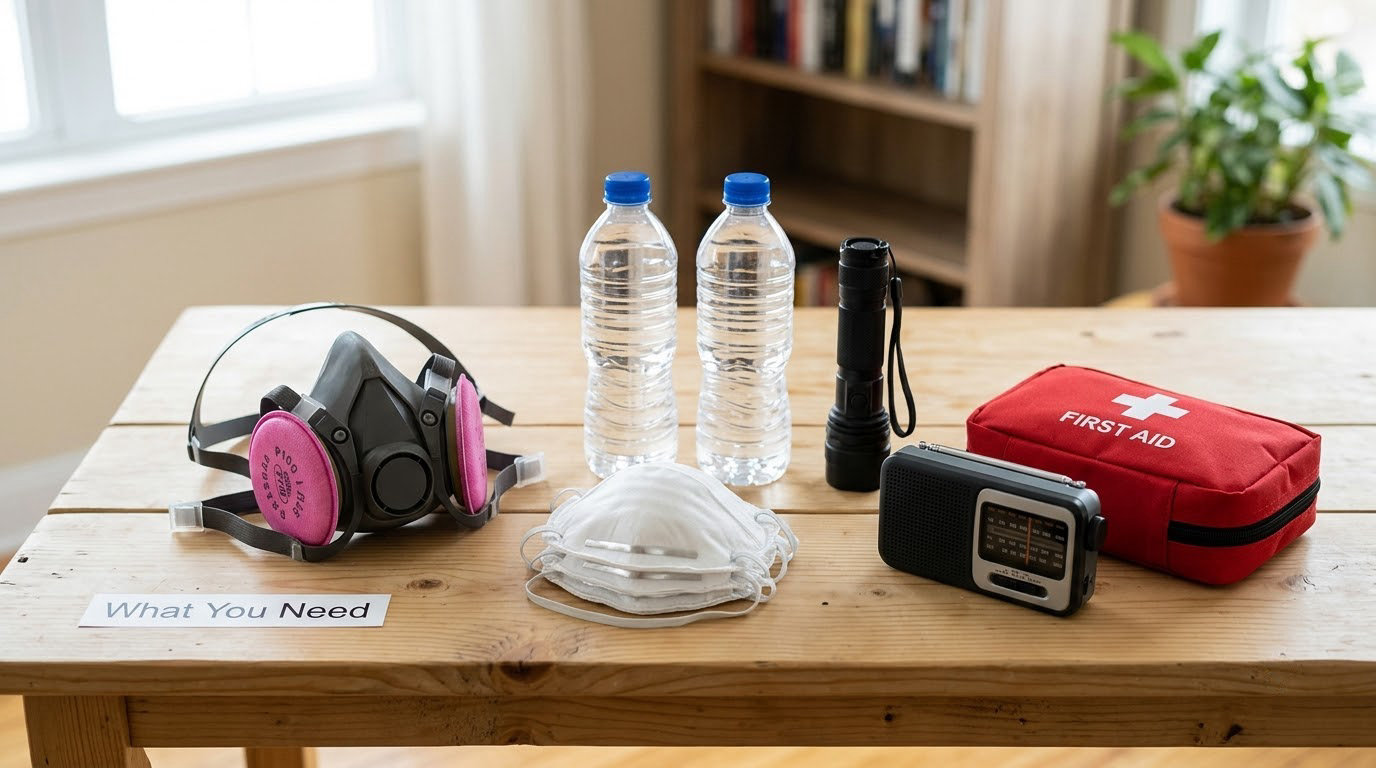
Most of what you need costs nothing. The items worth buying are filters, respirators and a way to move air, and those are the things that vanish in the first two days of an event. Gather them while the air is still clear.
- NIOSH-certified N95 or P100 respirators, one per person who leaves the house, plus a few spare. Dust masks and cloth coverings are not respirators.
- Extra furnace filters, rated MERV 13 or higher if your system accepts them. Buy two. Filters load up fast during heavy smoke and the second one saves you a trip during the worst hours.
- A 20 by 20 inch furnace filter and a 20 inch box fan if you plan to build a DIY air cleaner, plus a way to attach them securely with duct tape or zip ties.
- A portable HEPA air cleaner sized to a small room rather than to the whole house. A single clean room is a realistic goal for one smoky week.
- A weather radio or battery-powered phone charger, because smoke events frequently take out power along with everything plugged into it.
- Medication, at least a two-week supply, including inhalers and anything you would be miserable without. If the power goes out, your local pharmacy may be unreachable.
- Water, food, flashlight, spare batteries, first-aid supplies and copies of insurance and medication documents in one bag you can carry.
- A written list of who needs checking on, including anyone with heart or lung disease, children, older adults and pregnant family members, plus a backup person who lives outside the smoke zone.
If you rent, most of this still applies. Weatherstripping tape, removable window seals and a portable cleaner need no landlord permission and no tools you do not own. If you have central air, find out what filter rating your system was designed for before buying, because forcing a high-MERV filter into a unit that cannot take it can damage the equipment.
Step-by-Step: How to Prepare for Wildfire Smoke
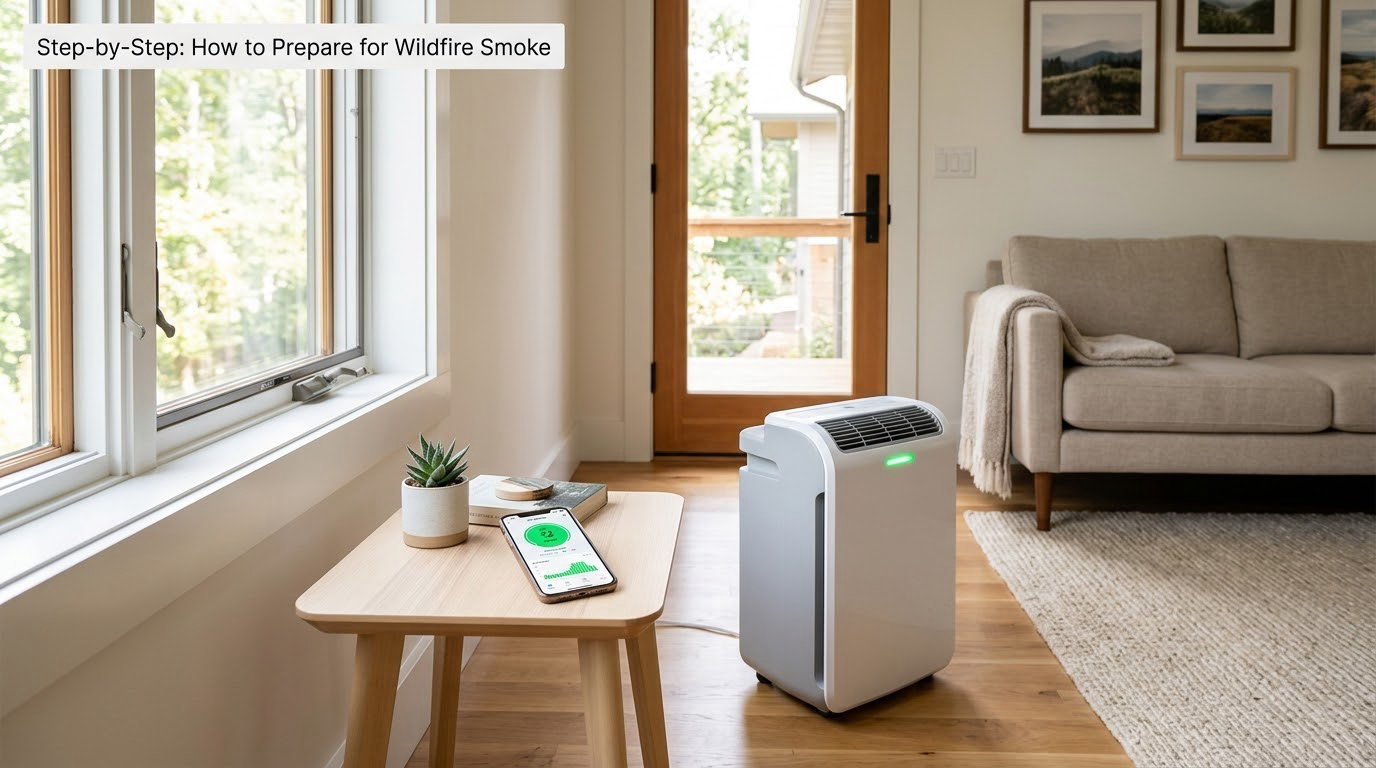
Work through this in order. The sequence matters because early steps buy you time for the later ones, and the last two decide whether a bad day becomes a dangerous one.
1. Check local fire, weather and air-quality alerts
Set up your sources now, before you need them. Bookmark the AirNow Fire and Smoke Map, which shows current and predicted smoke for your location, and install the Smoke Sense app so the phone alerts you when PM2.5 crosses into unhealthy levels where you are. Add your state or local air agency and your county emergency manager, since road closures, shelter openings and power shutoffs are announced there first. The National Weather Service issues smoke and density forecasts for your area; these tell you whether tomorrow morning or tomorrow evening is the better window.
Learn the AQI numbers before the smoke arrives, not during it. Good runs 0 to 50, Moderate 51 to 100, Unhealthy for Sensitive Groups 101 to 150, Unhealthy 151 to 200, Very Unhealthy 201 to 300, and Hazardous above 300. The color and the number matter more than the adjectives people use in conversation.
2. Prepare the home and indoor air
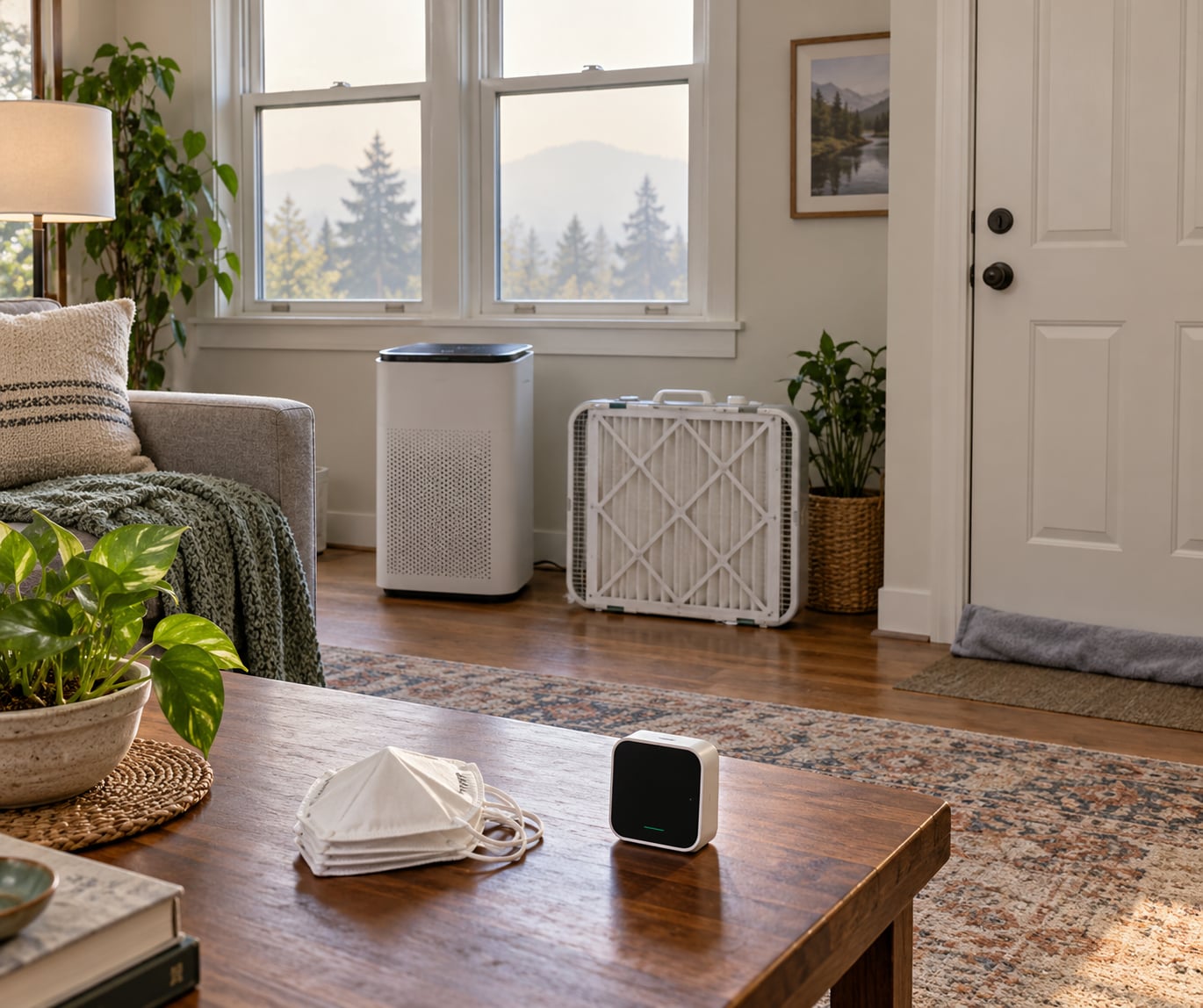
Close windows and doors while the outdoor air is still good. That single step does more than any filter, and it is the one people skip because mornings feel stuffy. Shut off or dampen the outdoor air intake on your HVAC system if it has one, and run the system on recirculate so it moves air inside rather than pulling smoke in through a fresh-air vent. Kitchen and bathroom exhaust fans pull smoke indoors through the ductwork, so leave them off during a smoke event. Run the air conditioner if you have it, since the indoor coil filters some particles and the closed-up house needs cooling just as much as it needs clean air.
Pick one interior room, ideally a bedroom with fewer windows and a closable door, and treat it as your clean air room. Tape a damp towel along the gap under the door and over any obvious window cracks. Run a portable HEPA unit there on high, and keep the door shut. For a whole-house system, upgrade to MERV 13 or higher if your unit permits it; people with central air report MERV 16 and 17 filters removing most smoke, provided the system can handle the pressure drop.
A DIY version of the clean air room uses a 20 inch box fan taped to a 20 by 20 inch furnace filter, blowing air out through the filter into the room. It costs very little and does a genuinely useful job in a room up to roughly 300 square feet, even when the room is not perfectly sealed. Two cautions. Never use an ozone-generating air cleaner, and never run a DIY fan filter unattended or overnight, because an improvised filter can overheat.
3. Protect your health and outdoor plans
Assume the worst indoor air is worse than the outdoor air, and plan outdoor time around the AQI rather than the calendar. Smoke levels often move through the day, dipping in the morning and rising with afternoon wind and fire activity, so shifting a run or a school walk to an earlier hour sometimes makes the difference between a clean outing and a smoky one. Post the AQI somewhere the adults check, not buried on a phone screen nobody opens.
Watch the people in your household who carry the most risk: young children, older adults, pregnant people, and anyone with asthma, COPD, heart disease, diabetes, or a recent COVID infection. Ask each of them to tell you early about a scratchy throat, chest tightness, coughing or unusual shortness of breath, rather than waiting to see if it passes. Outdoor workers should talk with their employer about respirator use and schedule changes now, while there is still time to arrange them. Anyone worried about breathing through a respirator should raise it with their doctor or pharmacist beforehand and ask about fit options.
4. Pack an emergency smoke kit
Put the kit in one container near the main exit, and leave it there. Everything in the list above belongs in it or in the rooms where it gets used, not in a closet you would have to search. Include respirators sized for every household member, a spare box fan filter, medication, water, a flashlight, a battery radio, chargers, first-aid supplies, and copies of prescriptions and insurance documents. Add a paper copy of your local evacuation routes and the phone numbers of the clean air shelter and cooling center nearest you.
Also plan for two things people routinely forget: pets and vehicles. For pets, keep an extra day of food and water, a carrier or leash at the door, and a plan for moving animals if an evacuation order comes, since most shelters will not take them. For driving, close the outside air intake, switch the recirculation button on, and leave windows up even in hot weather. Habit wins over smoke awareness when a car is hot, so check the recirculate setting before you pull out of the driveway rather than mid-highway.
5. Know when to leave, relocate or stay indoors
Shelter in place is the default when a fire is distant and the smoke is the problem. Evacuation is a decision made on fire proximity, not on air quality, and official orders carry the authority. Follow your county’s emergency notifications and the instructions from local officials rather than assumptions drawn from what happened in a past fire.
Between those two poles sit clean air shelters and relocation. When the AQI stays above 200 for days and your house cannot be filtered well, a designated clean air shelter or a stay with someone outside the smoke zone can be safer than staying put. Many communities open them during large events, and public libraries, community centers and cooling centers sometimes take pets. Ask your utility and your emergency office about outage maps before you need them, because a power cut with a sealed-up house is a fast way into trouble. If the heat rises while you are keeping windows shut, treat cooling as the emergency it is and get everyone into a cooling center.
6. Maintain protection after the smoke begins
Protection decays over days, so plan for upkeep. Check the AQI at set times rather than reacting to a hazy sky, since fine particles can be high before the air looks alarming. Keep the clean air room door closed and the unit running, and plan for filter changes roughly twice as often as usual during heavy smoke, because a loaded filter drops airflow and stops catching particles.
Inside, stop adding pollution to your own air. No candles, incense, scented oils, wood stoves, gas or propane heaters, aerosol sprays, or deep frying. Skip the vacuum unless your vacuum has a HEPA filter, since an ordinary vacuum exhausts fine dust back into the room, and hold off on indoor smoking entirely. Drink water, because dry air and smoke together irritate the throat, and keep indoor temperatures comfortable enough that people can sleep.
Clean up carefully afterwards. Dampen surfaces before wiping them, wash or vacuum curtains and rugs with a HEPA vacuum if you have one, and change bedding. If you have asthma or COPD, keep following your action plan and keep a reliever inhaler in every room. Seek medical care for symptoms that are severe or persistent: trouble breathing, chest tightness, wheezing, rapid heartbeat, or symptoms that come and go, since smoke exposure can also increase long-term cardiovascular risk.
Common Mistakes
Almost every harmful habit on this list comes from good intentions.
- Leaving windows open because the air looks better from the window. Visual haze lags behind particle levels. Check the AQI number, and only ventilate when it is genuinely good for your area and the fire outlook allows.
- Wearing a cloth mask, bandana or paper dust mask. These are not respirators. They fit loosely and filter almost nothing at the PM2.5 size. Use a NIOSH-certified N95 or P100, and check the seal by inhaling sharply at the edges, where a leak shows up.
- Lighting candles or incense for scent, then running a purifier. You are adding particles and VOCs while trying to remove them. It also cancels out the assumption that a scented product makes the air fresh.
- Leaving the kitchen or bathroom exhaust fans on. Most of them vent outdoors, drawing smoke in through the duct.
- Running the HVAC fan on fresh-air mode. That setting pulls outdoor air in. Switch to recirculate, and note that some older units and most heat pumps cannot recirculate at all.
- Using an ionizer, ozone generator or UV-only “purifier.” Ozone irritates the lungs, which is the opposite of what you want. Look for a true HEPA filter and skip units whose marketing leans on ion technology.
- Vacuuming with a standard vacuum during a smoke event. It aerosolizes fine dust back into the air. Wait until the smoke clears, or use a HEPA vacuum.
- Waiting to buy. Filters, box fans and N95s sell out fast once smoke arrives, usually within a day or two. Pre-season shopping is the whole trick.
- Running a DIY fan filter overnight or unattended. It is a helpful tool with a real fire-risk caveat. Use it while someone is home and awake.
- Staying sealed up in dangerous heat. Heat illness can be a worse emergency than the smoke. Use cooling centers, fans across the house, a wet towel on the neck, and cooler hours.
Frequently Asked Questions
Do masks help with smoke?
Only the right kind does. A NIOSH-certified N95 or P100 respirator filters out fine particles like PM2.5; cloth masks, bandanas and paper dust masks do not, because they fit loosely and their fibers are not fine enough to trap smoke particles. Fit matters more than the label. Check for NIOSH approval on the packaging, cover the nose and chin, and test the seal by inhaling sharply at the edges to feel for leaks.
Does an N95 mask help when the AQI is bad?
Yes, with limits. An N95 filters particles, so it substantially cuts your dose of PM2.5, but it does nothing for the carbon monoxide and other gases in smoke. It helps most when combined with the bigger win of staying indoors with filtered air. If the AQI is Unhealthy for Sensitive Groups, reduce or reschedule outdoor activity first and use a respirator second.
At what AQI should I stay inside?
For most people, cut back on outdoor exertion once readings pass 100, the Unhealthy for Sensitive Groups threshold. Sensitive groups should stay indoors and keep activity levels low from 101 upward. Above 150, everyone should stay indoors with windows closed and a filtered clean air room, and above 200 consider a clean air shelter, a cooling center or staying with someone outside the smoke zone.
How do I keep wildfire smoke out of my house?
Close windows and doors before smoke arrives, since outdoor air can look deceptively clear while particle levels are already high. Run your HVAC on recirculate rather than fresh air, and turn off kitchen and bathroom exhaust fans that vent outdoors. Seal obvious gaps with damp towels or removable weatherstripping, and designate one room with a portable HEPA unit as your clean air room, keeping its door closed.
How long does wildfire smoke stay in a house after it clears?
It fades, but not evenly and not as fast as you would like. Small particles settle and cling to surfaces, fabrics and floors, so odor and irritation can linger after the outdoor AQI drops. If the indoor air seems hazy, check for a source such as a stove or heating system before assuming smoke is responsible, then ventilate briefly once outdoor readings are genuinely good.
Should I leave my home because of smoke?
Air quality alone is rarely grounds for leaving your home. Evacuation orders are issued based on fire proximity, not air quality, and only local officials can call one. If smoke persists above 200 for days and your home cannot be filtered, a designated clean air shelter or time with someone outside the smoke zone may be safer than staying. Keep medication, water, respirators and pets ready so either decision is easy.
Conclusion
Start with four things: turn on alerts from the AirNow Fire and Smoke Map and your local air agency, close up the house while the air is still good, gather N95 respirators and extra MERV 13 or better filters while supplies last, and pick one room to be your filtered clean air room. Then check on the people who are most affected by smoke, since they will tell you sooner than any sensor will. When symptoms get severe or persistent, call a doctor rather than waiting the smoke out.