To read a medical bill and find errors, you line up every charge against the document your insurer sent you, check the services and dates against your medical record, and dispute anything that does not reconcile. It takes about an hour with a phone and a calculator, and this guide covers US insurance billing, which differs from other countries. Reviewed for accuracy in 2026; rules and protections change, so verify details with your own plan.
The confusion is understandable. One ER visit can produce a facility bill, a physician bill, a separate radiology bill and an ambulance bill, each with its own codes and its own logo. None of that is fraud, but genuine mistakes happen often enough that checking is worth the hour. Industry and academic studies commonly cited in patient advocacy put the share of bills containing errors anywhere from roughly 40 percent to as high as 80 percent of non-drug bills, depending on the study design, so treat any single number as a range rather than a promise.
Table of Contents
- What You Need Before You Start
- How to Read a Medical Bill and Find Errors, Step by Step
- Step 1: Confirm the Bill Is Yours and Current
- Step 2: Separate the Summary From the Line Items
- Step 3: Review Every Line Item
- Step 4: Compare the Bill With Your Explanation of Benefits
- Step 5: Check the Codes and Your Medical Record
- Step 6: Ask for Corrections Before You Pay
- Common Medical Bill Errors and How to Fix Them
- When to Contact Your Insurer or Healthcare Provider
- Frequently Asked Questions
- How do I read my medical bill?
- Is an explanation of benefits a bill?
- What percent of medical bills have errors?
- What are five common medical coding errors?
- What are possible results of asking for an itemized medical bill?
- Should I pay a medical bill before insurance processes it?
- Will disputing a bill stop it from going to collections?
- Conclusion
What You Need Before You Start
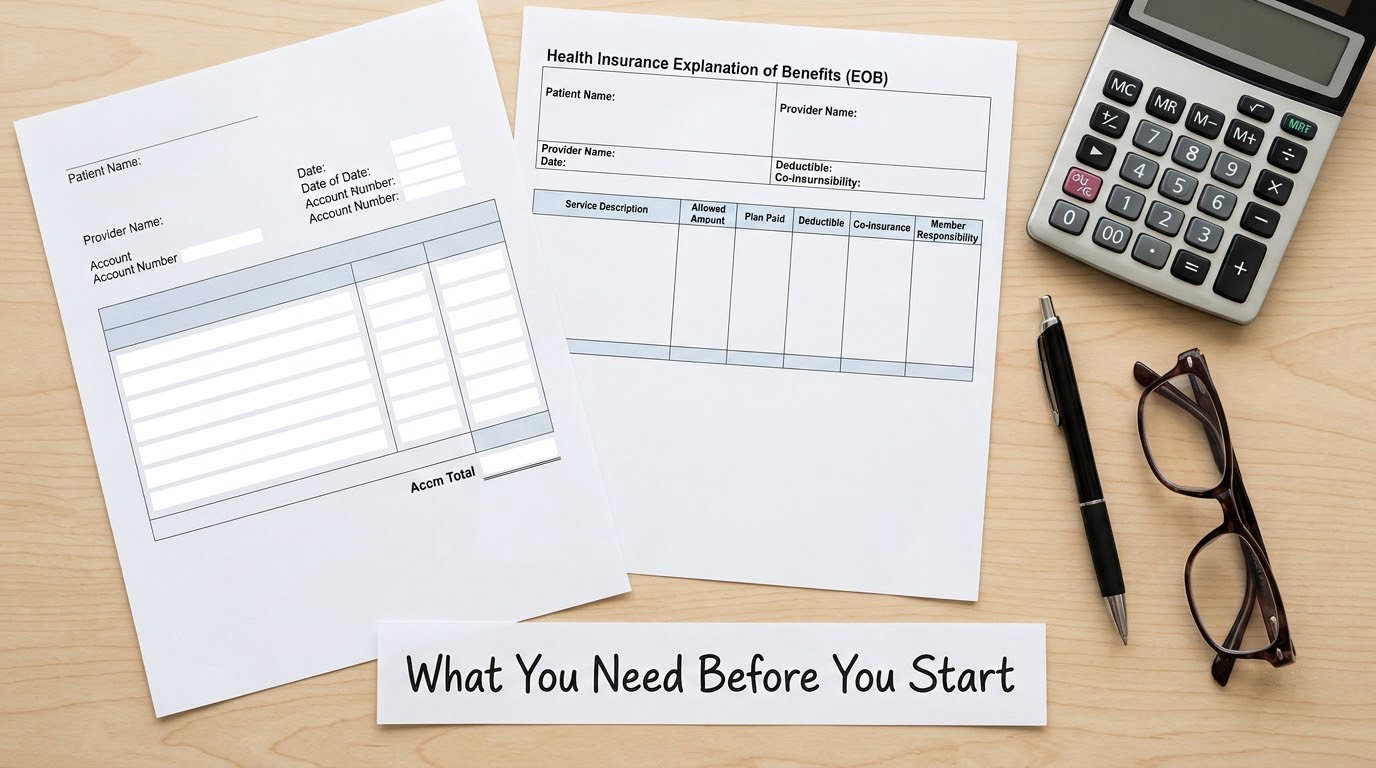
Gather these six things and the review takes under an hour. Missing one is the main reason people give up halfway.
- The itemized bill. A summary statement with no line items is not enough. Request the itemized statement from the provider’s billing office; Medicare beneficiaries have a legal right to one within 30 days of asking in writing, under section 4311 of the Balanced Budget Act of 1997.
- Your insurance card. You need the member ID, group number and the member services phone number, which is usually printed right on the card.
- The explanation of benefits (EOB). This is the insurer’s summary of what it paid and what it assigned to you. Find it in your insurer’s online portal or on paper; it is not a bill and you never pay it.
- Your medical record for that date. After-visit summaries, discharge paperwork and lab reports tell you what actually happened, which is the only reliable way to test a charge.
- Payment records. Bank or card statements, plus any receipt number the office gave you, so you can prove what was already paid.
- A calculator and a spreadsheet. Useful columns: date of service, provider, charge amount, allowed amount, insurance paid, you paid, payment date, still owed and notes.
Write down two phone numbers before you start: the provider’s billing office and your insurer’s member services line. You will end up calling one or both, and having them in front of you stops the half-hour hold time.
How to Read a Medical Bill and Find Errors, Step by Step
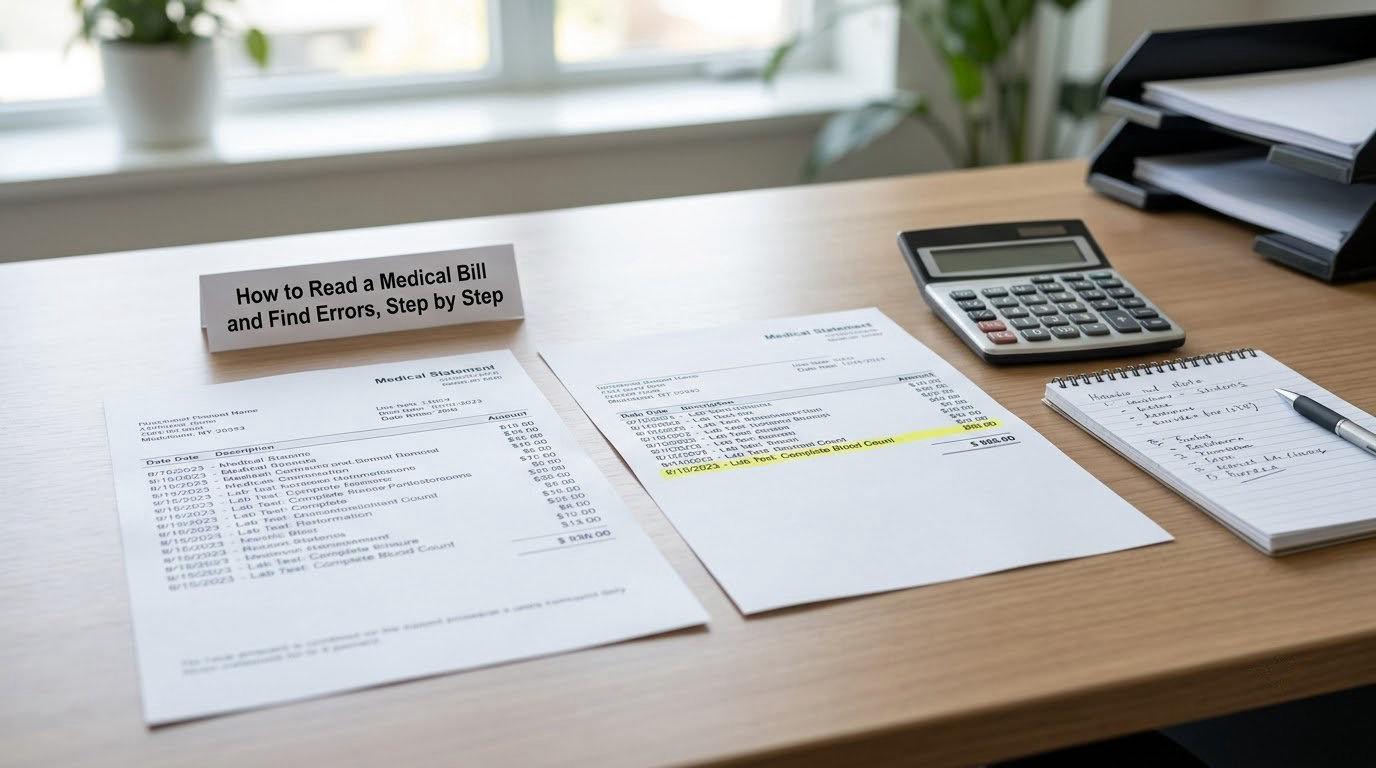
Step 1: Confirm the Bill Is Yours and Current
Check the header first: patient name, date of service, provider, account number, billing period and the notice type. Bills arrive as an initial statement, a corrected statement or a final notice, and only the current version matters. A corrected bill may carry the original account number plus a revision date, so keep every version you receive; sometimes the correction fixes the problem on its own.
Step 2: Separate the Summary From the Line Items
The summary block shows total charges, insurance adjustments, amounts paid, deposits, credits and the balance due, and it does not equal the sum of the listed charges. That gap is normal, because the provider’s charge is rarely what your plan allows. Here is a worked example of how the numbers connect.
| Line | Amount | What it means |
|---|---|---|
| Total charges | 480 | What the provider billed |
| Contractual adjustment | minus 174 | Amount written off under your plan’s contract |
| Allowed amount | 306 | What your plan recognizes the service is worth |
| Insurance paid | minus 226 | Plan share after deductible and coinsurance |
| Your responsibility | 80 | The only figure you may owe |
You never owe the contractual adjustment. That is a write-off between the provider and the insurer, and seeing it listed does not make it payable.
Step 3: Review Every Line Item
Go down the list one row at a time. For each row, confirm the service description, the date of service, the treating provider, the quantity, the price per item, the CPT or HCPCS code and the charge amount. Look for the same service billed twice on one date, a date you were not in the building, a quantity that does not match what you received (a box of tissues billed as a mucous recovery system, or an over-the-counter dose billed as an administration), and single-digit keystroke errors such as 10 appearing where 1 was meant.
Also note anything you never had done. Lab panels ordered by a doctor but never drawn, imaging that was cancelled, or a second E&M visit billed alongside a first are all worth a question.
Step 4: Compare the Bill With Your Explanation of Benefits
This is the highest-value step, and the EOB is the document that decides what you owe. Match each line on the bill to the same line on the EOB by date of service and service description. The three numbers that should agree are the allowed amount, the insurance payment and the amount the EOB assigns to you. Where they disagree, note which document the difference came from before you call anyone.
On the EOB, read the remark codes along the bottom or in the notes column. These short codes explain what the insurer did and why: denials, coordination of benefits problems, a service needing review, or a claim that needs more information. A remark code is often the fastest diagnosis available, because it names the reason before you make a single call.
Step 5: Check the Codes and Your Medical Record
CPT codes describe the procedures and services performed, HCPCS Level II codes cover supplies, drugs and non-physician services, and ICD-10-CM codes describe the diagnosis being treated. Each code set is maintained by a different body, and modifiers add extra context such as a later visit on the same day.
Two caveats matter here. A code is not proof of an error on its own; a high-level code can be correct. And you are not expected to become a coder to spot a problem. What you can verify is simpler: does the description attached to the code match the service listed in your after-visit summary, and does the date match? If the record says one thing and the bill says another, that is a question worth raising with a specific number attached.
Step 6: Ask for Corrections Before You Pay
Call the provider’s billing office and describe the discrepancy using three facts: the date of service, the service, and the amount. Ask what the charge represents, whether insurance was applied correctly, and whether they can rebill if something is wrong. Then contact your insurer’s member services if the issue is coverage, coding or the payment itself, and ask for the claim to be reprocessed. Get written confirmation of any correction before paying the disputed portion, and pay the undisputed part on time so you avoid a late penalty on the portion nobody disputes.
Common Medical Bill Errors and How to Fix Them
These are the problems that come up most often, with the fix for each. Most are resolved in one call once the patient can name the line.
- Duplicate charges. The same service appears twice on one date. Ask which line is being voided, and request the corrected statement before paying either one.
- Services never received. Ask the billing office to pull the underlying encounter record for that date; if the service was cancelled or never performed, it should come off the bill.
- Wrong insurance on file. The plan treated you as out of network because the wrong ID or group number was used. This is fixed at the provider’s office by resubmitting with correct information.
- Incorrect dates of service. Often a billing date rather than the visit date, or a midnight rollover on an overnight stay. Point to the discharge paperwork.
- Quantity or unit price mistakes. A single digit typed twice. Ask them to confirm the quantity and the price per item against the source document.
- Balance billing on in-network care. Charged above the allowed amount despite in-network status. This one belongs with the provider, and the plan’s allowed amount is your reference.
- Payments not applied. A deposit or payment taken but not credited. Send proof of payment and ask for the account to be rebalanced.
- Charges insurance should have covered. Usually tied to a remark code. Go to the insurer for reprocessing, then appeal the denial if it stands.
- Several bills for one visit. Normal. Facilities, surgeons, anesthesiologists and radiologists bill separately, so judge each one against its own EOB rather than expecting a single total.
When to Contact Your Insurer or Healthcare Provider
Each side can fix some problems and escalate others, and pointing fingers between them is the most common dead end. Use this routing table instead.
| Problem | Contact first | Ask this |
|---|---|---|
| Duplicate or unbundled line items | Provider billing office | Which line is being removed, and when will the corrected bill issue? |
| Service not received | Provider billing office | Can you pull the encounter record for that date? |
| Balance billing above the allowed amount | Provider billing office | Why was the charge set above the plan’s allowed amount? |
| Claim denied or not processed | Insurer member services | What are the remark codes, and can the claim be reprocessed? |
| Deductible or coinsurance applied wrongly | Insurer member services | Is my accumulated deductible amount up to date on this claim? |
| Out-of-network surprise bill | Both | Ask the plan whether a cost-sharing protection applies, then ask the provider to hold the bill. |
| Appeal after a reprocessing | Insurer, then external review | What is the internal appeal deadline, and what documents support it? |
| Uninsured self-pay charge | Provider billing office | Is a self-pay discount or financial assistance available for this charge? |
Keep a written log of every call: date, name of who you spoke with, what you asked, what they promised and by when. When a dispute stalls, that log is what an appeals reviewer or a billing advocate will ask for first.
If you cannot resolve it yourself, a medical billing advocate can review the bill for a fee or a share of what they save, and hospital financial assistance offices often have charity care and payment plans you were never offered. Uninsured patients can request a written good faith estimate before services, and for many out-of-network surprise bills the No Surprises Act gives patients a window to dispute the amount and reach a resolution. This is general information, not legal or financial advice; rules vary by state and by plan, and your insurer’s member services line can confirm what applies to your policy.
Frequently Asked Questions
How do I read my medical bill?
Start at the top and work down: confirm the patient name, date of service and provider, then separate the summary block from the line items, then check each line for service, date, provider, quantity, code and charge. Finally, match every line to the matching line on your insurer’s explanation of benefits. The allowed amount, the insurance payment and your assigned share should agree on both documents. Write down every mismatch before you call anyone.
Is an explanation of benefits a bill?
No. An explanation of benefits is the insurer’s report of how it processed a claim: what it allowed, what it paid and what it assigned to you. It is not a bill and you never pay it. The bill comes from the provider and should ask only for the amount your EOB assigned to you. If a bill asks for more than the EOB assigns, that is the first discrepancy to dispute.
What percent of medical bills have errors?
Estimates vary widely by methodology. Studies and industry statistics cited in patient advocacy commonly put flagged errors somewhere between roughly 40 percent of bills and as high as 80 percent of non-pharmaceutical bills. The spread comes from different definitions of an error and different samples, so treat any single figure as a range. That range is still enough reason to spend an hour reviewing before you pay.
What are five common medical coding errors?
The five patients notice most often are a wrong or unbundled CPT code, upcoding to a higher-complexity code than the service delivered, a missing or incorrect modifier, a diagnosis code that does not match the visit, and duplicate line items for the same service and date. You do not need coding knowledge to raise them. Simply ask whether the code matches the description in your after-visit summary.
What are possible results of asking for an itemized medical bill?
Usually you get a line-by-line statement with codes and charges instead of a summary. In many cases the request itself surfaces errors that get removed before the bill is finalized. Medicare beneficiaries have a legal right to an itemized statement within 30 days of a written request. Providers may also offer a self-pay discount or financial assistance once the itemized charges are visible.
Should I pay a medical bill before insurance processes it?
Usually not. If a bill arrives before your insurer has processed the claim, paying it means hoping the provider refunds you later instead of getting the number right the first time. Wait for the EOB if you can, then pay only the amount it assigns to you. If the due date lands before the EOB, call the billing office, ask them to hold the account while insurance processes, and pay the undisputed portion on time.
Will disputing a bill stop it from going to collections?
It often does, if you act early. Contact the provider as soon as you spot the problem and ask them to place the disputed amount on hold; that creates a record that you disputed it before any collections referral. Keep copies of everything you send. If the account is already with a collections agency, contact the agency in writing with your dispute and ask them to pause collection while it is reviewed.
Conclusion
Start with the comparison, not the payment. Put the itemized bill next to your explanation of benefits, match each line, and write down every place the allowed amount, the insurance payment or your assigned share disagrees. Then call the right office with three facts on the tip of your tongue: the date, the service and the amount, and ask for written confirmation before you pay the disputed balance.