
To request your medical records, contact the medical-records department of every doctor, hospital, lab or clinic that treated you, and ask for a copy of your complete designated record set. Most providers let you download it free from a patient portal, and where they do not, you can send a short written request and they must act on it within 30 days.
First, the thing nobody tells you: asking for your own chart is a legal right, not a favor. Plenty of people hesitate because they feel awkward, or worry a busy office will read them as difficult. Staff handle these requests every single day, and no justification is required.
This guide covers the whole process in the United States, from finding the right department to correcting an error once the files arrive. It is general information, not legal or medical advice. Rules and state fee limits change, so check the details with your own provider. Last updated October 2026.
Table of Contents
- What You Need Before You Contact a Provider
- Step-by-Step: How to Request Your Medical Records from Any Provider
- 1. Find the Right Health-Care Provider
- 2. Choose a Patient Portal or Written Request
- 3. Complete the Request Form Correctly
- 4. Ask About Identity Verification, Fees, and Processing Time
- 5. Submit and Save Proof of the Request
- 6. Follow Up If the Records Do Not Arrive
- 7. Check the Records for Accuracy
- Common Mistakes That Slow Requests Down
- Frequently Asked Questions
- Can I get a copy of my own medical records?
- How do I request medical records for a deceased family member?
- Can a new doctor request my medical records for me?
- Should I request medical records in PDF, paper, or electronic format?
- What should I do if a provider denies or delays my records request?
- Conclusion
What You Need Before You Contact a Provider
Requests get rejected for boring reasons more than any other. A misspelled date of birth, a missing authorization signature or a request with no dates of service is enough for a records department to send it back, and the 30-day clock never starts until a proper request arrives.
Gather the following first:
- Your full legal name, including any former or maiden name used at the time of treatment. Name mismatches are the single most common reason a request is rejected.
- Your date of birth, and your social security number if the provider asks for it. It is normal for a records office to verify identity this way.
- A valid photo ID, which many providers require before releasing anything, especially in person or by mail.
- Current contact information — a working phone number and an email you actually check, because that is how the office will deliver verification codes and confirmations.
- The full name of the provider or facility where you received care, plus the department if you know it.
- The approximate dates of treatment and the names of the clinicians who saw you. A month and year is usually enough, and a year alone often is not.
- The record types you want — visit notes, lab results, imaging, operative reports, discharge summaries, immunization history, billing records, or everything.
- Your preferred delivery format: a portal download, a secure email or encrypted link, paper by mail, or pickup in person.
If you are requesting for someone else, the list grows. For a minor child, bring proof of your relationship, such as a birth certificate. For an adult who cannot manage their own records, expect to show a health care proxy, guardianship or power of attorney paperwork. For a deceased relative, expect a death certificate and proof that you are the executor or the legally appointed personal representative.
Step-by-Step: How to Request Your Medical Records from Any Provider
1. Find the Right Health-Care Provider
Contact the organization that actually holds the record, not the office you think should have it. Health systems split records across a hospital, a separate physician practice, an imaging center, an outside lab and an independent specialist, and no single desk has the whole picture.
Start from a document you already have. A bill, a visit summary, a discharge paperwork packet or a portal page usually carries the facility name and the department you need. Then confirm it on the organization’s official website, where most hospitals list a Health Information Management or Medical Records department with its own phone number and request form.
Keep a running list. People who request from one provider and then discover they also need records from a hospital, an imaging center, a lab and a specialist are the most common source of frustration in patient forums. Write down every place you were seen, including walk-in clinics and urgent care, because those records are rarely folded into your primary doctor’s chart.
2. Choose a Patient Portal or Written Request
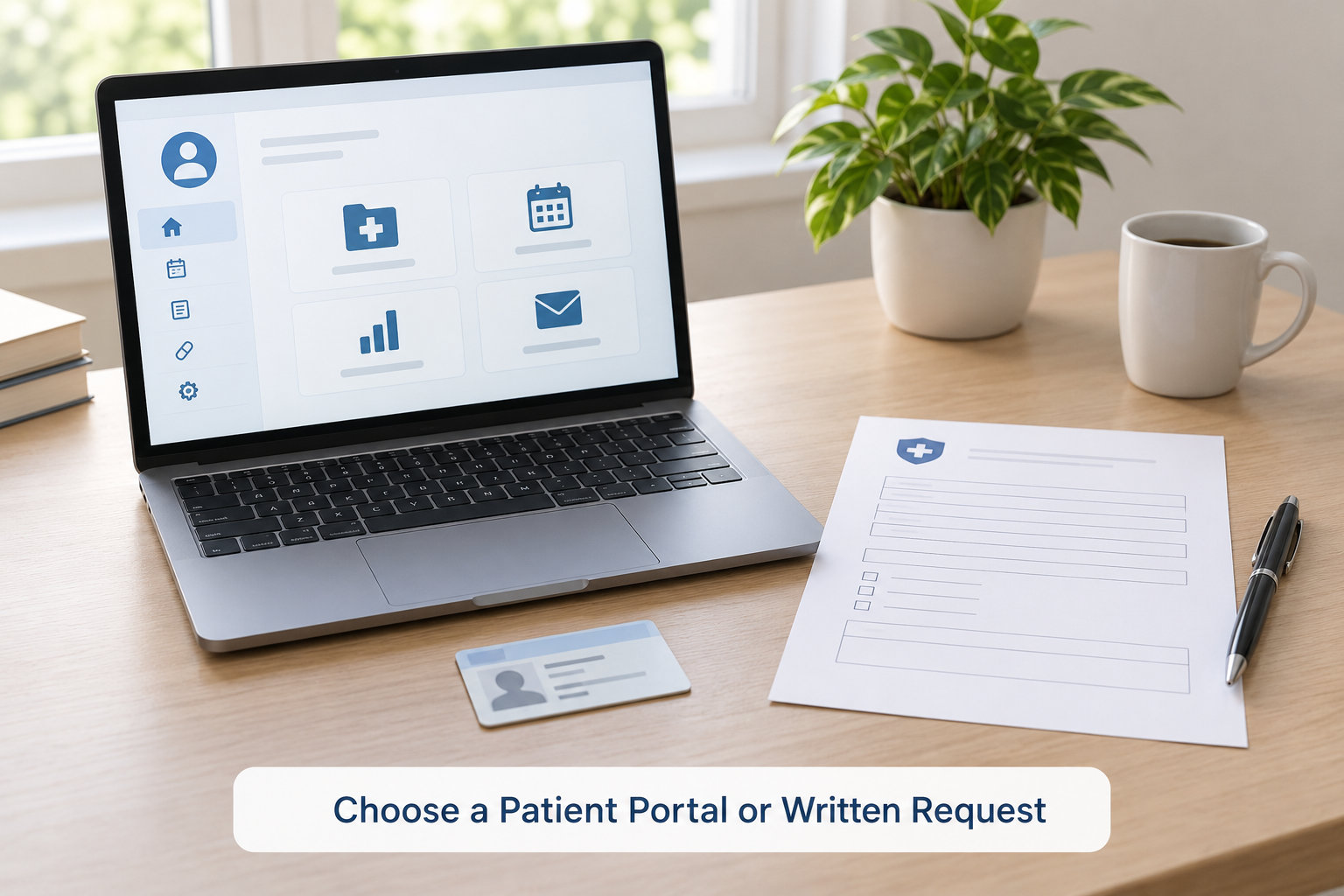
Use the patient portal if your goal is your own copy, because a portal download is free and immediate. Use a written request when you need a certified copy, need delivery to another doctor, need records from a date range the portal cannot produce, or need a paper trail you can point to later.
| Method | Speed | Cost | Best for |
|---|---|---|---|
| Patient portal download | Immediate | Free | Your own copy, lab results, visit notes |
| Written request or provider form | Up to 30 days | Reasonable, cost-based copying fee | Certified copies, large date ranges, sending to another provider |
| In-person pickup | Varies, often faster | Copying fee plus ID check | Urgent needs, large paper charts |
| Mail, fax or secure email | Up to 30 days plus delivery | Postage or delivery charges | No portal access, remote providers |
Provider procedures genuinely differ here. Some will not release anything outside the portal, some will not email records at all for privacy reasons, and some require their own proprietary form rather than a letter you wrote yourself. That is a process choice, and it does not change the 30-day deadline once a proper request is on file.
One caution from patient forums: a portal copy is not always the whole record. Portals usually show a curated view, and documents like operative reports, anesthesia records and full nursing notes often only exist in the formal file.
3. Complete the Request Form Correctly
Fill in every field, and if a line does not apply, write “not applicable” rather than leaving it blank. Include your legal name and date of birth, how the office should reach you, the facility and clinician names, the dates of treatment, the specific documents you want and the delivery method.
If a form asks you to name a reason, a short neutral phrase such as “personal copy” or “transfer of care” is fine. You are not obligated to explain your life to a records clerk.
Where the form contains an authorization for release, sign and date it. An unsigned authorization is one of the most common reasons a request sits in limbo. Where the form asks whether records should go to you or to another provider, pick deliberately: sending files to a new doctor usually requires a separate authorization naming that doctor and their practice address.
Not sure whether to write a letter or use the form? A short letter works. Copy this, fill in the blanks, and send it to the medical-records department:
To the Health Information Management Department,
I am requesting a copy of my medical records under my right of access. My name is [full legal name, including any former name], and my date of birth is [date]. I was seen by [clinician or facility] between [start date] and [end date].
Please send me [the complete designated record set for that period, or a list of the specific documents named below]. I would like the records [on paper by mail / as a secure electronic download] and understand that a reasonable, cost-based copying fee may apply. Please contact me at [phone] or [email] if you need identification to verify my identity.
Thank you for handling this request. Signed: [signature] Date: [date]
You can add this to the end: “If I do not receive the records within 30 days of this request, I intend to file a complaint with the HHS Office for Civil Rights.” Patients on privacy forums report that a clear, courteous statement like that tends to move things along.
4. Ask About Identity Verification, Fees, and Processing Time
Ask three questions on the phone before you assume anything: what they need to verify your identity, what the fee will be, and when they expect you to have the records. Providers must act within 30 days of receiving your request, and the clock starts on the day a proper request arrives, not the day you asked casually at a visit.
Get the fee in writing before you pay. Under a right-of-access request a provider may charge a reasonable, cost-based fee covering copying labor, supplies and postage, and it must say how the amount is calculated.
A provider may not charge a search or retrieval fee on a right-of-access request, may not charge for access to records through the patient portal, and may not charge more than a reasonable, cost-based amount. They also may not withhold your records because of an unpaid bill; billing disputes belong in a collections process. If you are asked to pay a fee you never approved, ask for the written fee schedule and the amount before you pay it.
Some states set their own per-page and search-fee caps. Those caps do not override the federal limits, and neither side gets to exceed them. If the charge looks out of line, ask for the breakdown in writing before paying.
5. Submit and Save Proof of the Request
Send it through a channel that produces a record: the provider’s online form, a secure portal message, or mail to the medical-records department on the official address. A phone call is a fine start, but a call alone starts nothing you can point to later.
Then save the confirmation email, the receipt or reference number, a scan or photo of everything you signed, and the date you sent it. Screenshot the submission page before you close the browser, because some portals show a number only in the confirmation screen.
Keep these in one folder with a simple naming scheme, such as the provider name and the date. When you follow up in week two or escalate in month two, this folder is the whole conversation, and that is what makes follow-up effective rather than an interruption.
6. Follow Up If the Records Do Not Arrive
If nothing arrives by day 15, call the department and ask for the status and a firm date. Silence is the most reported frustration in patient forums, and a dated request is what changes that. A written request plus a clear mention of the deadline is the combination patients report actually producing results.
Use this schedule, and keep a note of every attempt:
| When | What to do |
|---|---|
| Day 0 | Submit the written request and save proof of delivery |
| Day 15 | Call the medical-records department and ask for status and a firm date |
| Day 30 | Resend in writing, citing the 30-day deadline and stating that you will file a complaint if nothing arrives |
| Day 31 to 45 | Ask the provider’s privacy officer for the reason in writing, and request a denial appeal if a denial is issued |
| Day 46 to 60 | File a complaint with the HHS Office for Civil Rights, and consider your state health department or medical board |
| Beyond that | Contact a health privacy attorney or a legal aid organization, especially if the hold-up is a bill or a disputed claim |
You also have the right to a written accounting of disclosures, which shows who your information has been shared with. People ask for it far less often than they should, and it is a legitimate part of a records request.
If a provider says it cannot find your records, ask what databases and archives they searched and request a written statement of the search. A practice that closed, merged or moved is common, and records usually sit with the successor organization, the acquiring health system or a records storage vendor. For records from a facility you never visited, start with the health system in the area where the care happened.
7. Check the Records for Accuracy
Open the files as soon as they arrive and confirm three things: that every page belongs to you, that the dates and clinicians match what you remember, and that the documents you asked for are actually there.
A complete designated record set normally includes more than a visit summary. Expect to see:
- Physician office notes and progress notes
- Nursing notes
- Medication administration records
- Operative, anesthesia and pathology reports
- Discharge summaries and discharge instructions
- Lab results and radiology reports
- Imaging files, if you ask for the originals and not only the report
- Billing records, itemized statements and insurance claim records
- Immunization records and lab reports from any outside lab the provider ordered
A few items are lawfully excluded from the designated record set, and the exclusion is narrow. Psychotherapy notes kept separately by a mental health provider are the main one, along with certain substance-abuse, HIV-related and abuse records that carry their own special rules. If something is withheld, ask for the reason in writing; you are entitled to an explanation, and you can appeal a denial.
Then read the notes with fresh eyes. Patients have discovered delayed diagnoses, missed test results and coding errors only by reading their own chart, sometimes years later. Those are not unusual discoveries, and the cost of finding them early is a single request.
If something is wrong, ask for an amendment. Write that a specific entry is inaccurate, say what is inaccurate, attach any supporting material, and ask for the correction plus a written response. A provider must act on an amendment request within 60 days. If they deny the amendment, they must put the reason in writing, and you can file a statement of disagreement that is kept with the original record.
Common Mistakes That Slow Requests Down
Contacting the wrong department. Front desk staff cannot release records and will often take a message that never reaches health information management. Call or email the medical-records department directly, and ask for the department’s written contact details from the organization’s official site.
Using an outdated form. Forms change, and a scanned PDF from a search result may reference a process the provider no longer uses. Always take the form from the provider’s own website, and use one form per provider.
Sending an incomplete or unsigned authorization. An unsigned form, a missing date or a blank signature line sends the whole request back. Read the last page before you scan it, and confirm the signature and date are present.
Failing to specify dates of service or record types. “My chart” is ambiguous. Ask for the complete designated record set for a stated date range, and if you want originals such as imaging files or pathology slides, name them, because a radiology report and the DICOM image are different documents.
Not documenting the request. If you only called, there is no record that you asked. Keep the confirmation, the reference number and the date, and the follow-up conversation becomes about your deadline rather than about establishing that you called.
Assuming a portal download settles everything. Portal exports are convenient and free, but they are frequently a partial view, and they are rarely what a school, an insurer or a new doctor’s office will accept. For those situations you need the formal copy, and for delivery to another provider you need an authorization naming them.
Sending sensitive documents through insecure channels. Do not email unencrypted medical files, and do not post them in a message thread. Use the portal, a secure upload, tracked mail or in-person pickup with ID, and store what you receive somewhere private.
One last reassurance worth repeating: no provider can refuse you your records for asking, for being a new patient, or for asking again after a delay. Refusal is only lawful in the narrow cases described above, and even then it needs a written reason.
Frequently Asked Questions
Can I get a copy of my own medical records?
Yes. Under the HIPAA right of access, every health plan, doctor, hospital and other covered provider must give you a copy of your health records when you ask, usually within 30 days of receiving a proper written request. You do not have to give a reason. A patient portal download is free; a paper or electronic copy from the records department may carry a reasonable, cost-based fee. Ask each provider separately, because records are not shared between unrelated organizations.
How do I request medical records for a deceased family member?
Contact the provider’s medical-records department and say you are the executor or the personal representative of the estate. Expect to provide a death certificate and documents showing your authority, such as letters testamentary or a court appointment. The provider may release records to you in that role, though they often restrict clinical details to the executor rather than the whole family. Rules and required documents vary by provider and state, so ask for their exact list up front.
Can a new doctor request my medical records for me?
Yes, and it is usually the easier route. You sign a release of information form naming the new practice, and the new office handles the transfer directly. Some providers will not release records to a patient email address but will send them doctor to doctor. Sign the authorization with a specific receiving name and address, and give the new office a copy to include. If the old provider is slow, ask the new office to send its request in writing and keep their confirmation.
Should I request medical records in PDF, paper, or electronic format?
Match the format to the use. A PDF or portal download is best for your own review and for emailing to yourself. Paper by mail is worth requesting for anything you may need to hand to a school, an insurer, an immigration process or a court. For transfer of care, let the requesting clinic specify the format, since some systems cannot import a scanned paper copy. Many providers charge a similar cost-based fee regardless of format, so choose on convenience rather than price.
What should I do if a provider denies or delays my records request?
Escalate in writing. First, call at day 15 for a status. At day 30, resend in writing citing the 30-day deadline. After that, ask the privacy officer for the reason in writing and request a denial appeal if a denial was issued. Then file a complaint with the HHS Office for Civil Rights, and consider your state health department. If records are being held over an unpaid bill or a disputed claim, contact a health privacy attorney or legal aid, because withholding access on those grounds is generally not lawful.
Conclusion
Start at the provider’s patient portal and medical-records contact page, gather your photo ID and the facility details and dates of treatment, then send one specific written request and keep proof of delivery. Note the date, check in at two weeks, and escalate in writing if day 30 passes with nothing in hand. Reading the record is the part most people skip, and it is where errors and missed results turn up. When a record is missing something or says something that is wrong, ask for the amendment in writing, and get help from a qualified attorney or a legal aid clinic if the provider still will not release what the law requires.