Time zones were not invented by scientists or decreed by governments. Railroad companies created them in the United States on November 18, 1883, and an international conference in Washington spread the idea to the rest of the world a year later. Understanding how time zones were created explains almost every oddity you meet on a world clock today.
Before that date, each town set its clocks by its own sun. The result was a workable mess right up until trains started running timetables that depended on clocks agreeing, and then it stopped being workable.
Here is the short version, and the longer story behind it.
- Before 1883: towns set public clocks to local solar noon, so neighbouring cities disagreed by minutes.
- The trigger: railways and the telegraph needed a single schedule, and engineers’ watches drifting apart caused collisions.
- November 18, 1883: American railroads switched to Standard Railway Time, splitting the country into four zones. Towns observed a Day of Two Noons.
- October 1884: the International Meridian Conference in Washington, D.C. adopted Greenwich as the prime meridian and endorsed 15-degree zones.
- 1918 and after: the United States wrote standard time into law, and daylight saving time arrived as a wartime energy measure.
- Today: the same 24-zone geometry still runs GPS, internet time and financial settlement, with offsets adjusted by politics.
Table of Contents
- How Time Zones Were Created: From Local Time to Global Order
- How Time Zones Were Created in Three Historical Stages
- A Timeline of How Time Zones Were Created
- Why Did Towns Once Use Different Local Times?
- How Railways Forced Cities to Adopt Standard Time
- What Happened at the 1884 International Meridian Conference?
- How Time Zones Differ from Time-Zone Offsets
- How Did Daylight Saving Time Change the System?
- Frequently Asked Questions
- Who first proposed time zones?
- Did the railroads create time zones in 1883?
- How did people set their clocks in the 1800s?
- What problem did standard time zones solve in 1883?
- Why do different countries have different time zones?
- Conclusion
How Time Zones Were Created: From Local Time to Global Order
Two different things happened, and mixing them up is the most common source of confusion. The first was physical: the Earth turns, so noon arrives at different moments in different longitudes. The second was human: somebody had to decide that a place called Buffalo would run on the same clock reading as Pittsburgh, and that decision took money, logistics and eventually legislation.
The physical side was understood long before the human side. Astronomers had divided the day into 24 equal parts since antiquity, and navigators had known about longitude for centuries. What was missing was any agreement about which clock the people living in a particular place should read.
How Time Zones Were Created in Three Historical Stages
Stage one is measurement. People read time from the sky and from water clocks for thousands of years, and each settlement’s day began at its own noon.
Stage two is standardization. Industrial transport and the telegraph forced towns onto a shared clock, first inside countries and then across borders.
Stage three is coordination. International bodies settled on a reference line at Greenwich and a common mathematical time, UTC, so that machines anywhere can agree on the same instant.
A Timeline of How Time Zones Were Created
| Year | What happened | Why it mattered |
|---|---|---|
| 1675 | The Royal Observatory is founded at Greenwich | Gives astronomers an official place to measure the sky and the Earth’s rotation |
| 1761-1764 | John Harrison tests his marine chronometer | Navigators can finally find their longitude at sea, which makes exact time portable |
| 1809 | William Lambert campaigns for a common time in Britain | An early public argument that clocks should agree beyond one town |
| 1869 | Charles Ferdinand Dowd proposes four zones for the United States | The plan that the railroads will actually adopt |
| 1878 | Sir Sandford Fleming proposes a worldwide 15-degree system | Time zones stop being a national fix and become an international idea |
| 1879 | American Meteorological Society issues its Report on Standard Time | The idea gains scientific and institutional backing |
| 1883 | Railroads adopt Standard Railway Time on November 18 | The Day of Two Noons; four US zones switch in a single afternoon |
| 1884 | International Meridian Conference meets in Washington, D.C. | Greenwich becomes zero degrees and 24 zones become the global template |
| 1918 | United States passes the Standard Time Act on March 19 | Zones and daylight saving time enter national law |
| 1966 | The Uniform Time Act takes effect on April 13 | Daylight saving becomes nationwide and the federal government sets the dates |
| 1972 | Coordinated Universal Time replaces GMT as the global reference | Atomic clocks make a purely astronomical reference too unstable to rely on |
Greenwich itself was already old news by 1884. The Royal Observatory had been measuring there since 1675, and by the middle of the century its time signals were going out over telegraph wires, including the first wire-based time signal sent between towns in 1852. Britain’s railways had moved to Greenwich time decades before the conference, which is why the American railroad experience in 1883 looked familiar to European operators.
One number explains most of the timeline. Between the 1760s and the 1880s, the cost of a good accurate timepiece fell from something a ship’s master would finance to something an ordinary workshop could buy. Standard time became possible at the same moment that accurate clocks became ordinary objects.
Why Did Towns Once Use Different Local Times?
Because noon was a place, not a moment on a shared schedule. A town knew when its own sun crossed the meridian, and that was the moment it called noon.
The gap is easy to calculate. The Earth turns 360 degrees in 24 hours, which works out to 15 degrees of longitude per hour, or four minutes of time for every degree. Two cities a degree apart were therefore four minutes apart on their clocks. Boston and New York sat about two degrees apart, which is roughly eight minutes, and before standardization that was not a curiosity. It meant a train leaving Boston at noon arrived in New York at eight minutes past noon by Boston rules.
Nobody minded much. A town’s clock sat on a courthouse, a church or a market building, and its accuracy was a matter of local pride more than public utility. Days were divided into halves rather than quarters, so the sun had to be tracked twice a day anyway. Sundials worked in opposite directions before and after noon, which blurred the exact moment further.
Trade still worked because the world was slow. Letters took days, markets closed for the night, and a few minutes of drift between neighbouring markets rarely mattered. What broke this arrangement was not a new theory of time. It was a timetable.
How Railways Forced Cities to Adopt Standard Time
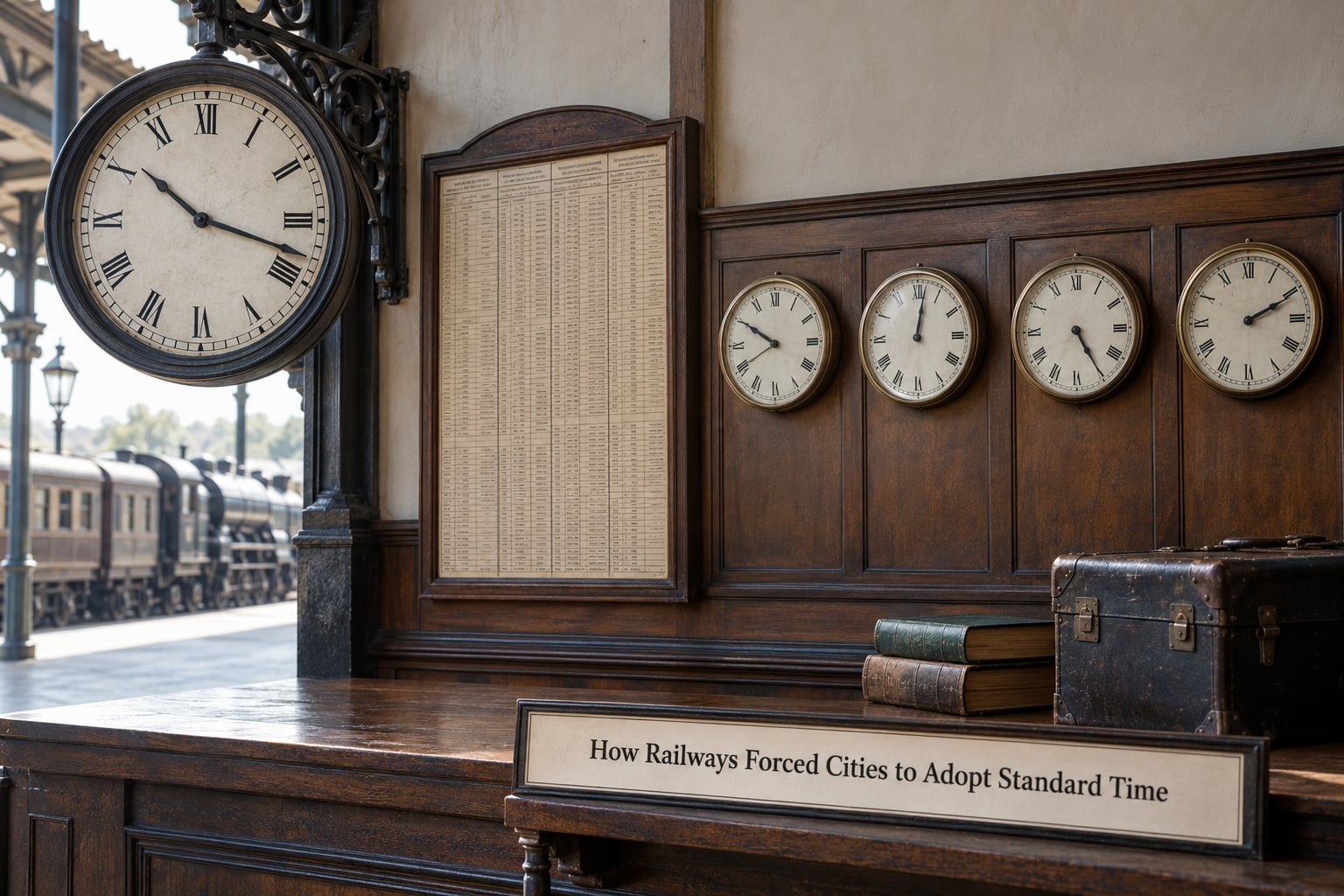
Railway companies published schedules that connected dozens of towns hundreds of miles apart, and a schedule is meaningless if the departure clock in one town reads a different time from the arrival clock in another. By the 1870s, American railroads were maintaining dozens of separate local timetables, and clearing houses existed largely to reconcile the mess at interchange points.
Several figures pushed for a shared clock, and the most under-reported is Charles Ferdinand Dowd, a Buffalo lawyer and railroad lobbyist. In 1869 he proposed dividing the United States into four zones of 15 degrees each, aligned to the prime meridian at Greenwich, and he revised the plan in 1872. His was essentially the system the country adopted.
The Canadian engineer Sir Sandford Fleming took the idea global. In 1878 he argued for a worldwide system of zones, and the following year a report on standard time by the American Meteorological Society, with William F. Allen and Cleveland Abbe among its contributors, gave the idea institutional weight.
Then there was the telegraph, which turned a proposal into an operation. Railways already owned telegraph lines, so a single time signal could be sent down the wire and every station on the network could reset its clocks at the same instant. On November 18, 1883, at noon Eastern time, operators received a signal based on the 75th meridian and the country’s railroads moved to Standard Railway Time.
The consequences were immediate and strange. Towns inside a zone that shifted their clocks simply struck twelve at the usual hour and moved on. Towns on the boundary had to decide which side of the line they were on, and some of them waited months before making the switch, which meant two communities ten miles apart genuinely disagreed about what time it was.
Do the railroads get full credit? Mostly yes for the mechanics, but the crash that dramatised the problem came earlier. At Valley Falls, Rhode Island, in 1853, two trains met on the same track because engineers’ watches disagreed about the time. Fourteen people died. That accident did not create time zones, but it made clear to engineers and legislators that local time had become dangerous.
What Happened at the 1884 International Meridian Conference?
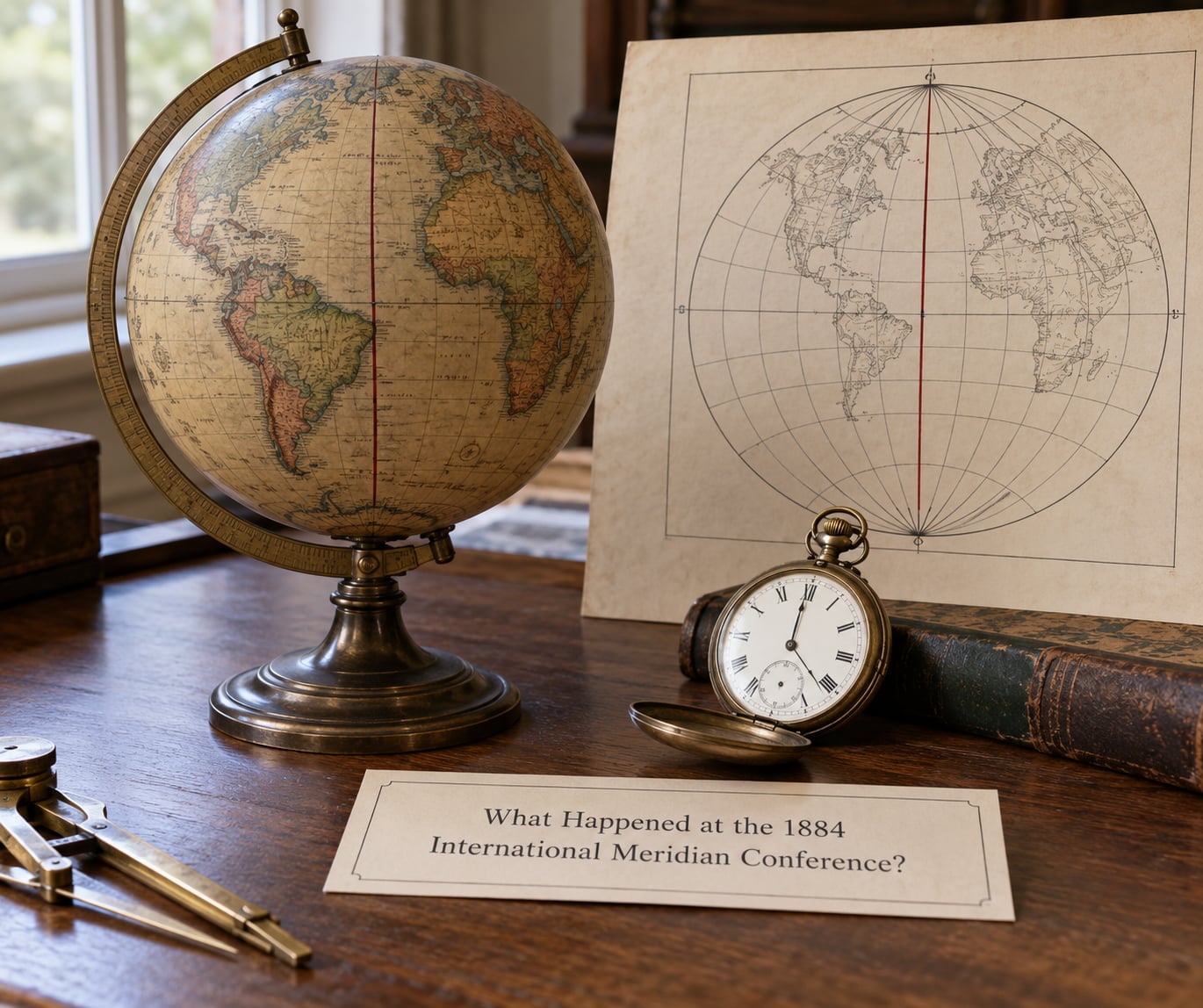
The conference met in Washington, D.C. in October 1884, and its central decision was to accept the Greenwich meridian as zero degrees longitude, with time measured from it. Delegates also agreed that the globe should be divided into 24 zones of 15 degrees and that a universal time should be used for scientific and telegraphic purposes.
Why 15 degrees? It follows from the Earth’s rotation, so it is the smallest even division that gives a whole-hour step and lines up with the meridian a system needs as its reference. Twenty-four zones of one hour is a mathematical compromise, not a discovery about the length of the day itself, which is not exactly 24 hours and drifts by small amounts against atomic clocks.
Here is the part often told as a smooth global rollout. It was not one. The 1884 resolutions were largely declaratory: countries adopted zones on their own schedules, and some still had not done so decades later. France kept Paris mean time into the twentieth century even though its own railway network had been on Greenwich time since 1891, because the capital’s astronomical tradition outlasted the practical need.
What the conference really produced was a reference. Once every railway, telegraph office and shipping line in a country agreed on a meridian, agreements between countries became arithmetic instead of negotiation.
How Time Zones Differ from Time-Zone Offsets
A time zone is a place on the map. A UTC offset is the number you get from that place’s clocks relative to Coordinated Universal Time. The same offset can cover several countries, and one country can hold several offsets at once.
That distinction explains most of the strange entries you see on a world clock list. Canada spans six offsets from coast to coast. Russia has eleven across its territory if you count every offset it has used, and the United States uses six in its contiguous and territorial maps combined.
| Example | Offset from UTC | What it means in practice |
|---|---|---|
| Eastern Time, United States | UTC−05:00 | Clocks read five hours behind Greenwich, adjusted by daylight saving in summer |
| Central European Time | UTC+01:00 | One hour ahead, and the default across much of the European Union |
| India Standard Time | UTC+05:30 | A half-hour zone, matching India’s position between the ideal 15-degree bands |
| Nepal Time | UTC+05:45 | A quarter-hour zone, one of only two offsets in the world at 45 minutes |
| China Standard Time | UTC+08:00 | One zone for the whole country, so the far west runs hours ahead of its own sunrise |
Offsets get chosen for political reasons as often as astronomical ones. China uses a single zone covering 5,400 kilometres, and Spain has sat one hour ahead of its solar time for decades despite most of its population living in the sunlit part of the country. Iran has moved its offset repeatedly. These are choices, not errors.
The International Date Line, which bends around a handful of island nations to keep whole countries on the same calendar date, exists for the same reason. Standardization is a human decision about which awkwardness to accept.
How Did Daylight Saving Time Change the System?
Daylight saving time is an addition to the zone system, not part of its creation. It shifts clocks forward by an hour during the warmer part of the year, so that evenings in winter become afternoons in summer and more daylight is used while people are awake.
It has an unexpected pedigree. Benjamin Franklin proposed something similar in 1785, but the version that took hold came from Germany and the United Kingdom during the First World War, when governments wanted to squeeze more useful working and daylight hours out of a wartime economy. The United States wrote it into law with the Standard Time Act of 1918, kept it in force during the Second World War under the War Time Act of 1942, and then made it permanent nationwide with the Uniform Time Act of 1966.
The 1966 law also changed how the system is administered. The federal government now sets the start and end dates, and individual states can opt out or shift the boundary within their own borders, which is why the United States maps show an irregular patchwork rather than clean lines.
Most of the world has the same arrangement through the European Union, which keeps a single set of rules across member states. A smaller group, including most of Arizona and much of Europe outside the EU, has abandoned the practice after studies showed the clock changes deliver small health and energy gains for large disruption costs. The debate continues, which is why some countries keep changing their minds.
Frequently Asked Questions
Who first proposed time zones?
Charles Ferdinand Dowd, a Buffalo lawyer working with railroad interests, proposed dividing the United States into four 15-degree zones in 1869 and refined the plan in 1872. Sir Sandford Fleming, a Canadian engineer, took the idea to the world stage in 1878. The idea had earlier roots too: William Lambert pressed the British government about longitude in 1809, and John Harrison’s chronometer had already solved the longitude problem at sea by the 1760s.
Did the railroads create time zones in 1883?
Yes, in the United States. Railroad companies adopted Standard Railway Time on November 18, 1883, moving the country into four zones so their timetables worked across the network. Governments did not force it. The United States only wrote standard time into national law with the Standard Time Act of March 19, 1918, thirty-five years after the railways had already made it the working standard.
How did people set their clocks in the 1800s?
Each town set its public clock to local solar noon, using a sundial and correcting it by observation. Because solar time shifts by about four minutes for every degree of longitude, neighbouring towns disagreed by minutes. Setting a clock by the sun took a few minutes of watching and adjusting, which is why accurate timepieces were a luxury before cheap factory clocks and railway time signals arrived in the 1880s.
What problem did standard time zones solve in 1883?
Railroads ran on dozens of separate local timetables, so a schedule from one town did not mean anything in the next. Engineers’ watches disagreed, and in 1853 a head-on collision at Valley Falls, Rhode Island killed fourteen people partly because of that disagreement. Standard time gave the whole network one clock, let timetables be published reliably, and made telegraph and freight coordination possible across hundreds of miles.
Why do different countries have different time zones?
Every country legally sets its own zones, so the map is a mix of geography, history and politics. Geographically, the Earth turns 15 degrees an hour, which suggests 24 one-hour zones. Politically, governments adjust for convenience and identity: China uses one zone for the whole country, India uses a half-hour offset, and North Korea once added an hour described as Pyongyang Time. No single authority controls world time.
Conclusion
The Sun set the first clock. Everything since has been people agreeing to disagree with their local sun by a fixed, shared amount, because travel and trade eventually required it.
Railroads built the system in 1883, an international conference gave it a reference line in 1884, and national law caught up in 1918. If you remember one thing, remember that the industrial timetable came before the statute: the modern clock exists because trains needed it. That, more than any committee resolution, is how time zones were created.