To forward mail temporarily, file a USPS temporary Change of Address with a start date and an end date, either online at USPS.com or in person at a post office using PS Form 3575. The window runs from 15 days up to 12 months. Eligible First-Class, Priority and Periodical mail then travels to your temporary address piece by piece, and forwarding stops on the end date without any further action from you.
Filing online takes about five minutes and costs 1.25 USD for identity verification. Filing in person is free. Either way, do it at least a week before you leave, because processing and moving the address into the system takes several business days.
Timing is the part that catches people out. The address change itself is the easy bit. What bites is filing it late and then wondering where a tax notice went.
Table of Contents
- What You Need to Forward Mail Temporarily
- Your old address, written exactly as USPS has it
- A real temporary address you can receive at
- Your dates
- Payment and identification
- What you cannot forward, even with all of the above
- How to Forward Mail Temporarily with USPS
- How to forward mail temporarily online
- How to forward mail temporarily in person
- How to extend, change or cancel a temporary change of address
- Choose the Right Temporary Forwarding Option
- How Long USPS Mail Forwarding Takes
- What happens when the forwarding period ends
- Common Mistakes When Forwarding Mail Temporarily
- Filing after you have already left
- Notifying only USPS
- Assuming everything will be forwarded
- Forwarding financial mail to a relative’s address
- Using an old address after the period ends
- Frequently Asked Questions
- Can I have mail forwarded temporarily?
- How long will USPS forward mail to a temporary address?
- How long does a temporary change of address take to start?
- What happens to my mail when a change of address ends?
- Why is USPS not letting me forward my mail?
- How do I forward mail that is not mine?
- Conclusion
What You Need to Forward Mail Temporarily
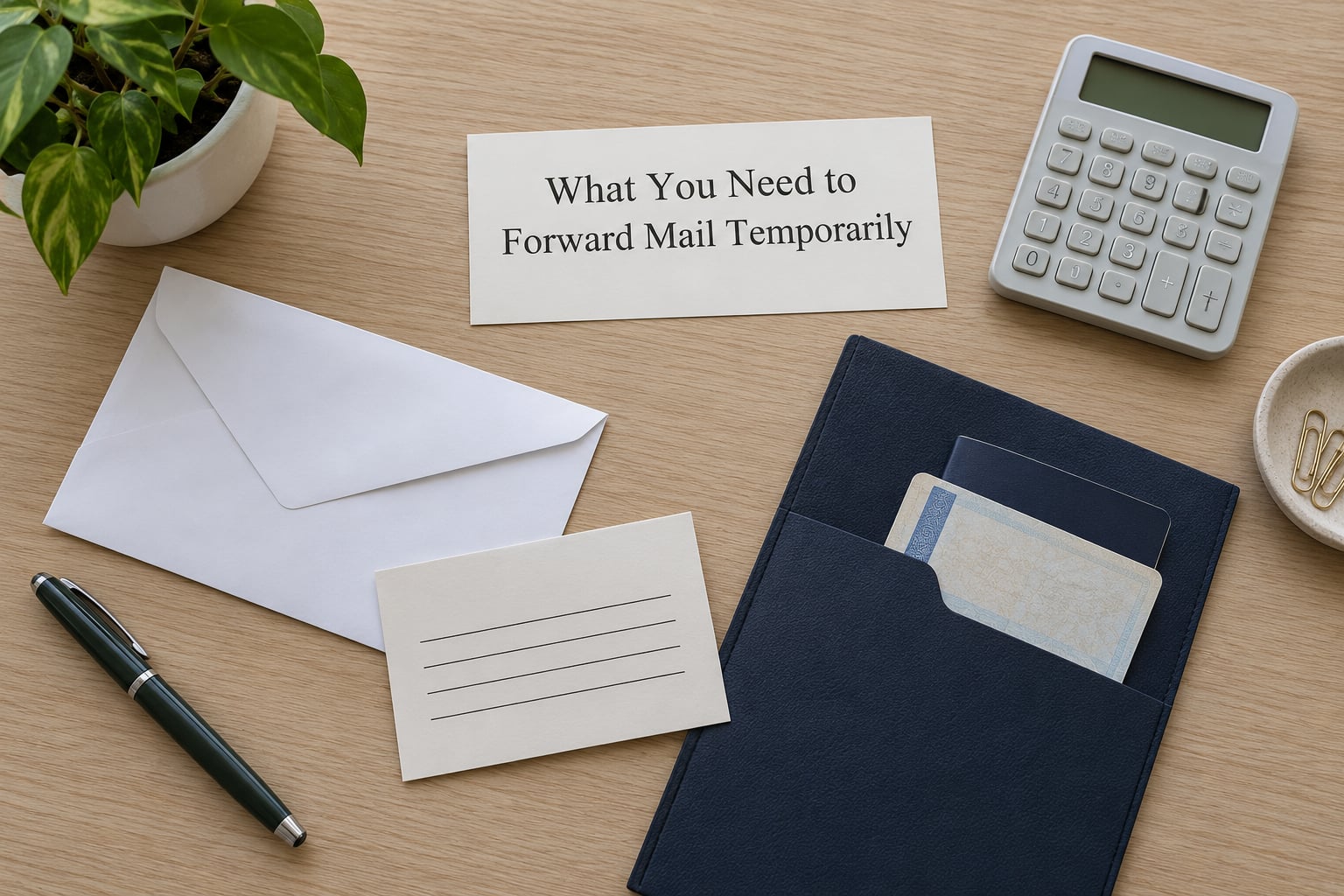
To forward mail temporarily you need five things: your old address, a temporary address you control, a start date, an end date, and a way to pay. Filing online also needs a USPS.com account and a debit or credit card. Filing at the counter needs a photo ID.
Your old address, written exactly as USPS has it
Use the form of the address on your mail, not the one you happen to type into a search box. Apartment and unit numbers matter more than street spelling, because a missing unit number is one of the most common reasons a change of address is rejected or silently mis-routed.
A real temporary address you can receive at
The address has to be one someone or something can accept mail at, every day, for the whole period. That could be a family member’s home, a friend who agreed, a storage unit with mail service, a coworking space, or a paid virtual mailbox. Mail sent to an address that looks inactive gets returned to the sender, and once that happens the forwarding record often does not retry.
Write the address in the standardized form USPS uses: no abbreviations, full street type, and the apartment or suite number on its own line if that is how the carrier delivers it.
Your dates
The minimum temporary forwarding period is 15 days. The first period can run up to 6 months, and the maximum is 12 months. Set the end date deliberately, because a temporary request left without one defaults to the 6-month maximum and mail keeps going after you have moved back.
Payment and identification
Online filings charge 1.25 USD as an identity verification fee, on top of postage on the mail itself. In-person filings at a post office are free. You can also pick up a Premium Forwarding Service option at the counter if you want USPS to ship your mail to you in a single box rather than forwarding it to an address.
What you cannot forward, even with all of the above
Standard Marketing Mail is not forwarded. Neither is most business reply mail, and pieces without a usable delivery address are simply returned. The sender matters here: forwarding follows the addressee on the piece, so if your name is not on the envelope, the piece does not travel with your change of address.
How to Forward Mail Temporarily with USPS
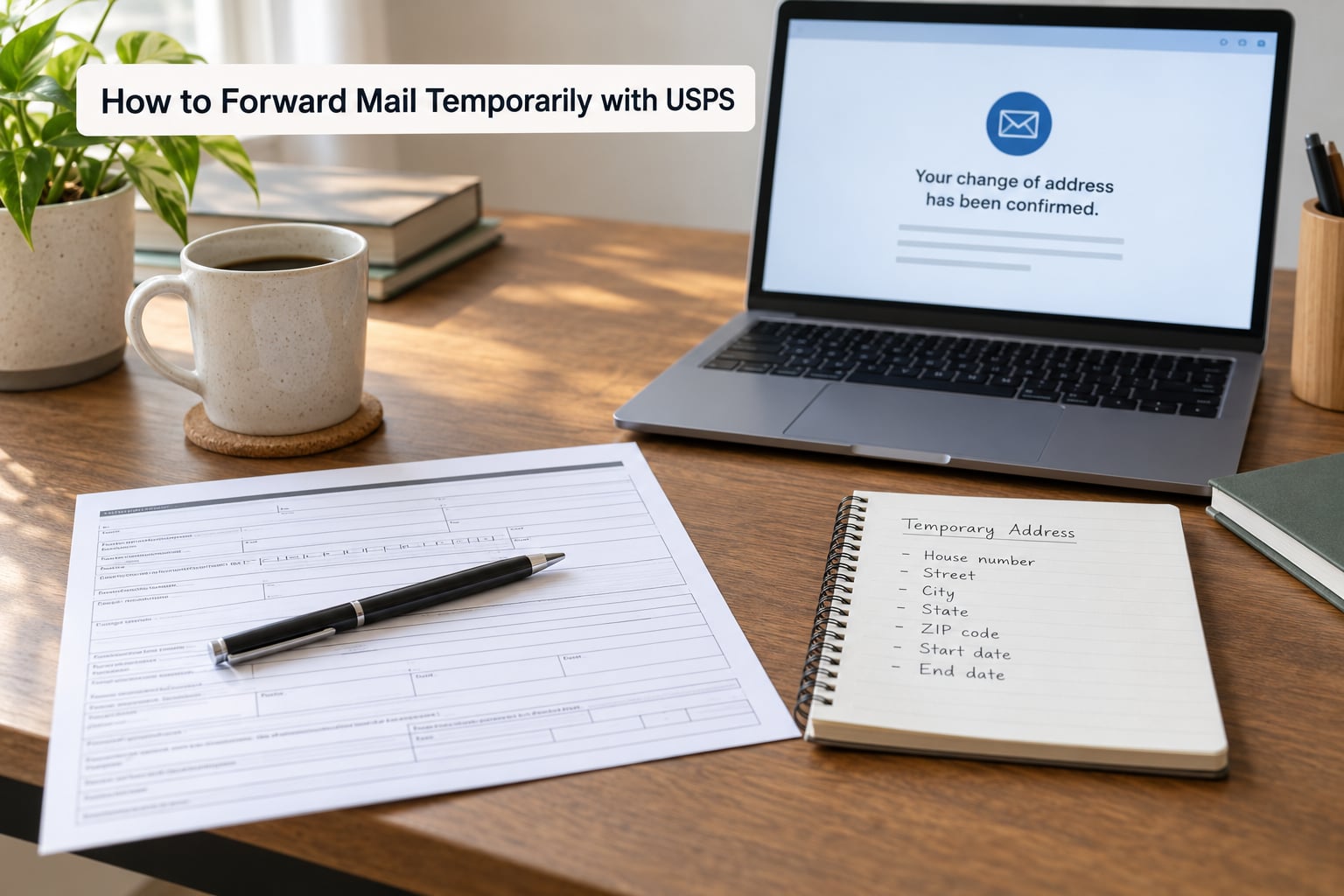
To forward mail temporarily with USPS, file a temporary Change of Address online or at the counter. Online is faster and gives you a confirmation number you will want later for extensions and cancellations. At the counter is free and useful when your identity or your old address is unusual.
How to forward mail temporarily online
- Sign in to USPS.com. If you do not have an account, creating one takes a couple of minutes and needs an email address. You should see a confirmation number at the end of the process, and a number is what makes step 7 possible.
- Open the Change of Address form and choose the temporary option rather than the permanent one. The two sit close together in the interface, and this is the single most common mistake people make.
- Enter your old address exactly as it appears on your mail, including any apartment or unit number.
- Enter the temporary address in full, standardized form, and add a nine-digit ZIP code plus the four-digit extension if you have it.
- Set the start and end dates. Start can be today or a future date, up to three months out. The end date must be 15 days after the start and no more than 12 months later. The first period is capped at 6 months.
- Choose what gets forwarded. You can forward everything, everything except Periodicals, or only specific classes such as First-Class and Priority. People who want to stop magazines from piling up usually pick the second option.
- Pay the 1.25 USD identity verification fee and confirm. The success page shows a confirmation number. Save it. Without it, extending or cancelling later is genuinely painful.
You should receive an email confirmation within a few days and a printed or electronic confirmation as well. If neither arrives after about a week, the request did not go through cleanly, and filing again is faster than waiting.
How to forward mail temporarily in person
- Go to a post office counter and ask for PS Form 3575, the Change of Address order form. USPS does not let you print this one at home anymore, so pick up a copy there.
- Fill in the old address in the upper block, matching what is on your mail.
- Mark the type of order as temporary and write the begin and end dates in the boxes provided. Leave them blank and you get the default period instead.
- Write the temporary address in the lower block, fully spelled out.
- Sign and date the form and present a photo ID when the clerk asks for it.
- Keep a copy or ask for the receipt. The clerk dates the form, and that date is your proof of when the request was accepted.
How to extend, change or cancel a temporary change of address
Extensions, address changes and cancellations all run through Manage My Move on USPS.com, and you need the confirmation number from the original filing. Log in, select the active change of address, and choose whether you want a new end date, a different address, or a cancellation.
Allow 7 to 10 business days for those changes to take effect. During that gap your mail is still going wherever it was going before, which matters if you are cancelling precisely because you do not want it arriving at a former address. A cancellation is not instant at the counter of a sorting facility.
Choose the Right Temporary Forwarding Option
The right temporary forwarding option depends on how long you are gone and how sensitive the mail is. Hold Mail for short trips, a temporary Change of Address for anything longer than a month, and a paid receiving service when you are living out of a vehicle or splitting time between two states.
| Option | Typical length | Where mail goes | Cost | Best for |
|---|---|---|---|---|
| Hold Mail | Up to 30 days | Collected at the post office | Free | Short trips under 30 days |
| Temporary Change of Address | 15 days to 12 months | Your temporary address, piece by piece | 1.25 USD online, free in person | Work assignments, snowbird seasons, students, medical treatment |
| General Delivery | Up to 30 days | Post office counter, address written to General Delivery | Free | People with no fixed address at all |
| Premium Forwarding Service | Renewed in blocks | Shipped to you in one weekly box | Paid subscription | Full-time travelers and RV living |
| Private virtual mailbox | Monthly | Mail scanned, listed and forwarded on request | Monthly fee | Digital mail, small apartments, mail with sensitive personal details |
Hold Mail is the one people overlook. Forum consensus on r/USPS and r/Advice is that for anything under 30 days, holding the mail and picking it up in one batch is simpler than a change of address, and it avoids the postage cost of forwarding everything individually.
General Delivery is the right answer for a different problem entirely. You address mail to General Delivery at the post office in a city you are passing through, and it is held there for up to 30 days. It costs nothing, but it is capped short and requires you to pick up in person.
Premium Forwarding Service and private virtual mailboxes both cost money, and both solve a specific problem: you have no stable street address. One subscriber who spent a winter away reported that only part of their mail arrived and that several senders got return notices claiming the household did not live there. A receiving service with a real street address would have avoided that.
How Long USPS Mail Forwarding Takes
Temporary mail forwarding usually begins about 7 to 10 business days after the request is accepted, and the order itself can run from 15 days to 12 months. That start-up delay is the reason to file a week or more before you leave rather than the night before.
Once it is active, the practical timing works like this:
- Processing: 7 to 10 business days for the address change, and the same again for extensions, modifications and cancellations.
- Minimum period: 15 days. Anything shorter has to go through Hold Mail instead.
- First period: up to 6 months.
- Maximum: 12 months in total, with a further 6 months available by extension.
- Per-piece transit: each forwarded piece travels as its own item, so magazines and catalogs arrive on their original schedules, not bundled.
What happens when the forwarding period ends
When the end date passes, forwarding stops. Mail still addressed to the old address is no longer rerouted, so it either gets delivered at the old address if anyone is there, or it is returned to the sender with a forwarding label attached showing the request expired. Bills, statements and notices that arrive after that point are often treated as undeliverable by the sender’s system, and chasing a returned tax document is a much bigger headache than extending a forwarding period a month early.
This is where snowbird patterns bite. If you are gone November through March and file the request in October, the first period covers you. If you file in January for a place you left in November, the timing is wrong and mail starts bouncing in the spring. Set a calendar reminder for two weeks before your end date, every year, and extend before it lapses.
Common Mistakes When Forwarding Mail Temporarily
The most common mistake is filing the wrong order type. The online flow offers a permanent change and a temporary change next to each other, and choosing permanent when you meant temporary means your mail keeps going to the temporary address indefinitely. That mistake is hard to undo cleanly and usually ends with a second filing.
Filing after you have already left
Late filing is recoverable but slow. Once the request is accepted, most mail starts moving, but the pieces that arrived during the gap were already delivered to the old address or returned. If you are the one still paying rent or collecting mail there, it barely matters. If you have already handed over the keys, it matters a lot.
Notifying only USPS
USPS moves the mail. It does not tell your bank, your employer, your insurer, your utility company, the DMV or the tax agency that your address changed. A change of address with a credit card company, a bank or a subscription service has to be filed separately, and those are the accounts where a missed statement turns into a missed payment.
The list is short enough to do in one sitting: banks and credit card issuers, the DMV if you drive, your employer for payroll, your health insurer, utilities, the tax agency, your landlord if you rent, and every subscription you would miss. Some of these offer their own temporary address settings, which is better than a blanket change because you can reverse them in one click.
Assuming everything will be forwarded
Catalogs, magazines and packages are the items people most often report as missing. Standard Marketing Mail is not forwarded at all, and Periodicals only travel if you keep that option selected. Priority Mail packages are forwarded, but a package that has already left the regional network moves at its own pace and may not make the cut before your end date.
Forwarding financial mail to a relative’s address
It works, and it is the most common arrangement people describe on forums, but it is worth thinking about once. Statements arriving at a family member’s address mean someone else may see your name, your balance and your account numbers. If that is a relative you trust completely and who has agreed, it is a reasonable choice for a short period. If it is a sibling’s house with a shared mailbox, or a friend’s place you visit occasionally, a paid virtual mailbox that lists and scans your mail is the safer option.
Whatever you choose, cancel the forwarding before you leave that second address. Leaving a permanent residence quickly without wanting mail to keep landing at a parent’s house after the temporary period was meant to be over is a common enough story. That is exactly the scenario a firm end date and a manual cancellation solve.
Using an old address after the period ends
Updates do not go back. Once the end date passes, any form, subscription or account still pointing at the old address sends mail to a place that is no longer yours. Sweep your own paperwork once more at the end date, not just at the start.
One last safety habit: turn on USPS Informed Delivery before you leave. It gives you a daily image of what is coming, which is the fastest way to notice that a sender is using the wrong address while the forwarding request is still active and correctable.
Frequently Asked Questions
Can I have mail forwarded temporarily?
Yes. USPS offers a temporary Change of Address that reroutes your mail from your old address to a temporary one for a set number of days. You file it online at USPS.com or in person at a post office with PS Form 3575, and you choose the begin and end dates yourself. The minimum is 15 days and the maximum is 12 months.
How long will USPS forward mail to a temporary address?
Between 15 days and 12 months. The first period can be up to 6 months, and after that you can extend for another 6 months through Manage My Move. When the end date arrives, forwarding stops automatically and mail addressed to the old address is returned to the sender with a forwarding label attached.
How long does a temporary change of address take to start?
Plan on 7 to 10 business days from the moment USPS accepts the request before forwarded mail starts arriving. Extensions, address changes and cancellations take about the same amount of time to process. File the request at least a week before you leave, and longer if bills or notices are expected at the old address.
What happens to my mail when a change of address ends?
Forwarding stops on the end date. Anything still addressed to the old address goes back to the sender carrying a forwarding label showing the request expired, and senders often treat those as undelivered. A temporary request filed without an explicit end date defaults to 6 months, so set your own date and set a reminder to extend before it lapses.
Why is USPS not letting me forward my mail?
The usual causes are picking the permanent option instead of the temporary one, leaving the old address blank or missing an apartment number, or filing a request for an address where the household does not currently receive mail. Hold Mail is the better tool for trips under 30 days, and a paid receiving service helps when you have no stable street address to forward to.
How do I forward mail that is not mine?
A change of address follows the addressee, so mail addressed to someone else will not move with your request. If you are handling mail for a parent, a deceased relative or a dependent, the sender usually has to update their records first, and some organizations will only accept a request with written authorization or proof of legal authority.
Conclusion
Start by confirming you have a real address that accepts mail every day of your absence, because that is the piece that decides whether the rest of the process works. Then file the temporary Change of Address at least a week before you leave, pick the temporary option rather than the permanent one, and write down the confirmation number so you can extend or cancel later.
Handle sensitive or time-critical mail separately: statements and tax documents are usually better routed to a mailbox you alone can open, and anything with a deadline should be redirected to a real sender before you go. Finally, check your confirmation dates and look through the new address a week after the move to make sure what is arriving matches what you expected.