A fresh coffee spill on a white shirt is a five-minute problem if you catch it now and a two-day problem if it goes through the dryer. The short answer is that most stains come out with a paste made from equal parts dish soap, 3% hydrogen peroxide, and baking soda, worked in gently, left to sit, then washed in cold water and air dried until the mark is gone. Heat is what makes a stain permanent, so the dryer is the last place a shirt goes.
I’m a household laundromat regular, and the same handful of supplies handle nearly everything. Below is the process I actually follow, plus a stain-by-stain table so you can match the treatment to the mark instead of guessing.
Table of Contents
- What You Need
- Step-by-Step: How to Get Stains Out of White Shirts
- Check the Care Label and Test the Cleaner
- Remove the Stain While It Is Fresh
- Pretreat the Stain With the Right Product
- Pretreat Options by Stain Type
- Wash the Shirt According to Its Care Label
- Inspect Before Drying and Repeat if Necessary
- Common Mistakes
- Tips for Better Results
- Frequently Asked Questions
- Can I use baking soda to get stains out of a white shirt?
- What is the best product for removing grease and oil from white fabric?
- Will bleach remove a stain from a white shirt?
- How do I remove yellowing from a white shirt after washing?
- Can I dry a stained shirt if the stain is still visible?
- What should I do if a stain remains after washing it several times?
- Conclusion
What You Need
Nearly all of this comes out of a kitchen cupboard. The point of the list is that each item does one specific job.
- Care label reader: the tag tells you the fiber and the safe wash temperature. Five seconds of reading saves a ruined shirt.
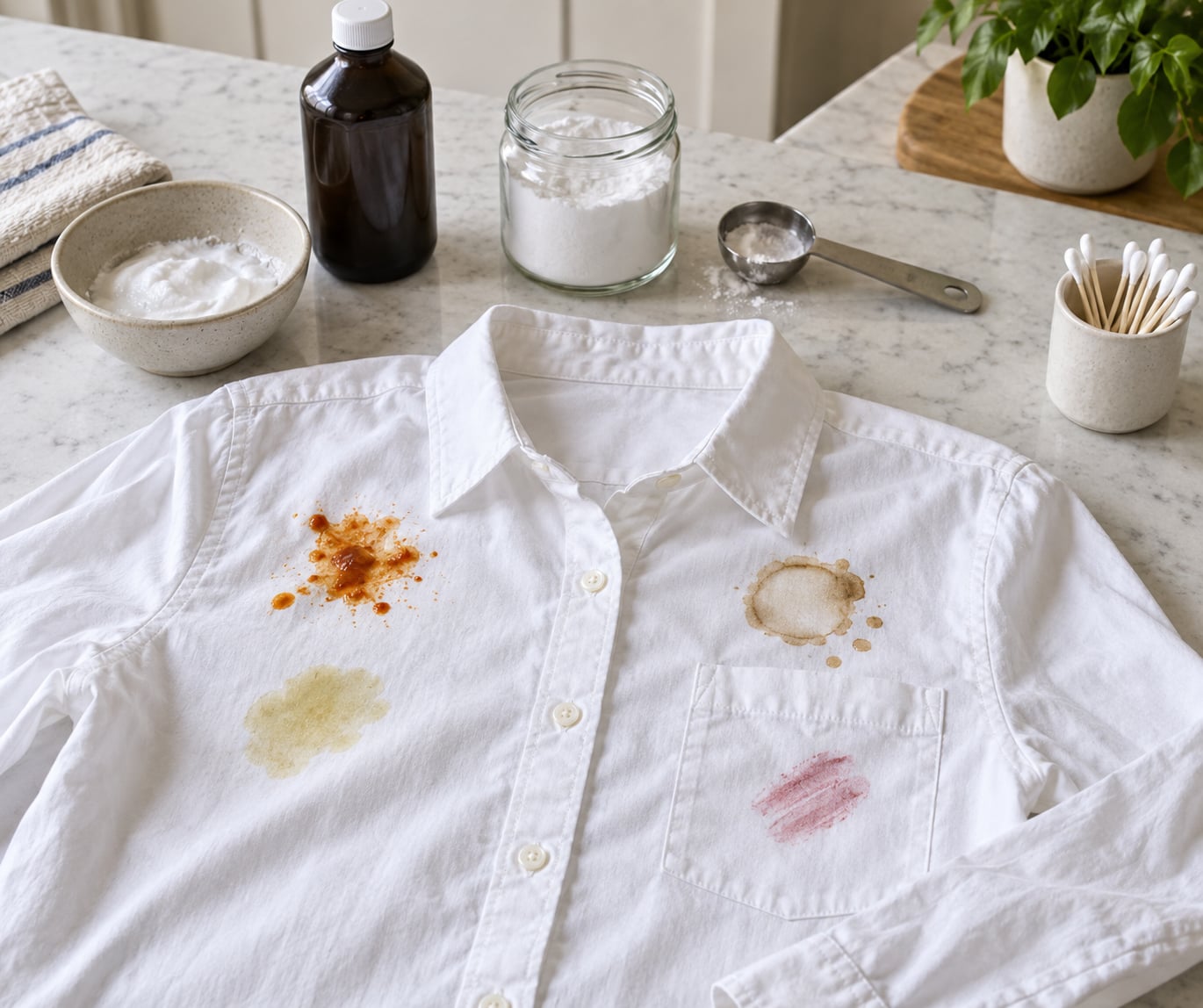
- 3% hydrogen peroxide: the pharmacy strength, not the 10% industrial bottle. This is what breaks down the pigment in coffee, wine, and yellow sweat marks.
- Grease-cutting dish soap: any clear or blue liquid dishwashing soap. Surfactants surround oil so water can rinse it away.
- Baking soda: a mild abrasive that lifts residue once the peroxide has softened it.
- White vinegar: useful for deodorant build-up and detergent residue, not for protein stains like blood.
- Cool or lukewarm water: cold flushes most fresh stains without setting them.
- An old toothbrush or soft-bristle brush: for working paste into the weave of a collar or cuff.
- Oxygen bleach (sodium percarbonate) powder: the gentler whitening booster for yellowed whites, if you want to buy one product.
- A shallow bowl, a white towel, and a spare toothbrush you don’t mind losing.
Budget about 15 minutes for a fresh stain and an hour if the mark has already dried and needs a soak. There is no specialist equipment involved.
Step-by-Step: How to Get Stains Out of White Shirts
Check the Care Label and Test the Cleaner
The care label decides what you are allowed to use. Cotton and linen tolerate peroxide and heat; silk, wool, viscose, and anything marked “dry clean only” do not. A crossed-out tumble dry symbol is telling you something too.
Test first regardless. Dab a small amount of your cleaner on a hidden seam or the inside hem, wait a few minutes, and check for fading or a change in texture. If the fabric is polyester or a printed graphic, peroxide can eat the print, so keep the patch test generous and give it time.
Remove the Stain While It Is Fresh
Blot, never rub. Rubbing drives the stain deeper into the fiber and spreads it over a wider area of the shirt.
For a solid spill like salad dressing, lift the residue off gently with a spoon or a dull edge, then flush the area from the back of the fabric with cool water. Water from the back pushes the stain out through the surface rather than driving it in.
Skip the dryer entirely for now. Warm water and heat are what set protein stains such as milk, blood, and egg, and heat bakes a sugar or oil mark permanently into cotton.
Pretreat the Stain With the Right Product
Water repels oil, which is why most people fail with plain water on a grease mark. Work out whether the stain is oil-based or water-based first, then choose your product.
For the general-purpose paste, mix equal parts dish soap, 3% hydrogen peroxide, and baking soda in a small bowl until it forms a thick paste. Spread it over the stain, work it in with a fingertip or toothbrush in gentle circles, and let it sit 30 to 60 minutes before washing. Rinse with cool water and check the mark in natural light before it goes any further.
Match specific marks like this: grease, oil, salad dressing, and makeup get dish soap first. Coffee, tea, red wine, tomato sauce, and yellow sweat stains get peroxide. Blood, milk, and egg get cool water and a dab of dish soap, with no heat anywhere in the process. Ink and dye-transfer marks get rubbing alcohol applied from the back of the fabric. Mud and grass get brushed off dry first, then washed cold.
For a stain that has already dried or been washed, the protocol takes longer: soak the garment in cool water with a scoop of oxygen bleach or powdered laundry booster for an hour, apply the peroxide and dish soap paste directly to the mark, leave it overnight if you can, then wash cold and air dry. One cycle rarely does it, and a stain six months old may need two or three attempts with air drying in between.
Pretreat Options by Stain Type
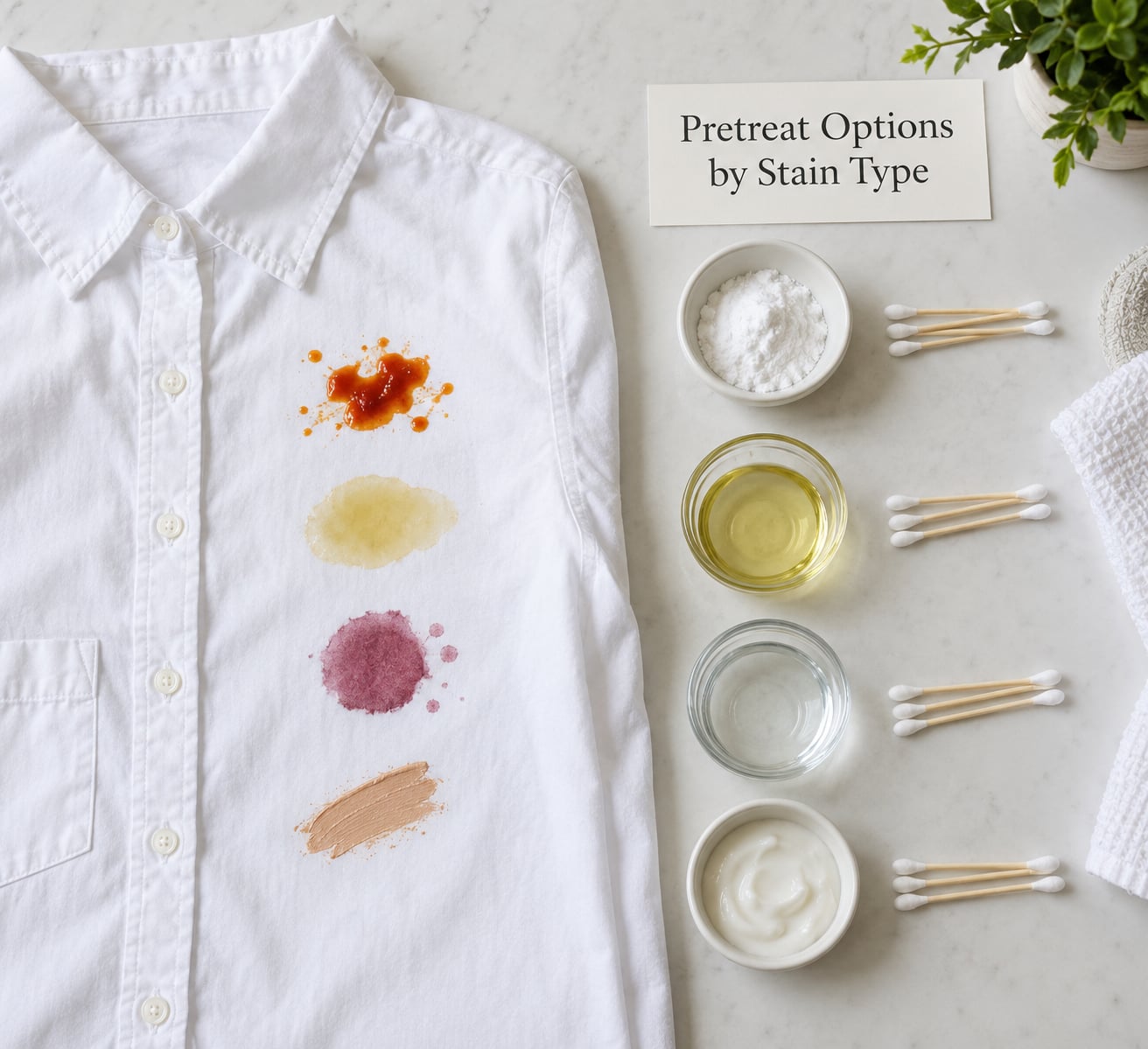
This table covers the marks that come up most often. Find your stain type, follow the first column, and use the wash setting in the last one.
| Stain type | First action | Treatment | Wait time | Wash setting |
|---|---|---|---|---|
| Grease, oil, salad dressing | Blot, lift residue | Dish soap worked into the fabric | 15 to 30 minutes | Warm wash, air dry |
| Coffee, tea, red wine | Blot, rinse cool from the back | 3% hydrogen peroxide or the dish soap and peroxide paste | 10 to 20 minutes | Cold wash, air dry |
| Yellow underarms, collar, deodorant | Scrub the weave with a damp toothbrush | Oxygen bleach soak, then a peroxide touch-up | 45 to 60 minutes | Cold wash with booster, air dry |
| Makeup, lipstick | Scrape off the top layer | Dish soap, then a peroxide dab if a mark remains | 15 minutes | Cold wash, air dry |
| Blood, milk, egg | Blot with cool water only | Cool water flush and a dab of dish soap. No heat at any stage | 10 minutes | Cold wash, air dry |
| Mud and grass | Let it dry, then brush off | Laundry detergent and a toothbrush on the fibers | 15 minutes | Cold wash, air dry |
| Ink or dye transfer | Do not rub | Rubbing alcohol from the back of the fabric, then rinse cold | 10 minutes | Cold wash, air dry |
| Detergent residue or hard-water yellowing | Wash the shirt alone | White vinegar solution soak, then a normal wash | 30 minutes | Cold or warm wash |
Wash the Shirt According to Its Care Label
Once the mark has faded, wash it. Cold water is the safe default for anything you have not fully verified, because heat is what fixes a stain that is still there.
Use a normal dose of liquid detergent rather than a heaped scoop, since excess detergent leaves its own residue that looks like dirt on white fabric. An oxygen bleach booster is fine for cotton and linen, but not for silk, wool, or viscose. If the shirt allows it, choose the longest cycle at the highest permitted temperature, since a longer wash gives the chemistry more working time.
Wash the white shirt on its own or with other whites. Mixing it in with colors can transfer fresh dye onto the fabric you just cleaned.
Inspect Before Drying and Repeat if Necessary
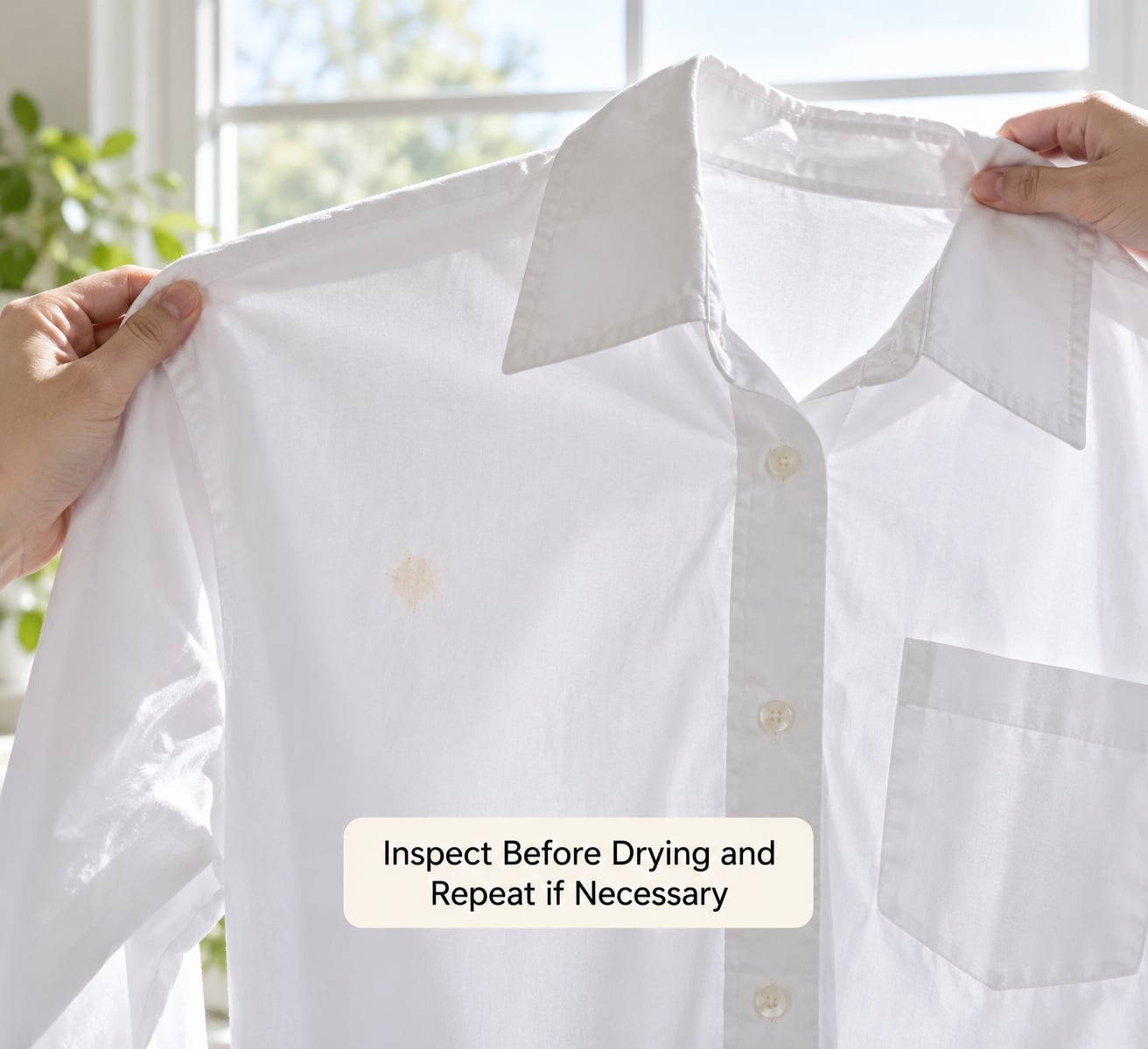
Hold the shirt up against a window or a lamp before it goes near any heat source. Look at both sides of the marked area, because a shadow of a stain often remains on the underside when the top looks clean.
If something is still there, air dry the shirt flat or on a hanger, then treat that spot again. Repeated targeted treatment beats running the whole shirt through the machine five times, which fades fabric and trims, loosens buttons, and wears out collars without necessarily removing the mark.
Give the shirt a day between attempts. If two careful rounds of pretreatment and cold washing leave no change, take it to a dry cleaner before you try a harsher chemical. Professionals deal with mystery stains and old set-in marks that home treatment often cannot reach.
Common Mistakes
Drying a shirt that still shows a stain. This is the number one reason stains become permanent. If you must dry it for any reason, air dry flat instead.
Rubbing the spot. It spreads the stain and pushes it into the fiber. Blot from the outside edge toward the center with a clean white cloth.
Using hot water on protein stains. Blood, milk, and egg set permanently with heat. Cool water only, from the first moment to the last.
Applying chlorine bleach to the wrong fabric. Bleach on protein-based stains and some dyed fibers can turn a white shirt brown or yellow around the mark, which is the complaint that shows up most often in laundry forums. Oxygen bleach is the safer choice on anything that is not a proven white cotton or linen.
Mixing cleaners together. Bleach plus vinegar or bleach plus ammonia produces harmful gas. One product at a time, rinsed fully before the next.
Skipping the patch test. Peroxide fades printed graphics and dyed synthetics. A hidden-seam test costs a minute and protects the whole shirt.
Retreating a spreading mark. If the discolored area is getting wider rather than smaller, you are using the wrong product for the stain type. Stop, and diagnose again from the table above.
Tips for Better Results
Treat stains the same day if you possibly can. Heat, air, and time each bond a stain more firmly to the fiber, so a mark handled tonight is often an easier problem than the same mark handled next week.
Air dry white shirts when the weather allows, and avoid running them through a dryer every single load. Repeated high heat is the main reason white cotton slowly yellows and thins at the collars and cuffs.
Wash whites separately from colors, and do not overload the machine. Clothes need room to move for detergent to reach the fabric and rinse out cleanly.
Change underarm shirts or liners daily if you wear white often, and wash shirts at the end of a day rather than the end of a week. Sweat and deodorant build up fastest in the underarm and collar area, and those are the spots people miss.
Use enough detergent to do the job and no more. Leftover powder and fabric softener residue read as yellow or gray patches on white fabric once the shirt dries.
Frequently Asked Questions
Can I use baking soda to get stains out of a white shirt?
Yes, and it is best used as part of a paste rather than alone. Baking soda is a mild abrasive, so it helps lift residue once something else has softened the stain. Mix it with equal parts dish soap and 3% hydrogen peroxide, work the paste into the damp fabric, and give it 30 to 60 minutes. On its own, with no soap and no peroxide, expect very little on an oily or colored mark.
What is the best product for removing grease and oil from white fabric?
Grease-cutting dish soap, because its surfactants surround the oil so water can carry it away. Warm the area with lukewarm water, work a small amount of soap directly into the stain with a toothbrush, and leave it 15 to 30 minutes before rinsing. Never use hot water first, since heat sets grease into cotton. For a heavy oil mark, repeat the pre-treatment and then wash the shirt on a warm cycle.
Will bleach remove a stain from a white shirt?
Sometimes, and it can also make things worse. Chlorine bleach is effective on some dye-based stains on true white cotton and linen, but it weakens fibres over time and can turn protein-based marks, such as blood, milk, or rust, brown or yellow. It also fades printed graphics and dyed synthetics. Oxygen bleach is the gentler option and is safe on far more fabrics, so reach for it first unless you know the shirt is plain white cotton.
How do I remove yellowing from a white shirt after washing?
Soak the shirt in warm water with a scoop of oxygen bleach or powdered laundry booster for 45 to 60 minutes, working the paste of dish soap and 3% peroxide into the underarms and collar with a toothbrush. Then wash it cold with the booster and air dry. If the yellowing is faint and comes back after every wash, the cause is often detergent residue or hard water rather than fabric age, and a vinegar soak before washing usually clears it.
Can I dry a stained shirt if the stain is still visible?
No. Heat is what sets a stain permanently into the fiber, and a single trip through a dryer can turn a mark you could have removed into one that stays. Air dry the shirt flat or on a hanger instead, inspect it in daylight, and treat the spot again. Repeated targeted treatment is gentler on the fabric and works better than laundering the whole shirt several times over.
What should I do if a stain remains after washing it several times?
Stop re-washing and re-diagnose. Identify whether the mark is oil-based, protein, or a dye, then use the matching treatment for that category rather than repeating the same cycle. Old set-in marks often need an overnight soak in oxygen bleach or laundry booster followed by air drying, and they may need two or three rounds. If careful treatment changes nothing, a dry cleaner has options for set-in stains that home products do not.
Conclusion
Start with the fabric, not the stain. Read the care label, patch test your cleaner in a hidden seam, work out whether the mark is oil-based or water-based, and apply the matching product to the right side of the fabric. Then let the shirt dry only after the mark is completely gone. That single rule, more than any product on the shelf, is what separates a stain that washes out from one that stays for years.