Cell phone plans are priced in layers. Carriers buy minutes, texts and gigabytes of data from a network owner at wholesale rates, then resell them bundled with a base service charge, per-line fees, regulatory surcharges and government taxes. The number in the ad is only the first layer, which is why your bill usually lands higher.
Here is the short version before the detail:
- The advertised price is the service charge alone, before taxes, fees and any device you are paying off.
- You pay for the data tier you buy, not the data you use. A plan costing more is not always better for you.
- The same network can carry plans priced 40 dollars apart, because the retail brand selling it has a different cost base.
- Per-line fees are the biggest lever most households control, and they apply to every extra line on the account.
- Taxes, carrier surcharges and optional services are three different things, and only one of them is a tax.
U.S. figures below are typical ranges gathered in 2026. They vary by region, change often, and every carrier prices its own lineup differently.
Table of Contents
- Typical Cell Phone Plan Costs by Line and Data Tier
- What Cell Phone Plans Usually Cost
- What Affects the Price
- How Data and Unlimited Plans Affect the Bill
- How Device Financing and Contract Terms Affect the Price
- What Taxes, Fees, and Optional Charges May Apply
- Ways to Save on Cell Phone Plans
- Frequently Asked Questions
- Why is my cell phone bill higher than the advertised plan price?
- Does an unlimited cell phone plan mean I can use unlimited data?
- Is it cheaper to buy a phone outright or pay for it in installments?
- How many phone lines make a family plan cheaper?
- Can I lower my bill without switching cell phone carriers?
- Conclusion
Typical Cell Phone Plan Costs by Line and Data Tier
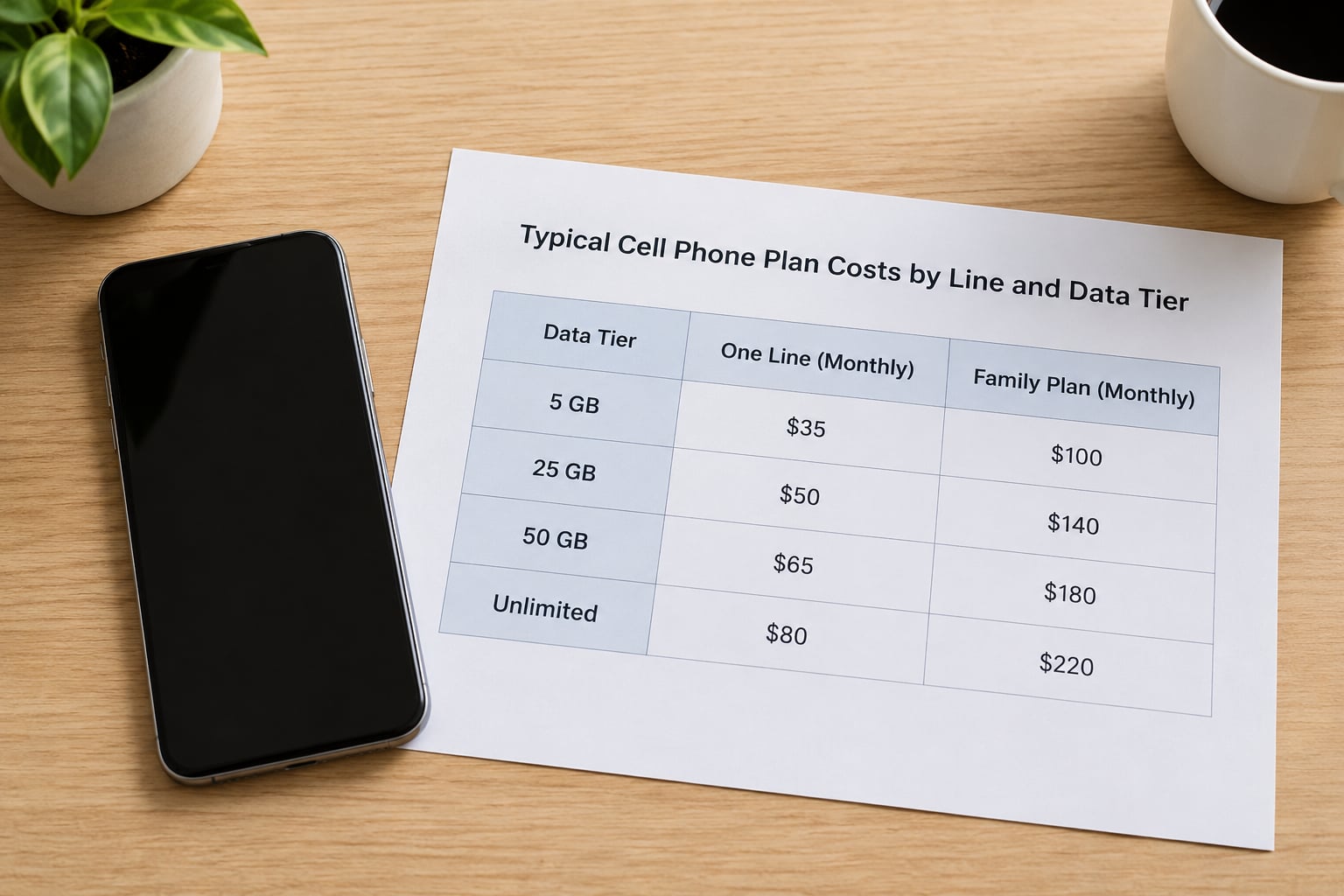
Here is what monthly service tends to cost before taxes, in the United States. Prepaid and virtual plans sit at the low end of each range; postpaid plans from the three national carriers sit at the high end.
| Number of lines | Basic data plan | Unlimited data plan | Premium tier |
|---|---|---|---|
| 1 line | 20-30 dollars | 60-70 dollars | 85-95 dollars |
| 2 lines | 35-45 dollars | 115-130 dollars | 145-160 dollars |
| 3 lines | 50-60 dollars | 160-175 dollars | 200-220 dollars |
| 4 lines | 65-75 dollars | 200-215 dollars | 250-270 dollars |
| 5 lines | 80-90 dollars | 240-260 dollars | 300-325 dollars |
Two patterns stand out. Unlimited plans on postpaid carriers cost roughly three times as much as basic prepaid plans per line, and every additional line on a postpaid unlimited account adds about 35 to 45 dollars rather than the small top-up a prepaid brand charges.
A basic tier means a capped allowance, usually somewhere between 5 GB and 15 GB. Premium tiers exist on postpaid accounts and bundle things like higher hotspot caps, streaming perks, cloud storage or international calling. They cost more because they carry more capacity and more bundled services.
Why does the same tower support both a 25 dollar plan and a 65 dollar plan? Because two different companies sell on it. A mobile network operator, or MNO, owns the spectrum, the towers and the network core, and sells access to that capacity wholesale. A mobile virtual network operator, or MVNO, buys wholesale capacity and resells service under its own brand with its own overhead and its own margin.
The big carriers also own their own cheaper brands. AT&T owns Cricket, T-Mobile owns Metro by T-Mobile, MetroPCS, Mint Mobile and Ultra, and Verizon owns Visible and Total by Verizon. The parent prices its own retail plan high, then uses the flanker brand to compete with other carriers’ flankers without undercutting its own main lineup. That is why two plans running identical network coverage can differ by more than 40 dollars a month.
Notice what the table does not include. Taxes, activation charges, device financing, insurance and roaming all sit outside these figures, and they are the reason an advertised 65 dollar plan frequently arrives as a bill in the low 80s.
What Cell Phone Plans Usually Cost
The advertised price buys you a service bundle: voice minutes, texts, a data allowance and access to the network. Everything else is layered on top, and a bill is usually readable as seven pieces.
- Base service charge, the advertised plan price for the tier you picked.
- Per-line access fee, added by some carriers to each line on the account, often the amount of the break for a second or third line.
- Carrier surcharges, a small administrative or operating fee per line plus a regulatory cost recovery fee, typically 1 to 3 dollars per line each.
- Federal Universal Service Fund contribution, charged as a percentage of your service charge, not a flat fee.
- State and local taxes, applied to the taxable portion of the bill at a rate that differs by jurisdiction.
- Activation and SIM charges, one-time fees that historically ran from 25 to 35 dollars and now often appear as setup fees.
- Optional services and device payments, insurance, protection plans, hotspot add-ons, international calling and monthly device installments.
Here is one line itemized, using a plan advertised at 65 dollars a month. The figures for the fee lines are typical ranges, not a specific carrier’s current statement.
| Bill line | Amount | What it is |
|---|---|---|
| Advertised plan price | 65.00 | Service charge for one line, unlimited data |
| Administrative and operating fee | 1.50 | Carrier charge per line |
| Regulatory cost recovery fee | 1.00 | Carrier charge per line |
| Universal Service Fund contribution | about 5.00 | Federal, percentage-based |
| State and local taxes | about 8.00 | Rate depends on where you live |
| Subtotal | about 80.50 | What a tax bill would show for one line |
| Device installment | 25-45 | Optional, if the phone is financed |
| Protection plan | 10-17 | Optional, if you kept the add-on |
| Total possible bill | 115-140 | One line, fully loaded |
That gap is not a trick. It is the difference between a service price and an invoice, and plenty of readers have never seen the two separated. One Reddit user estimated their taxes and fees at 5 to 6 dollars a line and was billed 11.14 a line on the first statement, which is a better illustration of the gap than any carrier brochure.
Regional taxes matter here too. The same plan costs more in some states and counties than others, and taxing authorities change wireless tax rates from time to time. That is the whole reason the same advertised price produces a different total depending on your ZIP code.
To push transparency further, the FCC’s broadband label rules now require carriers to show fees clearly on bills, and more carriers quote a fees-inclusive price in the headline. Even so, the advertised number still means different things on different pages, so read the fine print about what the price includes.
What Affects the Price
Line count, data tier, network ownership, device terms, activation charges, promotional pricing and regulatory taxes are the main levers. Here is how each one works.
How Data and Unlimited Plans Affect the Bill
You pay for the tier you buy, not the data you consume. A customer paying 65 dollars for 4 GB, who described it as absurdly expensive in a Reddit discussion, has bought a tier; using 2 GB does not produce a credit, and using 9 GB does not create an overage charge on most modern postpaid plans.
Below unlimited, overages are usually the next step. On a capped tier, crossing the allowance means the plan either slows down or bills extra gigabytes at a per-gigabyte rate set by the carrier. That is the only situation where consumption above the tier changes the invoice.
On unlimited tiers, deprioritization and throttling do the adjusting instead. During heavy congestion a carrier can move your traffic behind other customers, and older plans sometimes cap throughput once you pass a high threshold. Hotspot tethering is usually metered separately, with a lower cap than the on-phone allowance.
Unlimited generally means unlimited data, not unlimited everything. High-speed hotspot, 5G access, international calling, premium resolution and cloud perks each sit on their own tier, and a premium unlimited plan can cost 20 to 30 dollars more per line than the basic unlimited plan on the same account.
How Device Financing and Contract Terms Affect the Price
The device is a separate cost line and it is the one most people forget. A phone listed at 1,100 dollars spread over 24 interest-free installments adds about 46 dollars a month to a 65 dollar plan, so the real monthly number is close to 111 dollars.
In that no-interest example, financing is just spreading the same money over time. It gets more expensive when interest is charged, when you trade in a phone for less credit than the outstanding balance, or when you leave early and owe the remaining device balance.
A lease looks cheaper month to month because you return the phone at the end, but you never own it, and repeated leases mean paying for several phones you no longer have. Prepaid plans usually let you bring an unlocked device you already own, and buying a phone outright separates the two costs cleanly.
The two-year view is the honest comparison. A 1,100 dollar phone plus 65 dollars a month for 24 months is 2,660 dollars over two years. Finance the same phone at zero interest and the total is identical; finance it with interest, credit for a lower-value trade-in, or stop paying early and the financed version costs more.
Leases also carry an early upgrade trigger, and the pressure to upgrade on schedule is part of how carriers keep revenue predictable. If you dislike the commitment, you are not imagining it.
What Taxes, Fees, and Optional Charges May Apply
Sorting charges into three buckets explains most of the argument people have about phone bills. Only the middle bucket comes from a government.
| Bucket | Examples | Can you avoid it? |
|---|---|---|
| Government taxes | Universal Service Fund, state and local wireless taxes, E911 fees | No |
| Carrier surcharges | Administrative and operating fee, regulatory cost recovery fee, line activation charge | Only by choosing a different carrier or plan |
| Optional services | Device protection, hotspot add-on, international calling, directory assistance, premium messaging | Yes, remove them |
Carrier surcharges are the confusing bucket. A regulatory cost recovery fee exists so a carrier can pass through costs it is allowed to recover, and an administrative fee covers billing and support work. They are set by the carrier rather than by a legislature, which is why they attract more anger than the taxes do.
Activation fees are the other flashpoint. Paying a fee to turn on a number and swap a SIM card feels like a charge for automation, and readers in phone forums have made exactly that argument. Fewer carriers charge it now, but where it exists it can be 25 to 35 dollars per line.
International roaming is the item most likely to produce a genuinely large surprise. Legacy per-megabyte rates could generate hundreds of dollars for a week abroad, which is why travel add-ons and included-roaming tiers exist at all. Check what your plan does abroad before you land.
Optional add-ons are the easiest lever. Protection plans commonly run 10 to 17 dollars a month per device, and most households are paying for them because they were added during sign-up and never revisited.
Ways to Save on Cell Phone Plans
The savings below are specific to how plans are priced, and each one targets a different line on the bill.
- Count your lines honestly. Remove an old line, a second SIM in a drawer, or a family member who moved out. Extra lines are charged monthly forever, and they are the largest single item most households can remove.
- Measure twelve months of data, not one month. Pull the usage history and note the peak, not the average. A customer who once used 400 GB in one month has a real need for a higher tier; most people do not.
- Buy the tier below the one you have. If you sit far under the allowance every month, a lower tier costs less and changes nothing about your life.
- Move heavy traffic onto Wi-Fi. Streaming and large file transfers on home or work Wi-Fi shrink the tier you need, which is the cheapest bandwidth available to you.
- Audit the add-ons. Pull the protection plan, the streaming bundle, the international calling pack and the hotspot add-on, and cancel the ones you stopped using. This is a same-day change with no negotiation.
- Compare total billed cost, not advertised price. Two plans differing by 20 dollars can reverse after per-line fees and taxes. Look for the all-in figure where the carrier shows one.
- Ask for a retention discount. Call before switching and ask what they can do on the existing lines. Loyalty pricing and a new-customer offer on the same network are often close in value, and staying keeps your number porting free of risk.
- Time the switch. If you do leave, check the incentives first, since the trade-in value and promotional price change the comparison more than the base rate does.
- Watch the promotional calendar. Introductory pricing usually steps up after the first or second year. Look at the post-promo rate before signing, and see whether the plan carries a price guarantee.
- Consider prepaid for the whole household. Prepaid families often reach break-even earlier because each extra line costs only a few dollars more, which matters most at three lines or more.
Two things to weigh before switching. Coverage differs by address even on the same brand of network, so check the map for where you actually live, and note any device payoff remaining before you move. If the phone is already paid off, the plan is your entire monthly cost and the comparison gets much simpler.
Frequently Asked Questions
Why is my cell phone bill higher than the advertised plan price?
The advertised price is the base service charge only. On top of it come per-line access fees, carrier administrative and regulatory surcharges, the federal Universal Service Fund contribution, and state and local taxes that vary by where you live. Device installments, protection plans and roaming sit outside both numbers. Check the fee section at the bottom of your statement for the exact lines.
Does an unlimited cell phone plan mean I can use unlimited data?
It means the on-phone data allowance is not capped, not that everything is included. High-speed hotspot usually has a separate, lower cap. International calling, 5G access, cloud storage and streaming perks often sit on higher tiers, and older plans can slow throughput once you pass a heavy-usage threshold or when the network is congested.
Is it cheaper to buy a phone outright or pay for it in installments?
Compare the full amount over the same period. Financing a 1,100 dollar phone over 24 interest-free months spreads the same money, so the totals match. Financing costs more when interest applies, when a trade-in credit is worth less than the balance owed, or when you pay off early and owe the remaining device cost. Buying outright is simpler and removes the commitment.
How many phone lines make a family plan cheaper?
There is no universal break-even, because carriers price the second and later lines differently. On postpaid unlimited plans each extra line often adds 35 to 45 dollars, while prepaid families typically add only a few dollars per line. Families of three or more tend to see the widest gap. Compare your all-in monthly total for each option rather than the advertised headline rate.
Can I lower my bill without switching cell phone carriers?
Usually yes. Start by removing unused lines and add-ons such as protection plans and hotspot packs, then review twelve months of data to see whether a lower tier fits. Turning on autopay or paperless billing can unlock a small discount, and calling to ask for a retention offer often works on lines you have already kept for years.
Conclusion
Here is how cell phone plans are priced, in one line: base service charge, plus per-line fees, plus carrier surcharges, plus taxes, plus device payments and whatever extras you kept. Start by totaling that full monthly figure for your current plan.
Then compare it with what you actually use: your real peak data needs, the lines you genuinely need, and the add-ons you still value. That total, not the advertised rate, is the number worth shopping against.