To lower your phone bill, audit your last three bills, trim what you do not actually use, call your carrier’s retention team with a competing quote in hand, and only then move to a cheaper plan or a mobile virtual network operator. Work those four moves in that order and most households find real savings without losing service.
Cell service has quietly become one of the fastest-rising line items in a US household budget, and it usually creeps up rather than jumping. A promotional rate reaches its end date, an annual increase applies, a family plan gains a fourth line, and nobody made a decision. That is why the first step in learning how to lower your phone bill has nothing to do with shopping around. It has to do with reading what you already pay.
This guide covers how to do that, what to say on the call, and what to check before you port your number anywhere. Carrier policies change, and offers differ by market, so treat the ranges and program details here as starting points and verify them with your own carrier before you act.
Last reviewed in October 2026.
Table of Contents
- What You Need
- Step-by-Step
- How to Lower Your Phone Bill by Auditing Your Usage
- Call Your Provider and Ask for a Better Rate
- Remove Add-Ons and Optional Services
- Choose a Plan That Matches Your Real Usage
- Switch to a Lower-Cost Carrier or MVNO
- Use Wi-Fi, Data Saver, and Low-Data Settings
- Check for Discounts and Special Programs
- Negotiate the Bill Before You Cancel
- Confirm the New Bill and Watch for Hidden Changes
- Common Mistakes
- Frequently Asked Questions
- Do I have to change carriers to lower my phone bill?
- How much can I realistically save each month?
- Will switching carriers affect my phone number?
- What if my phone is still under contract or financed?
- Do family and prepaid plans really cost less?
- Conclusion
What You Need
Gather these before you touch anything. The process takes about an hour the first time, and most of that hour is reading.
- Your account PIN or passcode. Without it you cannot port the number, and the retention team will ask for it as a first verification step.
- Two or three months of itemized bills. One bill shows a single month. Three show a pattern, including the month you traveled or the month you went over.
- Your usage history. Most carriers show daily data, text and call totals in the app or the account page. Export or screenshot the peak month.
- Your current plan details. Plan name, data allowance, price per line, and the promotional end date if one applies.
- Your device payoff balance. If a phone is financed, the remaining balance shapes every switch decision you make afterwards.
- Contract and upgrade dates. Know when you are free to leave and when any trade-in credit finishes.
Have all of it in one place, preferably a single note on your phone. You will be referencing it repeatedly on the call, and scrambling for account numbers mid-conversation is the fastest way to lose the room.
Step-by-Step
There are nine moves, and the order matters. Auditing before you call gives you evidence, evidence plus a competing quote gives you bargaining power, and bargaining power before a cancellation notice is what turns into a permanent reduction. Comparing the full monthly total rather than the advertised base price is the mistake that undoes most of the work, because headline rates rarely include taxes, fees and add-ons.
How to Lower Your Phone Bill by Auditing Your Usage
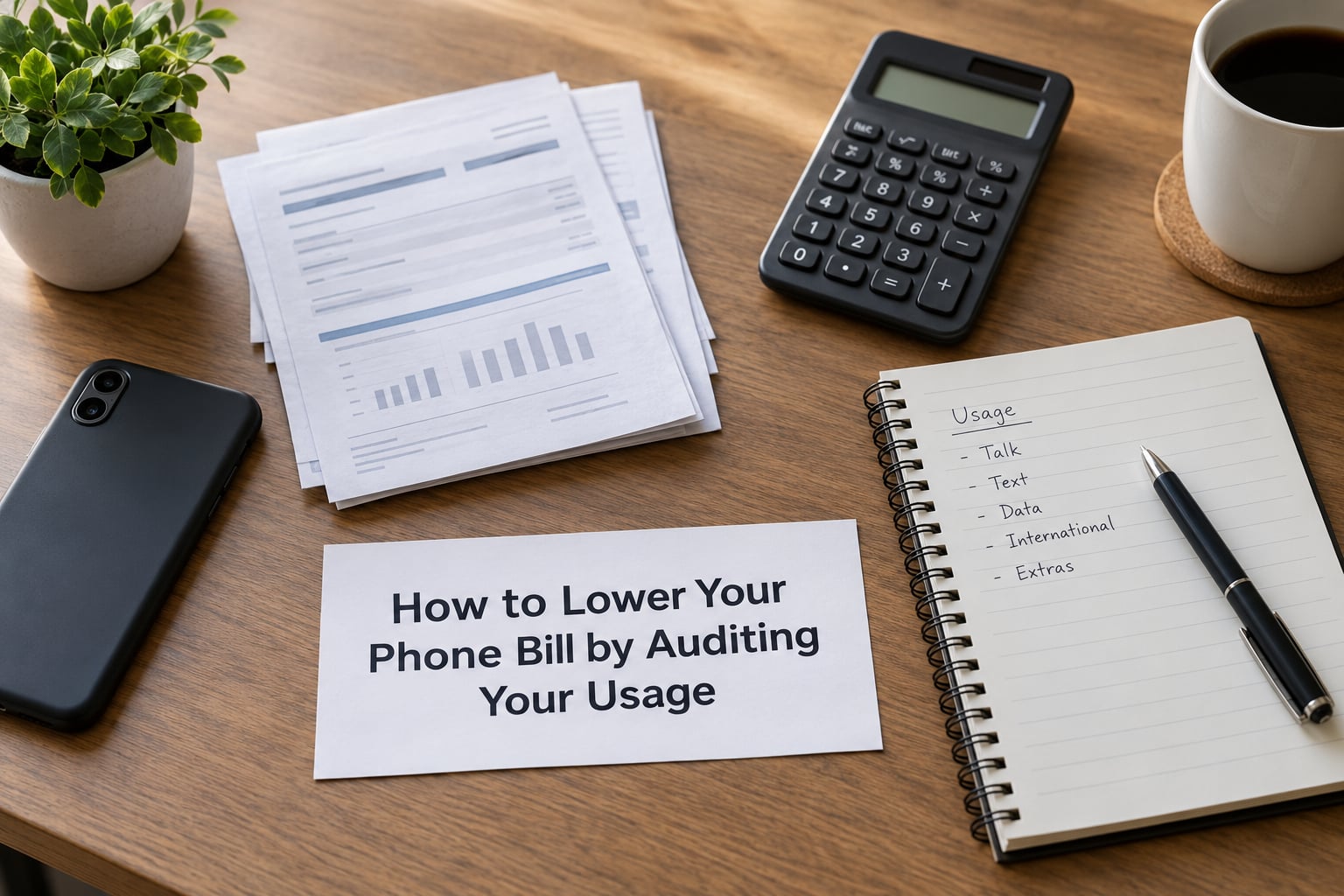
Start with the line-item breakdown, not the total. Most carriers show one summary page and one detailed page, and the detail is where the money actually sits.
Build a simple worksheet with one column per bill and one row per category: base line charge, data charge or tier, add-ons, device payment, taxes and regulatory fees, and anything you cannot identify. Three columns is enough to see the pattern. The single most common finding is not a surprise charge at all. It is that the household has been on a data tier sized for a much heavier user, or that a promotional rate quietly ended several months ago.
Add your usage totals underneath: peak-month data, roaming days, and any international use. Then compare that against your plan’s allowance. If your heaviest month sits well below your allowance, you have already proved to yourself that a cheaper tier would work, and that proof is the single most useful thing you can bring to a negotiation.
Note one-time fees separately from recurring charges. Activation charges, upgrade fees and early termination charges belong in their own column because they do not repeat, and mixing them into a monthly average makes a real saving look imaginary.
Call Your Provider and Ask for a Better Rate
Retention is the department authorized to make pricing changes that frontline service cannot. Reach it by asking for the retention team, the loyalty department, or the department that handles cancellations. Each carrier names it slightly differently.
Before you dial, write down three things: the price you pay now, the price of a specific competing plan you actually intend to switch to, and how long you have been a customer. A named competitor with a real plan beats a vague threat every time.
Write down the representative’s name and the confirmation number at the end of the call. Repeat the new price and the effective date back before you hang up, and ask them to email the summary. People in the r/Frugal community repeat one consistent lesson about these calls: what matters is not the tone but the specificity, because a general request produces a general answer.
Remove Add-Ons and Optional Services
Add-ons are the easiest money to recover because they are usually optional by definition. Look for mobile protection plans, device insurance, premium messaging bundles, hotspot entitlements, international calling packs, visual voicemail upgrades, and third-party subscriptions billed through your carrier such as ringtone services and news feeds.
Two checks before you cancel anything. First, device protection often overlaps with a manufacturer warranty or a credit card benefit, so read the terms before removing it. Second, some add-ons are attached to a bundle discount, so removing one can trigger a repricing of the whole line. Ask the representative to confirm the new total before the cancellation goes through, not after.
Also look outside the carrier. Streaming trials, cloud storage, and app subscriptions billed to the payment card on file can inflate what feels like a phone bill even though they never appear on the itemized statement.
Choose a Plan That Matches Your Real Usage
Match the plan to your audit, then add a cushion. A cushion of roughly 20 percent above your peak month protects you in a month with a road trip, a new device setup, or a firmware update that eats data.
Unlimited data plans are straightforward but not unlimited in the way most people assume. The better plans throttle after a high-speed threshold rather than stopping service, and deprioritization on a crowded network can slow things down during busy hours. Limited-data plans are better value for anyone whose peak month stays well under the allowance, and the overage behavior matters: some throttle, some add charges, some simply stop the data.
| Plan type | Best fit | Watch for |
|---|---|---|
| Unlimited data | Households with heavy streaming and no reliable Wi-Fi | Throttling after a high-speed threshold, deprioritization, higher monthly cost per line |
| Limited or capped data | Light and moderate users whose peak month stays under the allowance | Overage behavior, throttling, hotspot limits |
| Family or multi-line | Three or more lines under one account | Per-line pricing that grows quietly, line-level add-ons |
| Prepaid annual | Users who want one predictable annual payment | Annual plans may be prepaid, so check the refund policy before buying |
| MVNO | Users who want lower cost on a national network | Different customer service, fewer in-store locations, priority rules on the parent network |
Family plans deserve their own audit. Per-line pricing is deliberately hard to see, so ask the carrier to print a per-line breakdown. Moving one heavy user to a different plan while keeping everyone else in place often beats trying to renegotiate the whole account.
Switch to a Lower-Cost Carrier or MVNO
A mobile virtual network operator rents network capacity from one of the three national carriers and resells it, usually for less because it carries fewer retail costs. Because the underlying network is the same, coverage in most markets is nearly identical, with the honest caveat that some MVNOs get lower priority during congestion and have far fewer physical stores. Brand names readers ask about most include Mint Mobile, Visible, Consumer Cellular, US Mobile, Cricket Wireless, Metro by T-Mobile and Boost Mobile.
Before switching, check five things: the coverage map for your exact addresses rather than the national one, whether your current phone is compatible or unlocked and whether it works with an eSIM, the full monthly cost including taxes and activation fees, the cost and duration of any device financing the new carrier offers, and what the new carrier charges to keep your existing number.
Then respect the order of operations, which is where people lose their numbers. Start the new service first, confirm it works on both phones, port the number only after everything is live, and cancel the old line last. Cancelling first releases the number, and recovering it afterwards is far harder than porting it forward. A reader in r/USMobile described moving a seven-line family plan to a different carrier and said the switch took about five minutes per phone once the plan was selected, which is the part most people assume will be far worse.
Use Wi-Fi, Data Saver, and Low-Data Settings
If your audit shows the household sits close to its allowance most months, device settings can remove the problem entirely rather than moving you to a different plan.
On current iPhone versions, open Settings, then Cellular, and turn off Cellular Data for any app you never want using mobile data. Personal Hotspot, Low Data Mode and Background App Refresh under Settings, then General, are the three settings that change the most. On current Android versions, the equivalents live under Settings, then Network and internet, then SIMs, where per-app mobile data controls and Data Saver sit.
Menu names shift between versions and some carriers place the same controls inside their own app instead of the system settings, so look for the concept rather than the exact label. Turning off background refresh for video apps, disabling automatic downloads over cellular, and setting a device-level spending cap all do the same job: they cap the damage in the one month you forget to check.
Check for Discounts and Special Programs
Several discounts are automatic once you ask and are never volunteered. Autopay enrollment, paperless billing, multi-line bundles, and moving to a plan the carrier classifies as a lower tier are the common ones. Some carriers also offer military, first-responder, student, senior and employer programs, and eligibility rules differ by carrier and state.
Two federal programs are worth checking regardless of carrier. Lifeline provides a monthly discount on service from participating providers for households that meet income or eligibility criteria, and the Affordable Connectivity Program offers a similar credit toward internet and connected devices. Both have application rules and enrollment periods, so verify current status with the program directly rather than assuming eligibility.
For every discount, get three facts in writing: the exact amount, the renewal price when it ends, and whether it applies to the whole line or only the base charge. A discount that quietly reverts after twelve months is a delay, not a saving.
Negotiate the Bill Before You Cancel
Retention representatives usually have more room than frontline service, and the strongest lever is a credible alternative you genuinely intend to use. Tell the truth about it: you have a competing plan selected and you are willing to port today. That is a statement about a completed plan, not a bluff.
What comes back is usually one of three things, and the difference matters more than the number attached to it. A permanent rate reduction changes what you pay every month. A one-time statement credit changes one bill and leaves the next one untouched. An extra line at a reduced rate helps only if you genuinely need another line. People in the r/Frugal community describe being offered a one-time credit in place of a permanent cut often enough that it is worth naming the distinction out loud on the call: “I am looking for a permanent reduction, not a one-time credit.”
If the first representative cannot help, ask politely for a supervisor and stay calm. A supervisor has slightly more authority, and the escalation is faster than arguing. A reader in r/ATT described a quoted price that appeared on the bill at several times the amount, which is a good reason to request written confirmation of any figure you agree on rather than trusting a conversation you cannot see.
One reader on a Facebook group wrote about paying far above the national average for a flip phone and a smartphone, and asking the carrier for the senior and accessibility support that came with that line. Check whether an add-on such as device protection is quietly buying you priority support worth keeping.
Confirm the New Bill and Watch for Hidden Changes
The saving is only real once it shows up on a statement. Read the first two or three bills in full, not just the total, and compare them line by line against the numbers you agreed on.
Look specifically at taxes and regulatory fees, which are calculated as a percentage of your service charge and therefore fall when your plan falls. A reduced base rate is not the same as a reduced total, and this is the step that confirms whether the negotiation held.
If a charge looks wrong, dispute it in writing through the carrier’s billing portal, keep the reference number, and allow the stated response window. If it goes unresolved, the next step is a complaint to the Federal Communications Commission, which is the body that handles consumer complaints about US wireless providers.
Then set two calendar reminders: one for any promotional rate end date, and one for the final payment on a financed device. Both are the dates when a bill quietly jumps back up.
Common Mistakes
Most failed attempts come down to a small number of repeated errors, each with a simple correction.
- Cancelling the old service before porting the number. Cancelling releases the number and makes recovery harder. Port forward first, cancel last.
- Comparing advertised base prices. Headline rates exclude taxes, fees and add-ons. Compare the total you will actually pay.
- Accepting a one-time credit as a rate reduction. Ask specifically whether the change is permanent and when it reverts.
- Switching before checking coverage at your real addresses. National coverage maps hide building and neighborhood differences. Test before you commit.
- Ignoring promotional and financing end dates. These are the two dates that undo the saving later.
- Dropping a line that provides roaming or accessibility support without replacing it. Check what the removed add-on was actually covering.
If you do only three things this week, do these: pull the last three itemized bills and total the data and add-on columns, call retention with a named competing plan in hand, and set a reminder for your promotional end date. In that order they take a single evening, and they cover the majority of what most households can recover.
Frequently Asked Questions
Do I have to change carriers to lower my phone bill?
No. Most households get a meaningful reduction without leaving their carrier, because the biggest costs are usually an oversized data tier, expired promotional pricing, add-ons nobody uses, or a financed device. Start with the audit, remove what you do not need, and call retention with a competing quote. A carrier switch is the option of last resort once those levers are exhausted.
How much can I realistically save each month?
Savings vary with line count and usage, and anyone promising a fixed figure is guessing. A light user on a premium unlimited plan usually has the most room, while a heavy streaming household on a good unlimited plan may have very little. Multi-line accounts show the largest swings. The honest measure is the difference between your current total and the all-in total of the plan you would switch to.
Will switching carriers affect my phone number?
No, if you port the number correctly. Number portability rules in the US mean the new carrier handles the transfer, and your number moves with it. Start the new service first, confirm it works, port the number, then cancel the old line. Cancelling first releases the number and turns a routine transfer into a recovery problem that can take weeks.
What if my phone is still under contract or financed?
A financed device does not lock you in the way people assume, but the remaining balance changes the math. You can port your number to another carrier while still owing money, and you will still owe the balance. Before switching, ask the current carrier for the payoff amount, check whether paying it off unlocks a discount, and compare that against the cost of financing a device with the new carrier.
Do family and prepaid plans really cost less?
They can, and the gap is usually widest on multi-line accounts. Family plans spread the cost across lines, and prepaid plans remove much of the retail overhead. Taxes can still apply to prepaid service, and some prepaid plans must be paid for a year up front. The catch there is that annual plans are often prepaid in full, so read the refund terms before buying. Check the per-line total, not the headline.
Conclusion
The fastest route to a lower phone bill runs through four moves in sequence: read the last three itemized bills, find the single largest cost line, call retention with a named competing plan and ask specifically for a permanent reduction, then compare the all-in monthly total of a smaller carrier or MVNO against what you pay now.
Start today with one task: open the carrier app and look at your data usage for the last three months. It takes five minutes, and it tells you whether the rest of this process is even necessary. Whatever you decide, verify the final monthly total on a real statement before you consider the saving locked in, and set a reminder for the promotional end date before the bill climbs back up on its own.