
Finding a contractor you can trust comes down to four checks you can do yourself: verify the license and insurance independently, call references you reach yourself, compare itemized written estimates, and sign a contract before any work starts. Most bad hires trace back to one of four things — an unverified credential, an unsigned scope, no insurance, or money handed over up front. Each takes about an hour to check, and each is expensive to unwind once drywall is open. Here is the whole process, in the order that works.
Last reviewed for 2026. Rules on licensing and deposits vary by state, county and city, so check your local building department before you rely on anything below.
Table of Contents
- What You Need to Find a Contractor You Can Trust
- Step-by-Step: A Seven-Stage Hiring Process
- 1. Define the Project and Ask for the Right Credentials
- 2. Check Identity, Business Standing, and Real-World History
- 3. Contact References and Review Recent Work
- 4. Get at Least Three Itemized Written Estimates
- 5. Interview Contractors and Ask Questions That Reveal Reliability
- 6. Use a Detailed Written Contract
- 7. Control Payments and Document the Completed Work
- Common Mistakes: The Warning Sign and the Fix
- Frequently Asked Questions
- How can I tell if a contractor is legitimate?
- Should I hire a licensed contractor?
- How much should I pay a contractor upfront?
- Is it risky to accept the lowest estimate?
- What are the red flags when hiring a contractor?
- What should I do if a contractor takes my deposit and disappears?
- Conclusion
What You Need to Find a Contractor You Can Trust

Assemble these before you make a single call. Having them ready turns the vetting conversation into a checklist instead of an improvised conversation.
- A written description of the work. Rooms, dimensions, what is being removed, what is being installed, and what you are willing to live with during construction.
- A realistic budget range and a contingency. Contractors quote far more accurately when they know the number you have in mind and the amount of slack behind it.
- A photo or video of the problem area plus anything already inspected, so quotes describe the same condition instead of different guesses.
- The names and contact details of two or three recent customers you have heard good things about — neighbors, your local building supply store, your home inspector.
- Your state’s licensing board website and local building department page. These are where license numbers and permit rules get confirmed, and it helps to have the links open before the first meeting.
- A folder for documents: license number, certificate of insurance, each written estimate, the signed contract, every change order, every invoice and every photo you take of the job.
- Your local building department’s permit requirements, including who is allowed to pull the permit as the holder of record.
That last item catches more people than it should. In many jurisdictions the homeowner who pulls the permit becomes legally responsible for the work, so write down who pulls permits before you compare quotes.
Step-by-Step: A Seven-Stage Hiring Process
The stages run in this order because each one produces the evidence the next one needs. Skipping ahead — signing before checking insurance, paying before comparing estimates — is what turns a normal home project into a dispute.
1. Define the Project and Ask for the Right Credentials
Write the scope down before you contact anyone, then tell each candidate what trade or role you need. A general contractor manages the whole job and often subcontracts the trades. A trade contractor — roofer, electrician, plumber, HVAC — does one discipline directly.
For a kitchen remodel or an addition, you want a general contractor. For a panel replacement or a water heater swap, you want the licensed trade, and hiring through a general contractor adds a layer of markup you do not need.
Ask each candidate directly what credentials they hold for this specific work: license class where licensing is required, general liability coverage, workers’ compensation coverage, manufacturer certifications for the systems they install, and any trade association membership. The answer should be specific, and every claim should come with a number you can look up.
2. Check Identity, Business Standing, and Real-World History
Treat any credential a contractor shows you as a claim until you confirm it independently. A photo of a license, a laminated card, or a certificate with a logo is not verification — it is marketing.
Here is what each credential actually proves, and where you confirm it:
| Credential | What it proves | Where to verify it |
|---|---|---|
| License | The person met minimum training, exam and local qualification rules, and the license belongs to this person or company | Your state licensing board’s online lookup, by license number |
| Surety bond | A financial backer guarantees the contractor shows up or finishes; it is not insurance for your damage | The licensing board record or the surety itself |
| General liability insurance | Damage to your property or injury to a third party is covered up to the policy limit | Request a certificate of insurance and confirm the carrier and limits with the carrier |
| Workers’ compensation | You are not covering an injured subcontractor’s medical bills | Your state’s workers’ compensation board, or the insurance carrier |
Note the difference between a certificate and a policy. A certificate of insurance is a snapshot the contractor hands you, and a certificate proves nothing on its own. Call the carrier on the phone number in the document and confirm the policy is active, the limits are real, and you are listed as additional insured for the duration of the job.
Then check the business itself. Search the legal business name in your Secretary of State’s registry to confirm it exists and is in good standing. Look for a real street address rather than a post office box. Check complaint records at the Better Business Bureau and your state attorney general’s consumer complaint database, and read how the contractor responded to negative reviews — a business that answers complaints calmly is telling you something useful.
Be honest about licensing rules. Some states do not require a contractor license at all, and several cities and counties enforce their own registration. Where licensing is not required, the checks shift toward insurance verification, permit history, references and a real address. One poster in a Homebuilding forum put it bluntly — a license is just a piece of paper — and that argument has real merit where the board does no inspections. Paperwork that nobody checks is a filter, not a guarantee.
3. Contact References and Review Recent Work
Ask for at least three references from jobs finished in the last two years, ideally on projects that resemble yours. Then call them yourself. Never use the phone number on a card the contractor hands you — take the number from the public listing, a neighbor, or the board record.
Ask questions that produce real answers:
- Was this project similar in size and scope to mine, and roughly when was it done?
- What was the total experience like day to day, and did the crew show up when promised?
- Did anything come up that was not in the estimate, and how was it handled?
- Have you seen the finished work six months later, and how has it held up?
- Would you hire this contractor again, and would you give them another job?
The last question is where the signal sits. Fence-sitting is normal. Look, if you can, at recent work in person — a kitchen the contractor finished last month, a roof on a house two streets over. Drive by a job in progress and note whether the site is organized, whether materials are stacked sensibly, and whether anyone is actually working.
4. Get at Least Three Itemized Written Estimates
Three is the floor, not the ceiling. A single quote gives you nothing to compare against, and the price you see is only meaningful when the scope behind it matches everyone else’s.
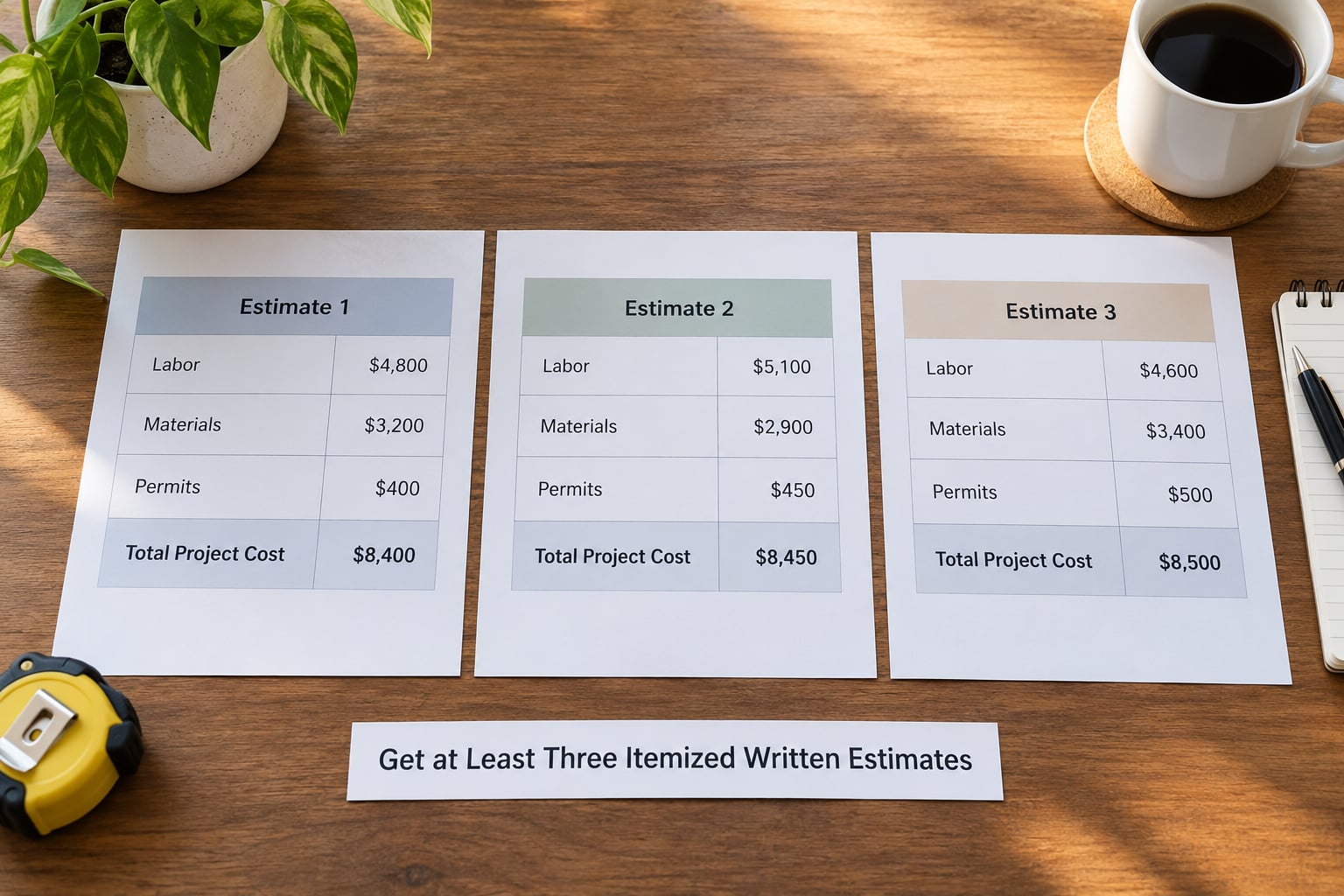
Line the three bids up row by row and compare the same categories: scope of work, labor hours or crew size, material grade and brand, allowances for what is not yet priced, permits and inspection fees, subcontractor list, start and completion dates, payment schedule, and warranty on labor and materials.
Two details cause most of the confusion. Allowances are placeholders — a plumbing allowance of a fixed amount means the final price moves when the actual fixture cost is known. Ask which allowances are likely to grow and how changes get approved.
The second is labor assumptions. Two bids can carry identical material lists and differ by thousands because one assumes a two-person crew for ten days and the other assumes a five-person crew for five days. Ask who is actually doing the work, whether they are employees or subcontractors, and who supervises.
A written overrun cap keeps everyone honest — a common term is that the final price will not exceed the estimate by more than a set percentage. Ask for it in writing rather than as a verbal reassurance.
5. Interview Contractors and Ask Questions That Reveal Reliability
Meet every finalist in person, at your property if possible. The interview is worth more than any advertisement, because you are screening judgment as much as paperwork.
- Who is my single point of contact for the whole job, and how fast do they return a call?
- Who supervises subcontractors daily, and are they your employees?
- What happens when work runs behind, and who tells me first?
- Who pulls the permits, and what does the inspection process look like?
- How do you handle a change I request mid-project, and what does it cost me?
- What safety practices protect workers, my property, and my family while the job runs?
- How is the site cleaned at the end of each day, and who removes debris?
- What is your warranty on labor, and which parts are the manufacturer’s responsibility?
- Who do I call if something fails six months after you have moved on?
- Have you ever walked away from a job mid-project, and what happened?
The answers to the last two tell you more than the first eight. A contractor who names a specific warranty contact and describes a real dispute from their history is showing you how they handle problems before you have one.
6. Use a Detailed Written Contract
No contract, no work. A document headed “estimate” or “authorization to proceed” is frequently a binding contract in disguise, so read what you are signing rather than what you assume you are signing.
Your contract should state the deliverables in plain language, start and completion dates, the payment schedule tied to milestones, who holds the permits, insurance requirements carried during the job, the warranty period on labor and materials, the procedure and cost for change orders, and a cancellation clause with a stated fee schedule.
Add an overrun clause, a lien waiver requirement, and a clause covering what happens if the contractor fails to show up or abandons the job. Any change to the scope or the price gets a written change order signed by both of you before the work happens. Verbal permission is how budgets quietly double.
7. Control Payments and Document the Completed Work
Pay deposits in the range contractors consider normal — commonly around ten to fifteen percent — and never the full project cost. Tying each subsequent payment to a completed milestone keeps leverage on your side for the whole job.
Be careful about paying for someone else’s materials up front. Money handed over before the goods are on site is money you have advanced to a stranger. Ask for lien waivers from each subcontractor as they are paid, because a lien filed on your property can outlast the dispute.
Keep every invoice, text, email and photo in one folder. Take dated photos at each stage, including the framing before anything is covered up. Walk the job weekly against the written scope and keep a punch list of incomplete items and defects, dated and signed. Final payment waits until that list is closed out.
Common Mistakes: The Warning Sign and the Fix
These come up repeatedly, and each one has a straightforward correction. The table pairs the signal with what it usually means and what to do next.
| Red flag | What it signals | What to do next |
|---|---|---|
| Asks for the full amount or payment in cash before work starts | Money is the goal, not the job | Decline, and check the business and license records by name before continuing |
| Will not provide proof of insurance, or hands you a certificate without a carrier phone number | Coverage may not exist | Call the carrier yourself and confirm the policy is active with named limits |
| Pressures you to sign today for a discount, or names you a selected demo project | A closing technique borrowed from high-pressure sales | Slow down. A legitimate contractor tolerates a week of deliberation |
| Refuses to sign a written contract, or offers only a phone agreement | Nothing is enforceable if the job goes wrong | Walk away, or have your own scope and contract drafted |
| Asks the homeowner to pull the permits | Shifts legal responsibility for the work onto you | Require the licensed contractor to be the permit holder of record |
| Bid far below everyone else with no line-item explanation | Missing scope, inferior materials, or a bid designed to add cost later | Ask for an itemized comparison and treat the gap as a question, not a bargain |
| No verifiable street address, or cannot produce three reachable references | Short-lived operation, or a subcontracted job | Check the business registry, then decide whether the risk is acceptable |
| Goes quiet after a deposit, or stalls on scheduling | The classic fly-by-night pattern | Send a written demand and move quickly to the licensing board and small claims options |
Two habits prevent most of these. Verify every credential yourself rather than accepting a document, and never let enthusiasm for the project’s outcome rush the paperwork.
Frequently Asked Questions
How can I tell if a contractor is legitimate?
Match the contractor’s legal business name and phone number with your state licensing board records, then confirm the license is current and belongs to the company or person who will perform the work. Next, call the insurance carrier listed on the certificate of insurance to confirm the policy is active. Finally, call three recent references from numbers you found yourself, not numbers on a business card.
Should I hire a licensed contractor?
Yes, where licensing is required for the work. A current license usually means the person met minimum training, exam and local qualification rules, and it gives you a board to complain to if something goes wrong. Where your state does not require licensing, shift your attention to verified insurance, permit history, real references and a physical business address.
How much should I pay a contractor upfront?
Most contractors expect a deposit in the range of ten to fifteen percent of the project total, which commonly covers mobilization and initial materials. Avoid any arrangement where a large share of the price is handed over before work begins. Safer structures pay a modest deposit, then release money against completed milestones, with a final payment held until the punch list is finished.
Is it risky to accept the lowest estimate?
The lowest offer is not automatically a bad deal, and it is not automatically trustworthy either. Compare every estimate using an identical scope, material grade, labor assumptions, permit responsibility, allowances and warranty terms. A bid far below the others often means missing line items, thinner materials, or a price designed to rise once work begins. Ask for the itemization and find out what is different.
What are the red flags when hiring a contractor?
Watch for pressure to sign immediately, a request for full payment or cash up front, refusal to provide proof of insurance, no written contract, a demand that you pull the permits, an unexplained bid far below competitors, a post office box instead of a street address, and going silent after a deposit. Any one of these is a reason to pause, and several together mean walk away.
What should I do if a contractor takes my deposit and disappears?
Send a written demand by email and certified mail that states the amount paid, the dates of contact, and what you expect, and keep a copy. Then file a complaint with the state licensing board and your state attorney general’s consumer protection office. If the contractor disputes the money rather than vanishing, small claims court is often the practical next step, and a local attorney can review lien risk on the property.
Conclusion
Start by writing the project down: scope, budget with a contingency, permits, and timeline. Then run every candidate through the same seven stages — credentials, identity and standing, references, three itemized estimates, an in-person interview, a detailed written contract, and milestone-based payment with documentation kept as the work proceeds. The first action costs you an evening and it is the one that decides whether the rest of the project goes smoothly. Verify everything yourself, compare written evidence rather than impressions, and sign nothing until the terms are clear on paper.