Selling a used car privately means handling the whole job yourself: valuing the vehicle, writing the listing, screening the people who show up, verifying their money and signing the title over. Most sellers who do it once say the extra work pays for itself, because a private sale usually clears more money than a trade-in offer. The catch is that the title transfer, the bill of sale and the post-sale notice to your DMV become your problem, not the dealer’s. Budget a couple of weekends and a phone full of messages, and expect the car to sell in three to six weeks rather than overnight.
Table of Contents
- What You Need for How to Sell a Used Car Privately
- Step-by-Step
- Prepare and Document the Vehicle
- Set a Competitive Asking Price
- How to Sell a Used Car Privately: Create the Listing
- Screen Buyers and Arrange Safe Viewings
- Negotiate and Verify the Payment
- Complete the Title Transfer and Handover
- Follow Up After the Sale
- Common Mistakes
- Frequently Asked Questions
- How much should I sell my used car for privately?
- Do I need a bill of sale when selling a car?
- Should I remove the plates before selling my car?
- What payment methods are safest for a private car sale?
- Can I let the buyer take the car for a test drive?
- What do I do if someone wants to pay with a cashier’s check?
- Conclusion
What You Need for How to Sell a Used Car Privately
Assemble these before you write a single line of the listing. Missing one item at the handoff is what turns a smooth sale into a dispute.
- Signed title in your name. Check the name on the title against your ID before anything else. A name mismatch stops the transfer at the DMV.
- Bill of sale. Some states supply a form, others do not. Write your own with the fields listed in the handover section below.
- Odometer disclosure statement. Required in most states and federally required for vehicles under 10 years old. Do it at the same time as the title.
- Lien release, if you still owe money. The lender holds the title until the loan is paid off.
- Service records and warranty documents. A thick folder of receipts does real work at the negotiating table.
- Current registration and proof of insurance. You need these for the test drive and the DMV filing.
- A phone that photographs well and a clean set of keys. Also a pen, a flashlight for the VIN, and a fuel card if you like the car handed over full.
One caveat before you go further: title transfer rules, sales tax thresholds, plate rules and inspection requirements are set state by state and change often. Treat everything below as the national process and confirm the last mile with your DMV.
Step-by-Step
Prepare and Document the Vehicle
Start by being honest with yourself about the condition, because buyers check. Walk around the car, photograph every scratch, dent and stain, and note anything mechanical you are unsure about. Fix only what is cheap and visible: a dead bulb, a cracked lens, worn wipers, low tire tread. Skip a full detail and spend that money on a prepaid inspection instead, which buys you protection when a buyer claims something is broken that isn’t.
Then verify the VIN on the dashboard matches the VIN on the title and the VIN on your registration. Mismatches mean stolen or rebuilt records, and no buyer will walk away from that alone. Resolve any lien now by calling the lender for a payoff quote, which is valid for about ten days.
Reddit sellers raise one point often enough that it is worth repeating: black out your home address on any document you hand over. Service invoices carry names, addresses and sometimes signatures, and those are exactly what an identity thief wants.
Set a Competitive Asking Price
Private-sale guides peg the usual discount at a few hundred dollars under the asking price, so set your number with room to negotiate and then hold it. Pull the value from at least two guides such as Kelley Blue Book, Edmunds or NADA, and compare them against live private-party listings for the same year, trim and mileage in your area. Live listings tell you what people are actually asking; the guides tell you what a dealer would call fair.
Adjust for the things buyers price hard: mileage, accident history in the vehicle history report, one-owner status, tire age, and whether the service records are complete. An older truck with 180,000 miles and a clean history can beat a lower-mileage sedan with three owners. Publish the number you want and note privately where your floor sits.
Decide firm or best offer before you list. Firm pricing filters out tire-kickers and saves you days. Best offer brings more messages but more lowballs, and in my experience the serious buyers all make a reasonable offer anyway.
How to Sell a Used Car Privately: Create the Listing
A listing is an advertisement and a screening tool at once, so write it for both. Twelve to fifteen clear photographs beat thirty dark ones: all four sides, the interior, the odometer, the engine bay, the trunk, and a close-up of every flaw. Natural light, an uncluttered background, no reflections of you in the paint.
In the text, lead with year, make, trim, mileage, drivetrain, transmission and price in the first two lines, because many people scan nothing else. Follow with the service history, the tire date, what the car does not do, and a sentence on why you are selling. Disclosing a fault costs you a little now and saves you a bad review or a claim later.
Post where serious buyers look: Facebook Marketplace and Craigslist for volume, CarGurus and Autotrader for buyers who want a dealer-style search. Run the same photos and copy everywhere, then delete every listing the moment the car sells. A duplicate live listing invites lowballs from people trying to pit you against yourself.
Never click a link a buyer sends you. The recurring trick on r/Scams and r/askcarsales is a buyer who needs a vehicle history report and sends a link that harvests your card details or installs something. Say plainly that you can provide the report yourself or that the buyer can buy their own copy. That ends the conversation fast.
Screen Buyers and Arrange Safe Viewings
Conversations start over the phone or platform chat. Ask the buyer their name, what vehicle they drive today and what they would use yours for. Real buyers answer. Scammers vanish or turn aggressive about logistics. Confirm they have a valid driver’s license and active insurance before you agree to a meeting, since an uninsured test drive puts your policy at risk.
Meet in daylight, in a busy public place, and never at your home. A bank parking lot, a big retail lot or a coffee shop forecourt with cameras gives you witnesses and an exit. Tell a friend the time, the location and the buyer’s name, and if you feel uneasy bring someone along. Several solo sellers, particularly women, say simply having another person present changed how the meeting went.
Wherever it happens, keep the same rule: the car does not leave with the buyer until the money is verified and the paperwork is signed. A request to drive it to a mechanic or to “send it to their shipper” is a possession grab with extra steps. Ride along on any extended test drive, keep it to fifteen minutes or so, and check the driver’s license matches the person standing in front of you.
Negotiate and Verify the Payment
Respond to offers with a counter and stay factual. Naming a recent repair you did not do, or a tire you replaced last month, is more persuasive than defending a number. People on seller forums consistently expect to end up a few hundred under the asking price, so plan for that and decide your floor before the negotiation starts.
Then take payment seriously. In rough order of risk for the seller:
- Bank or credit union transfer or cashier’s check, verified before handoff. The strongest option. Some buyers finance through a lender, and the lender’s check goes straight to you, which removes the buyer from the payment step entirely.
- Cash, in person. Fine under roughly 1,000 to 2,000 dollars. Count it in front of the buyer, in daylight, in public, and be ready to decline a larger all-cash deal.
- Instant peer-to-peer payments. Treat as a bank transfer only after the funds actually land in your account, not when the app shows a pending notification.
Never take an unsigned or unverified check as a deposit, and never hand over keys or a title against a promise to pay later. If a check bounces, recovering the car after you released it is a genuinely difficult fight.
Complete the Title Transfer and Handover
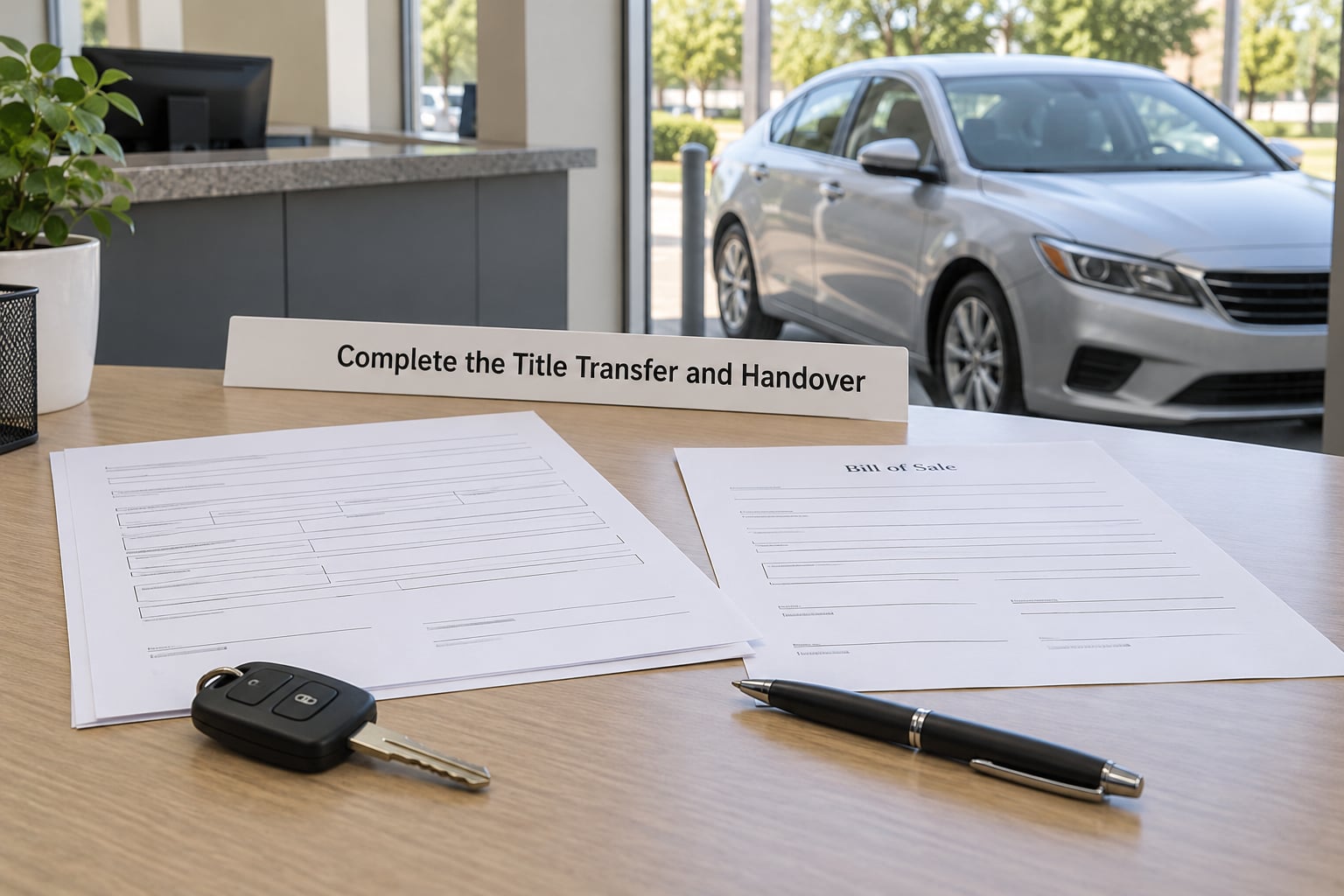
The order matters more than anything else you do. Confirm funds are cleared, then sign, then hand over, all in one sitting.
- Confirm the payment cleared. For a cashier’s check, call the issuing bank yourself using the number printed on the check, not the one your buyer gives you, and confirm the funds are actually available.
- Sign the title. Both of you sign in the correct boxes, with the date. Do not sign blank or pre-date it.
- Complete the odometer disclosure. Exact current mileage, the sale date and each party’s details.
- Complete the bill of sale. Date, both names and addresses, VIN, year, make, model, mileage, sale price, payment method, and an as-is clause stating the car is sold in its present condition with no warranty or guarantee.
- Hand over keys, plates and documents together once the above are done. If your state requires the plates to stay with the car, keep them on it.
- Give the buyer copies of the signed bill of sale, the odometer disclosure and their title application, and keep your own set.
Common bill of sale mistakes: leaving the odometer blank, leaving the as-is clause out, misspelling the buyer’s name so it fails to match their ID, and skipping the VIN. Those four cause most of the problems reported on seller forums. If your state sets a dollar threshold above which sales tax is collected, this paperwork is what proves the sale happened, so keep it for several years.
Buying at a bank together works well too. One buyer described completing the entire transaction at their credit union with a loan officer present, and other sellers endorsed the idea. A neutral location with a witness is easier to manage than a parking lot.
Follow Up After the Sale
Remove the listing everywhere the same day. Then handle the loose ends, and they matter more than most sellers expect because they are what protect you later.
- File a notice of sale or release of liability with your DMV. Many states have a deadline measured in days, and a few charge a small fee. This is the document that cuts your liability for the vehicle once it is in someone else’s hands.
- Cancel insurance on that vehicle once the sale is done, not before. Driving uninsured to sign paperwork is a real and avoidable risk.
- Handle plates per your state. Some states require them returned or removed, others let them travel with the car.
- Keep the signed paperwork for your tax records and for any dispute about tolls, tickets or accidents that arrive weeks later.
- Swap the plates onto your next car if your state allows it, and remember most states let you do that only after the sale is complete.
Common Mistakes
Most problems come from a handful of avoidable habits. Here is the fix for each one.
Overvaluing. Sellers who never look at live private listings watch their phone for weeks. Check ten real cars in your area with the same year and mileage before you commit to a number.
Hiding defects. Every undisclosed flaw is a negotiation weapon later. Photograph and disclose, and write the as-is clause.
Publishing too much personal information. Use a marketplace message thread instead of publishing your phone number in the ad, and keep your home address off every document.
Accepting questionable funds. An overpayment or refund scam arrives as a certified check with a request to send the difference back. It is fraud, every time. Unsolicited checks in the mail are the same trick in slower motion. Decline and walk away.
Skipping the bill of sale. Without it you have no written record of the price, the mileage or the as-is condition, which is exactly what you need if the buyer brings a complaint weeks later.
Removing plates where it is not allowed. Rules on keeping or returning plates vary, and putting a for-sale sign on a street where it is banned can earn a ticket. Check the local rules once.
Signing the title before money clears. This is the one that really hurts. Once the buyer has a signed title, your leverage is mostly gone.
A few habits that smooth the rest: fill the tank before the handoff so it is not your problem, photograph the odometer and the signed paperwork together, and keep every message with the buyer in case the buyer keeps none.
Frequently Asked Questions
How much should I sell my used car for privately?
Start with two value guides such as Kelley Blue Book or Edmunds, then compare them with live private-party listings for your year, trim and mileage in your own area. Expect the final price to land a few hundred dollars under your asking price. Adjust for accident history, tire age, one-owner status and complete service records.
Do I need a bill of sale when selling a car?
Most states require one or strongly expect it, and it is your written proof of the sale. It should record both names and addresses, the VIN, the year, make and model, the exact mileage, the sale price, the payment method and the date. Add an as-is clause stating the car is sold in its present condition with no warranty.
Should I remove the plates before selling my car?
It depends on your state. Some require plates to stay on the car and travel with it, some require you to remove them, and a few let you keep them and use them on a newly purchased vehicle. Getting it wrong creates a registration problem for the buyer. Check your DMV rule before the handoff rather than guessing.
What payment methods are safest for a private car sale?
A bank transfer or cashier’s check verified with the issuing bank is the safest, because the money is committed before you release the car. Cash works well under roughly 1,000 to 2,000 dollars if you count it in public. Peer-to-peer payments count only once funds have actually landed. Never release keys against a personal cheque or an unverified deposit.
Can I let the buyer take the car for a test drive?
Yes, but keep it short, local and daylight. Confirm the buyer holds a valid licence and active insurance, photo their licence, meet in a public place and ride along. Do not let them take the car alone or drive it to a mechanic, because that is the usual pretext for keeping it. Cancel insurance on that vehicle only after the sale closes.
What do I do if someone wants to pay with a cashier’s check?
Treat it as cash only after verification. Confirm the buyer’s identity and the check’s bank, then call that bank yourself on a number you look up independently, and ask whether the funds are available. Some counterfeit checks take days to clear and then bounce. Do not sign the title or hand over keys until the bank confirms.
Conclusion
Two things decide whether this goes well: confirm you legally own the car with a clean title, and know what the car is actually worth before you publish a number. Do those first, then work through the handover in order.
Your start-here checklist: title in your name and VIN matching, lien resolved or payoff quote in hand, service records gathered, value set against ten live local listings, photos taken including every flaw, listing live on two platforms. Then meet in daylight, verify the money first, sign everything second, and file the notice of sale with your DMV as soon as you are home.