Dashboard warning lights are color-coded symbols on your instrument cluster that signal a problem with a vehicle system or tell you a feature is active. Learning how to read the warning lights on your dashboard takes about five minutes, and the answer is usually in your owner’s manual or in a code your car’s computer already stored. Red means stop driving as soon as you safely can, amber means a problem is developing, and blue or green usually just tells you something is switched on.
The color rule is the whole system in four lines:
- Red — danger now or a major system has failed
- Amber or yellow — a developing problem, drive carefully and get it looked at
- Blue, green or white — information, or a feature you switched on
- Flashing — worse than solid, almost always means stop
Everything below builds on that. Note the color your light actually is, not the color in a photo you found online, because the same system can change shade between model years and manufacturers.
Table of Contents
- What You Need
- Step-by-Step
- How to identify the color and symbol
- How to match the light to your car’s manual
- What to do when a red warning light appears
- What to do when an amber or yellow light appears
- How to read the trouble code with an OBD2 scanner
- How to check simple causes safely
- When to turn off the engine or stop driving
- Common Mistakes
- Frequently Asked Questions
- Is it okay to drive with the check engine light on?
- Why is my check engine light on but everything seems fine?
- How long can I drive with a check engine light on?
- Why are all my dashboard lights on at once?
- When should I go straight to a mechanic?
- Conclusion
What You Need
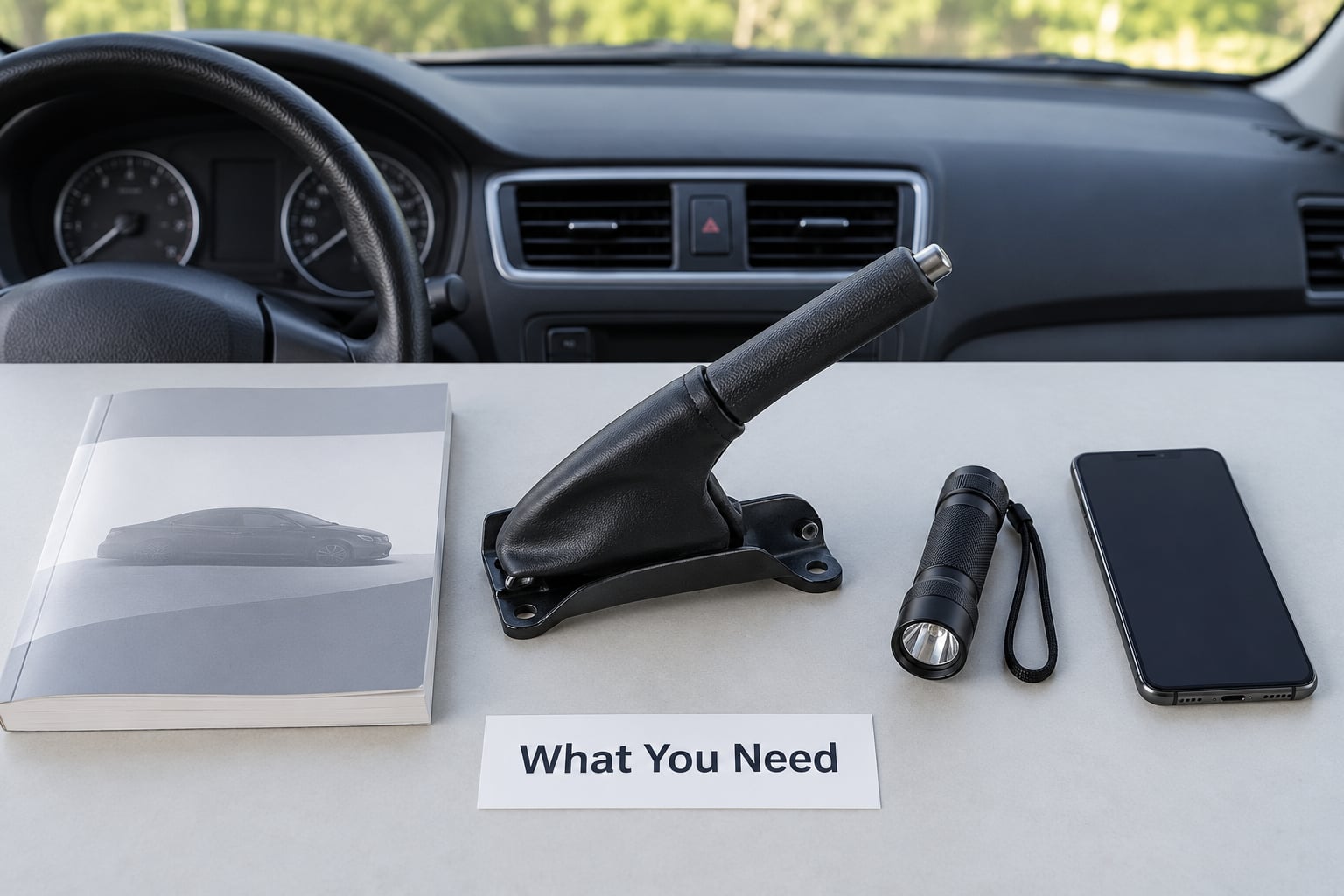
You need four things, and three of them are free.
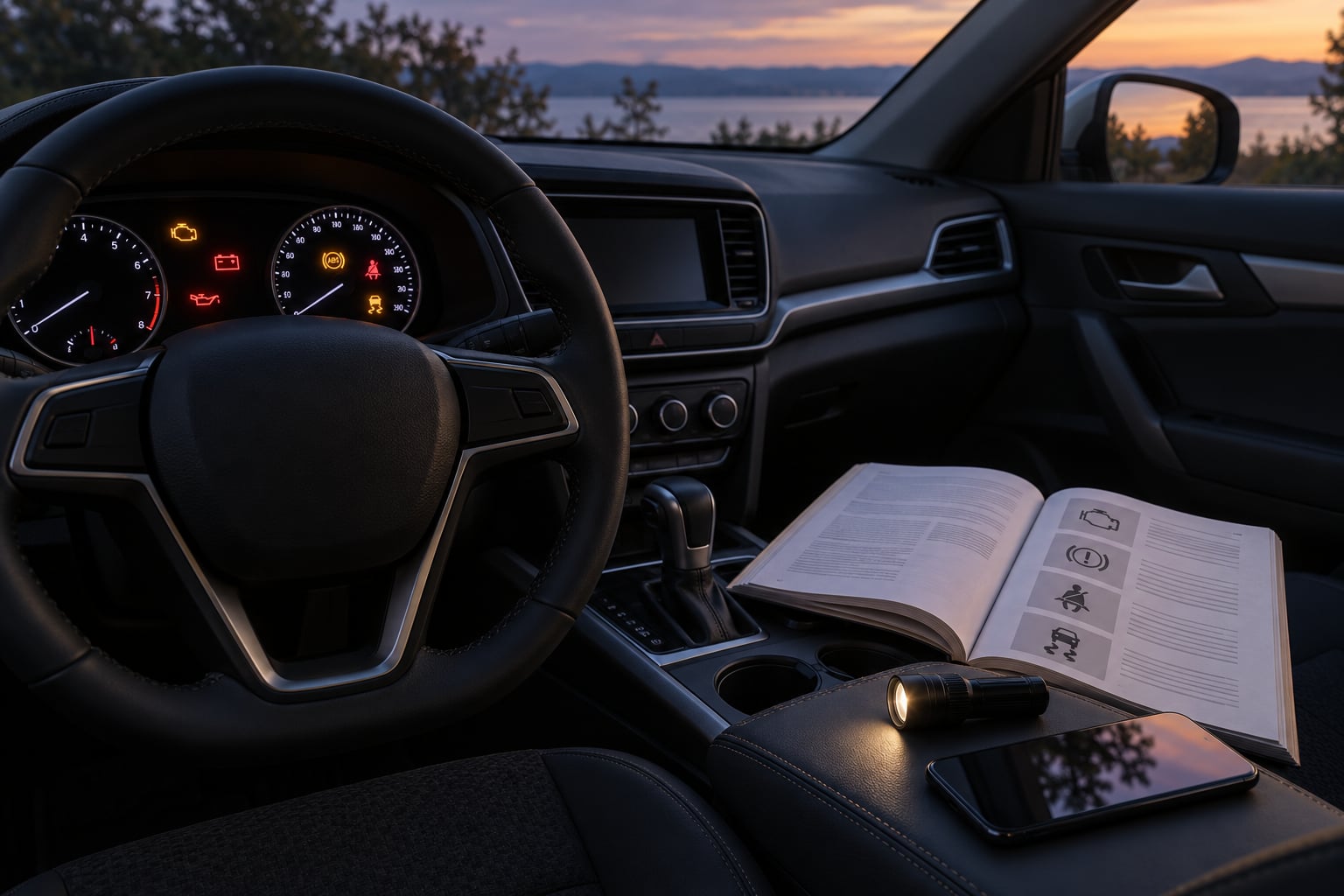
- The owner’s manual for your exact vehicle, or the symbol chart printed inside the fuel door or glove box. Year and model matter, so a chart from a different car is a guess.
- A safe place to stop. A parking lot, a wide shoulder, or your driveway. Turn on your hazard lights if you are stopping in traffic.
- A phone, for a photo of the symbol and a quick search on the make and model. Photos beat squinting at a backlit cluster in daylight.
- A flashlight and basic tools — a tire pressure gauge, a rag, a socket set for a bulb change if your car uses accessible bulbs.
If you plan to read trouble codes yourself, add an OBD2 scanner. Many auto parts stores will lend you one at the counter for free, and you can buy a decent one for the price of a takeaway meal.
Step-by-Step
How to identify the color and symbol
Start with color, because it narrows the field faster than shape. Red symbols sit in the same cluster across most makes and usually mean a system has lost the ability to protect you or the engine. Amber symbols are polite reminders: the car is still working, but something is off. Blue and green mean a driver-assistance feature, cruise control, or your lights are on.
Shape comes second. A circle with a squiggle through it, or the outline of an oil can, is the oil pressure light. A thermometer over a wavy line is coolant temperature. A circle containing the letters P, R, N, D or an E is the automatic transmission indicator, and it is not a warning. Once you can name the shape, the manual’s symbol chart becomes a five-second lookup instead of a guessing game.
How to match the light to your car’s manual
Turn to the warning light section of the manual and use three filters in order: the shape of the symbol, the color, and the page’s description of the system. Related systems sometimes reuse colors in ways that surprise people. On some vehicles the anti-lock braking system light is amber while on others it is yellow or red, and on plenty of cars a red brake warning light means the parking brake is engaged rather than that the brake fluid is low.
Manual groups also tell you the conditions that trigger the light, which is the part people skip. The oil pressure light has a pressure range below it, the tire pressure monitor icon says to check the spare too, and the check engine page tells you whether your particular car uses the engine-shaped icon or the words CHECK ENGINE.
What to do when a red warning light appears
Pull over safely, switch off the engine if the manual says to, and treat the light as the most urgent item on your list. These are the red ones and what each one is telling you.
- Brake system — either the parking brake is still on, or brake fluid is critically low or the pressure system has failed. Check the parking brake first. If it is off and the light stays on, do not drive.
- Oil pressure — the engine is not being lubricated. A few extra seconds to circulate oil won’t ruin anything, but minutes at idle can. Switch off and check the dipstick.
- Engine temperature — the coolant is too hot or the level is low. Stop, let it cool, and never open the radiator or coolant cap while it is hot; the pressure releases scalding fluid.
- Battery or charging — the alternator or the battery connection has failed. The car will run for a while on stored charge, then stop. Turn off accessories and drive directly to a safe place.
- Tire pressure — on many cars this light is red, not amber. A tire far below its door-jamb pressure can fail without warning. Stop and check.
- Airbag or SRS — the restraint system has a fault. Drive carefully to a shop. If you have had a crash and the light came on, get the car checked before anyone rides in the front seats.
Red and flashing is the emergency tier. A flashing check engine light almost always means the engine is misfiring, which sends unburned fuel into the catalytic converter and can destroy it. Drivers on owner forums consistently say the same thing: shut it down and deal with the ignition coils, spark plugs or plug wires before driving again.
What to do when an amber or yellow light appears
Amber means the car has a plan for the problem and is following it. In many vehicles the computer limits power or skips fuel to protect the engine, which is why fuel economy drops and the car feels softer than usual.
- Check engine, solid — a fault has been stored. The engine usually runs fine, and the light can stay on for hundreds of miles. Not an emergency, but not something to ignore either.
- Check engine, flashing — active misfire. Stop driving.
- Tire pressure monitor — one or more tires is outside the range the sensor expects. A slow leak, cold temperatures, and a tire that is 3 psi under all count.
- Anti-lock braking system — the ABS self-test failed or a wheel speed sensor is off. Normal braking still works, but the anti-lock function does not, and the light stays on until you fix it and clear the code.
- Traction control or stability assist — usually momentary. The light flickers on wet roads and goes out on its own. If it stays on, a wheel speed sensor or brake pad wear sensor is the usual suspect.
- Power steering — the assist is reduced or gone. The car is heavier to steer and you should avoid heavy traffic until it is checked.
- Maintenance or wrench icon — an oil life or service interval reminder. This is a calendar, not a fault, and many cars let you reset it from the trip computer once the work is done.
Diesel drivers see two more: a glow plug indicator that is normal during startup and turns off when the plugs are hot, and a diesel particulate filter warning that means the filter is loaded and needs a proper regeneration drive, not a slow idle crawl.
How to read the trouble code with an OBD2 scanner
The light on your dash tells you the category of the fault. The code tells you which part. Every gasoline car sold since the mid-1990s has an OBD2 port, usually under the steering wheel or near the center console, and reading it is a five-step job.
- Park the car and turn the ignition on, usually one or two clicks without starting the engine. Leave the engine off unless your scanner needs it running.
- Find the port. It is a rectangular socket, about the size of a phone, with 16 pins. Check under the dash on the driver’s side, the lower center console, or beside the glove box.
- Plug the scanner in. Most units confirm connection with a beep and a green light, and they read codes automatically. Phone apps work the same way over Bluetooth.
- Read and write down the codes before you touch anything. Stored codes are marked as past or confirmed; pending codes have not failed twice yet.
- Look them up by number. A code beginning P is a powertrain code, U is a network or module code, B is a body code, and C is a chassis code. Free lookup tables cover the common ones.
A handful of codes come up again and again: P0300 and P0301 through P0304 for misfires on specific cylinders, P0420 for catalytic converter efficiency, P0171 for a lean mixture often traced to a vacuum leak or a dirty mass airflow sensor, and P0455 for a loose or failed gas cap. Codes describe a symptom. They do not tell you which part to buy.
How to check simple causes safely
Several common faults have a free fix that takes a minute. With the car off and cool, look at the fuel gauge, open the fuel door and check the cap is present and clicks tight, walk around the tires and look for a nail or a sidewall bulge, pull the oil dipstick and confirm the level sits between the marks, and check the coolant reservoir between the minimum and maximum lines without lifting the cap. A loose gas cap is the single most reported check engine cause in owner threads, and topping up oil or washer fluid accounts for plenty more.
Then note whether the light returns. Clear the codes, restart the engine, and drive for fifteen minutes. If the same light comes straight back, the fault is real and the light was never going to be the diagnosis.
Keep your hands off anything hot, pressurized or secured under a guard. Do not open a cooling system cap on a warm engine, and do not pull a coolant or power steering reservoir off a running engine to look at it. Those are the two ways a simple check turns into a burn or a hose rupture.
When to turn off the engine or stop driving
Stop driving now, pull over where it is safe, and switch the engine off when any one of these is true.
- Any red warning light stays on once the car is moving and settled.
- The temperature gauge climbs into the red or you smell hot coolant under the hood.
- Steam, smoke or a sweet burning smell appears, or fluid is pooling under the car.
- The brake pedal travels further than usual, feels soft, or the brake warning light comes on with the parking brake released.
- The steering feels heavy or vague, or the car pulls hard in one direction.
- Any warning light flashes instead of holding steady.
- The check engine light is on and the car is shaking badly, running rough, or losing power.
A solid check engine light on an otherwise smooth-running car is the exception. That one you can drive home and book a diagnostic, but drive it gently and get the code read before the deadline on your registration or emissions test catches up with you.
Common Mistakes
Ignoring a red light because the car still moves. The car will move for now, which is exactly the problem: it keeps moving until the failure becomes expensive. Oil pressure and coolant temperature failures take minutes, not days. Pull over.
Assuming every icon means the same thing in every car. A red TPMS light on one model is an amber light on another, and some cars show a maintenance wrench where others show a little car on rollers. Use the manual for your year and model, not a listicle.
Opening the radiator cap to look at the coolant while the engine is warm. The system is pressurized. The cap can come off in your hand and the release is hot coolant. Check the reservoir sight glass cold instead.
Replacing parts without reading the code. Owners regularly buy an oxygen sensor, a mass airflow sensor or a battery before reading anything, and the light comes back within weeks. Read the code first, then look at what the code points to.
Clearing the light and calling it fixed. Clearing a code erases the evidence. It does not repair anything, and some cars run a drive cycle before the monitor will set again, so the light can look fixed for a day and return tomorrow. Fix the cause, then clear.
Driving on through overheating or brake symptoms. Overheating warps cylinder heads and burns coolant, and a brake problem that gets worse while you are driving at highway speed is the most dangerous fault on this list.
Panicking when every light comes on at once. Owners on model-specific forums report the same pattern repeatedly: the whole cluster lights up, the gauges go dead, and it turns out to be a blown fuse or a loose ground behind the instrument cluster, not twenty failing systems. If the lights come on during startup and clear after a restart, that is your first suspicion.
Two habits pay for themselves. Read the code before you clear it, so you can describe the fault to a mechanic instead of saying the light came back. And when the scanner reads no codes while the dash is full of warnings, the light is often coming from a body or network module rather than the engine, so have a shop look at it rather than assuming you have a free pass.
Frequently Asked Questions
Is it okay to drive with the check engine light on?
A solid check engine light on a car that runs smoothly is usually fine for a short trip to a shop or an auto parts store. It means the engine stored a fault and turned on the malfunction indicator lamp. A flashing check engine light is not fine: that is an active misfire, and continuing can destroy the catalytic converter. Stop the car. Also stop if the light comes on alongside shaking, power loss or a temperature warning.
Why is my check engine light on but everything seems fine?
A warning light reports a reading outside the expected range, not necessarily a failure you can feel. A loose gas cap, an infrequent oil change that clogged a control valve, a vacuum leak or an aging sensor can all set the light while the car drives normally. Owners report this constantly. Read the code, fix the free things first, and only buy parts once the code tells you where to look.
How long can I drive with a check engine light on?
Treat a solid light as a scheduling problem rather than a safety emergency, because the engine is usually in a protected mode. Do not treat it as a reason to wait. Emissions tests and registration renewals fail while a code is stored, so the deadline usually arrives before the light goes away on its own. Read the code this week, fix it, and clear it before you renew anything.
Why are all my dashboard lights on at once?
When the entire cluster illuminates, including the gauges going dark, the cause is usually electrical rather than twenty separate faults. Think a blown fuse, a loose battery ground, a recently disconnected battery, or a cluster connector that lost contact. It often clears after a restart, which is why owners focus on the fuse box. Rule out the fuse and ground before paying anyone to diagnose twenty systems.
When should I go straight to a mechanic?
Go directly when the light is red, when it flashes, when the engine is shaking or overheating, when the steering or braking feels different, or when you smell burning. Also go straight if a body or network code is stored, since a parts-store scanner often shows no engine codes while the dash stays full of warnings. Read the code wherever you can first, because it saves a diagnostic fee and tells the shop where to start.
Conclusion
Read the color first, then the shape, then the manual. Red means find a safe place to stop, amber means book a look, blue and green mean a system is switched on. Flashing beats solid on the urgency scale every single time.
Photograph the symbol while it is lit, read the stored code with an OBD2 scanner if there is one, and check the four free things before spending money: fuel cap, oil level, tire pressure and visible leaks. If the light returns after those, that is the moment to see a mechanic, and taking the code with you is the cheapest insurance there is.
And never talk yourself past a red warning, a temperature needle in the hot, a soft brake pedal or smoke. Those four are not opinions, and the car does not care what you have scheduled that afternoon.