
To transfer a car title to another person, the registered owner signs the certificate of title in the seller’s box, gives the buyer a bill of sale, and the buyer files the signed title with a state title transfer application, proof of insurance and ID at the DMV or county office.
That paper is the only proof of legal ownership, so until it changes hands the vehicle is still yours in the state’s eyes. Sign it over carelessly and you can still be on the hook for tickets, tolls and accident claims long after the car is gone.
Here is the whole process in order, plus what to do when a loan is still open, when the buyer lives in another state, and when the names on the title do not match anyone’s ID.
Table of Contents
- What You Need Before You Start
- How to Transfer a Car Title to Another Person: Step by Step
- How to Transfer a Car Title to Another Person in Your State
- How to Transfer a Car Title to Another Person When a Loan Is Open
- Get the Buyer’s ID, Bill of Sale and Proof of Insurance Ready
- Sign and Complete the Title Correctly
- Complete the State Title Transfer Application
- Submit the Signed Title to the DMV or County Office
- Receive the New Title and Finish Registration
- Common Mistakes That Get Applications Rejected
- Frequently Asked Questions
- Can I transfer a car title to someone in another state?
- What happens if there is a lien on the vehicle?
- Do both the buyer and seller have to be present?
- What if the names on the title do not match the ID?
- How long does a car title transfer take?
- Should I file the title transfer before or after the vehicle inspection?
- What to Do First
What You Need Before You Start
Assemble the paperwork before you meet the buyer, not after. Exact requirements vary by state, and the state agency is the only authority on its own forms.
| Document | Who signs it | When it is required |
|---|---|---|
| Certificate of title | Seller, and every owner listed | Always |
| Bill of sale | Seller and buyer | Most states; required by some as proof of price |
| Odometer disclosure | Seller | Required on vehicles under a certain age or exempt on older ones, by state |
| Title transfer application | Buyer | Always; form name is state-specific |
| Photo ID | Buyer | Always; some states accept a passport or consular document instead of a state license |
| Proof of insurance | Buyer | Usually required before registration |
| Lien release | Lienholder | Only if a loan or lien still shows on the title |
| Gift affidavit or gift transfer form | Seller | Only for a family or qualifying gift |
| Inspection or VIN verification certificate | Buyer | Some states, often when the vehicle comes from out of state or out of the country |
Have copies of everything. The agency keeps the original title, and if the application is rejected you want to be able to rebuild the file without starting over.
How to Transfer a Car Title to Another Person: Step by Step
How to Transfer a Car Title to Another Person in Your State
Start at your state’s official motor vehicle agency site, not a third-party title service. Form names and numbers are state-specific: Texas uses the 130-U, Pennsylvania uses the MV-13ST, Florida uses the 8050, and many other states use their own numbered title application.
Check four things before anyone signs anything.
- Whether the transfer is filed with the state DMV or with a county tax assessor-collector or county clerk. In a handful of states, the county handles it.
- Whether an appointment is required or whether the office takes walk-ins.
- Your deadline. Many states expect the buyer to apply within a set window after the sale, and Washington, for example, treats failure to apply after an initial deadline as escalating beyond a civil penalty.
- What the office accepts as payment. Card, check, money order and cash rules differ enough that people get turned away for the wrong method.
The short version: match the VIN and name, clear any lien, sign and bill of sale, file the state application with fees, then register and insure in the buyer’s name before the car is driven. Get those details right and the process usually takes one visit.
How to Transfer a Car Title to Another Person When a Loan Is Open
A lienholder’s name on the title is the most common reason a simple private sale gets complicated. The buyer cannot take clean title until the loan is closed and the lienholder releases its claim.
The usual path: pay off the loan and get the lienholder to release the lien on the title face, then sign the title. Some lenders instead issue an Electronic Lien and Title record, which means the release happens in their system rather than on paper, and you may need a printed lien release to give the buyer.
If there is a prepayment penalty left on the loan, settle that before the handoff. Users on Reddit’s r/DMV threads describe the same pattern repeatedly: the payoff quote changes if they wait even a few days, so get the final amount in writing on the same day you intend to close.
Get the Buyer’s ID, Bill of Sale and Proof of Insurance Ready
The buyer should arrive with a valid photo ID, the signed bill of sale, and evidence of coverage in their own name. Insuring the car before the transfer is finished is what keeps the driving legal during the gap between signing and the new registration arriving.
A bill of sale is the buyer’s receipt and the seller’s proof of the transaction. It usually wants the purchase price, the date, both names and signatures, and the VIN. For a gift instead of a sale, write the gift value as zero and attach the gift form where the state requires one.
Sign and Complete the Title Correctly
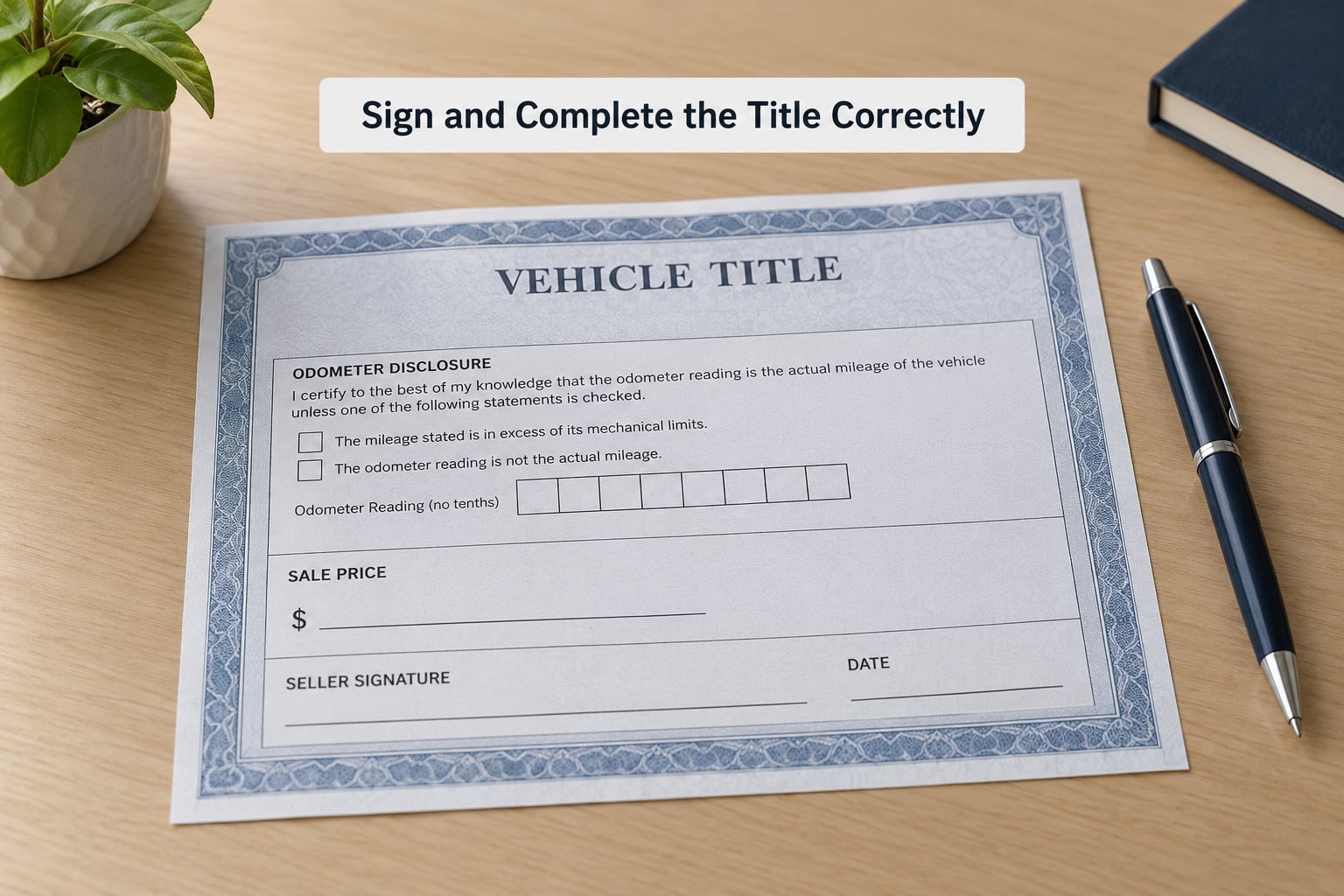
Sign in the box labeled for the seller, and only that box. Buyer signature lines belong to the buyer, and a seller who signs those too creates a mess rather than a shortcut.
Use the ink color the state accepts, which is usually black or blue, and write the buyer’s full legal name, matching their ID, the date of sale, the sale price and the odometer reading. If two owners are listed and the names are joined by “and,” both must sign.
Never use correction fluid, never erase, and never cross out a field. A corrected title usually has to be replaced through the issuing state with a new or duplicate title, which costs more time and more paper than getting it right the first time.
Ohio users on Reddit describe the simplest version of this step: fill in the transfer information on the back of the title and take it to the BMV. Pennsylvania users, by contrast, report that every person named on the title must appear in person with valid ID and an insurance card, so the presence rule is worth checking before the meeting.
Complete the State Title Transfer Application
The application is where the buyer, not the seller, takes responsibility. It asks for the buyer and seller details, the odometer disclosure, the sale price or the gift statement, and the date, and it is the document that triggers the tax and fee assessment.
Sales tax is usually calculated on the purchase price or on the state’s assessed value, whichever is higher. Gifts and inheritance follow different paths, and many states charge a flat fee instead of tax when a vehicle changes hands for no money, provided the transfer qualifies as a family gift.
A few states require notarization of the seller signature, and some require a power of attorney when a parent handles a transfer for an adult child or a minor. If you are assembling documents before the deal is final, check that the form you filled out is the current version, since states revise them.
Submit the Signed Title to the DMV or County Office
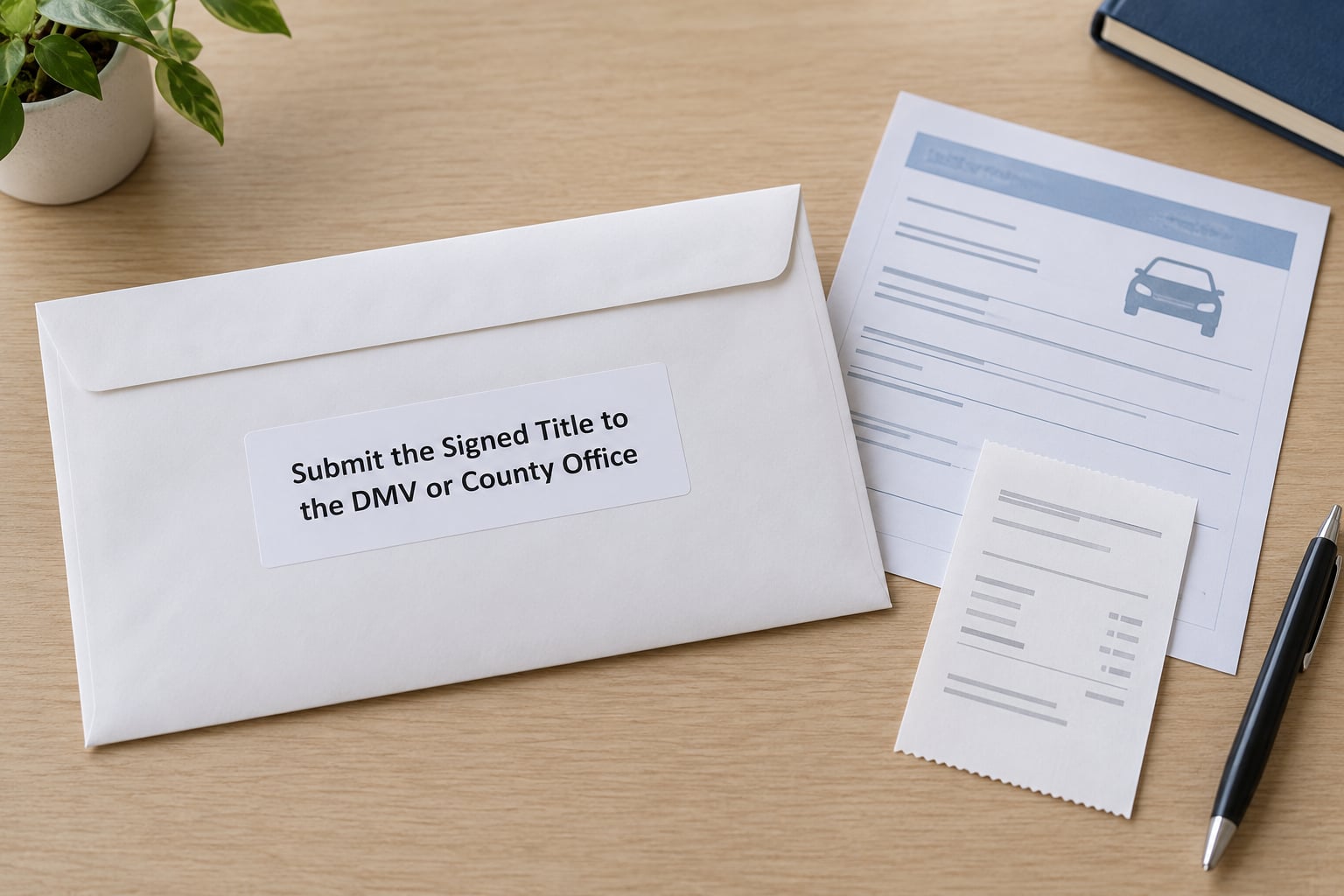
Submit in person, by mail, or online where the state allows it. In-person counter service is the best option when anything is uncertain, because a clerk can spot a missing signature or a lien before you leave.
Mail and online submissions mean the original title leaves your hands, so photograph every page first and keep the bill of sale. What you want back is a receipt or stamped copy showing the application was received, which becomes your proof of filing date if the buyer stalls.
Dealer-assisted transfers are a separate path: when you buy from a licensed dealer, the dealer normally handles the paperwork with the state, and you receive the vehicle with plates or a temporary tag already in process.
Receive the New Title and Finish Registration
New titles are often mailed to the vehicle address on file, so confirm the buyer has that address right. Delivery commonly takes a few weeks by mail, and some offices issue a temporary registration document in the meantime.
Pay any remaining taxes and fees by the state’s deadline, since late filing penalties accumulate monthly in many states and can eventually exceed the transfer fee itself. Then update your insurance records, your DMV profile and, if you were the registered owner, your tax and toll accounts.
Sellers should also close out anything tied to the old registration: remove the plates if the state requires it, cancel toll tags, and note the date of sale so tickets arriving later can be matched to the new owner.
Common Mistakes That Get Applications Rejected
Counter rejections are almost always about one of a handful of details. Most are visible in seconds once you know what to look for.
| Mistake | Why it happens | The fix |
|---|---|---|
| Signing before the price is settled | Sale price and odometer fields are blank or guessed | Agree on price and payment terms first, then complete the title in one sitting |
| Name on title does not match the ID | Misspelling, a nickname, or a name change after marriage | Use the exact legal name from the ID; if the owner name itself is wrong, fix that first with a name-change application |
| Missing lien release | The loan was paid off but the lienholder never released it | Get a lien release from the lender before the buyer applies, or expect a hold |
| Odometer disclosure skipped or wrong | Owner assumed it was optional | Complete it on the title and the application; states compare the two figures |
| Correction fluid or crossed-out fields | A small error fixed at the kitchen table | Start over with a clean title; never alter the document |
| Taxes and fees unpaid | Transfer filed but the balance not settled by the deadline | Pay online or at the office before the penalty period starts |
| Driving before registration and insurance are active | Buyer picks up the car the same day | Insure first, then drive; an insurance card or digital policy should be in the car |
Two habits prevent most of this. Fill out every field, including the ones you think do not apply, and photograph the completed title and application before anyone leaves the parking lot.
Frequently Asked Questions
Can I transfer a car title to someone in another state?
Usually the vehicle is titled first in the state where it currently sits, then registered in the buyer’s new state. Most states give a short grace period and temporary tags, and a few require an out-of-state title or a VIN inspection before registration. Check the new state’s rules before the trip, because the inspection requirement decides whether the car can be driven home legally.
What happens if there is a lien on the vehicle?
The buyer cannot receive a clean title until the lienholder releases the lien. Pay the loan off, obtain a lien release, and either the lienholder or the buyer removes the lien entry before filing. Many lenders use Electronic Lien and Title, where the release is recorded electronically and a printed authorization may still be needed. Paying off the loan does not release the lien by itself.
Do both the buyer and seller have to be present?
It depends on the state. Some offices let the buyer file alone with the signed title, bill of sale and the seller’s copy already signed. Others, including Pennsylvania in many cases, require every person named on the title to appear with ID and proof of insurance. Handling how to transfer a car title to another person safely means checking the presence and notarization rules for your state before you meet.
What if the names on the title do not match the ID?
If the buyer’s name is misspelled on the title, get a corrected or duplicate title from the issuing state rather than writing a new name in the buyer box. If the owner’s own name is wrong, that is a name-change application rather than an owner change, and the two are handled by different forms. Minor differences in middle names or suffixes are often accepted but can be flagged, so bring the ID to the counter.
How long does a car title transfer take?
An in-person appointment often finishes the same day, with a temporary registration issued on the spot. Mailed applications commonly take a few weeks, and the new certificate of title is usually mailed to the vehicle address, which adds more time. Allow extra days if a lien release, notarization, an inspection certificate or a corrected title is involved, since each of those pauses the file.
Should I file the title transfer before or after the vehicle inspection?
File the transfer application once you have the inspection or VIN verification certificate in hand, if your state requires one. The clerk will usually ask for it with the title application, and trying to file first means a second trip. The order that matters most is insurance first, then inspection, then the title application, then registration plates and tags before the car is driven.
What to Do First
Open your state’s official motor vehicle agency page and download the current title transfer application and fee schedule. That single step tells you which form to fill out, whether the county or the state handles it, and what the deadlines and taxes will be, since those figures change often and vary by state.
Everything after that follows from the first document: match the VIN and names, clear the lien if there is one, sign the title once, hand over a bill of sale, and file before the deadline with insurance already in the buyer’s name.