If an airline cancels your flight, you are entitled to a full refund to your original form of payment — even if you bought a ticket labelled nonrefundable — or free rebooking on another flight, and the choice is yours to make. The catch is that almost nothing happens unless you ask. Refunds are not automatic, and the first person who will offer you a voucher instead is usually trying to save the airline money, not you.
So what to do when an airline cancels your flight comes down to order and speed. When a weather event or a crew shortage hits, phone queues fill within minutes and hotel rooms near the airport sell out fast. Work through the steps below in sequence and you will be in front of the problem instead of queueing behind it.
One warning before we start: passenger rights depend on where your flight departs from, who operates it, and why it was cancelled. The United States rules, the European rules and the Canadian rules do not say the same thing. This guide explains how the common situations work so you know what to ask for, but treat it as general information rather than legal advice.
Table of Contents
- What You Need
- Step-by-Step: What to Do When an Airline Cancels Your Flight
- 1. Confirm the cancellation before you leave home
- 2. Check whether the airline already changed your itinerary
- 3. Contact the airline immediately
- 4. Decide between a replacement flight and a refund
- 5. Get everything in writing
- 6. Protect the parts of the trip that cannot wait
- 7. Save receipts and check what you can claim
- 8. Escalate when the airline does nothing
- Common Mistakes
- Frequently Asked Questions
- Am I automatically entitled to a refund when my airline cancels?
- Can I refuse a replacement flight after my flight is canceled?
- Will the airline pay for my hotel, meals, or another ticket?
- Should I buy a new ticket before contacting the airline?
- How long does an airline cancellation refund take?
- What if the airline cancels my flight and offers no alternative?
- Conclusion
What You Need
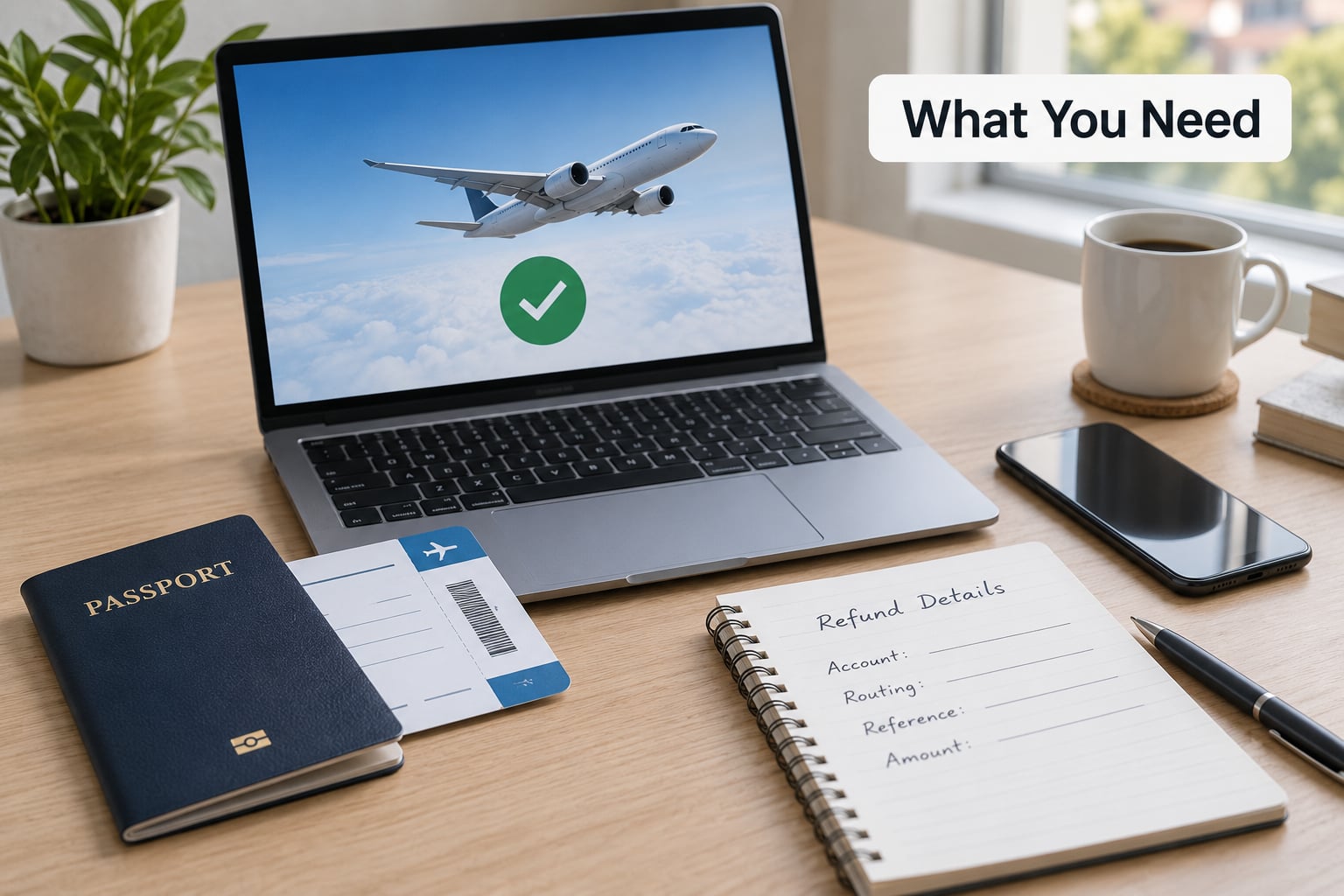
Gather these before you start dialing, because every minute you spend looking for a booking number on hold is wasted time.
- Your booking reference. The six-letter record locator appears in your confirmation email and in the airline app. It is the fastest way for an agent to pull your reservation.
- The original confirmation email. Keep it open on your phone. It shows what you paid for and how you paid, which matters later if you dispute anything.
- The full itinerary. Every flight number, connection city and date, including your return leg. A cancellation on one segment can quietly break the rest of the trip.
- ID and your payment method. Keep the card you paid with within reach so a refund can go straight back to it.
- Screenshots. Capture the cancellation message, the app status screen, and any chat or email from the airline. Take them before you close the app.
- Your passport or ID. Useful if you get rebooked onto a partner carrier or need to fly out of a different airport.
- Pen and paper, or a notes app. You will be given a new booking reference, a voucher number or a case number. Write it down as you receive it.
Step-by-Step: What to Do When an Airline Cancels Your Flight
1. Confirm the cancellation before you leave home
Open the airline app or manage-booking page and look at the status of each segment. A cancelled flight usually shows the word cancelled, a struck-through flight number, or a message telling you to contact the carrier.
Check the app and the website, then compare both against the original email. If they disagree, trust the airline’s own system over a third-party booking site, and note the disagreement in case you need to raise it later.
Write down the exact wording of the notice and any reference number in it. That single line of text becomes your proof if the airline later claims the cancellation was a delay, not a cancellation.
2. Check whether the airline already changed your itinerary
Plenty of passengers never notice the swap. The airline quietly moves you to a different flight, sometimes with a twelve-hour layover in a city you never wanted to visit, and treats it as a favour.
Look at every segment, not just the first. If you booked a round trip and the outbound was cancelled, check whether the return leg still exists. That trap comes up constantly: passengers rebook their way home themselves and then find the airline refusing to refund or cancel the unused return segment. Ask about it directly, in writing.
If the airline’s version of your itinerary no longer matches what you booked, the change was involuntary, and that distinction shapes every option that follows.
3. Contact the airline immediately
Pick the channel that matches your situation. The app and website suit straightforward refunds. The phone line suits complex problems, though queues get long. The airport counter or gate agent works if you are already at the airport, and can often solve what a call centre cannot. Social media accounts are surprisingly responsive for simple refund requests and leave a public record.
Have these ready: your record locator, the flight number, the full name on the ticket, the destination, and the date you purchased. Agents ask for the same five things every single time.
If you are still at home, use the time well. Airlines often push travellers toward self-service booking tools, which are fine for a straightforward change but slow and clumsy for a cancellation involving connections.
4. Decide between a replacement flight and a refund
You have three real options, and one trap.
Accept the rebooking if the alternative flight gets you where you need to be with time to spare. Check the arrival time against anything time-sensitive: a work meeting, a wedding, a medical appointment, a connecting international flight with a separate ticket.
Pick a different flight yourself if the airline offers something workable but not ideal. You can usually request a specific alternative and have it priced at no change fee.
Ask for a refund to your original form of payment if the rebooking ruins the trip, if you want to rebook on your own terms later, or if you simply want your money back. This is your right when the airline cancels, not a favour.
The trap: a travel credit. It looks like a refund, but it usually cannot be transferred, often expires in twelve months, frequently has restrictions on who can use it, and gives the airline interest-free use of your money. Passengers on flight forums describe accepting a voucher at the gate, realising weeks later what it was worth, and wishing they had asked. Ask for the refund. If you want a credit later, you can always take one.
5. Get everything in writing
Before you leave the counter or end the call, ask for a confirmation containing: your new booking reference if you were rebooked, the refund amount and the payment method it goes back to, the date the refund was issued, the cancellation record, and any voucher number with its expiry date.
Ask the gate agent to annotate your record locator on the reservation. Forum users report this single step cutting refund processing from about a week down to two days, because the airline’s back office already has a reason documented on the booking rather than on a call log that expired.
Screenshot everything, and keep the emails. Verbal promises at an airport counter are worth very little after you have flown home.
6. Protect the parts of the trip that cannot wait
If the cancellation threatens something fixed, tell the airline before you accept anything. A missed cruise, a separate international connection, a booked hotel, childcare arrangements or a medical appointment each need a different conversation.
If you booked the whole trip separately, contact the other carriers directly. A hotel, a car hire company and an insurance provider are not covered by the airline’s duty to help you, though your insurance policy may cover disruption if you have one.
Contacting a second airline yourself is sometimes faster than waiting for a rebooking that puts you on the wrong side of the world. Just keep the receipts.
7. Save receipts and check what you can claim
Keep every receipt from the moment the flight is cancelled: hotels, meals, taxis, trains, parking, a replacement ticket you bought yourself. A folder of receipts on your phone is enough.
What you can claim depends on where you are. In the United States, a cancelled flight gives you a refund or re-accommodation, and there is no general rule requiring the airline to cover your hotel or meals, though many airlines offer vouchers as a courtesy. Elsewhere the picture is different. European rules can entitle you to compensation on top of a refund, and the UK’s and Canada’s regimes have their own thresholds. Check the rules for your departure point rather than assuming a US answer applies.
Ask directly for hotel accommodation, meals and ground transport if you are stuck overnight. You will often be offered something even where you are not strictly entitled to it.
8. Escalate when the airline does nothing
If a legally owed refund does not arrive, climb in order and keep a record at each stage.
- Ask the airline in writing for a final answer. Email the refunds team, reference the booking, and state what you are owed and why. You want a clear refusal on the record, not silence.
- Use the official consumer complaint channel. In the US that is the Department of Transportation’s Air Travel Consumer Report. Other countries have their own equivalents, including national aviation regulators and consumer-protection bodies.
- Dispute the charge with your card issuer. Credit card purchases are generally protected by dispute rights under the Fair Credit Billing Act, with a 60-day window from the transaction date. Say clearly that this is a refund dispute for a cancelled flight, and attach the booking and cancellation records.
- Take a small claims route. Airline complaints about cancellation make up a noticeable share of small claims filings, and the airline is usually named correctly in the paperwork. Check your local filing limit and cost before committing.
Send a short timeline rather than a long letter: booking reference, what was cancelled, when you asked, what the airline offered, and what you have in writing from them. Agencies move faster on twenty lines than on ten pages.
Common Mistakes
Deleting the original booking. Never cancel the reservation yourself while the airline is mid-process. Cancelling first can strip them of the obligation to rebook you and remove your clearest claim. Ask for the refund in writing and let them process it.
Accepting a replacement without checking the connection. A rebooking that lands eleven hours later is not a solution if the trip includes a separate connection, a hotel night booked by the hour, or children in tow. Check the full arrival time, not just the departure.
Buying a second ticket before you understand the position. It is reasonable to rebook yourself when the trip is collapsing, but do it once, keep the receipt, and ask the airline directly whether they will reimburse it. Buying twice without asking is how people end up with two tickets and a dispute.
Missing the deadline. Refund requests carry time limits, as do card disputes. The 60-day chargeback window is the one people miss most often, and it does not pause while you wait for the airline to respond.
Relying on a verbal promise. Agents contradict each other, and the passenger leaves with no record. One person says you are eligible, the next says call back. Every conversation ends with the reference number written down.
Filing without evidence. A complaint with no timeline, no receipts and no cancellation notice gets closed. The documentation is the complaint.
Ignoring the outbound leg while worrying about the return. When an outbound is cancelled and you rebook home yourself, ask immediately about the return leg. Passengers report airlines refusing to cancel an unused nonrefundable return segment once they have already flown home.
To reduce the damage next time, book with a card, keep travel insurance that covers cancellation in your own scenario, check whether the airline issues change and cancellation waivers during weather events, and know your fare’s flexibility before a crisis rather than during it.
Frequently Asked Questions
Am I automatically entitled to a refund when my airline cancels?
Not automatically. If the airline cancels the flight, you are entitled to a full refund to your original form of payment, even on a ticket sold as nonrefundable, or free re-accommodation on another flight. In practice the airline rarely sends the money on its own. You have to request it, and if the request is ignored, escalate in writing rather than assuming the rule settled it for you.
Can I refuse a replacement flight after my flight is canceled?
Yes. When the airline cancels, you choose between a refund and being re-accommodated. You can also accept the airline’s rebooking but request a specific alternative flight if the one offered has an unworkable arrival time or connection. Refusing an unacceptable replacement does not forfeit your right to a refund.
Will the airline pay for my hotel, meals, or another ticket?
It depends on where you are flying from. US rules require a refund or re-accommodation but set no general requirement to cover your hotel or meals, though many airlines offer vouchers as a courtesy. European rules can go further and may allow compensation on top of a refund. Keep every receipt and ask early, because an offer made at the gate is easier to get than one requested weeks later.
Should I buy a new ticket before contacting the airline?
Contact the airline first if you can, because they may re-accommodate you at no cost and reimburse a ticket you bought yourself. If the trip is collapsing, a connection is at risk, or the queue is hopeless, buy the ticket you need and keep the receipt and confirmation. Then ask the airline in writing to reimburse it.
How long does an airline cancellation refund take?
It depends on the airline and how the refund is processed. Some issue it back to the card within a few days, while others take a week or two, and card posting times add several more business days on top. Ask for the date the refund was issued and keep the confirmation, because you cannot check the status yourself once the airline treats it as closed.
What if the airline cancels my flight and offers no alternative?
That is exactly the situation where your refund rights apply. Request a full refund to your original form of payment in writing and keep the evidence. If nothing comes, escalate in order: airline refunds team, the official consumer complaint channel such as the US Department of Transportation’s Air Travel Consumer Report, your card issuer within the dispute window, and small claims court as a last step.
Conclusion
Confirm the cancellation in the airline app, write down the notice and the reference number, then contact the airline the same hour. Ask for a refund to your original form of payment rather than a voucher, get the answer in writing, and keep every receipt and every message until the money lands. Your right to a refund exists, but it does nothing on its own — you have to claim it, and the first person to ask is the one who gets it.