To renew a driver’s license, check your state’s motor vehicle agency site for eligibility, gather your identity, residency and payment documents, complete any required vision screening, then renew online, at a kiosk, by mail, or in person. Rules, documents and fees differ by state, so start with your official state portal.
That is the whole process in three sentences, and most of the difficulty people run into comes from one thing: starting without confirming which path their state allows them to use. Some readers finish online in about ten minutes. Others get partway through, discover a hold on their driving record, and end up at an office counter anyway.
This guide covers the United States. Every state runs its own licensing agency, and the agency is not always called the DMV. Texas has DPS, Florida has FLHSMV, New York has the DMV, and some states route licensing through a separate department of revenue or a motor vehicle commission.
Last reviewed in October 2026. Fees, document lists and eligibility rules change, so treat everything here as a map and verify the specifics on your state’s official site before you submit anything.
Table of Contents
- What You Need
- How to Renew a Drivers License: Step by Step
- 1. Confirm Your Renewal Deadline and Eligibility
- 2. Gather the Required Documents
- 3. Complete Any Vision or Medical Requirements
- 4. Choose Online or In-Person Renewal
- 5. How to Renew a Drivers License Online
- 6. Renew at a DMV or Licensing Office
- 7. Confirm Receipt and Check the New Card
- Common Mistakes
- Frequently Asked Questions
- Can I renew a driver’s license after it has expired?
- How do I renew a driver’s license while living in another state?
- Can I renew a driver’s license online if I have moved?
- What should I do if my renewal is denied because of tickets or a driving record?
- How long does a temporary driver’s license remain valid?
- Conclusion: Start With Your State Licensing Agency
What You Need
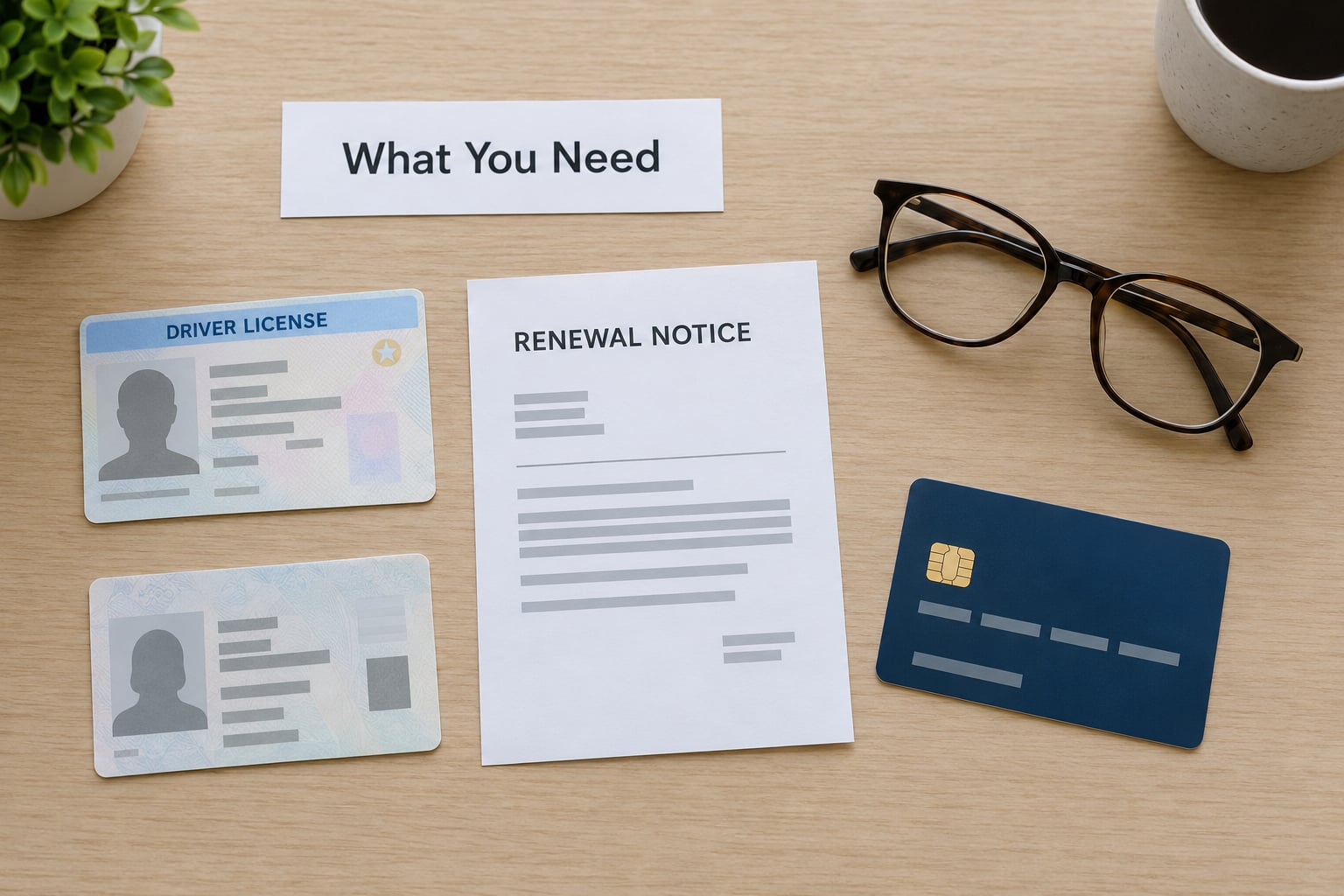
Requirements, fees and accepted documents vary by state, so treat this list as the common core that most renewals need. Your state’s checklist page is the authority, and it usually takes one search to find.
- Your current license. Most states want the physical card in hand, whether you renew online or in person. Some portals let you renew using only the license number printed on it.
- Your renewal notice. The letter or email your agency sends about 60 to 90 days ahead of expiration often contains a renewal authorization number that speeds up the online application. Check your junk folder if you cannot find it.
- Proof of identity. A passport, birth certificate or permanent resident card usually covers this. Some states accept a state ID instead.
- Proof of Social Security number. A Social Security card, a W-2, a 1099, or a state-issued card displaying the number. Online portals often ask for only the last four digits during verification.
- Two proofs of residency. Utility bills, a lease or mortgage agreement, bank statements and insurance documents are the usual stand-ins. Digital statements are accepted in many states, though some still want a printed copy.
- Payment. A card or check for the fee listed on your state’s page. Some offices no longer take cash, and a few states add a convenience charge for card payments.
- Your online account credentials. If your state uses a customer portal, you need the username and password you set up previously.
- Vision, insurance or medical proof, where required. A small number of states ask for a vision screening certificate, proof of vehicle insurance, or a medical statement for a temporary restriction.
Two things catch people regularly. First, your legal name has to match across every document, and a mismatch is one of the most common reasons an application bounces back. Second, some states issue a temporary paper license at the counter and mail the plastic card separately, so expect to carry both for a few weeks.
How to Renew a Drivers License: Step by Step
1. Confirm Your Renewal Deadline and Eligibility
Start with the expiration date printed on your card, then open your state’s official licensing agency site. Every state has a renewal page that lists who qualifies for each renewal method, and that page is the only reliable source for your situation.
Compare four things before you pick a method: the expiration date, whether your license has already lapsed, how many renewals you have completed, and whether any holds or violations are attached to your driving record. In-person visits are usually required for a second renewal cycle, an address change, a name change, a replacement card, or certain commercial driver categories.
You can verify this step worked by locating your expiration date on the card and matching it against the eligibility language on your state’s page. If the site offers an online renewal button and you are not blocked, you are eligible online.
2. Gather the Required Documents
Use a three-group method so nothing gets missed. Group one covers identity and lawful status: passport, birth certificate, permanent resident card or state ID. Group two covers the Social Security number, usually proven by a card or a tax form. Group three covers residency, where two separate documents are typical.
Add a fourth group only if it applies to you: certified court or marriage documents for a legal name change, a residency document in your new name, or proof of vehicle registration for commercial drivers.
Some states require original or certified documents, which means a photocopy will not pass. Check the language carefully, because “certified” and “original” are not interchangeable. Verify this step by laying every document on one surface and comparing the name and date of birth on each against your license.
3. Complete Any Vision or Medical Requirements
Most states require a vision screening at renewal, and a growing number let you complete it through an approved provider or a kiosk instead of at the counter. Others accept a self-certification you sign during the application, and a handful still require the eye chart machine in the office.
Where a provider is allowed, use one from your state’s approved list and make sure the certificate carries the form number your state expects. An ordinary eye exam summary from a private doctor is often not the same document as the state form, which is a routine reason for a rejected second trip.
If you have concerns about your vision, a medical restriction, or a condition that affects your driving, talk to the licensing agency directly and to a qualified clinician rather than working from a general checklist. You can verify this step by holding the signed form or certificate and confirming its number matches the one listed on your state’s renewal page.
4. Choose Online or In-Person Renewal
The choice is usually made for you by eligibility, so check before you plan around a method. Within that constraint, compare convenience, speed, verification depth, and accessibility.
Online is fastest for a clean record. You confirm identity, review your data, pay, and wait for the card to arrive by mail. Document verification is automated, so a name or residency problem shows up as an error screen rather than a person at a counter.
Kiosk is the middle path, available in many states at locations inside grocery stores, pharmacies and motor vehicle offices. You get an in-person photo and a vision check without an appointment, and several states run them during extended hours.
Mail is available for renewal cycles after the first, and sometimes for military personnel and those serving abroad, based on your state’s rules.
In person is the fallback for anything online cannot verify, plus anyone who needs a new photo, a vision test in office, an address change, or a record hold cleared. Expect an appointment and a longer visit than the other options.
Verify this step by confirming your chosen method appears in the eligibility list on your state’s page, and by checking whether your county or nearest office takes walk-ins or requires a booking.
5. How to Renew a Drivers License Online
The typical secure process runs the same way almost everywhere. You open the state’s official portal from a link you trust, not from a search ad. Create an account or sign in to the one you already have, then choose the renew a license option.
Next, review the personal information the portal pulls up and correct anything that is wrong. Some states ask for the last four digits of your Social Security number when the official site requires it for verification; type those only into the state’s own domain, and never into a page reached through a paid third-party listing.
Upload documents if the portal requests them, confirm the fee shown on screen against the amount on your state’s fee schedule, and pay with a card. When it goes through, you get a confirmation number or a printable receipt on screen.
That confirmation is the proof the renewal worked, and you can verify the step by saving a screenshot or a PDF before you close the browser. If an error appears instead, write down the exact message, because that code tells you whether you are blocked by a record hold, a document problem, or an eligibility gap.
6. Renew at a DMV or Licensing Office
Use the state office locator or appointment system on the agency site, and pick a location that handles licensing rather than registration if the building hosts both. Hours, wait rules and appointment availability differ by county, and some offices close for lunch or on a rotating basis.
Bring everything from the document checklist plus the current license and your payment method. At the counter, expect staff to verify your identity against your documents, confirm your address and name, take a new photo, and run a vision screening if your state requires one on this visit.
Before you leave, ask for a printed receipt or temporary paper credential and confirm what it is valid for and how long it works. You can verify the step by leaving with a document that names your license or customer number and shows the issue date.
7. Confirm Receipt and Check the New Card
Your state’s portal usually has a license status or transaction history page, and that is where you confirm the renewal posted to your driving record rather than to a queue. A renewal can complete at the agency level weeks before the plastic card reaches you, so check both status and delivery separately.
Delivery windows vary by state and by issuance method, and in-person pickup is sometimes available for a small extra charge. When the card arrives, compare the name, address, photograph, license number and expiration date against what you submitted.
If something is wrong, report it to the agency right away using the contact on your receipt. A card printed with an error is usually replaced, but many states only correct a printed card if you report it within a set window. If the card is invalid, do not drive on it. Verify this step by logging into your account and confirming the new expiration date and card status before you rely on the license.
Common Mistakes
Most wasted trips trace back to a short list of predictable problems. Here they are with the fix for each.
- Expired identification. A passport or state ID past its expiration usually cannot be used. Check every document’s dates before you go and get a current one if needed.
- Name mismatch across documents. A marriage certificate in one name and a utility bill in another will stall an application. Resolve the mismatch with certified documentation before you apply, not after.
- Third-party renewal websites. Sites that look official but charge a large service fee for a free government renewal are the most common complaint in driver forums. Type your state’s agency domain yourself or use a government link directory.
- The wrong portal. Many states have separate sites for licensing, registration and commercial licensing. Landing on the registration portal can send you to a form that will not work for a renewal.
- Unpaid tickets, fines or holds. An unpaid citation or a medical or vision suspension blocks renewal in many states. Settle the balance or request a hearing before you apply.
- Missing insurance proof. A few states want proof of vehicle coverage at renewal. Get an insurance card or declaration page in hand before you submit.
- A skipped vision requirement. Leaving a vision or medical item unresolved can turn into a suspension notice. Finish the requirement on the state’s terms and keep the certificate.
- Waiting until the last week. Late renewal fees, longer queues and mail delays all stack up near expiration. Renewing a little early costs nothing in most states.
Two more problems deserve their own note, because readers ask about them constantly. If your online renewal is blocked, the message usually names the cause: a record hold, a photo requirement, or a mismatch between your account and your license. Deal with the named cause through the agency rather than retrying the same submission.
If your license expired a while ago, the timeline matters. States commonly allow an online or mail path for a recent lapse, require a vision test and documents after a longer gap, and treat a license expired by more than about two years as a new application with knowledge testing. Driving on a lapsed license can bring a ticket, impoundment and insurance problems, which is why the safest move is to resolve it before you drive.
Track the mailed card rather than assuming. Save the confirmation, check the transaction history on your state portal, and keep the temporary credential with you until the plastic card arrives.
Frequently Asked Questions
Can I renew a driver’s license after it has expired?
Usually yes, but the route depends on how long it has been expired. Many states let you renew a recently expired license online or by mail, but require a vision test and identity documents after a longer gap, and treat anything beyond roughly two years as a new application with written and road testing. Check your state agency page for the exact threshold, and resolve any holds or unpaid citations first, since those block renewal at any stage.
How do I renew a driver’s license while living in another state?
You can generally renew from out of state through your home state’s online portal or by mail, because renewal does not require living in the issuing state. You cannot renew in the state you have moved to, though, since that is where a new residency and driving record would apply. If your new state requires a vision test or in-person visit, plan for that separately before you rely on the mailed card.
Can I renew a driver’s license online if I have moved?
Often yes. If your address changed but you still live in the issuing state, many agencies let you update it during an online renewal, sometimes with a proof of residency document uploaded. Moving to a different state usually blocks the online path and starts a new residency and record there instead. Confirm on your state agency site whether an address change counts as a renewal or requires an office visit before you pay the fee.
What should I do if my renewal is denied because of tickets or a driving record?
Read the denial notice closely, because it should name the hold and the agency holding it. Settle outstanding citations or request a hearing through the court or agency listed, then confirm the hold is released on your state portal. A medical or vision suspension has to be cleared with a clinician or the licensing agency. Renewal cannot proceed until the hold is lifted, and repeating the same application will fail again.
How long does a temporary driver’s license remain valid?
Temporary paper licenses usually carry their own printed expiration date, which is set by the issuing state and is often shorter than people expect. The validity window matters because it is often the only credential you hold while the mailed card is in transit. Read the date on the document, keep it with you whenever you drive, and check your state portal for whether the temporary credential can be reprinted if you lose it.
Conclusion: Start With Your State Licensing Agency
Four actions cover nearly every renewal. Verify your deadline and eligibility on your state licensing agency’s official site, choose the renewal method you qualify for, gather the identity, residency and payment documents that state requires, and hold onto the confirmation until the new card arrives in the mail.
State rules and fees vary, and they change more often than people expect, so check the official page before you submit anything or pay a fee through any third-party site. If you have moved states, changed your name, or have an unresolved hold, contact the agency directly rather than working from a general checklist.