To read a vehicle history report, work top to bottom in a fixed order: confirm the 17-character VIN matches the car in front of you, decode the title brands, read the accident and damage entries, count owners and check how the car was used, follow the odometer readings in sequence, then review service, recall, lien and theft records. Budget 30 minutes for the report and another hour for an independent inspection.
A vehicle history report is a compilation of publicly available records tied to a vehicle’s VIN, arranged by date, showing title history, accidents and damage, mileage, ownership, service, recalls, and theft or lien records. It only shows what was reported to it. Current as of 2026, the format has been stable for years.
Seven checks, in the order I read them:
- Does the VIN on the report match the VIN plate on the car?
- Does the title carry any brand: salvage, rebuilt, flood, buyback, destruction?
- What do the accident and damage entries actually say, and how severe?
- How many owners, and was the car ever fleet, rental or commercial?
- Do the odometer readings only ever go up, at a believable rate?
- Is the service and maintenance history consistent with the mileage?
- Is there a lien, a theft record or a registration problem to clear first?
Table of Contents
- What You Need
- Step-by-Step: How to Read a Vehicle History Report
- 1. Confirm the Report Matches the Vehicle
- 2. Read the Report Summary and Basic Facts
- 3. Check Ownership and Title History
- 4. Verify the Mileage for Red Flags
- 5. Review Accidents, Damage, and Service Records
- 6. Look for Theft, Registration, and Other Alerts
- 7. Make a Final Decision and Get an Inspection
- Common Mistakes and Useful Tips
- Frequently Asked Questions
- What does a clean vehicle history report mean?
- Can a vehicle history report miss an accident?
- Why does the reported mileage in a vehicle history report sometimes decrease?
- Is a rebuilt or salvage title the same as a clean title?
- How long does it take to obtain a vehicle history report?
- What should I check before buying a used car?
- Conclusion
What You Need
Reading a report is quick; the prep is what makes it accurate. Here is what I ask for before I sit down with a vehicle.
- The report itself, pulled fresh by VIN on the day you are looking at the car. A report printed months ago misses recent damage.
- The VIN from the car, not from the listing. It sits on the driver door jamb sticker and on a plate under the hood or on the dash.
- The title document, if the seller has it. The brands printed on the title are the legal record; the report is only a copy of what was reported.
- Seller or dealer details, especially the state they registered the car in most recently.
- Independent tools: a state DMV title-record search, the federal recall database, and a mechanic you choose yourself for the pre-purchase inspection.
Where the data comes from matters as much as what it says. The three sources you will meet most often overlap but do not agree perfectly.
| Source | Where the data comes from | Extra signal it adds | Known blind spot |
|---|---|---|---|
| CARFAX | DMVs, insurers, police agencies, auction records, service businesses | Accident severity wording and airbag or structural damage notes | Cash repairs and damage never claimed through insurance never appear |
| AutoCheck | Same core sources, plus its own vehicle history database | An AutoCheck Score from 1 to 100 comparing the car with similar vehicles | A strong score can sit next to a salvage title; the score is not a verdict |
| NMVTIS | Federal title and brand information supplied by participating state DMVs | Confirms whether a title was issued and which brand was stamped on it | Narrower than a consumer report: it is the title record, not the accident log |
Buyers on forums like r/askcarsales and r/askcarguys consistently recommend running your own report by VIN before visiting a seller, rather than relying on one the dealer prints. If a seller resists a fresh report, that refusal is itself information.
Step-by-Step: How to Read a Vehicle History Report
1. Confirm the Report Matches the Vehicle
Start by matching the report to the car, because a report for the wrong VIN tells you nothing. Compare all 17 characters of the report VIN against the door jamb sticker, the plate under the hood and the title paperwork.
The VIN has three parts. Characters 1 to 3 are the World Manufacturer Identifier, which tells you the country and maker. Characters 4 to 8 are the Vehicle Descriptor Section, covering model, body type and engine. Characters 9 to 17 are the Vehicle Identifier Section, which carries the model year, plant, serial number and a check digit. If any character differs, stop and ask why before reading anything else.
You know this step worked when the year, make, model, trim and colour on the report header all match the badge on the car and the plate on the listing.
2. Read the Report Summary and Basic Facts
The summary block gives you the basics: current title status and issuing state, reported mileage, vehicle use, and the date the report was generated. Check the report date first. A report generated before an accident cannot show that accident.
Look at the vehicle use field. Personal, commercial, fleet, rental and taxi are separate labels, and they tell you how the car was treated. Also note the current state of registration, since several states title and register separately.
You know this step worked when you can state the report date, the title state, the current odometer reading and the use type without scrolling.
3. Check Ownership and Title History
The title section tells you who has owned the vehicle and whether the title has ever been branded. Read the ownership timeline in date order and note how many transfers there were and how quickly they happened. Several owners in a short window on an older car is a reason to slow down, not to walk away on its own.
Then read the brand stamped on the title. This is permanent, and it follows the car for the rest of its life.
| Title brand | Plain-English meaning | Typical risk | What to do |
|---|---|---|---|
| Clean | No brand on the title | Low, but says nothing about unreported damage | Continue to accident and odometer checks |
| Salvage | Declared a total loss by an insurer | Structural or safety damage; hidden repair costs | Walk away unless you have budget and a mechanic’s full inspection |
| Rebuilt or reconstructed | Repaired and re-certified for the road | Quality of the rebuild varies wildly | Negotiate hard and have a body shop review it |
| Flood | Submerged or exposed to rising water | Hidden corrosion in wiring, brakes and fuel lines | Walk away on any passenger vehicle |
| Lemon law buyback | Repurchased by the maker after repeated faults | Chronic, possibly safety-related defects | Walk away, or price in a full repair plan |
| Certificate of destruction | Declared unsalvageable and intended for parts | Must not be rebuilt or resold as a vehicle | Do not buy it as a car |
Title washing is the pattern to watch for: damage in one state, a brand removed, then re-registration in a state that does not require a physical inspection. A car that changed states shortly after a flood event, or that shows a title transfer with no matching registration history, deserves a call to the DMV in the state where it was last titled.
4. Verify the Mileage for Red Flags
Every odometer entry the provider has collected should appear as an ascending sequence. Read them in order and check three things: that the numbers only increase, that the gap between entries matches the time between their dates, and that the last recorded reading is close to what the dashboard shows.
A decrease means a possible odometer rollback and is a walk-away finding. A large unexplained jump, or a car reported at 90,000 miles whose interior looks like 30,000, means someone backdated entries. Watch the rate too: a vehicle that gained 30,000 miles in three months was either driven hard or the readings were not collected evenly.
Physical wear is the cross-check that costs nothing. Look at pedal pads, steering wheel and seat bolster shine, and the door jamb sticker showing the factory mileage. They should broadly agree with the reported history.
5. Review Accidents, Damage, and Service Records
Damage entries vary in severity wording, and the difference matters. Minor or cosmetic damage is often a scraped bumper or a garage dent. Moderate usually means panels replaced or substantial repair work. Severe commonly involves structural damage, airbag deployment or the vehicle being declared a total loss. Any airbag deployment or frame damage is a serious finding regardless of how the entry is labelled.
Also read what kind of incident it was. Collision with an animal, undercarriage damage, side or rear impact and hail damage each point at different parts of the car. Damage reported to an insurer is not the same as a collision reported to police; private property damage never reaches police records at all.
Service and maintenance entries tell you whether the car was looked after. Regular oil changes and brake work at climbing mileages support the reported odometer sequence. Long gaps are not automatically bad; a car stored seasonally or during a loan can have them, which is why the ownership timeline matters as much as the gap itself.
6. Look for Theft, Registration, and Other Alerts
Further down the report are the entries buyers most often skim. A stolen-vehicle record means the car was taken and later recovered, so check whether it was recovered damaged. Odometer flags issued by a state or by the manufacturer can signal suspected rollback. Lien records name the lender or finance company still holding a claim, and buying without clearing one can mean losing the car.
Registration problems show up as unusual state moves, a title issued without a matching registration, or inspection and emissions failures. Recall entries matter for safety, and the free federal recall database is authoritative where a report’s recall list can be incomplete.
Electric vehicles deserve their own caution. Reports for EVs typically say nothing useful about battery state of health or fast-charging history, so treat the report as silent on the battery and ask for a battery health report from the manufacturer or a capacity test instead.
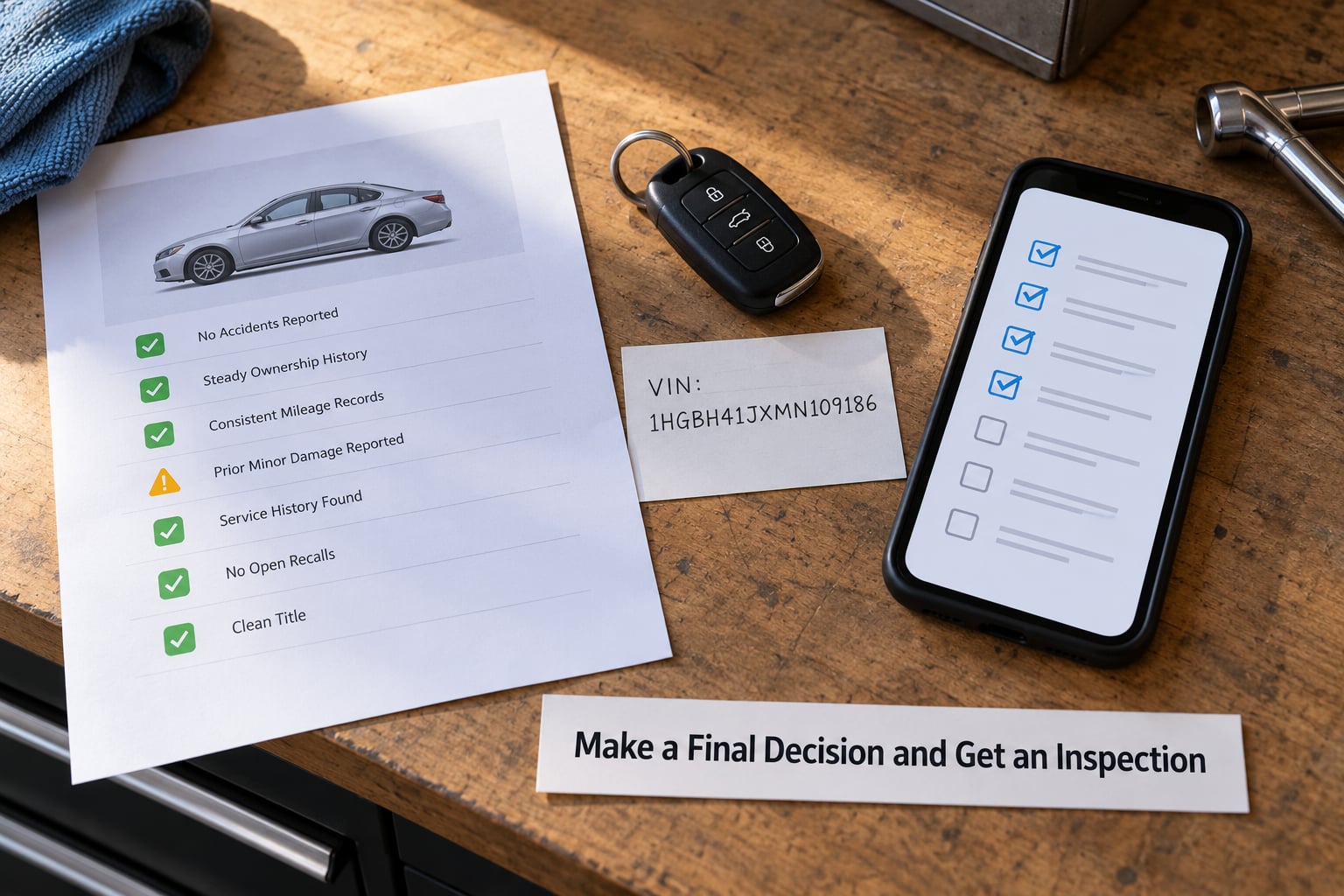
7. Make a Final Decision and Get an Inspection
Sort what you found into three tiers before you negotiate. This is the step most guides skip, and it is the one that turns reading into a decision.
- Walk away: salvage or certificate of destruction branding, flood branding, an odometer rollback, an unreleased lien, a reported stolen-vehicle status that was never recovered.
- Negotiate: rebuilt or reconstructed title, a moderate or severe accident entry without structural damage, many recent owners, rental or fleet use, odometer flags, missing service records.
- Proceed with an inspection: a clean title, a rising and believable mileage sequence, one or two long-term owners, regular service records, no open recalls or liens.
Whatever the tier, book an independent pre-purchase inspection by a mechanic you choose. Print the report and take it with you so the mechanic can check the physical car against it: mismatched panel gaps, uneven paint, fresh primer and worn pedal pads against a clean history. Ask the seller to explain anything on the report you cannot reconcile, and get the answer in writing.
Common Mistakes and Useful Tips
Most bad decisions on a used car come from misreading the report rather than ignoring it. Here are the errors I see most, with the fix for each.
- Treating one report as the whole story. A provider only knows what was reported to it. Run a second source, and check the state DMV record for the title brands.
- Skipping the VIN match. Sellers hand over reports for a different car. Compare all 17 characters before reading a single entry.
- Reading a clean title as a clean car. The title describes paperwork, not condition. A cash repair at a small body shop leaves no trace anywhere.
- Accepting an old report. Check the report date. Damage from last month will not be on a document generated last year.
- Trusting the AutoCheck Score. It compares a car with similar vehicles and leans heavily on age and mileage, nothing more. A high score can sit right beside a salvage title, so treat the score as a starting point and the title brands as the verdict.
- Ignoring small mileage discrepancies. A dip is serious; a small early reading that never matches exactly is common, especially on older cars.
- Skipping the physical check. Mismatched panel gaps, uneven paint, fresh primer and a worn driver seat tell you more than the accident section.
Two habits make this easier. First, print the report and take it to the car; screen layouts hide nothing but reveal little. Second, run your own report before you travel, so you are negotiating with facts instead of the seller’s summary. If you need a mechanic on short notice, ask for a mobile pre-purchase inspection, which is widely available in most metro areas.
Frequently Asked Questions
What does a clean vehicle history report mean?
A clean report means no accident, damage, title brand, mileage or ownership events were reported to that provider. It does not mean the car is in good condition. Cash repairs, garage damage and private property collisions never enter the databases, so treat a clean report as a reason to keep evaluating the car, not a reason to stop.
Can a vehicle history report miss an accident?
Yes, and it is common. Providers collect only what was reported through insurers, police agencies, DMVs and auctions. A bump in a parking lot paid in cash, damage repaired by the owner or a collision on private property produces no record. This is why an independent pre-purchase inspection still matters after a clean report.
Why does the reported mileage in a vehicle history report sometimes decrease?
A decrease in the odometer sequence can indicate odometer fraud, where the reading was rolled back to make the car look younger. It can also come from a data entry mix-up or a reading taken from a different vehicle. Either way the car fails a basic sanity check, so ask the seller for the DMV inspection records that support each reading before going further.
Is a rebuilt or salvage title the same as a clean title?
No. A salvage title means an insurer declared the vehicle a total loss. A rebuilt or reconstructed title means it was repaired to legal standards and re-certified, but the quality of that work varies. Both brands stay on the title permanently, reduce resale value and can raise insurance costs. Many buyers walk away, and those who continue should have a body shop inspect the repairs.
How long does it take to obtain a vehicle history report?
A consumer report from CARFAX or AutoCheck is usually available within a few minutes of entering the VIN. A report tied to a specific title transaction can take a few business days because records come from state title offices. If a dealer offers you a report, check the generation date to confirm it was pulled recently rather than reused from an earlier buyer.
What should I check before buying a used car?
Check the VIN matches the car, read the title brands, review accident and damage entries by severity, count owners and check whether the car was fleet or rental use, follow the odometer readings to confirm they only rise, review service records against the mileage, and confirm there is no lien or theft record. Then book an independent pre-purchase inspection before signing anything.
Conclusion
Start with the VIN. If the report does not match the car in front of you, nothing else matters. Then read the title brands, follow the odometer to confirm the numbers only ever rise, and sort the accident and ownership findings into walk away, negotiate or proceed. When the paperwork checks out, the last step is the one no report replaces: an independent pre-purchase inspection by a mechanic you choose.