You can raise your fuel economy by fixing three things first: drive at a steady 55 to 65 mph instead of 70, keep every tire inflated to the pressure on your door-jamb label, and stop idling. Those three habits alone usually recover 10 to 20 percent of what you lost, and none of them costs you a new car. Add clean filters, correct fuel and a lighter, drag-free body, and the gap between your real mileage and the sticker gets a lot smaller.
The rest of this guide is a sequence, not a wish list. Measure first, change one thing, measure again. That way you find out which fixes actually move your number instead of guessing.
Table of Contents
- What You Need
- Step-by-Step: How to Improve Gas Mileage Without Buying a New Car
- Check Your Baseline Fuel Economy
- Keep Tires Properly Inflated: the Cheapest Mileage Win
- Remove Excess Weight and Accessories
- Use Smooth, Moderate Driving
- Use the Right Gear, Cruise Control and Drive Mode
- Keep the Engine and Air Filter in Good Condition
- Reduce Idling and Plan Efficient Trips
- Use the Fuel Your Engine Asked For
- Measure the Changes and Make Them Routine
- Common Mistakes
- Frequently Asked Questions
- How much can I improve gas mileage without buying a new car?
- Does premium gas increase fuel economy in a regular car?
- Should I worry if my check-engine light comes on?
- What is the fastest way to improve fuel economy?
- Does tire pressure really affect gas mileage?
- Can fuel additives improve gas mileage?
- Start With the Highest-Value Changes
What You Need
Before you touch anything, gather four things. Most of the work costs nothing beyond a Saturday morning.
- Your owner’s manual and the tire-and-loading label on the driver’s door jamb. The placard is the only pressure spec that counts. The number molded into the tire sidewall is a maximum, not a target, and using it costs you mileage.
- A quality tire-pressure gauge. A pencil-style gauge from an auto parts store is fine. The free gauge built into a fuel pump is often inaccurate, and a reading off by 3 PSI is a reading off by 3 PSI.
- A fuel log. A notebook or a note in your phone. Every fill-up, every odometer reading, every gallons figure.
- Basic hand tools and a service center for the rest. An air filter and a tire check are DIY. Injectors, sensors and exhaust work belong to a technician.
Step-by-Step: How to Improve Gas Mileage Without Buying a New Car
Here is roughly what each change is worth, ordered by return on the time you spend. The percentages come from AAA, the U.S. Department of Energy and EPA estimates, and they describe a typical car that has drifted out of tune, not a brand-new one.
| Change | Typical effect on fuel economy | Effort | Cost |
|---|---|---|---|
| Inflate tires to door-jamb PSI | About 3 percent per 3 PSI under the target | Ten minutes, monthly | Free |
| Drop 5 to 10 mph on the highway | Up to 14 percent | Habit change | Free |
| Stop accelerating hard | 15 to 30 percent on highways, up to 40 percent in the city | Habit change | Free |
| Shut the engine off instead of idling | Removes a quarter to half gallon per idle hour | Habit change | Free |
| Combine errands and cut short trips | Several percent, more in cold weather | Scheduling | Free |
| Remove roof racks and heavy cargo | Roughly 1 percent per extra 100 lbs; 2 to 25 percent for roof cargo | An afternoon | Free |
| Clean air filter, correct oil, healthy plugs | Usually 2 to 5 percent when badly neglected | DIY or shop | Parts |
| Fix what the check-engine light reports | Varies, often 5 to 15 percent | Technician, plus diagnosis | Repair |
| Buy additives, magnets or a tune-up chip | Nothing measurable | Shopping | Your money |
Check Your Baseline Fuel Economy
You cannot improve a number you never wrote down. The trip computer is useful but optimistic, and it recalculates constantly, so it is a poor baseline on its own.
Fill the tank to the same level each time, and do not top off. At every fill-up, write down three things: the odometer total, the gallons you added, and the miles since the last fill-up. Divide the miles by the gallons to get your real MPG. Run that for at least three full tanks before changing anything.
Compare like with like. A weekend of 400 miles of open highway and a week of 40-mile stop-and-go commutes produce numbers that are not comparable, and mixing them will convince you a change failed when it worked. Keep a note of the route type, the weather and any towing or roof load, because those explain most of the variation you are about to see.
If your MPG fell suddenly rather than gradually, skip ahead to the check-engine light section. A step change in fuel economy almost always has a mechanical cause behind it.
Keep Tires Properly Inflated: the Cheapest Mileage Win
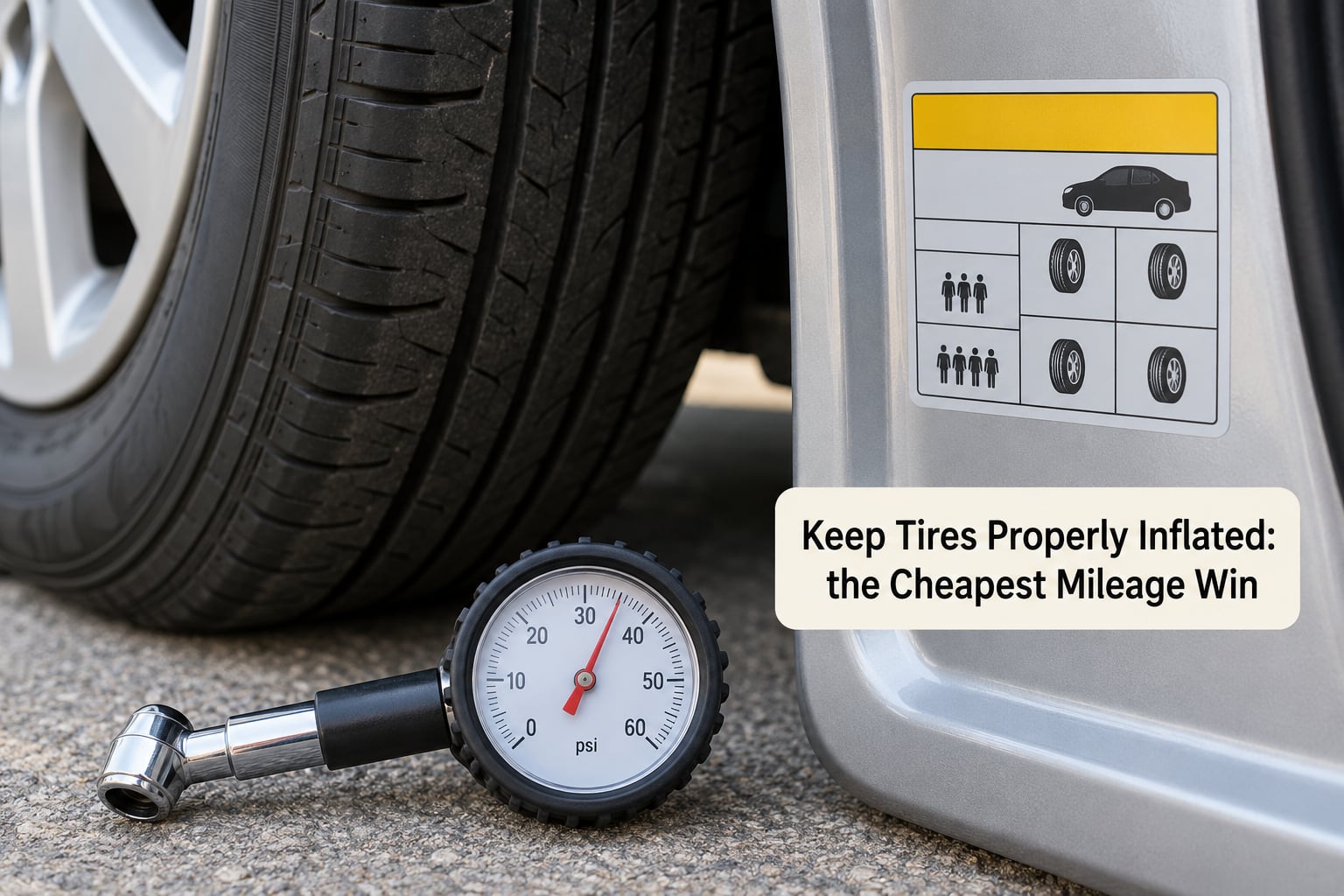
Tire pressure is the easiest fix on this page, and the one most people skip. A tire that is underinflated by 3 PSI costs about 3 percent of your fuel economy, because the tread rolls farther with every revolution and the sidewall flexes continuously.
Check them when the tires are cold, which means the car has been parked for at least three hours or driven less than a mile. Compare the reading with the tire-and-loading information label on the driver’s door jamb, not with the sidewall number. Add air if you are low, and recheck the same tire in about a month, plus whenever temperatures drop sharply, since cold air lowers pressure.
While the gauge is out, walk around the tires and look for uneven wear. If one shoulder is noticeably more worn, the alignment or the tire itself is costing you fuel as well as tread life.
Remove Excess Weight and Accessories
Every extra 100 lbs in the vehicle costs roughly 1 percent of fuel economy. A family of five, a stacked toolbox, a full tank of camping gear and a car seat in the back add up quietly, and most people have stopped noticing the load.
Roof cargo is the worse offender because it attacks two problems at once: added weight and extra aerodynamic drag. Crossbars alone can cost a few percent. A roof box or a loaded bike rack can cut 2 to 25 percent depending on how tall and how blunt the load is.
Take the rack off between trips, move the weight inside the vehicle where the structure already handles it, and take off wheel covers and other bolt-on trim for long highway runs if you want every fraction back. Adding a spoiler to an ordinary sedan is a different story: it helps only if the carmaker designed and tested it, and an unproven one can add drag.
Use Smooth, Moderate Driving
Fuel economy peaks somewhere around 50 to 55 mph, and pushing past 65 makes it fall off quickly because aerodynamic drag rises faster than speed. AAA has put the gain from trimming 5 to 10 mph at up to 14 percent, and most people find the slower pace feels unbearably slow for the first few days and then normal.
Acceleration matters more than most drivers expect. The EPA’s own rule of thumb is that every 10 mph of acceleration in a stop-and-go run can cost about 1 mpg in city driving. Mental Floss put the total at 15 to 30 percent on highways and up to 40 percent in the city, which matches what owners on r/MechanicAdvice and r/cars report about their own commutes.
Brake the same way. Every hard stop wastes the energy it dumps, and the engine has to burn fuel to build speed again. Merge early, leave a two-second gap, and take the corner at a speed that means no brake work. Choose routes that avoid the stop-and-go arterial if the detour adds only a few minutes, and use a navigation app that accounts for live traffic when the trip is long enough for it to matter.
Use the Right Gear, Cruise Control and Drive Mode
On a flat highway, cruise control holds a small, steady amount of throttle and takes over the work of maintaining speed. It is one of the easier habits to keep. It does nothing useful in stop-and-go traffic, where holding 70 while a light is red just means a later launch.
If your car has an Eco or Comfort mode, understand what it changes before you rely on it. Most switch the throttle response to something less eager, which helps in traffic, and some raise the transmission’s shift points so the engine stays in its most efficient range. On a manual, short-shifting and avoiding unnecessary high revs is the equivalent, and owners on r/Frugal treat it as the biggest single gain on an older diesel or an older manual.
Do not coast down a hill in neutral. The engine stops pumping, so you save no fuel, and you lose the engine braking, the power steering assist and the brake vacuum assist that older cars need. Popular Mechanics flagged this one early, and it remains the most repeated bad-advice item on fuel-saving lists.
Keep the Engine and Air Filter in Good Condition
A dirty air filter restricts airflow, the engine leans its mixture out of proportion, and fuel economy drops. Check it against the interval in your manual, and check the element rather than just the box if your car takes one.
Oil that has gone thick or dirty adds drag inside the engine. Change it on the schedule in the manual and use the specified viscosity, because a heavier oil in a hot climate can quietly cost you a point or two of economy. Worn spark plugs, dirty injectors, clogged fuel filters and exhaust problems all show up as a drop in MPG, sometimes months before anything else feels wrong.
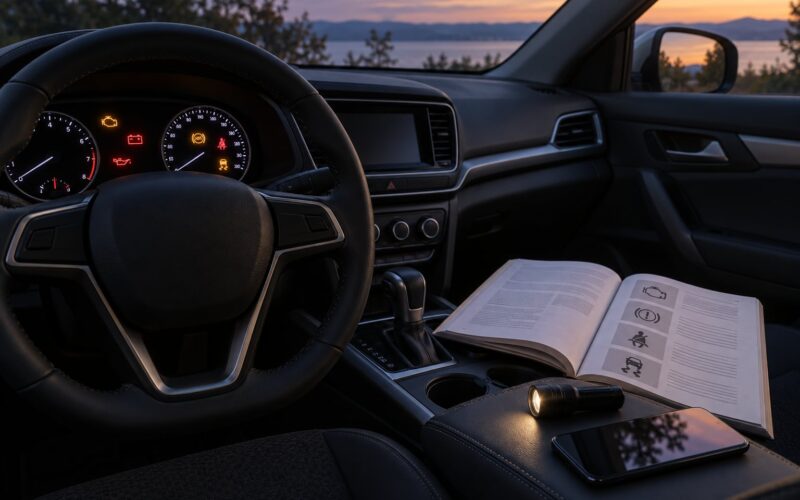
Treat a check-engine light as a diagnosis, not an annoyance. The light means a sensor has flagged a fault, and a fault that makes the engine run richer burns more fuel. Common culprits are an oxygen sensor, a MAF sensor, a loose gas cap, failing spark plugs or a vacuum leak. Codes can be read at almost any parts store, and reading the code before you replace parts saves you from buying the wrong thing.
One warning: an evaporative emissions system leak, a catalytic converter problem or a removal of emissions hardware is illegal in many places, and none of it is a smart way to save fuel.
Reduce Idling and Plan Efficient Trips
Idling is the most expensive thing you can do with a car that is standing still. AAA puts a typical engine at roughly a quarter to a half gallon of fuel per idle hour, and the car is going nowhere. If a stop will last more than about a minute, shut it off. Restarting costs roughly ten seconds of fuel against minutes of idle, which is why the off-and-on-around-the-park pattern is the one that quietly drains the tank.
Modern gasoline engines do not need a long warm-up. Follow the manufacturer’s guidance, which is usually to start gently and drive: a few seconds of idling, then off. Ten minutes of idling in a driveway on a cold morning wastes fuel and, with a catalytic converter, can send more moisture into the oil. In cold climates, the habit worth building is the monthly pressure check, since cold air drops tire pressure fast.
Plan trips in a way the engine actually likes. Short hops across town never reach operating temperature, so the oil holds moisture, the fuel never fully vaporizes and the engine runs rich the whole way. Combine errands into one longer route, drive when traffic is lighter, and if you have a second car, assign it to the short trips.
Hypermiling, the practice owners on r/Frugal and r/cars trade tactics on, is just this taken further. Take back roads, use a routing app that prefers fewer lights over raw distance, keep a steady hand on the wheel, and log every tank so a slow decline shows up before it becomes obvious. Never hypermile in a way that ends in running a red light or an unsafe lane change.
Use the Fuel Your Engine Asked For
Fill up with the grade on the fuel door or the manual. If it says regular 87, use regular 87. Higher octane is a knock resistance rating, not a cleaning product, and a car designed for regular gains nothing measurable from premium, so you’re buying the same miles at a higher price per gallon.
Some cars genuinely need higher octane to meet their own emissions and output targets, and a knocking or pinging sound under load is the signal to switch. Check the manual before assuming.
Top Tier is a separate idea. It’s a detergent standard that identifies fuels meeting certain deposit-control criteria, chosen with the recommendation on the fuel door or in the manual. It is not the same thing as premium, and it is not a mileage upgrade. A gallon from a Top Tier station is the same price as the same gallon from anywhere else.
Skip the additives, the fuel magnets, the catalytic-converter removals and the plug-in chips. They have no measurable effect, and the converter removal is both illegal and a bad trade, because you lose the part that cleans the exhaust. Accessories are worth checking too: the EPA has estimated that active electrical use can cost 5 to 25 percent of fuel economy, and the A/C on a hot day is real load. Windows down at highway speed is not a free substitute, since drag climbs sharply with them open.
Measure the Changes and Make Them Routine
Change one thing, then run at least three more full tanks and compare against your baseline. If your baseline was 24 mpg and a tire pressure fix moves you to 26, that is a real gain and it stays until the tires go soft again.
Keep the log. Once you have a baseline and a new number, the annual math is simple: take your yearly miles, multiply by the difference in MPG, and you have your yearly gallons saved. At 12,000 miles a year, 2 mpg is about 24 gallons a year. That framing is what tells you whether an optional product is worth buying, and it is also how you decide when a repair has crossed into replacement territory. If keeping a car running costs more than what a better one would save, the numbers stop arguing.
Then keep it. A monthly pressure check, a log entry at every fill-up and a service schedule followed on time cost almost nothing and hold most of the gain. What made the difference was never a gadget. It was stopping the small leaks of fuel economy that were happening all along.
Common Mistakes
Using the sidewall pressure instead of the placard. The sidewall number is a maximum the tire can handle, not the pressure it should run at. Overinflating hurts braking, ride and fuel economy too.
Judging a change after one short trip. A cold 8-mile drive tells you almost nothing. Three full tanks under similar conditions is the minimum before you decide anything.
Buying additives, magnets or chips. No measurable gain, and some of it is unlawful. Forums are consistent on this one, and the pattern is the same as any other cure-all: expensive, permanent, unproven.
Ignoring a check-engine light. It is a live diagnosis of a fault that is likely costing you fuel right now. Read the code before buying parts.
Comparing a highway tank against a city tank. Keep a note of the driving type in your log so the numbers mean the same thing each time.
Warming the car up for ten minutes. Modern engines want to be driven gently, not idled. Follow the manufacturer’s guidance.
Frequently Asked Questions
How much can I improve gas mileage without buying a new car?
Most drivers can recover 10 to 20 percent, sometimes more on a neglected vehicle. The big levers are steady 55 to 65 mph driving, tires inflated to the door-jamb pressure, no idling and smooth acceleration. Fixing an engine fault flagged by the check-engine light can add another 5 to 15 percent. Set a baseline over three full tanks first, so you can prove which changes worked rather than guessing.
Does premium gas increase fuel economy in a regular car?
No. Octane rating measures resistance to engine knock, not cleanliness or power. If your fuel door or manual calls for regular 87, premium gives you the same miles at a higher price per gallon. A handful of turbocharged or performance models genuinely need higher octane to meet their output and emissions targets, and the manual will say so. Top Tier is a separate detergent standard, not a mileage upgrade.
Should I worry if my check-engine light comes on?
Treat it as a live diagnosis, not a dashboard light to ignore. A flagged fault usually makes the engine run richer than it should, which burns extra fuel every mile, and a step change in fuel economy is one of the common symptoms that gets a driver to check. Read the stored codes at a parts store before replacing anything, so you fix the sensor or leak that is actually causing the fault instead of swapping parts at random.
What is the fastest way to improve fuel economy?
Tire pressure, then driving style, then idling. Inflate every tire to the pressure on the driver’s door-jamb label while the tires are cold, which takes about ten minutes and a free gauge. Next, hold 55 to 65 mph and stop accelerating hard, since aggressive driving can cost 15 to 30 percent of highway economy. Finally, shut the engine off for stops longer than a minute instead of idling through the queue.
Does tire pressure really affect gas mileage?
It does, and the effect is measurable. A tire running 3 PSI under the specified pressure costs about 3 percent of fuel economy, because the tread rolls farther and the sidewall flexes on every revolution. Check pressures when the tires are cold, at least monthly and whenever temperatures drop, since cold air lowers pressure. Use the door-jamb placard rather than the sidewall maximum, and recheck about a month after inflating.
Can fuel additives improve gas mileage?
The ones sold to restore or boost mileage do not have a measurable effect on a healthy engine, and forum consensus across r/MechanicAdvice and r/cars has been consistent for years. Additives aimed at cleaning deposits can help an engine that has genuinely fouled, but the same job is usually done more cheaply and reliably by replacing the fuel filter, cleaning the injectors or replacing the air filter. Catalytic converter removals and plug-in chips are the ones to stay away from.
Start With the Highest-Value Changes
Do these four things this month, in order. Record three full tanks to get your baseline, inflate every tire to the door-jamb pressure and check it monthly, pull the roof rack and heavy cargo off, and read the check-engine code if the light is on. Then hold 55 to 65 mph, accelerate like you have an egg under your right foot, and shut the engine off instead of idling in the drive-through line.
Re-measure after three more tanks and write both numbers down. If the gain was worth it, most of it comes from keeping the habit rather than the one-time fix, and none of it required a new car.