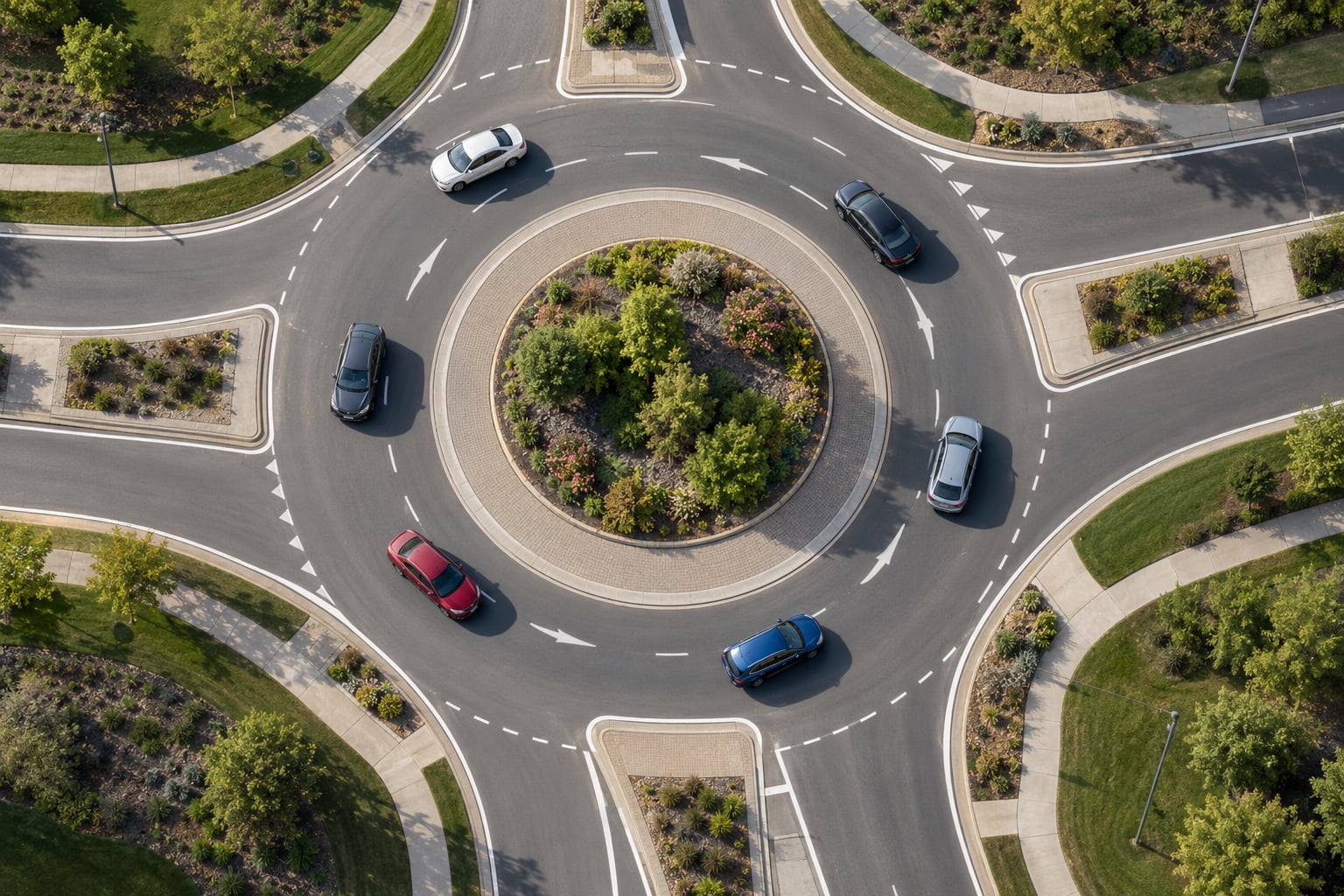
A roundabout is a one-way circular junction, and the whole system rests on one rule: slow down as you approach, give way to traffic already circulating and to anyone in the crossing, then merge in. Once you are inside, hold your lane, keep moving, signal, and leave at the exit you need. That is essentially all there is to how roundabouts work for drivers.
The design does most of the enforcement for you. A curved entry with a splitter island physically forces you to slow before you reach the yield line, and the one-way flow means nobody is ever waiting to turn across your path. What is left is a set of consistent habits, and they are not hard once you know which lane to be in.
Table of Contents
- What Is a Roundabout and Why Do Drivers Use It?
- How Roundabouts Work for Drivers: The Basic Rules
- How Do You Enter a Roundabout?
- How Do You Choose the Correct Lane?
- What Happens When You Are Already Inside the Roundabout?
- When Should You Signal in a Roundabout?
- How Do You Exit a Roundabout Safely?
- What Should You Watch For Around Pedestrians and Cyclists?
- What Are the Most Common Roundabout Driving Mistakes?
- How Do You Handle Special Roundabout Situations?
- Frequently Asked Questions
- What is the golden rule at roundabouts?
- What way do you drive in a roundabout?
- What should you do if you miss your exit?
- Do you have to indicate at a roundabout?
- How does a roundabout work with 2 lanes?
- What are the downsides of roundabouts?
- Conclusion: Drive Roundabouts by Predicting the Next Move
What Is a Roundabout and Why Do Drivers Use It?
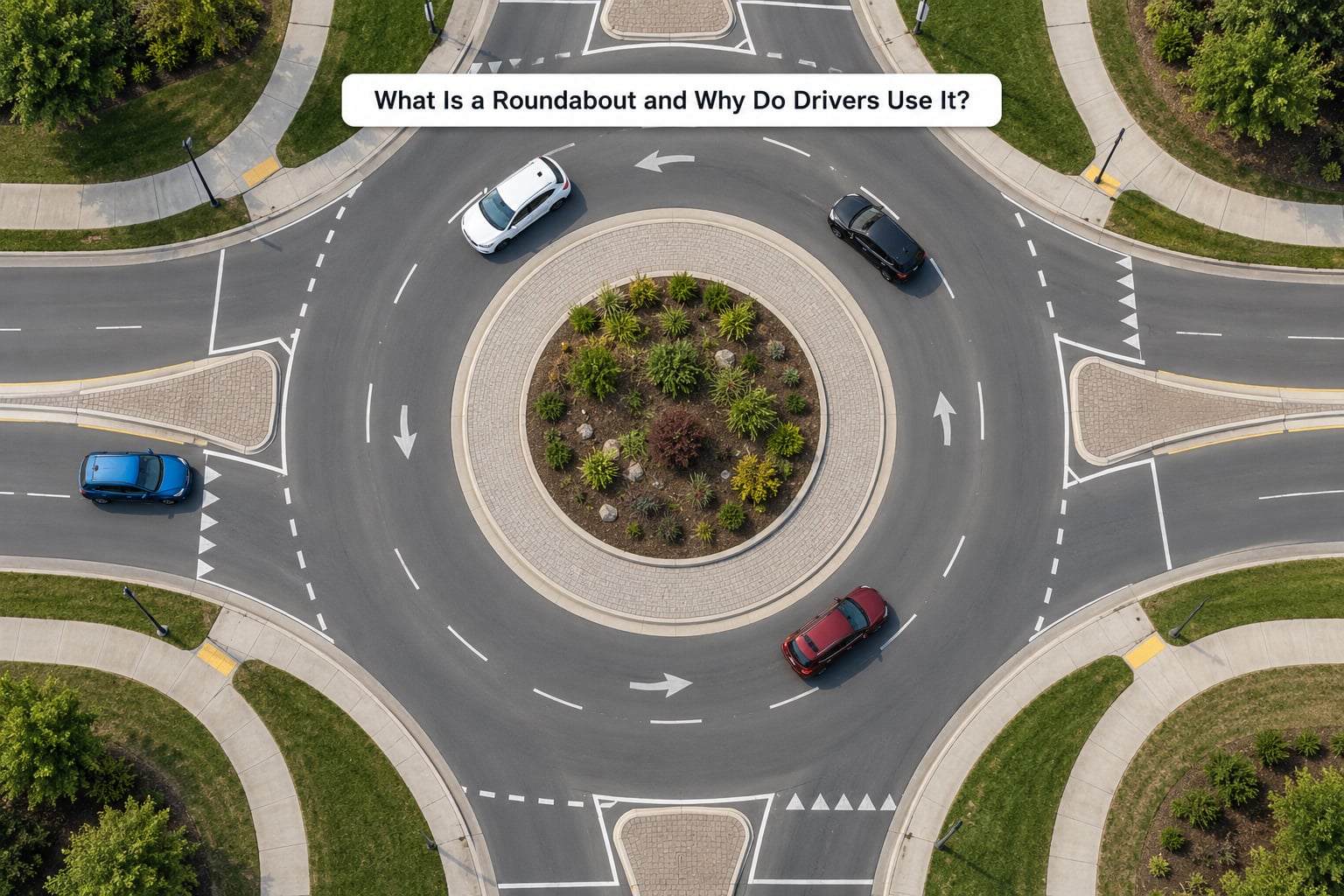
A roundabout replaces a junction of signals or stop signs with a circular roadway around a raised central island. Traffic circulates counterclockwise in right-hand-traffic countries, and every vehicle enters and leaves at the same small opening rather than crossing opposing streams at a right angle.
Four pieces of the design do the real work. The central island blocks the view straight across the junction, which removes the temptation to watch for oncoming traffic and stop in the circle. The splitter island at each approach separates entering traffic from exiting traffic, so nobody merges into the back of a queue. The entry deflection is the curve that slows you down. And the circulating roadway is one-way by design, so two streams can never collide head-on.
That entry curve is not decorative. Its geometry is calculated to bring an approaching driver down to roughly 15 to 25 mph before the yield line, without relying on a sign or a brake pedal. Slow traffic means smaller angles of impact, and fewer crossing conflicts mean fewer chances to meet at 90 degrees.
Figures published by the U.S. Federal Highway Administration in its roundabout informational guide report roughly a 37 percent drop in total crashes, about 75 percent fewer injury crashes and about 90 percent fewer fatal collisions compared with traditional signalised intersections, with pedestrian crashes down around 40 percent. Treat those as national figures rather than a promise about your local junction, but they explain why road authorities keep converting intersections.
How Roundabouts Work for Drivers: The Basic Rules
Five rules cover almost every situation: slow on approach, yield at the entry line, follow the circulating lanes without changing them, signal when local rules require it, and leave only through your intended exit.
- Slow down. Approach speed sets everything else. Entering at 40 mph in a circle designed for 15 mph is the single biggest cause of roundabout crashes.
- Yield. The yield sign at the entry line means give way to anything already in the circle, and to traffic already on the roundabout approaching your exit.
- Do not stop inside. A roundabout cannot work if vehicles queue within it. Keep moving and take another lap if you must.
- Do not change lanes mid-circle. Choose your lane at the entry and stay in it until you leave.
- Exit through the opening you intended. No cutting across the central island, no swinging wide around the outside.
Waving a driver in is not a courtesy. It reverses the rule, and it is the behaviour most often complained about, because someone stops dead in the circle to wave and the car behind them has nowhere to go.
How Do You Enter a Roundabout?
Entering is a five-step routine, and doing it in the same order every time is what makes it feel automatic.
- Slow and read ahead. Take your foot off the accelerator early enough to read the advance signs, not just the sign at the give-way line.
- Choose your lane. Decide before you reach the yield line which lane leads to the exit you want.
- Check left and check the crossing. Look left for circulating traffic and at the pedestrian crossing on your approach.
- Yield, then merge smoothly. Enter when there is a usable gap. Do not stop at a clear entry simply because you are allowed to.
- Hold your lane. Once you are circulating, that lane is yours until you signal out of it.
For a first exit, which is usually a left turn or a quick turn off to the left of your approach, the outer lane is usually the right choice on a single-lane circle. For the second exit, stay in the lane that the arrow and the destination sign send you to. Where signs conflict with markings, the signs on the ground win over habits carried over from another junction.
How Do You Choose the Correct Lane?
Lane choice is decided before you enter, using the lane arrows painted on the approach and the destination signs mounted at or before the give-way line. Read them in that order, and if you are still unsure, take the outer lane and go round again rather than cutting across.
| Roundabout type | Right turn or first exit | Straight ahead or later exit | Left turn or last exit |
|---|---|---|---|
| Single lane | Only lane | Only lane | Only lane |
| Two lanes | Right-hand lane | Follow the arrow; left lane for later exits | Left lane where signed, otherwise go round again |
| Three lanes | Right lane, then move out after entering | Middle lane usually | Left lane |
| Four lanes | Right lane | Lane matching the arrow for that exit | Left lane, with an earlier exit where possible |
| Mini roundabout in a residential street | Only lane | Only lane | Only lane |
Left turns are the awkward case. On larger multi-lane circles the left lane often has a double arrow, meaning you may pass an exit and still leave at the one after it. On small or older junctions the left lane is frequently marked for left turns only, so a car that missed its exit and drifted left will have to complete a full lap.
What Happens When You Are Already Inside the Roundabout?
Inside the circle, you have right of way over entering drivers and your job is to be predictable. Keep a steady speed, hold your lane, and watch for hazards rather than for opportunities.
Two habits cause most trouble. The first is easing off while a driver at the entry hesitates, which reads as an invitation and produces a half-hearted merge. The second is drifting across the lane line to reach an exit, which puts you across the blind spot of the vehicle beside you. Neither is necessary; the exit will still be there a moment later.
Watch for pedestrians crossing at the exits on your left as you come round, and for cyclists riding the circulating roadway. On many multi-lane junctions cyclists are given their own approach lane and a ring path around the outside, so an exit you take can cross that path.
When Should You Signal in a Roundabout?
Signal on the approach for a right turn or an exit ahead, signal left while circulating as a courtesy in countries that follow the practice, and signal left before leaving for any exit. Keep the left signal on only for the exit you intend to take.
Conventions differ by jurisdiction. Some authorities expect a signal on approach only when turning right, others expect it for every departure, and a few expect no signal at all on entry with the left signal used only before the exit. In left-hand-traffic countries the indicator sense reverses with the flow.
This is the part drivers argue about more than almost anything else on the road, and the honest answer is that it depends on the junction. Follow the signs and markings at your roundabout, and where they say nothing, use the pattern above.
How Do You Exit a Roundabout Safely?
Exiting is about patience. Move to the exit well before you reach it, signal, hold your lane all the way through, and let the geometry carry you out.
- Keep your lane position steady; do not slide across the centre line to shorten the arc.
- Signal left once you have passed the exit before yours.
- Check your mirror and blind spot as you approach the give-way line at the exit, for cyclists alongside and for traffic on the road you are joining.
- Give way to anyone already on that road and to anyone in the crossing at the exit.
- Accelerate gently onto the road rather than stopping at the exit line.
If you miss your exit, keep going. Do not stop, do not reverse, do not cut across the island to correct yourself. Carry on round, take the exit you actually want, and if you need to rejoin the approach road, re-enter properly and go round again. The same recovery applies when you pick the wrong lane at the entry: finish the loop and take the exit you needed.
What Should You Watch For Around Pedestrians and Cyclists?
Pedestrians and cyclists have priority over you at the crossings, and they are the ones most often hurt at roundabouts. Give way on approach before entering, and give way again at the exit where people cross the road you are joining.
Pedestrians walk one approach at a time, so a standing pedestrian on one corner says nothing about the next corner. Cyclists are harder to read: some ride the circulating roadway in a marked lane, some use a separate off-road path, and at many junctions both an on-road and an off-road route are marked. Do not assume which one a cyclist chose.
Turn across a conflict area and you take the cyclist’s path without seeing them. Check the mirror and look over your shoulder before moving across a lane near an exit, and leave a cyclist beside you enough room that they are not boxed in against the kerb. Vehicle drivers at a roundabout also have a duty to check for cyclists on the inside shoulder before turning in front of one, which is where most car and bicycle collisions at junctions happen.
What Are the Most Common Roundabout Driving Mistakes?
- Stopping at a clear entry. The circle is empty and you stop dead anyway, causing a braking cascade behind you. If it is clear, go.
- Speeding on approach. The deflection curve only slows you if you let it. Braking hard at the give-way line narrows your view of the circle.
- Stopping or waving inside the circle. Illegal, and the reason circulating traffic behind you has nowhere to go.
- Changing lanes mid-circle. Choose at the entry. One move out to leave, never a weave across the circle.
- Entering in the wrong lane and forcing it. Finish the loop and take the correct exit instead.
- Cutting across the central island on exit. Stay in your lane and let the radius take you out.
- Speeding up on the exit road. The circle ends; the road does not. Match the speed of the traffic you are joining.
Four of those are approach mistakes specifically: speeding on the way in, a late lane change, failing to check left at the give-way line, and stopping or waving to let someone in. Fix those four and most of your roundabout stress disappears.
How Do You Handle Special Roundabout Situations?
Large vehicles need more room than the painted lines suggest. The ring of harder pavement just outside the central island is the truck apron, and it lets the rear wheels of a truck or bus swing wide without hitting the island. If you see a truck riding the apron, it is doing it correctly. Truck drivers on two-lane circles also routinely hold both lanes through the turn, which surprises car drivers but is a deliberate technique, not rudeness. Give them space and do not try to pass on the inside.
Motorcycles can sit in more than one place at once, so leave extra space alongside them and check your blind spot before changing lanes or exiting.
If you break down, keep moving if you can and leave at the next exit. If you cannot move, hazards on, get out to the central island where it is safer than standing in a live lane, and call for help. Never stop in a live circulating lane.
If an exit is blocked by queued traffic, stay in your lane and continue around, then exit at the next one and use the road network to come back. Emergency vehicles take priority over everything: clear the circle at the next exit and pull over clear of it, but never stop inside the circle in front of them.
In heavy rain, at night, or with glare from a low sun, the raised island means you cannot see far across the junction, so rely on the yield line and your mirrors rather than on searching for eye contact. Drivers on high-speed approaches need more deceleration distance than the sign suggests.
Finally, if you drive abroad: in left-hand-traffic countries such as the UK and Ireland, roundabouts run clockwise and priority goes to the right rather than the left. At unsigned or unmarked mini roundabouts and small traffic circles, the general give-way-to-the-right rule can apply instead of the yield-sign rule. Check which one you are at before you move.
Frequently Asked Questions
What is the golden rule at roundabouts?
Traffic already circulating in the roundabout always has priority. You yield at the give-way line to vehicles approaching from your left and to anyone in the pedestrian crossing on your approach. Once inside, you keep priority over entering drivers. That single rule, applied consistently at every entry, is what stops the circle from ever locking up.
What way do you drive in a roundabout?
Counterclockwise in right-hand-traffic countries, so you always look left for circulating traffic before entering. In left-hand-traffic countries such as the UK and Ireland, roundabouts run clockwise and you give way to traffic coming from your right. Entering, circulating, and exiting all follow the same direction of travel around the island.
What should you do if you miss your exit?
Keep going. Do not stop in the circle, do not reverse, and do not cut across the central island to correct the mistake. Carry on round and take the next exit, then rejoin the approach road if you need to. The same recovery works if you entered in the wrong lane: finish the loop and leave at the exit you originally wanted.
Do you have to indicate at a roundabout?
Conventions differ by country and by junction, so local signs and rules come first. The common pattern is to signal on approach when turning right, signal left while circulating, and signal left before leaving for any exit. Some authorities require no signal on entry at all, and in left-hand-traffic countries the indicator direction reverses with the flow.
How does a roundabout work with 2 lanes?
Read the lane arrows and the destination sign before you reach the give-way line, then stay in that lane until you leave. The right lane handles the first exit and right turns, the left lane handles later and left-turn exits, and a lane marked with two arrows lets you pass one exit and take the next. Changing lanes inside the circle is the most common cause of side-impact collisions.
What are the downsides of roundabouts?
Capacity can drop in heavy traffic, since a queue on one arm can block an exit upstream of the junction and turn a free-flowing circle into a slow crawl. They are also harder for cyclists and large vehicles, and drivers meeting one for the first time on an unfamiliar commute report real anxiety. Very large or mini roundabouts in residential streets can feel like overkill for the traffic they serve.
Conclusion: Drive Roundabouts by Predicting the Next Move
The best roundabout drivers are the ones other drivers can read. Slow on the approach, read the signs early enough to pick a lane, look left and check the crossing, yield only when you must, hold your lane, signal before you leave, and accelerate gently onto the road you are joining.
Start with the entry, not the exit. Pick your lane in advance and let the rest of the routine follow from it, and the circle stops feeling like a negotiation. Where signs and markings disagree with what you remember from somewhere else, the signs win.