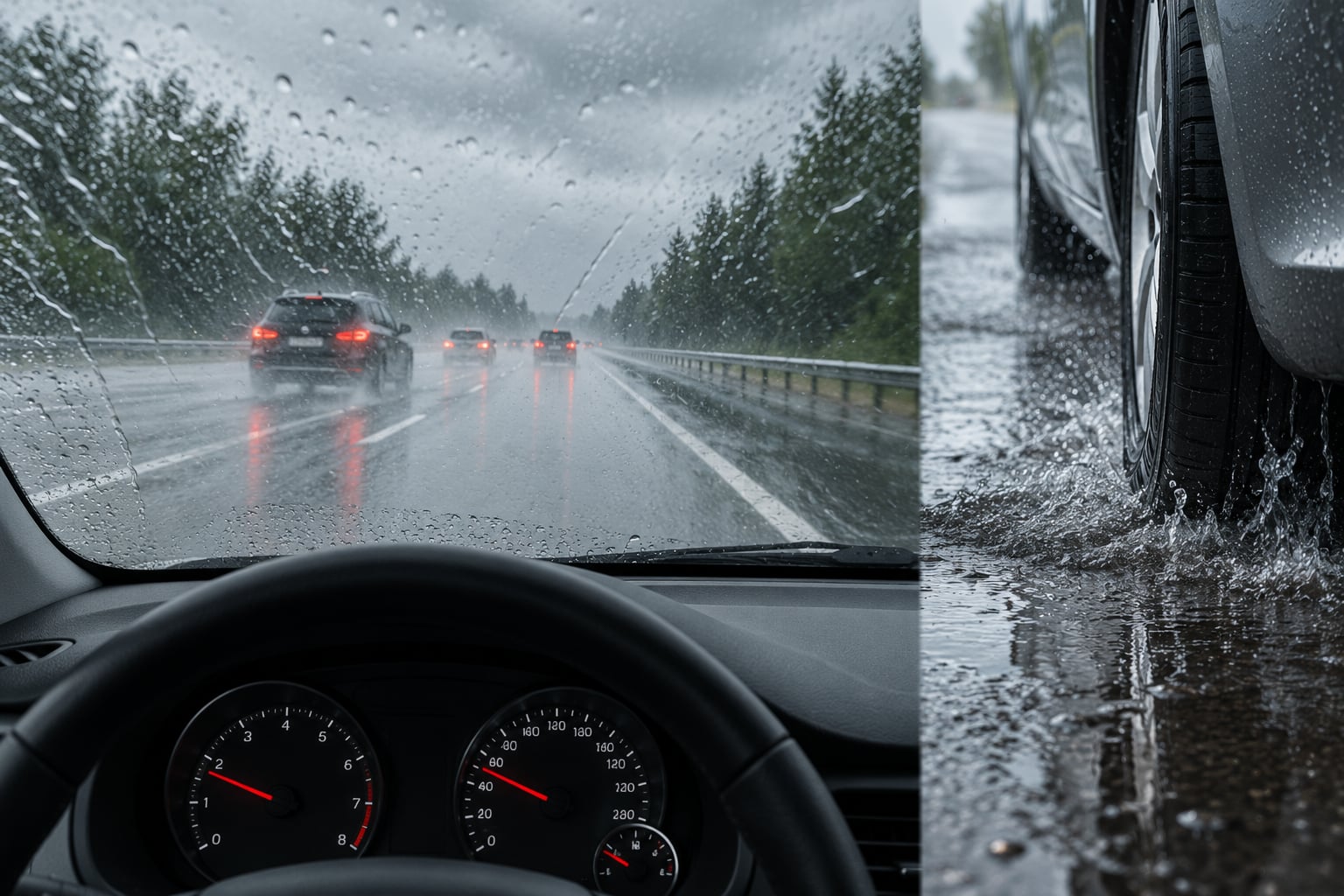
Hydroplaning happens when a tire meets more water than its tread can push aside, so the wheel rides on a film of water and briefly loses both steering and braking. Learning how to avoid hydroplaning comes down to three levers: a speed that matches the water on the road, tires that can still clear it, and calm inputs if the car starts to slide.
Slow down before the surface looks wet, keep your tires inflated and deep, and stay out of standing water. Those three habits do more than any safety feature bolted to the car.
Last reviewed for 2026. Guidance follows U.S. federal tire tread standards, National Weather Service floodwater advisories and standard wet-weather practices published by tire manufacturers. Follow your owner’s manual above anything written here.
Table of Contents
- What You Need
- Step-by-Step: How to Avoid Hydroplaning
- 1. Check Tire Tread and Pressure Before Leaving
- 2. Inspect Brakes, Wipers and Visibility
- 3. Slow Down Before the Road Becomes Slick
- 4. Increase Following Distance in Wet Conditions
- 5. Avoid Sudden Braking, Steering and Acceleration
- 6. Cross Standing Water Carefully
- 7. Use Road Warnings and Weather Information
- 8. If the Vehicle Starts to Skid, Ease Off Inputs
- 9. Pull Over Safely When Visibility or Control Is Lost
- Common Mistakes
- Frequently Asked Questions
- What are the two biggest causes of hydroplaning?
- At what speed do you start hydroplaning?
- What should I do the moment I start to hydroplane?
- How many inches of water does it take to lose traction?
- Does cruise control make hydroplaning worse?
- Am I at fault if my car hydroplanes?
- Conclusion: What to Do First
What You Need
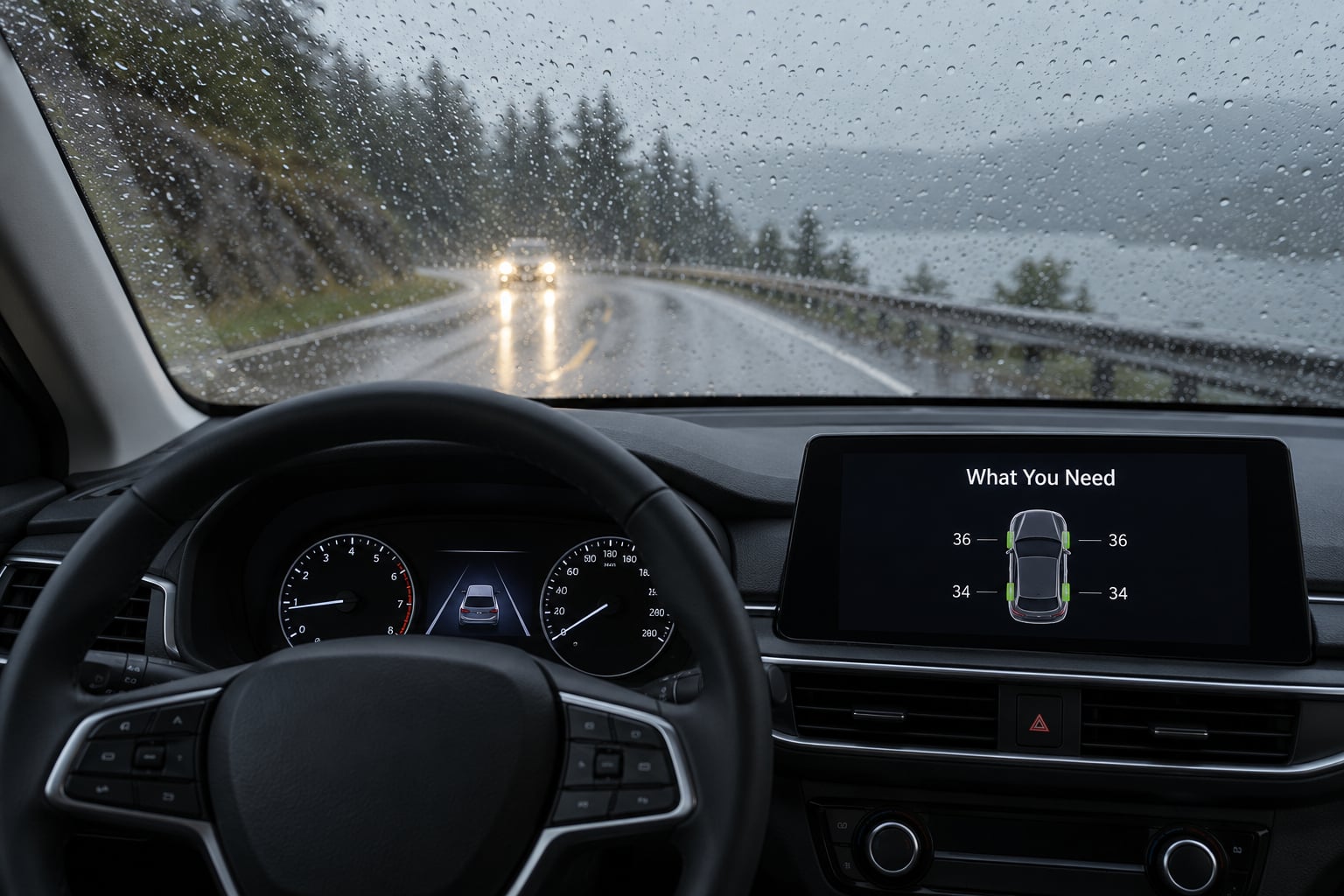
Before a long drive in rain, run through a short checklist. It takes about five minutes and it catches the small problems that become dangerous at highway speed.
Tires
- Tread depth you can actually measure, not assume. A U.S. penny works as a gauge: if you can see more than half of Lincoln’s head above the tread, the tire is worn past the point most manufacturers recommend replacing it (4/32 inch). The federal legal minimum in the U.S. is 2/32 inch.
- Correct cold pressure for every tire, matching the placard in the door jamb rather than the number molded into the sidewall. That sidewall number is a maximum, not a target.
- No bulges, cuts, exposed cords or tires wearing unevenly across the tread. Uneven wear usually points at alignment, worn shocks or a tire that needs balancing.
- A tire age you are comfortable with. Tire makers generally start flagging rubber at six years and recommend replacement somewhere around ten, regardless of remaining tread.
Visibility and control
- Wipers that clear the windshield in one sweep, plus washer fluid and a working defroster.
- Clean mirrors and side windows. Most drivers look through a dirty windshield in a downpour and never realize it.
- All lights working, including brake lights and hazards, since rain cuts your visibility to others as much as your own.
- Brakes that feel normal. Grabbing a loose or pulling brake pedal means the car should not be out in heavy rain.
Weather and supplies
- A working phone with a weather and road-closure app, plus a charger.
- Emergency gear that suits the weather: reflective triangles, a flashlight, a first-aid kit, warm layers and water.
- For rental and loaner cars, the habit of inspecting the tires yourself before leaving the lot. You usually inherit somebody else’s maintenance record, and bald tires on a rental are common enough to check every time.
Step-by-Step: How to Avoid Hydroplaning
1. Check Tire Tread and Pressure Before Leaving
Tread depth is what gets water out from under a tire. Grooves channel water sideways and backward so the rubber can touch pavement again; when those grooves are shallow, water builds under the whole patch instead of escaping.
Inflation matters just as much. An under-inflated tire flexes as it rolls, which rounds the tread edges and shrinks the contact patch, so the tire has less rubber and fewer working grooves available to displace water. Set pressure cold, before you drive, and check the spare too.
You will know the tires are doing their job when the car tracks straight, holds a steady line in a light shower and the steering feels normal rather than vague or twitchy.
2. Inspect Brakes, Wipers and Visibility
Hydroplaning steals your brakes, so they need to be in good shape before the water gives you a chance to need them. Have pads and fluid checked on the schedule in your owner’s manual, and never ignore a pedal that sinks, grabs or pulls.
Wipers and defrosters decide how much of the road you can see at all. A worn blade smears water into a film and is one of the most common reasons drivers get into trouble in rain.
The test is simple: with the engine running and the wipers on their fastest setting, you should have a clear view of lane markings and the car ahead at any speed you would actually drive.
3. Slow Down Before the Road Becomes Slick
Speed is the dominant variable, and it works because of time. At higher speed, each tire covers more ground per second, so the water has less time to be pushed out of the way before the next stretch of road arrives underneath. The wedge thickens until the tire lifts onto it.
Reduce speed early and in proportion to what you see: a drizzle, steady rain, a downpour, standing water, darkness or worn markings each call for a lower number than the posted limit allows. Dropping 5 to 10 mph below the limit in ordinary rain, and much further in a downpour, is a reasonable habit.
| What you see | What to do |
|---|---|
| Light drizzle, dry markings | Hold normal speed, stay alert for slick painted lines and manhole covers |
| Steady rain, some spray | A few mph below the limit, double your following distance |
| Downpour, wipers at fastest | Reduce well below the limit, expect large gaps in visibility |
| Standing water, ponding at intersections | Slow substantially and cross it in a straight line, or turn around |
You will know the speed is right when you can read the lane markings ahead and the car ahead never becomes a vague shape.
4. Increase Following Distance in Wet Conditions
Wet pavement roughly doubles or triples stopping distance compared with dry pavement, and spray hides the vehicle in front of you until you are already close. Doubling your normal gap is a sensible minimum; three or four car lengths in a downpour is better.
Extra space buys you time to see a pool of water forming, to roll off the throttle early and to steer around the hazard instead of relying on braking that has less grip than usual.
Staying in the tire tracks of the vehicle ahead helps because that car has already pushed water out of those lines, but it is not a substitute for distance. The car ahead can hydroplane too, and if it does, you are now directly behind it with no room left.
5. Avoid Sudden Braking, Steering and Acceleration
On wet pavement, grip is the scarce resource, and every hard input spends it at once. Slamming the brakes locks the tires and removes steering. Jerking the wheel yanks the car sideways. Standing on the accelerator spins a driven wheel and pushes water ahead of it instead of away.
Make inputs gradual and early. Look further ahead than usual and start easing off the gas before you need to brake at all. Trail the brake pedal rather than grabbing it, and hold a line through curves instead of sawing at the wheel.
When things feel right, the car responds to small corrections and stays where you put it. The first sign of trouble is a steering wheel that suddenly feels light or the car drifting without any input from you.
6. Cross Standing Water Carefully
Standing water hides potholes, debris, lane markings and drop-offs. Slow well before you reach it, then cross in a straight line at a steady, modest speed with both hands on the wheel. Do not swerve to splash through the shallow end or to avoid a wave the car in front sent up.
Never assume a flooded road is safe because another vehicle crossed it a minute ago, and never follow a car into water of unknown depth. The National Weather Service treats moving or unknown-depth water as a turn-around situation: roughly six inches of moving water can knock an adult off their feet, and around a foot can carry a small vehicle. Where depth is clearly marked and below the danger threshold, still cross with the care above.
7. Use Road Warnings and Weather Information
Rain alerts, flash flood warnings, road closures and water-depth markers all exist because someone had to decide where not to drive. Check them before you leave and again before you turn onto a highway or a rural route where a closure would strand you.
Warnings also tell you when conditions are bad enough to postpone a trip. Drivers routinely talk themselves into a flooded intersection because they have driven the same road for twenty years in dry weather, and that road is not the same object in a flood.
If a route is officially closed, treat it as closed. Local authorities have typically already checked it and found the conditions unsafe.
8. If the Vehicle Starts to Skid, Ease Off Inputs
This is the part most advice online gets wrong. When the wheels stop gripping, braking hard does not help; it usually locks the tires and takes away the steering you need.
Here is the order to work in. Stay calm and keep looking where you want the car to go. Ease the accelerator up gradually so the tires slow down and regain their bite. Do not slam on the brakes and do not pump them. Hold the steering wheel pointed where you want to travel and make only tiny corrections. Then let the tires do their job as the car comes through the water and grip returns.
The whole event is often over in a second or two, though a long one on deep water can last several. You will know it has passed when the steering loads back up and the car starts responding again. Reapply the throttle and braking gently at that point, and expect the road to still be slippery.
9. Pull Over Safely When Visibility or Control Is Lost
There is a point where continuing costs more than stopping. If visibility collapses in a downpour, lane markings disappear, water rises around the wheels, another vehicle is close enough to be a hazard, or you simply cannot tell whether the car is tracking straight, the correct move is to stop.
Pull as far off the travel lane as you safely can, well away from a curve crest or a low-water crossing, turn on your hazards and stay in the vehicle with the seat belt on. Wading out into moving floodwater to check a tire puts you at greater risk than the traffic problem you were avoiding.
Wait until the rainfall eases, then rejoin traffic well below the speed limit until the tires are fully dry again.
Common Mistakes
Driving through water at normal speed. This is the most common and the most avoidable. Crossing pooled water slowly and straight is the correction; so is choosing a different route when the pool is large or deep.
Following too closely in the rain. You cannot see what the car ahead cannot handle either. Double the gap in rain, more in a downpour.
Leaving cruise control on. Cruise control holds the throttle and, on many cars, the braking, exactly where you cannot adjust them. Cancel it the moment rain starts or visibility drops.
Changing lanes suddenly in spray. A tire that has just crossed a wet line has less grip than the tire still sitting in dry pavement. Change lanes early and smoothly, or wait for the surface to dry.
Running on worn tires. Deep tread is the mechanism that clears water. Replace worn tires rather than waiting for the legal minimum, especially if the car is driven on highways or in hilly areas.
Ignoring a flooded-road warning. Closures are posted because conditions were verified as unsafe. Turning around costs minutes; going through can cost far more.
Braking hard during a skid. Locked wheels have no steering. Ease off the accelerator and hold the wheel steady instead, then let grip return.
Two last reminders. Never drive through floodwater to reach a person, a pet or a vehicle; call emergency services and wait for trained crews with proper equipment. And keep following the service and tire schedules in your owner’s manual, since most of the prevention work here happens weeks before the rain does.
Frequently Asked Questions
What are the two biggest causes of hydroplaning?
The two biggest causes are speed and tire condition. The faster you drive, the less time each tire has to push water out of its contact patch, so the water builds into a wedge faster than the tread can clear it. On the tire side, shallow tread and low pressure cut the rubber and grooves available to displace that water. Deeper water on the road makes both problems worse.
At what speed do you start hydroplaning?
There is no single number, which is why the honest answer is lower than the posted limit. The risk depends on tread depth, tire pressure, water depth and how much water is already on the road. Drivers lose control in heavy rain well below highway speeds. Treat any sign of standing water or spray as a reason to drop well below the limit, not as a test of how fast is safe.
What should I do the moment I start to hydroplane?
Stay calm, look where you want the car to go, and ease the accelerator up gradually. Do not slam on the brakes or pump them, because locked tires give you no steering at all. Hold the steering wheel steady in your intended direction and make only very small corrections. Grip usually returns within a second or two, at which point you can gently reapply the throttle.
How many inches of water does it take to lose traction?
Less than people expect. A light film of water on a worn or under-inflated tire can be enough at moderate speed, and standing water a few inches deep can hydroplane a car with good tires. The National Weather Service notes that about six inches of moving water can knock an adult down and around a foot can carry a small vehicle. Treat unknown or moving floodwater as a reason to turn around.
Does cruise control make hydroplaning worse?
It removes your options rather than causing the skid. Cruise control manages the throttle and, on many vehicles, the braking for you, so it cannot ease off when the tires stop gripping or slow down before a hazard. Drivers often do not react fast enough to cancel it in time. Cancel cruise control as soon as it rains or visibility drops.
Am I at fault if my car hydroplanes?
It depends on the state and the circumstances. Rules about losing control in the rain vary, and claims often turn on whether you were speeding, whether the road was closed, and whether tire condition was cited as a contributing factor. That is why sound tires and modest speeds matter legally as well as physically. If you are filing a claim, tell your insurer the facts and consider a local attorney, because this is individualized legal advice.
Conclusion: What to Do First
Check tread depth and cold tire pressure before you drive. Reduce speed the moment roads are wet, not when they look dangerous. Double your following distance, make every input gradual, avoid standing water and flood closures, and if the car starts to skid, lift off the gas and hold the wheel straight.