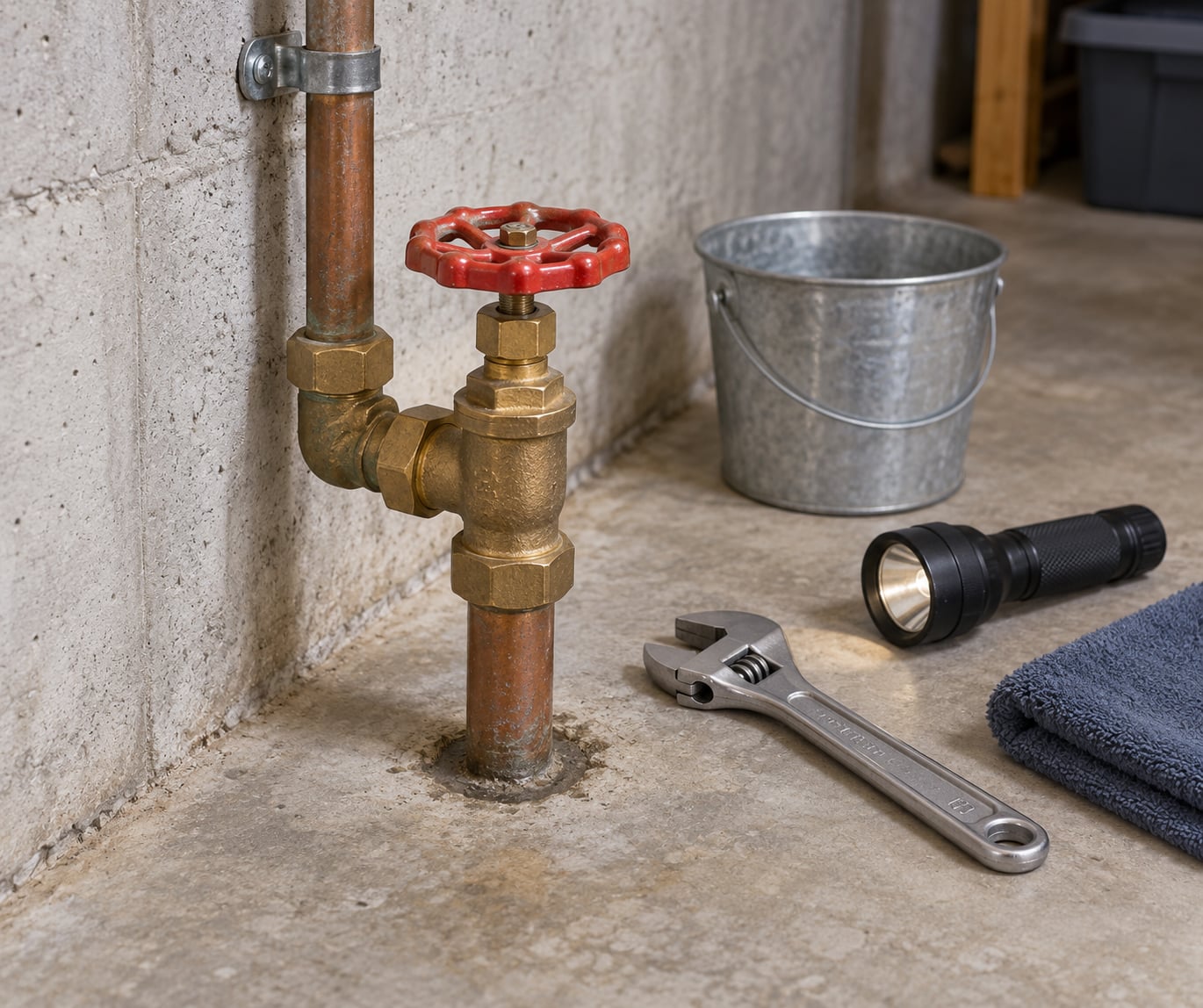
Shutting off the water main means turning one valve clockwise until it stops. On a lever-handle ball valve that is a quarter turn; on a wheel-handle gate valve it is several turns. Most homes have that valve either where the service line enters the house or inside a meter box near the curb, and turning it takes about five minutes with no plumbing experience.
The reason to know where it is sits in a flooded basement. A burst pipe can dump several gallons a minute, and the main is the only fast way to stop it while you call a plumber. It also comes in handy before any plumbing work, before a water heater swap, and before you leave a house empty for weeks.
One caveat up front: in an apartment or condo the main valve usually belongs to building management, and the utility owns the curb-side valve at the meter. If you rent, your realistic options are the valves inside your own unit and a call to the building.
Table of Contents
- What You Need Before You Turn Anything
- Step-by-Step: How to Shut Off the Water Main in Your House
- Step 1: Locate the Main Water Shutoff Valve
- Step 2: Check the Valve Before Turning It
- Step 3: Turn the Valve Off Slowly
- Step 4: Test That the Water Is Off
- Step 5: Repair the Leak or Burst Safely
- Step 6: Restore Service When Repairs Are Finished
- Common Mistakes When Shutting Off the Water Main
- When to Call a Plumber
- Frequently Asked Questions
- Why is water still running after I turn the main valve off?
- How long does it take for water to stop after turning off the main valve?
- Which valve do I turn if my meter box has two?
- What do I do if the main shutoff valve will not turn?
- How do I shut off the water in an apartment or condo?
- Do I need to turn off the water heater before shutting off the main?
- Conclusion: Find Your Valve Before You Need It
What You Need Before You Turn Anything
You need almost nothing, which is why people put this off for years and then need it at midnight. A flashlight and a clear path to the valve cover most cases.
- A flashlight or headlamp. Crawlspaces and meter boxes at night are genuinely dark, and a phone flashlight drains fast.
- An adjustable wrench. Only for a corroded gate valve or an old curb stop. A healthy quarter-turn ball valve needs nothing at all.
- A T-shaped water meter key. This lifts the cast lid on a curb-side meter box. Hardware stores sell them inexpensively, and many homes already have one in a shed or garage. A flathead screwdriver can pry a loose plastic lid, but it chips the concrete edges.
- A bucket and a couple of towels. Water still in the line will come out of the faucets when you open them to relieve pressure.
- Clear access to the valve. Move whatever is stored in front of it first, while you still have time.
It also helps to know whether you are on municipal water or a private well. If a utility bills you, you have a meter and possibly two valves at the curb. If you do not pay a water bill, the shutoff is at the well pump or on the well line inside the house.
Step-by-Step: How to Shut Off the Water Main in Your House
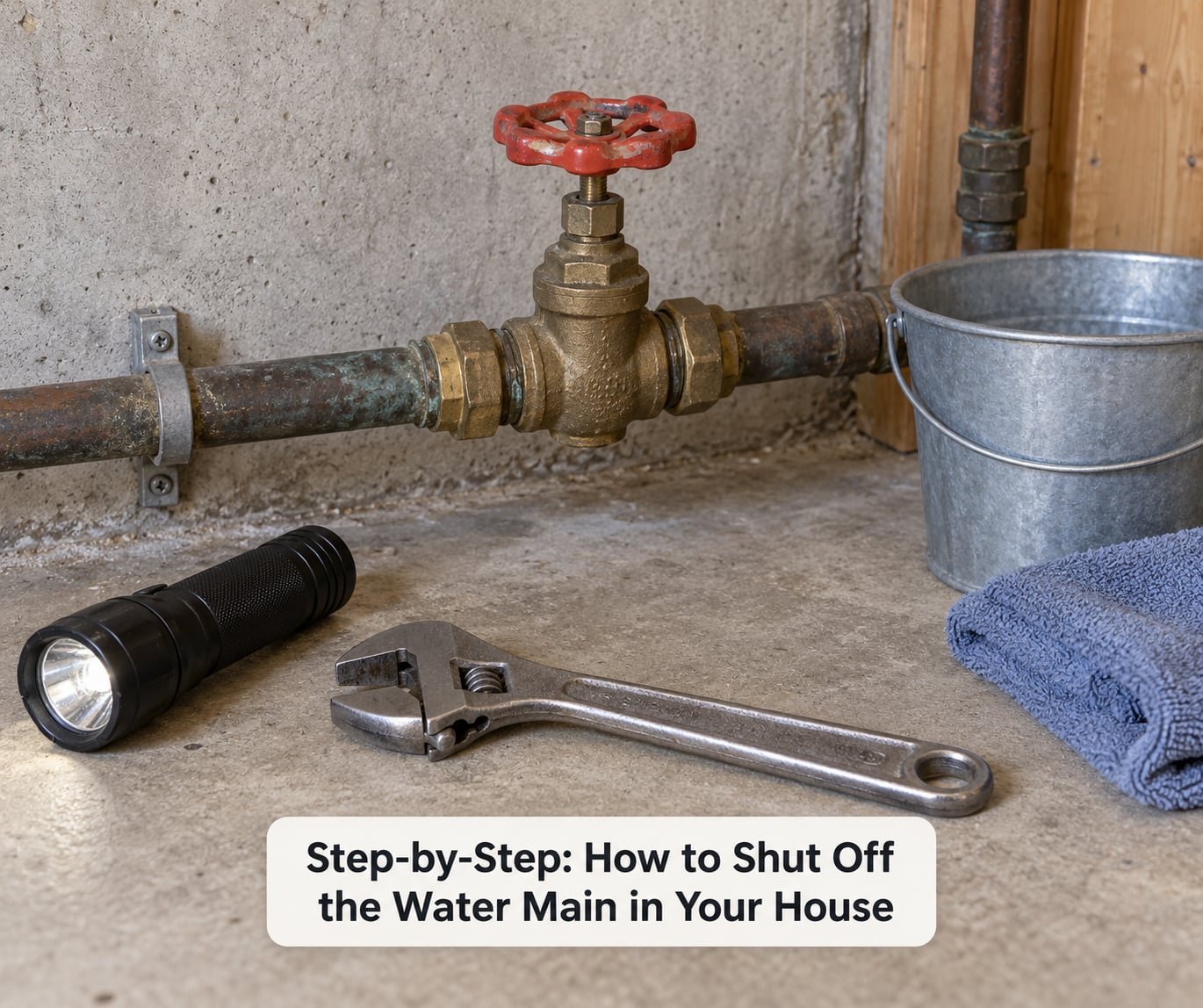
Step 1: Locate the Main Water Shutoff Valve
Inside the house, the valve usually sits where the cold water service line enters the building. Trace an exterior faucet or hose bib back through the wall and look directly opposite it on the other side, at the lowest level of the home.
Common indoor locations include a crawlspace near the front foundation wall, a basement mechanical room, a garage wall, a laundry or utility closet, or a plastic box recessed into an exterior wall in warm climates. Homeowners find theirs in stranger spots than expected, which is why labeling it matters.
Outside, look for a rectangular or round meter box in the ground along the property line, often near the sidewalk or driveway. Its lid is usually marked WATER. Lift it with a meter key and you will see the meter itself, a utility-side valve on the street end, and a house-side valve between the meter and the home. Turn the house-side one. Turning the street-side valve is utility property, and breaking it gets you a bill for the repair.
Step 2: Check the Valve Before Turning It
Look at the valve for a minute before touching it. A ball valve has a lever handle and needs a quarter turn. A gate valve has a round wheel and needs several slow turns until it stops. A small inline valve feeding a single fixture is not your main.
Warning signs mean stop: corrosion flaking off the body, paint or grime caked on the stem, a handle that wobbles, or weeping around the bonnet. A seized valve that has not moved in a decade is exactly the valve that snaps its stem if you lean on it.
Step 3: Turn the Valve Off Slowly
On a ball valve, put the lever perpendicular to the pipe and rotate it a quarter turn clockwise so the lever ends up parallel to the pipe. That position is off, open is along it.
On a gate valve, turn the wheel clockwise steadily until it stops, usually 5 to 10 turns. Steady pressure beats body weight. Do not use a pipe wrench on a good valve; the jaws scar the bonnet and the fittings, and you may need that wrench later.
Step 4: Test That the Water Is Off
Open a faucet on the lowest level of the house and a cold tap on the highest. Both should run for a few seconds, sputter, then drop to a trickle and stop. That trickle is what is left in the pipes, not a failed shutoff.
If a faucet runs a steady stream, you turned a branch valve by mistake or the water is coming from a different supply. Find the valve that is farthest from the house and try again.
Step 5: Repair the Leak or Burst Safely
With the water off, open the faucets fully to relieve pressure and drain what is standing in the lines. That stops the trickling and makes any joint work far cleaner.
Keep electricity out of the room if water is near a panel, an outlet, or an appliance, and switch off the breaker first. Move what you can out of the way, open cabinet doors under sinks to catch drips, and set towels where water runs off a joint rather than down a wall.
If you have a water heater, a long shutdown with a full cold tank can leave the heating element running dry when power returns. Many plumbers recommend shutting off or letting the tank cool and drain before a shutdown lasting more than a day.
Step 6: Restore Service When Repairs Are Finished
Open a few faucets first, then turn the main valve counterclockwise and slowly. On a gate valve that means several unhurried turns back to where it started. Turning it on fast is the single most common way people cause water hammer and crack joints in older homes.
With the supply back, let the open faucets run until the flow is steady and sputter-free, which flushes air and sediment. Check the repaired joint and the joints you disturbed, then close the faucets one at a time. If a faucet only dribbles, remove the aerator and clean it.
Leave the main fully open when you are done. A valve left partly closed throttles flow and makes the next emergency shutdown harder.
Common Mistakes When Shutting Off the Water Main
Almost every mistake here comes from acting before knowing which valve is which. These are the ones that show up over and over.
- Turning a fixture valve instead of the main. Under-sink and toilet valves stop one fixture. Follow the pipe to where it enters the house and use the largest valve on that line.
- Forcing a seized valve. Plumbers warn consistently against it. A snapped stem turns a valve that only needed a wrench into a flooded wall.
- Choosing the utility-side valve at the meter. The house-side valve is yours; the street-side one is not.
- Ignoring the water heater. During a long shutdown an empty tank with a powered element is how heaters fail.
- Cranking the water back on fast. Slow reopening prevents water hammer, which can split pipes that were fine an hour earlier.
- Leaving the valve half open afterwards. You lose pressure and create a new leak path the next time you need it.
- Not teaching anyone else. Label the valve with bright tape and tell every adult in the house where it is.
When to Call a Plumber
Stop and call for help when the main valve will not turn, when it turns but the water keeps flowing, or when you cannot tell which of two valves is the real one. Those are repair jobs, not homeowner jobs.
Call a plumber for a burst pipe you cannot reach, a sewage backup, water near electrical equipment, or a shutoff that fails on the second attempt. Call your water utility, not a plumber, if the valve that will not move is the street-side one at the meter or the curb stop itself, since those are utility property and may need a utility-only key.
Exercise the valve once or twice a year by turning it off and back on with no plumbing work pending. A valve that moves regularly rarely seizes, and a valve that has sat closed for ten years often does.
Frequently Asked Questions
Why is water still running after I turn the main valve off?
For the first minute or two that is normal. Water already in the pipes drains out, so faucets run, then sputter, then trickle and stop. Fixtures above the shutoff can keep a small flow because of check valves, and irrigation or an outdoor spigot on a separate branch may still be live. If a steady stream lasts more than five minutes, you turned a branch valve rather than the main.
How long does it take for water to stop after turning off the main valve?
You should see the flow drop within 15 to 30 seconds and stop completely within two to three minutes in most homes. A large house on a long service line, or a home with a water heater and a full toilet cistern, can take closer to five minutes. Anything beyond that, or a faucet that runs at full pressure, usually means the valve you closed is not the main.
Which valve do I turn if my meter box has two?
Turn the one closer to your house, between the meter and the home. It is often labeled as the consumer or customer valve. The other valve, between the meter and the street, is owned by the water utility, and forcing it can leave you paying to replace it. If the house-side valve will not turn, call the utility rather than working on the street-side one yourself.
What do I do if the main shutoff valve will not turn?
Do not force it. A corroded or painted-over gate valve usually snaps its stem, and a replacement runs from a simple washer swap to cutting into the wall. Try a gentle quarter turn with an adjustable wrench and nothing more. If it does not move, a plumber can often free a stuck valve with a stem nut and penetrating oil, or replace it in an accessible location.
How do I shut off the water in an apartment or condo?
Most buildings keep the main valve in a mechanical room or a locked utility closet that only staff can reach, and the meter at the curb belongs to the utility. What you can control is inside your unit: the angle stops under each sink, the shutoff valves on the toilet, and the valve feeding a water heater if your unit has one. For anything at the building level, call management and say whether you have an active leak.
Do I need to turn off the water heater before shutting off the main?
For a repair lasting a few hours, no. For a shutdown of a day or more, yes: switch the heater off at its breaker or gas control, or let it cool and drain. An empty tank with a powered heating element can burn out the element the moment power returns. The same reasoning applies if you are replacing the heater, where draining the tank is part of the job anyway.
Conclusion: Find Your Valve Before You Need It
The whole job is one valve turned clockwise, a faucet opened to confirm it worked, and the same valve turned back slowly when the repair is done. Spend ten minutes this month walking your home, finding the main water shut-off valve, and taping a label on it.
If you cannot find a valve anywhere, start at the meter box by the curb or at the utility access point your water bill references, and ask your water utility where the service enters your property. Then test it, so the next time a pipe fails you are guessing at nothing.