Negotiating a car price at a dealership comes down to four things: know the car’s real market value, collect written offers from several dealers, negotiate one number instead of a monthly payment, and be genuinely willing to walk out. Bargaining skill matters much less than preparation, and preparation takes an afternoon.
The reason buyers lose money is rarely the sticker price. It is the layer of fees, add-ons and financing markup that arrives after they think the haggling is done. So the order of operations matters more than the words you use. Price first, trade-in second, financing third, add-ons never.
Below is the process I would follow, in the order I would follow it.
Table of Contents
- What You Need
- Step-by-Step: How to Negotiate a Car Price at a Dealership
- 1. Set a maximum price before you visit
- 2. Research the vehicle and its market value
- 3. Get competing written offers
- 4. Negotiate the vehicle price separately from the total cost
- 5. Make a confident first counteroffer
- 6. Ask what would make the dealer beat your offer
- 7. Review financing, trade-in value and the buyer’s order
- 8. Know when to walk away
- Common Mistakes
- Frequently Asked Questions
- How much can you usually negotiate off a car price?
- Can the out-the-door price be negotiated?
- What should you never reveal to the dealer when negotiating?
- How do I get a dealer to come down when they say the price is final?
- Should I negotiate by email, by phone, or in person?
- Is negotiating off MSRP a good deal?
- Conclusion
What You Need
Before you contact a single salesperson, get these in place. The whole list is a couple of hours of work, and it takes a dealer about ten minutes to notice you have done it.
- A hard ceiling written down. The most you will pay in total, everything included, written on paper before you walk in. One number, no exceptions.
- Real transaction prices, not sticker prices. Edmunds and Kelley Blue Book give you ranges, but what people actually paid is more useful. CarEdge and TrueCar lean toward real sold numbers.
- A vehicle history report. A Carfax report on a used car, so you are not discovering problems while standing on the lot.
- Financing pre-approval. A credit union or your own bank will usually approve in a day, and the letter proves you can close the deal without the dealer’s finance office.
- Trade-in benchmarks. Instant offers from CarMax and Carvana give you a floor to measure the dealership’s appraisal against.
- Written offers from other dealers. Email, not a phone call. A number in an inbox is evidence; a number in your memory is not.
- A quiet hour before you go. Never negotiate the same evening you researched. You will make bad calls when you are tired and excited.
One more thing: decide now what you will do if the dealer will not meet your number. The answer is usually that you drive home with your trade-in still in your driveway. Buyers who decide that in advance negotiate far more calmly than buyers who hope for the best.
Step-by-Step: How to Negotiate a Car Price at a Dealership
1. Set a maximum price before you visit
Write down one number: your out-the-door limit. That means the selling price plus doc fee, taxes, registration, plus anything optional you might be talked into. If you skip this step, every number the dealer mentions becomes a negotiation against an undefined target.
Add a little room above your ceiling for the trade-in conversation, but keep the ceiling itself fixed. A buyer who walks in without a number spends the whole afternoon guessing at what is reasonable.
2. Research the vehicle and its market value
Compare the same trim, the same mileage range, the same options, the same condition across at least five listings of that exact car. Three from dealers, two from private sellers, so you can tell whether a dealer asking a particular figure is normal or padded.
Then find out what that configuration actually sold for. A discount from MSRP means nothing on its own, because dealers discount in the sticker before they start talking. What you want is the net figure a buyer paid after fees.
3. Get competing written offers
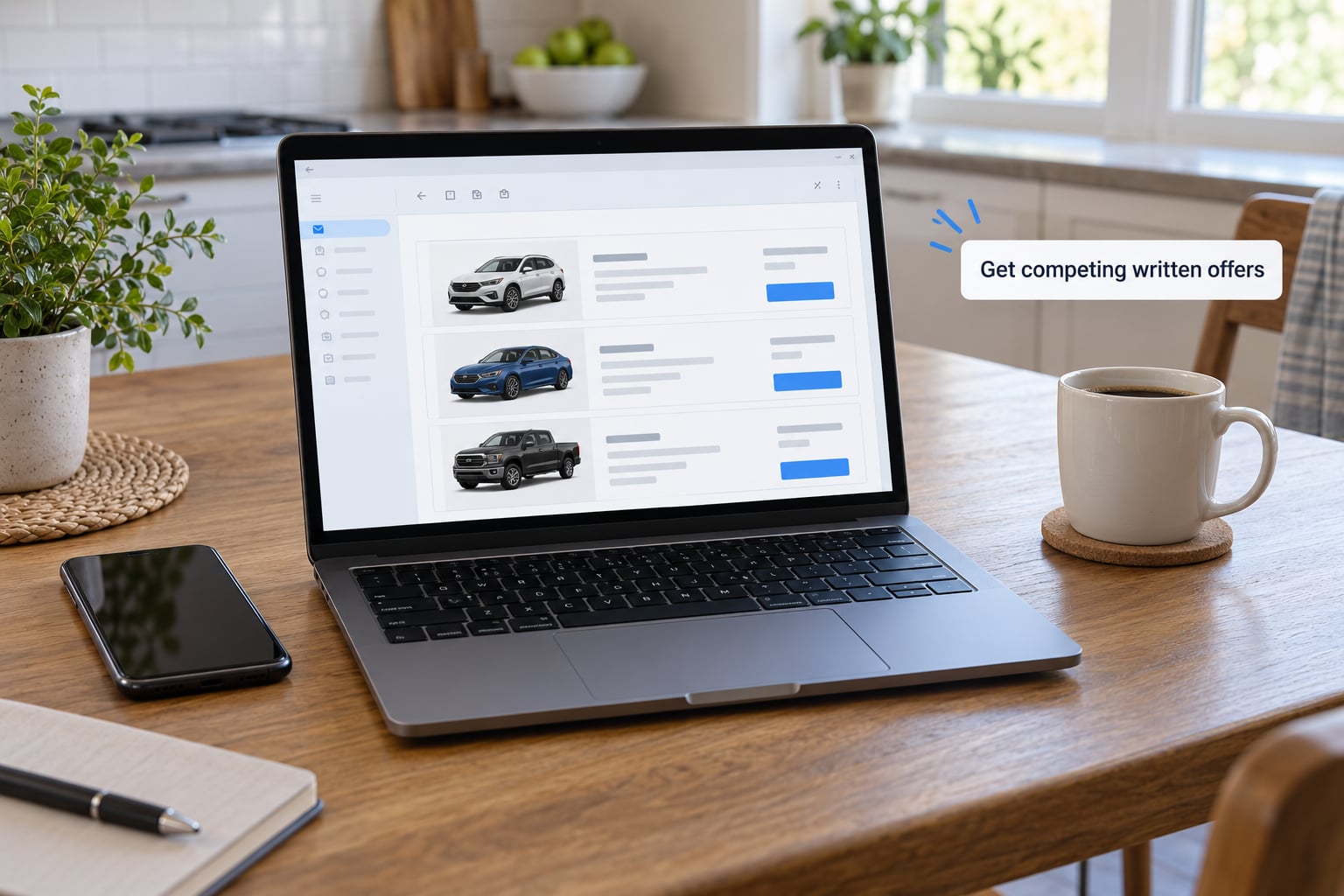
Email five to ten dealers the same message and ask for the out-the-door price in writing on a specific vehicle. Something like: “I’m looking at the [year, trim, mileage] in stock. Please email me the out-the-door price, itemized, with any doc fee and dealer charges listed separately.”
Most dealers answer within a day. Some refuse and invite you in instead. Refusal is information: they do not want the number in writing where you can compare it against the next dealer’s answer.
When a dealer says come in and we will work it out together, a neutral reply works: “I will come in once I have a number I can compare. If you can get me close to that in writing, I will be there this week.”
4. Negotiate the vehicle price separately from the total cost
Split everything into line items and work them in a fixed order. The selling price is fully negotiable. The doc fee is negotiable in most states, though a few cap it. Taxes and registration are set by law and are not part of any conversation.
When a dealer quotes a monthly payment, do not work with that number. Ask for the price of the vehicle, then ask what is added to it. Monthly payments let a dealer hide an expensive car inside a payment that looks affordable, and extending the loan term is how they do it.
5. Make a confident first counteroffer
Open a little above where you expect to land, because the first number is never the last one. Anchor your ask to the market range you found, not to the discount the dealer already advertised.
Deliver it in one sentence, without a speech: “Based on what these cars have been selling for, I am at [number] out the door.” Then stop talking. Long explanations give the salesperson something to attack, and a stated reason turns an offer into a debate.
6. Ask what would make the dealer beat your offer
When they come back higher, do not counter with a smaller number. Ask what would have to change for them to go lower: “What would it take for you to get to [number]?”
This question works because it moves the burden onto them to name a specific barrier, and often there isn’t one. The salesperson may need to bring a manager for approval, which is normal and fine. Allow about thirty minutes for that step and then wait.
7. Review financing, trade-in value and the buyer’s order
Do the trade-in after the vehicle price is agreed, and never let it blend into the number. Get the instant offer amounts first, then let the dealership try to beat them. If you sell the vehicle privately instead, the sales tax treatment often works out better too.
Compare any dealer financing against the letter you already have. Look at the APR and the loan term, not the payment, and reject add-ons you did not ask for: extended warranties, gap coverage, paint or fabric protection, VIN etching, nitrogen tires, wheel locks.
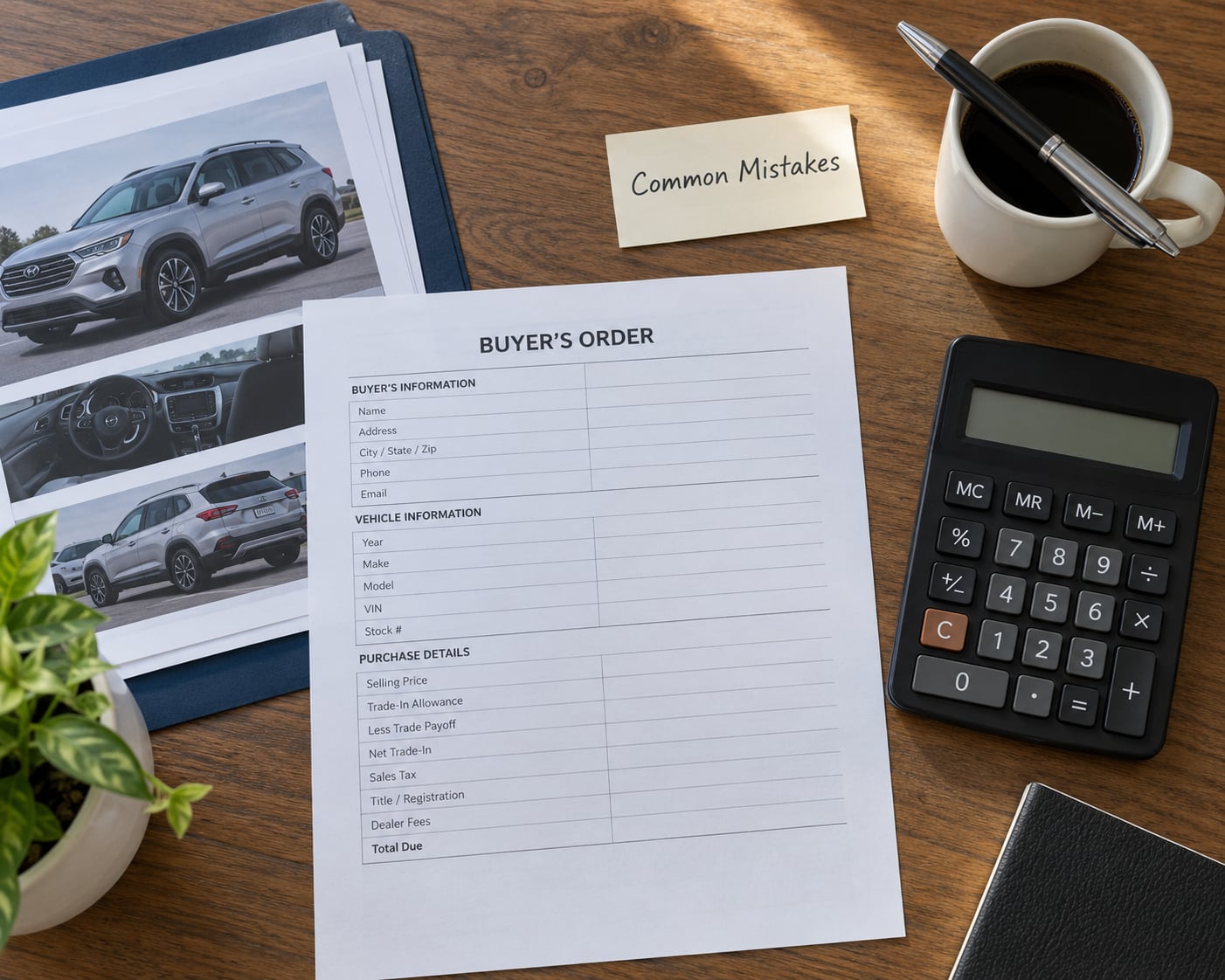
Then check the buyer’s order line by line against the out-the-door figure you agreed on. Compare the printed copy with whatever is on the screen. Ask for every change to be initialled. Do not sign anything you have not read, and take the contract home if they push.
8. Know when to walk away
Leave when the total will not move below your written ceiling, when a fee appears that was not disclosed, or when the pressure turns personal. A dealer who will not put the price in writing is telling you something useful.
Walk out calmly: “Thank you for the time. I am going to go back to the other offers I have and see what happens.” Then actually leave. Many dealers call back within a day or two with a real number, because the sale was never the problem, the price was.
Common Mistakes
Almost every costly misstep in car negotiation comes from one of these.
Revealing your budget too early. The moment a dealer knows your ceiling, the negotiation is over in their favour. Answer budget questions with a redirect: “I’m buying the car, not the payment. What is your best out-the-door number?” Keep your pre-approved amount and your trade-in condition to yourself until those numbers are settled.
Negotiating in the wrong order. Trade-in before price, or financing before price, and the numbers stop being separate. The order is always vehicle price, trade-in, financing, add-ons.
Treating the monthly payment as the goal. A lower payment achieved by stretching the term means you paid more for the car. Ask for total cost every time.
Falling for a discount off a pre-discounted sticker. Some dealers mark up above MSRP and then cut it back to look generous. The percentage is theater. Compare the out-the-door number against what the car actually sells for.
Signing on a deadline. Daily quotas, month-end targets and year-end clearouts are real pressure, and they work in the buyer’s favour. Refusing to decide on the spot gives you all the leverage you need.
Skipping the independent inspection on a used car. A pre-purchase inspection by a mechanic who is not connected to the dealer runs a few hundred dollars and routinely finds enough to justify itself.
Treating an unusually low price as a win. Buyers in forums repeat the same warning about cheap cars: a price far below the market usually means a history problem or mandatory fees added back later. Check the history report before you celebrate.
Two habits keep you steady through all of this: take notes during the conversation, and stay polite. Dealers expect to bargain, and a calm buyer who is asking for numbers gets treated better than a tense one. Politeness costs nothing and it buys you room.
Frequently Asked Questions
How much can you usually negotiate off a car price?
On an in-stock vehicle at an independent dealer, or near a month-end or quarter-end target, there is often three to five percent of the selling price available. Limited-production and high-demand vehicles may not move at all. Open above that range, because the first number is rarely the last. Judge the result by the out-the-door total rather than the discount.
Can the out-the-door price be negotiated?
Yes, and it is the number you should work on. The selling price is fully negotiable, the doc fee is negotiable in most states, and taxes and registration are fixed by law. Negotiating the total captures all three at once, which is why it beats haggling over line items one by one.
What should you never reveal to the dealer when negotiating?
Keep four things back: your maximum budget, the monthly payment you can live with, the terms of your financing pre-approval, and the condition of your trade-in before it is appraised. Each one hands the dealer a target. You can confirm you are a serious buyer with a credit union pre-approval letter without naming a number.
How do I get a dealer to come down when they say the price is final?
Ask what would make them go lower, then wait. Prices declared final early usually mean the salesperson has not yet asked a manager, who can approve more than the person who greeted you. Give it half an hour. If the number genuinely will not move after a manager is involved, you have your answer and your decision is simply whether it clears your ceiling.
Should I negotiate by email, by phone, or in person?
Start by email, because written offers are comparable and pressure-free, and you can reach far more dealers than you could visit. Phone works well for one clarifying question. In person is where a manager gets involved and where the closing happens, but only after you already have written numbers to compare.
Is negotiating off MSRP a good deal?
Not on its own. MSRP is a starting figure that some dealers mark up before cutting back, so a discount from it can mean nothing. Look at what the same trim with similar options has actually sold for, then compare the out-the-door total. A small discount on a fair price usually beats a large discount on an inflated one.
Conclusion
Start with one afternoon of research before you start any negotiation. Find the real market range for the exact car, get an instant trade-in offer, get financing pre-approved, and email five to ten dealers asking for itemized out-the-door prices in writing.
Then work the list in order: vehicle price, trade-in, financing, add-ons. Never mention a monthly payment, never reveal your ceiling, and never sign a buyer’s order that has changed since you last read it. That sequence alone puts most buyers ahead of the person next to them on the lot, and it costs nothing but the afternoon you spent preparing.