A family emergency communication plan is a written, rehearsed document that tells every member of your household who to call, where to go and what to do when a disaster separates you from each other. Building one takes 30 to 60 minutes the first time and about ten minutes per update after that. The hard part is not writing it down — it is deciding, in advance, the handful of details everyone else will be too stressed to remember.
Plenty of households have a full go-bag and no plan at all: three days of water in the closet, and when the power goes out nobody can say who was supposed to call grandma. That gap is the whole reason this guide exists. You need the supplies, but you need the contact sheet, the two meeting spots and the backup channels more, because those are what you actually reach for in the first ten minutes.
Below is the six-step version I walk families through, plus a fill-in contact sheet and message scripts you can copy straight out of this page. No downloading a PDF, no filling in a form on a government site. Just paper and a pen.
Table of Contents
- What You Need
- Step-by-Step: How to Make a Family Emergency Communication Plan
- 1. Identify Likely Emergencies and Communication Failures
- 2. Build a Contact List With Primary and Backup Options
- 3. Assign Family Roles and Check-In Procedures
- 4. Choose Meeting Places and Backup Routes
- 5. Create Offline Copies and Message Templates
- 6. Practice, Review, and Update
- Common Mistakes
- Frequently Asked Questions
- How often should a family emergency communication plan be updated?
- What if the mobile network is unavailable during an emergency?
- Should children be responsible for making emergency calls?
- How do you choose an out-of-area emergency contact?
- Where should the family keep a copy of the communication plan?
- Conclusion
What You Need
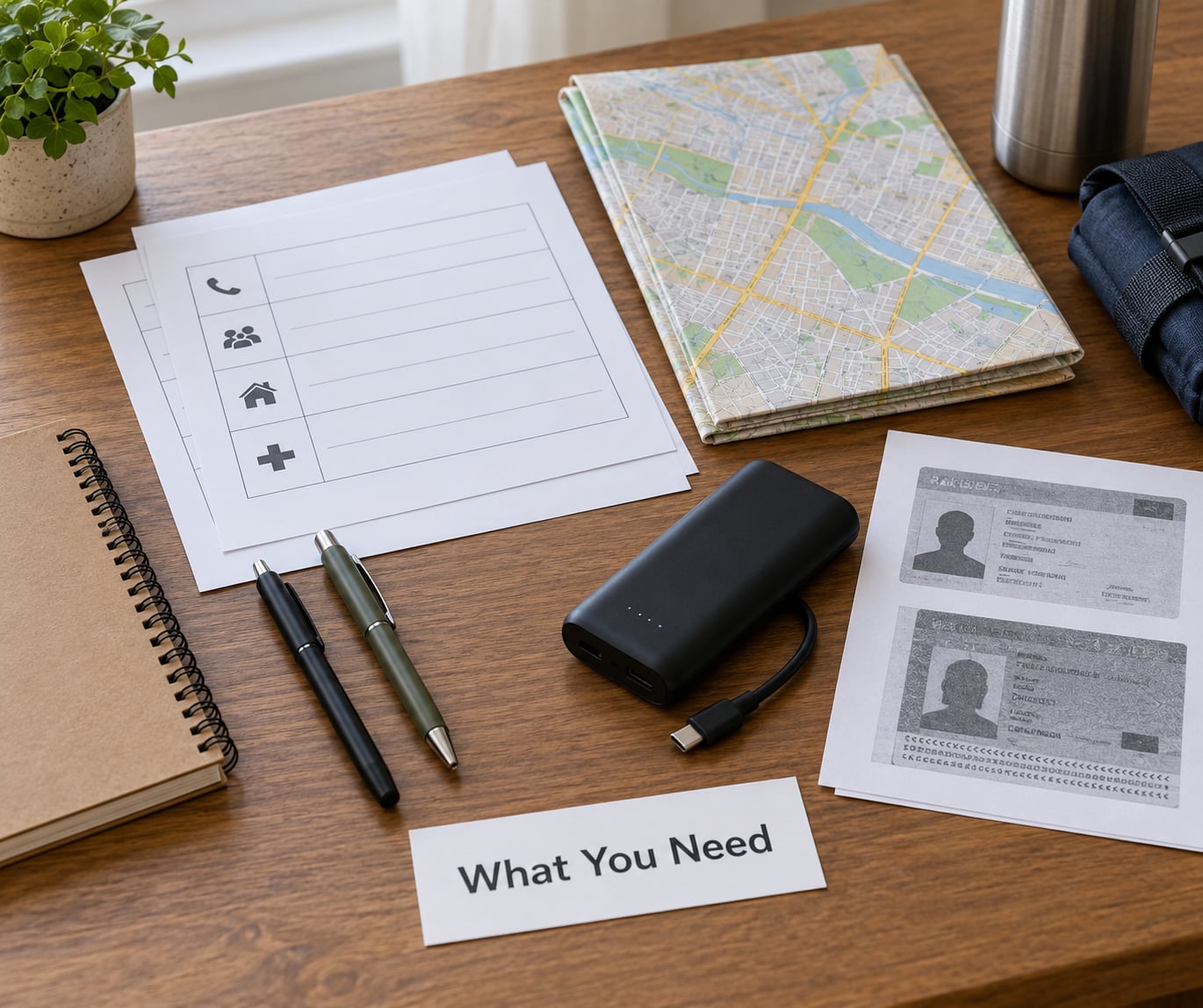
Gather these before you write a single line of the plan itself. Everything here is information you assemble once, then reuse every year.
- The emergencies your area actually has. Check your county emergency management site and your state alerts page for the hazards that hit your zip code: tornado warnings, river flooding, wildfire zones, earthquake fault lines, hurricane surge maps.
- Contact details for every household member. Mobile, work or school number, and email. Kids get the school office number, not just a parent’s phone.
- One out-of-town contact plus two backups. Someone 60 to 100 miles away who is not on your local cell network.
- Two meeting places. One near home, one outside your neighborhood, both reachable on foot.
- Medical and accessibility details. Prescriptions, allergies, mobility needs, service animals, doctor and pharmacy names, insurance card numbers.
- Identification documents. Copies of ID, birth certificates and insurance cards for each family member.
- A reliable local emergency number and current evacuation guidance. Know the non-emergency number for your local police and fire department too — during a big event the emergency line is flooded and the desk line still answers.
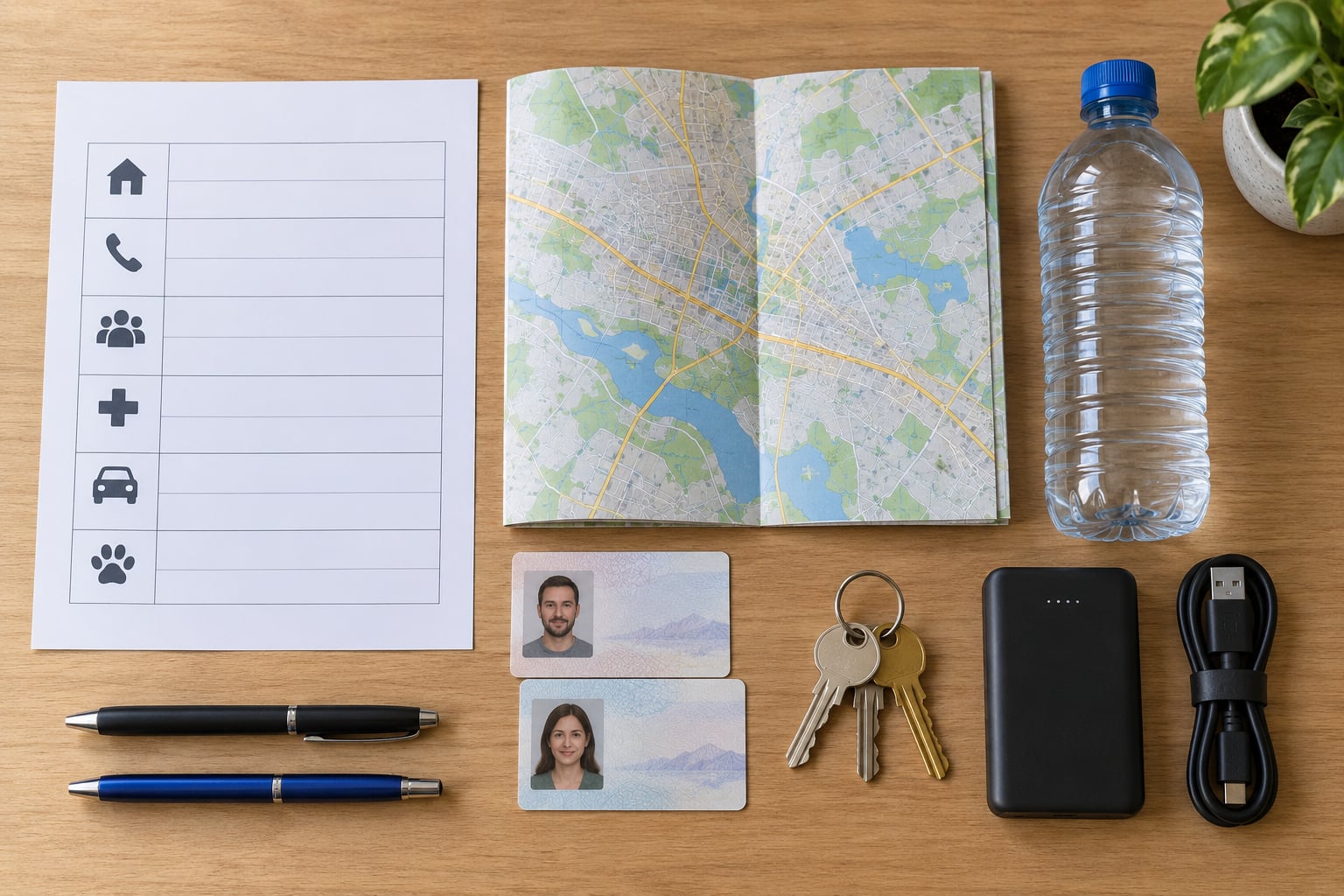
Write the plan on paper and store copies in five places: every adult’s wallet, the go-bag, a copy at home near the front door, one in the vehicle’s glove box, and one in any school bag that goes back and forth. A plan that lives only in a phone is a plan that disappears at exactly the wrong moment. The Federal Emergency Management Agency at Ready.gov and the American Red Cross both publish free checklists you can use as a starting template if you’d rather not start from a blank page.
Step-by-Step: How to Make a Family Emergency Communication Plan
Six steps. Work through them in order, because each one feeds the next, and expect 30 to 60 minutes for the first pass. After that, updates take ten minutes and happen whenever something in your household changes.
1. Identify Likely Emergencies and Communication Failures
Start by naming the situations that could separate your family, then decide which services fail in each one. Severe weather, a home fire, a flood or flash flood, an earthquake, a chemical or gas release, a medical emergency, a missing child, a school closure, a neighborhood evacuation — write down the three or four that are realistic where you live and discard the rest.
For each one, ask a second question that most checklists skip: what communication breaks? In a wildfire evacuation, cell towers lose power and the network gets crowded at the same moment. In an earthquake, towers are fine but handsets and landlines are broken. During a winter storm, the power goes and the car battery dies before the phone battery does. When you know which failure belongs to which hazard, you know which backup channel has to be ready.
Skipping this step is what turns a plan into a generic piece of paper. A family in a flood-prone town needs a walking route to higher ground. A family on a wildfire interface needs a two-hour departure time, not a phone number. Prioritize by your location, not by a national list.
2. Build a Contact List With Primary and Backup Options
Everyone’s phone number is the easy part. The plan needs three layers: a local contact for most situations, an out-of-town contact for when local networks fail, and a named alternate for each of them. One person is a single point of failure, and that person is usually the one who is hurt, asleep, or driving three hours away from home.
Choose an out-of-town contact carefully. Pick someone who is not in your zip code, does not live with you, is awake at odd hours, and has no trouble using a phone or a group text. Relatives in another state or country work well. Ask them directly, in writing, that they agree to relay messages, and give them a copy of your contact list too. Then pick a second and a third in case the first is also affected.
Now decide how you reach someone whose phone is lost, damaged, powered off, or simply unable to receive a text. Do not assume a call going unanswered means something is wrong, and do not assume a text that never arrives means it was ignored. Write the fallback into the plan: send one text, wait fifteen minutes, try the work or school number, then try the person’s emergency contact rather than calling again immediately.
The point of knowing how to make a family emergency communication plan is redundancy. Build a channel list that works when phones do not.
| Channel | Works without power | Works without cell service | Best for |
|---|---|---|---|
| Mobile phone call | No | No | Most everyday contact |
| SMS text message | Briefly | Often longer than calls | Status updates, slow networks |
| Landline phone | Yes, if the line is up | Yes, in most outages | Homes that still have one |
| Wi-Fi calling or messaging apps | No | No | Only when both networks work |
| Two-way radio | Yes | Yes | Neighbor check-ins, short distances |
| Battery pack or car charger | Yes | Yes | Extending phone life during an outage |
| Walking to a trusted neighbor | Always | Always | Children, anyone without a phone |
| Satellite messenger or satellite phone | Yes | Yes | Remote areas and long outages |
| Local radio or TV broadcasts | Battery radio only | Yes | Official evacuation and shelter news |
Most households no longer have a landline, so treat that row as a gap to fill rather than a plan to rely on. A cheap prepaid home phone or a battery-powered two-way radio covers the same hole for a lot less money than most people expect. Sign up for your county’s reverse-911 alert system and enable Wireless Emergency Alerts on every adult’s phone, which sends an automatic warning to nearby phones without needing an app.
3. Assign Family Roles and Check-In Procedures
Give every family member a role that matches their age and ability, and always write a second person for each critical role. One adult calls the emergency service, one gathers medication and the go-bag, one supervises the children, one handles pets, one notifies relatives. A twelve-year-old can hold a younger sibling and read a printed contact sheet aloud. A teen can take the dog leash and meet their grandmother at the door.
Then fix the check-in procedure, because improvisation is what breaks under stress. Decide who makes the first outside call, how long you wait before trying again, and what the message must contain. A workable rule: one adult sends the first message to the out-of-town contact, and everyone else waits fifteen minutes before trying anything. If nothing gets through, that single adult switches to the backup channel in the table above rather than calling repeatedly and clogging the network.
Plan for the adult in charge being unable to help. This is the gap most checklists leave open: a small child who cannot make a call when every adult’s phone is locked behind a passcode. Solve it with a few specific steps rather than a promise. Put medical information in the phone’s emergency or medical ID settings so a responder can read it without unlocking the device. Turn on emergency SOS. Leave a prepaid or basic handset charged in a drawer with the emergency numbers written on it. Choose one neighbor within walking distance and tell your child that person’s name, and tell the neighbor too — on both sides, so nobody is relying on a stranger opening the door.
Give children a clear split between calling for help and asking a trusted adult. Under about twelve, most situations are the second kind: call a neighbor or a relative for a lost toy, a scrape, or a flooded basement. True emergencies are fire, smoke, a person not waking up, someone bleeding badly, a gas smell, or being told to leave the house. Write both lists on the card your child carries so nobody has to make that call twice.
4. Choose Meeting Places and Backup Routes
Name three places and put them on paper. The first is close to home, something a child can reach in ten minutes on foot — a specific driveway or a specific corner store, not “the neighborhood park,” because people look in different parks. The second is a few blocks away but on the other side of whatever hazard you planned for, such as a floodway or a chemical plant. The third is outside your neighborhood, near a gas station or a parking lot with one entrance and enough room for everyone to arrive by car.
Write down when to use each one, because the decision is the hard part. If officials order an evacuation, leave immediately and go to the out-of-area spot. If the incident is contained and you are told to shelter in place, stay put and send a message instead. If the house is on fire, meet at the near spot. If the emergency is on your street and you are several miles away, go straight to the meeting place rather than driving into the affected area.
Plan the route with the slowest family member in mind. Walk it once. Check that an older adult or someone with a wheelchair can get through a gate, over a curb, and into a building with an automatic door. Note the backup route if the primary road floods or gets blocked, and pick a meeting point that does not depend on crossing a bridge, a tunnel, or an intersection near a fire station.
Pets and medications belong in this section, not in a supply list nobody reads. Decide who owns the leash and carrier, whether the pet goes with you or stays with a neighbor, and where medication lives if you evacuate versus shelter. Families with two homes need a version that reaches both addresses, including the other parent’s phone, the second school’s office, and a rule for who tells the children what is happening.
5. Create Offline Copies and Message Templates
Print the contact sheet, fill it in, and run two copies off. This is the single most useful artifact in the whole plan, and it takes five minutes.
| Name | Mobile | Work or school | ICE contact | Notes | |
|---|---|---|---|---|---|
| Parent 1 | — | — | — | — | Out-of-town contact |
| Parent 2 | — | — | — | — | — |
| Child, school pickup | — | School office | — | — | Authorized pickup |
| Child, school pickup | — | School office | — | — | Classroom |
| Neighbor (walking distance) | — | — | — | — | Has key, knows kids |
| Out-of-town contact | — | — | — | — | Backup 1 and 2 |
| Doctor and pharmacy | — | — | — | — | Prescriptions |
Write the messages down before you need them. Under stress, people type three paragraphs and the important fact is in sentence four. Use short texts, because SMS often gets through on a congested or degraded network when data-heavy apps stall completely.
- All clear: “We are all safe at home. Power is out. No injuries. Next update at 6pm.”
- Status with location: “Mom and Dad are OK. We are at the corner store on Main St. Waiting out the wind.”
- Danger: “Gas smell in the house, leaving now. Do not enter. We are going to the high school lot.”
- Destination: “Leaving for the shelter at the community college. Adults and two kids. Will text when we arrive.”
- Need help: “Grandma fell and cannot get up. Ambulance called. I am with her.”
- Update to the out-of-town contact: “All four of us accounted for. No injuries. We are staying put until the all-clear tomorrow at 7am.”
Protect the copies without making them useless. Keep full contact numbers on the copy at home and in the go-bag, and keep a reduced wallet card with one contact number and the meeting place rather than everything. Avoid putting insurance numbers or medical details on a card that rides in a school backpack all week. Lock the plan in a drawer or a folder, not on the refrigerator where anyone walking through sees it.
6. Practice, Review, and Update
An untested plan is a guess. Run a 20-minute drill twice a year — once before storm season, once before the school year — and include two scenarios every time: a power outage where nobody’s phone charges, and a separated-family scenario where one adult is “injured” and cannot make calls. Announce it as a drill so nobody is frightened, then run it for real. Time how long it takes to reach the out-of-town contact, check that everyone can get to the near meeting spot on foot, and confirm the child can find the wallet card and the neighbor’s name.
Add a code word that means “everything is fine, stay where you are,” so kids can report in without a suspicious-sounding message. Test that the emergency SMS template actually arrives, and that the battery pack is charged rather than sitting empty since last year.
Knowing how to make a family emergency communication plan also means knowing when to rewrite it. Name one person as the owner of the plan. Then set triggers, not just a calendar: a move, a new job or school, a separation or new partner, a new baby, a new caregiver or pet, a phone number change, a prescription change, or anyone starting to need help getting around. Review the whole document every six months anyway, and hand the job to the next person if that owner moves away.
Common Mistakes
Keeping the plan in one place. A single copy at home helps nobody who is not at home. Fix: five copies — wallet, go-bag, front door, vehicle, school bag — and a photo of the contact sheet in the family group chat as a backup.
Relying on one relative. The out-of-town contact is also the person most likely to be on vacation with no signal. Fix: two alternates, in the same out-of-area region, with their numbers on the sheet.
Using a group chat as the only channel. Group chats depend on every phone being on, charged, and online, and they collapse in a crowded network. Fix: one-to-one SMS to the out-of-town contact, plus a non-phone backup in the same plan.
Leaving the meeting place vague. “Meet at the park” produces three people waiting at three different parks. Fix: name the address, the cross street, and the exact building or lot, and add a backup spot across the hazard.
Assigning roles only to adults. The adult who handles everything is usually the one who gets hurt. Fix: two people per critical role, including children and teens in tasks they can genuinely do.
Leaving out non-phone options. If your only channel is a cell phone, your only plan is a cell phone. Fix: a trusted neighbor within walking distance, a battery pack charged quarterly, a battery radio, and a paper map.
Never updating it. A plan written three years ago has dead numbers and a first-grader who is now in middle school. Fix: a named owner, six-month reviews, and rewrite triggers tied to specific life changes.
A few habits that make the difference. Keep every instruction to one sentence a stressed person can follow. Give responsibilities to the youngest people who can handle them. Pick backups who answer unknown numbers. Rehearse at least once without phones so the plan is not purely digital in your muscle memory. And never delay a call for emergency help in order to follow your own plan — the plan gets out of the way the moment a real emergency is happening.
Frequently Asked Questions
How often should a family emergency communication plan be updated?
Review the whole plan every six months, and rewrite it immediately after any change: a move, a new job or school, a separation, a new baby, a new pet or caregiver, or a phone number or prescription change. Mark one person as the plan owner so the job does not quietly disappear. A six-month review checks numbers and meeting spots; a life change means redoing it entirely.
What if the mobile network is unavailable during an emergency?
Stop calling and switch channels. SMS often gets through when calls fail because it uses less network capacity. Try a landline if you have one, a two-way radio, or walk to the trusted neighbor you named in the plan. Send one message to the out-of-town contact, wait fifteen minutes, then change channel. Repeated failed calls add to the congestion that blocks others.
Should children be responsible for making emergency calls?
Old enough to speak clearly to a dispatcher and old enough to stay on the line, yes, with practice. Younger children should go to the named neighbor or call a relative, and carry a card with the home address and that neighbor’s name. Store medical information in your phone’s emergency ID settings so a responder can read it without unlocking the device.
How do you choose an out-of-area emergency contact?
Choose someone who lives 60 to 100 miles away, outside your county and outside your cell carrier’s local network, so their phone keeps working when local towers are down. Pick someone awake at odd hours and comfortable with group texts. Ask them in writing that they will relay messages, give them a copy of your contact list, and name a second and third person as backup.
Where should the family keep a copy of the communication plan?
Keep at least five copies: one for each adult’s wallet, one in the go-bag, one at home near the front door, one in the vehicle’s glove box, and one in any school bag that travels. On the wallet version, keep it minimal — one contact number and the meeting spot — and leave insurance and medical details in the fuller copies at home.
Conclusion
Do not try to build this whole thing tonight. Pick two emergencies your family could realistically face, choose one out-of-town contact and one backup, and name two meeting places. Fill in the contact sheet for every person in the household, copy it into five places, then run the 20-minute drill with a power outage and a separated-family scenario. That is how to make a family emergency communication plan that still works when the towers are down and nobody can think straight.