Chargebacks are how consumers reverse a card payment they did not authorize, never received, or were double charged for. You ask your bank to investigate, the bank temporarily takes the money back from the merchant, and the card network makes the merchant prove the purchase was legitimate. If you understand how chargebacks work for consumers, you know two things that matter most: you usually have a short window to file, and the evidence you gather in the first 48 hours decides the outcome far more often than anything you write later.
A chargeback is not a complaint and it is not a return request. It is a formal dispute that your bank files on your behalf, and it carries real consequences for the merchant, which is why merchants move quickly when one lands. This guide walks through the process, the deadlines, the paperwork, and what happens to your money while the case runs.
One note before we start: rules and protections differ by country and by state, and issuers change their internal procedures often. What follows describes how the process generally works in the United States.
Table of Contents
- What Are Chargebacks and Why Do They Happen?
- How Chargebacks Work for Consumers Step by Step
- 1. Check the transaction and contact the merchant first
- 2. Gather proof before you touch the bank
- 3. Tell your card issuer
- 4. Get a case reference number
- 5. Answer the reason questions honestly
- 6. Watch for the provisional credit
- 7. Wait for the decision and read it
- Who actually does the investigating?
- Which Payment Methods Can You Dispute?
- Credit cards
- Debit cards
- Digital wallets
- Bank transfers and peer-to-peer payments
- Buy now, pay later
- Store and merchant credit
- How Long Do Chargebacks Usually Take?
- What Evidence Should You Submit?
- Why Might a Chargeback Be Denied?
- Is filing a chargeback legal, and can it backfire?
- What to do when the issuer says no
- What Happens to Your Money and Credit During a Dispute?
- Does disputing a charge hurt your credit score?
- What about your account?
- What Should You Do After a Chargeback?
- Frequently Asked Questions
- Does disputing a charge with my credit card hurt my credit score?
- Can a merchant retaliate after I request a chargeback?
- Can I reopen a chargeback after the bank closes the case?
- How do I dispute a digital purchase or subscription?
- What should I do after my bank finishes investigating a chargeback?
- Conclusion: Start With the Payment Provider
What Are Chargebacks and Why Do They Happen?
A chargeback happens when a cardholder tells their card issuer that a transaction is wrong, and the issuer reverses it. The merchant gets a debit for the amount and a window to respond with evidence. The card network then rules on the case and the money settles to whichever side wins.
The system exists because a merchant is far easier to ignore than a bank. When a shop ignores a refund email, your card issuer is the only party with the authority to make the money come back. That authority is why chargebacks work, and also why the process feels blunt.
Four things routinely trigger one:
- Unauthorized charges. Card theft, a compromised account, or a purchase you never made and cannot recognize.
- Goods or services never received. The package never arrived, or a paid membership, course or repair was never delivered.
- Duplicate charges. The same amount debited twice, often a double-click or a retry after a timeout.
- Product problems that the merchant refused to fix. Damaged on arrival, materially different from the listing, or a warranty the seller ignores.
People also charge back subscriptions they forgot to cancel, refunds that were promised but never paid, and marketplace orders where a third-party seller disappeared. Those are harder to win than straight fraud, but not impossible.
Three different tools solve three different problems, and using the wrong one costs you weeks:
| Route | Who handles it | Typical timing | Best when |
|---|---|---|---|
| Refund request | The merchant | 3 to 14 business days after the merchant approves | You received the goods and want your money back |
| Chargeback | Your card issuer, then the card network | Usually 60 to 120 days to a final decision | You were charged for something wrong, missing or fraudulent |
| Fraud report | Issuer plus credit bureaus and law enforcement | Weeks to months, runs alongside everything else | Someone opened credit in your name, or your card data was stolen |
A fraud report is not an alternative to a chargeback. If your card was stolen, you usually do both at once: lock the card with your issuer, then report the identity theft separately.
How Chargebacks Work for Consumers Step by Step
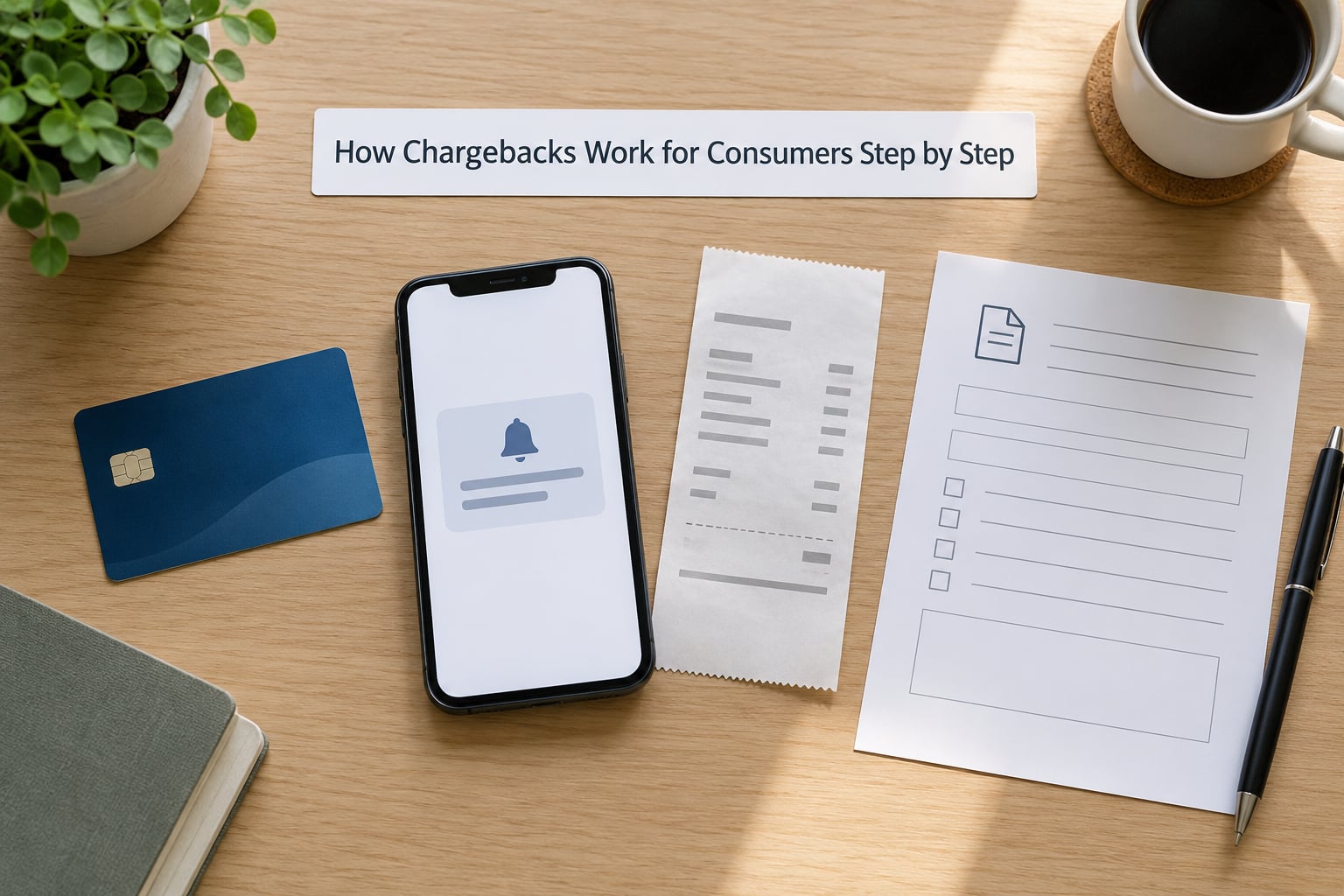
Here is the sequence most disputes follow, from the moment you notice the charge to the moment the money settles.
1. Check the transaction and contact the merchant first
Open your account and find the exact date, amount and merchant descriptor. The descriptor is often shortened and unrecognizable, which is why people miss charges that were real. For most reason codes, contacting the merchant first is part of the rules, and skipping it can weaken the case later.
2. Gather proof before you touch the bank
Save the receipt, order confirmation, shipping notice, tracking number, and screenshots of every message with the merchant. Take a screenshot of the transaction itself while it is still visible on your account.
3. Tell your card issuer
Most large US banks let you file from the mobile app: open the transaction, choose dispute or report a problem, pick a reason, and upload documents. Chase, Bank of America, Capital One, Wells Fargo and American Express all have this flow, and all also accept a phone call. Smaller banks and credit unions usually start with a phone call or a secure message.
4. Get a case reference number
Write it down. You will quote it every time you call, and it is what lets you check the status instead of starting over.
5. Answer the reason questions honestly
The form asks you to classify the dispute. Pick the reason that actually fits, because an inaccurate category gets routed to the wrong team and can be closed without a full look.
6. Watch for the provisional credit
Many issuers post a temporary credit to your account while the dispute is open, often within a few business days. It is not a refund and it is not final. If the merchant wins, the amount comes back out and can leave your balance negative.
7. Wait for the decision and read it
When the case closes you get a written result with a reason code. Read it. A denial with a clear reason is more useful than a denial with none, because it tells you whether to escalate or to try the merchant again.
Who actually does the investigating?
Your issuer does the initial work, then passes the case to the card network (Visa, Mastercard, American Express or Discover). The network asks the merchant’s bank, the acquirer, for proof. The merchant replies, sometimes with a signed receipt and delivery confirmation. The network then rules. Most cases are decided on documents rather than on who argues better on the phone, which is the single most useful thing to know before you start.
Which Payment Methods Can You Dispute?
Every major payment method has a dispute route, but the strength of your protection depends on the method and the rulebook behind it.
Credit cards
The strongest position. Two federal statutes cover credit card billing errors, and the Fair Credit Billing Act lets you challenge charges for goods you did not receive, charges for services that were never delivered as promised, and charges on a card you never received. Typical windows run from 60 days to 120 days after the statement, and issuers usually allow a full billing cycle or two to file in writing.
Debit cards
Debit disputes run under Regulation E, the rule implementing the Electronic Fund Transfer Act. Your bank must investigate and generally must correct your account within ten business days if you give written notice within 60 days of the statement. That ten-business-day provision is the part most consumers never hear about, and it can be much faster than a credit card dispute.
Digital wallets
Apple Pay, Google Pay and similar wallets ride on the underlying card or bank account. Disputing a wallet purchase usually means disputing the card transaction behind it, and the flow is the same. The practical difference is that wallet receipts are easier to find, which makes gathering evidence faster.
Bank transfers and peer-to-peer payments
This is the weakest ground. Transfers sent through a payment app or a person-to-person service are not card transactions, so the card networks have no role. Your only routes are a complaint to the provider, a report to the bank that sent the money, or a police report for genuine fraud.
Buy now, pay later
Installment plans have no chargeback process of their own. Each installment is treated as an ordinary charge, so your remedy is a dispute with the merchant over the underlying purchase, plus a complaint to the provider if the plan was opened without your consent.
Store and merchant credit
Balances held with a retailer are usually governed by that retailer’s own terms, not by card network rules. Some retailers are bound by state gift card and stored-value laws, and many are not. Read the terms before assuming you have a chargeback right.
How Long Do Chargebacks Usually Take?
A chargeback that takes two weeks to file and four months to finish is normal, not broken. The stages run at very different speeds.
| Stage | Typical length | Who controls it |
|---|---|---|
| File with your issuer | A few minutes in the app, longer by phone | You |
| Issuer acknowledges and assigns a case | 1 to 5 business days | Issuer |
| Provisional credit posted | Often 1 to 10 business days after filing | Issuer |
| Merchant response window | Roughly 20 to 45 days | Merchant and its bank |
| Second review or representment | About 15 to 30 days | Acquirer and issuer |
| Pre-arbitration step | A few days to two weeks, if you use it | Both sides |
| Final decision | Commonly 60 to 120 days from filing | Card network |
| Arbitration, only if you opt in | Several more months | Independent arbitrator |
Now the part that catches people: the filing deadline is shorter than most people assume. A 540-day figure circulates widely online as the consumer’s right, and it is wrong. That number comes from a different context entirely, and issuers routinely refuse cases filed months after the statement.
Here is the accurate version. US rules give you 60 days from the statement date to report a billing error on a credit card. Debit disputes run on a 60-day notice window too, with the bank required to correct your account within ten business days. Network rules allow an issuer to accept a chargeback it initially declined, and some do within about 120 days of the transaction.
The practical rule is simple. Treat 60 days as your real deadline, file as soon as the problem is confirmed, and do not wait for the merchant to be slow. A late filing can be refused outright.
What Evidence Should You Submit?
Issuers rarely investigate the way the public imagines. The bank looks at a small packet of documents and decides. So build the packet before you call.
- The receipt or order confirmation with the date, amount and last four digits of the card.
- Delivery proof. A carrier tracking page, a signed delivery confirmation, or a shipping notice showing the destination address matches yours.
- Screenshots of the listing at the time of purchase, especially for goods that arrived damaged or different.
- Your message history with the merchant, including the dates you asked for help and the dates they stopped replying.
- A copy of the transaction line from your statement, with the merchant descriptor visible.
- Any prior refund already issued, so the issuer does not treat the dispute as a duplicate claim.
One more thing matters more than people expect: a short timeline. Three lines beat three pages. For example: “Ordered a laptop on the 4th, tracking number stopped updating on the 9th, contacted support on the 11th, no response by the 18th.” Issuers read hundreds of these. Clarity saves the case.
Keep copies of everything you submit. If the dispute goes to a second review or an arbitration, the same documents are what the decision rests on.
Why Might a Chargeback Be Denied?
Most denials come down to timing, category or paperwork, not to the merits of the complaint.
- You missed the window. Past the issuer’s deadline, the case may be closed before anyone looks at it.
- The charge was already refunded and the merchant’s credit is still processing.
- You picked the wrong reason code. “Credit not processed” for an order that simply took longer to ship is a mismatch.
- No evidence of non-delivery. Tracking showing delivery to your address is hard to argue with.
- You had already used the product. Once a downloaded game, a meal, or a hotel stay is consumed, the case is much weaker.
- The payment method is not covered by card rules, as with most bank transfers.
- You never contacted the merchant. Some reason codes require a good-faith attempt first, and the timeline proves whether you did.
Is filing a chargeback legal, and can it backfire?
Filing one on a purchase you knowingly made and received, after you used the goods, is not illegal, but it is a false claim and the issuer can close your account and report the activity. This is called friendly fraud, and merchants deal with a lot of it. The same goes for a charge you already received a refund for.
What to do when the issuer says no
- Ask for the reason in writing. Get the reason code and a copy of the merchant’s response.
- Send a short written appeal. One page, timeline first, evidence attached, and a clear statement of why the decision is wrong.
- Escalate to a regulator. If the issuer ignored its own investigation deadlines, a complaint to the Consumer Financial Protection Bureau or your state attorney general carries real weight, because regulators report complaint volumes back to the banks.
Arbitration exists too, but it is a formal step with its own costs and a binding outcome. Treat it as a last resort, not a next step.
What Happens to Your Money and Credit During a Dispute?
Provisional credit is the part that surprises people most, so it is worth understanding clearly.
A provisional credit is a temporary credit to your account while the dispute is open. It usually appears as a separate line rather than a reduction of the original charge, and it is reversible. If the merchant wins, the issuer removes the credit and the original charge comes back due. On a debit card that can leave your checking account negative with no notice.
So keep an eye on your balance for the whole case, not just the first week.
Does disputing a charge hurt your credit score?
Normally, no. Filing a dispute is not reported to the credit bureaus as a default or a derogatory mark, because you paid the bill or the bank reversed it. What can hurt is the debt itself: if a provisional credit is clawed back and you never pay the resulting balance, that is ordinary delinquency reporting, with the same credit score consequences as any other missed payment.
There is a second risk that is not about credit scores at all. A burst of disputes, especially on cards you have held briefly, can trigger a fraud review or a limit review from the issuer. That is unusual, and it is the pattern, not the single dispute, that tends to trigger it.
What about your account?
You will not be charged a fee for filing a dispute. The fee in a chargeback is charged to the merchant, and it is part of why merchants respond quickly. The realistic account consequences are a hold on disputed funds, a possible credit limit review, and closure only in cases involving confirmed fraud claims.
What Should You Do After a Chargeback?
Once the bank confirms the case is open, work through this list.
- Record the case number and filing date in one place, with the merchant’s contact details.
- Save every document in a single folder, including the screenshots you already took.
- Watch your balance weekly so a clawed-back provisional credit never catches you by surprise.
- Do not accept a second refund. If the merchant refunds you after the dispute is filed, tell the issuer, or you will be charged twice for the same loss.
- Keep paying every other balance. A dispute is an argument about one charge, not a reason to let the whole statement ride.
- Lock the card and request a new number if the dispute involved card theft or a compromised account.
- Check the closing notice when the case ends and confirm the final outcome matches the letter.
- Pull your credit reports if identity theft was involved, and follow up with the bureau about anything fraudulent that appeared.
If you are dealing with a subscription rather than a one-time purchase, the first move is always to cancel and request a refund from the merchant, then dispute with your bank only if the merchant refuses. Bills of that kind are harder to win after the fact.
Frequently Asked Questions
Does disputing a charge with my credit card hurt my credit score?
Usually not. A dispute itself is not reported to the credit bureaus as a negative mark. What does affect your credit is an unpaid balance: if a provisional credit is reversed and the original charge comes back due, and you do not pay it, that becomes ordinary delinquency. Keep every other balance current and a single dispute stays invisible to scoring models.
Can a merchant retaliate after I request a chargeback?
A merchant cannot cancel your cards or blacklist you the way some sellers do on their own platforms, but they can block your email address or refuse future orders, and a very high volume of disputes on one card can prompt an issuer review. In practice retaliation is mostly inconvenience, not punishment, and filing a legitimate dispute is well within your rights.
Can I reopen a chargeback after the bank closes the case?
Sometimes, and it depends on why it closed. If it was closed because you supplied incomplete information, you can often refile with better evidence inside the issuer’s window, commonly 60 to 120 days from the transaction. If it was decided against you on the merits, a second look is much less likely, and your realistic route is a written appeal, then a regulator complaint.
How do I dispute a digital purchase or subscription?
Digital goods are disputed through the card you paid with, using the digital-goods or service-not-received reason. Evidence matters more than usual: order receipts, login or download records, and screenshots showing what you received. Consumed items are harder, so cancel first, ask the merchant for a refund, and only dispute if the merchant refuses or never answers.
What should I do after my bank finishes investigating a chargeback?
Read the closing notice and note the outcome and reason code. If you won, confirm the credit is permanent rather than provisional and keep the letter. If you lost, ask for the reason in writing, review the merchant’s evidence, and decide between a short written appeal and a complaint to the Consumer Financial Protection Bureau or your state attorney general.
Conclusion: Start With the Payment Provider
The first action is small and immediate: review the transaction on your statement, contact the merchant if it is safe to do so, and then file with your card issuer well inside the 60-day window. Save the receipt and every message with the merchant before you pick up the phone, because that packet does more work than anything you will say later.
Chargebacks are a blunt tool with real teeth, and they belong to you as a customer. Use them when the money is genuinely wrong, not because a merchant is being slow, and you will rarely have to think about them again.