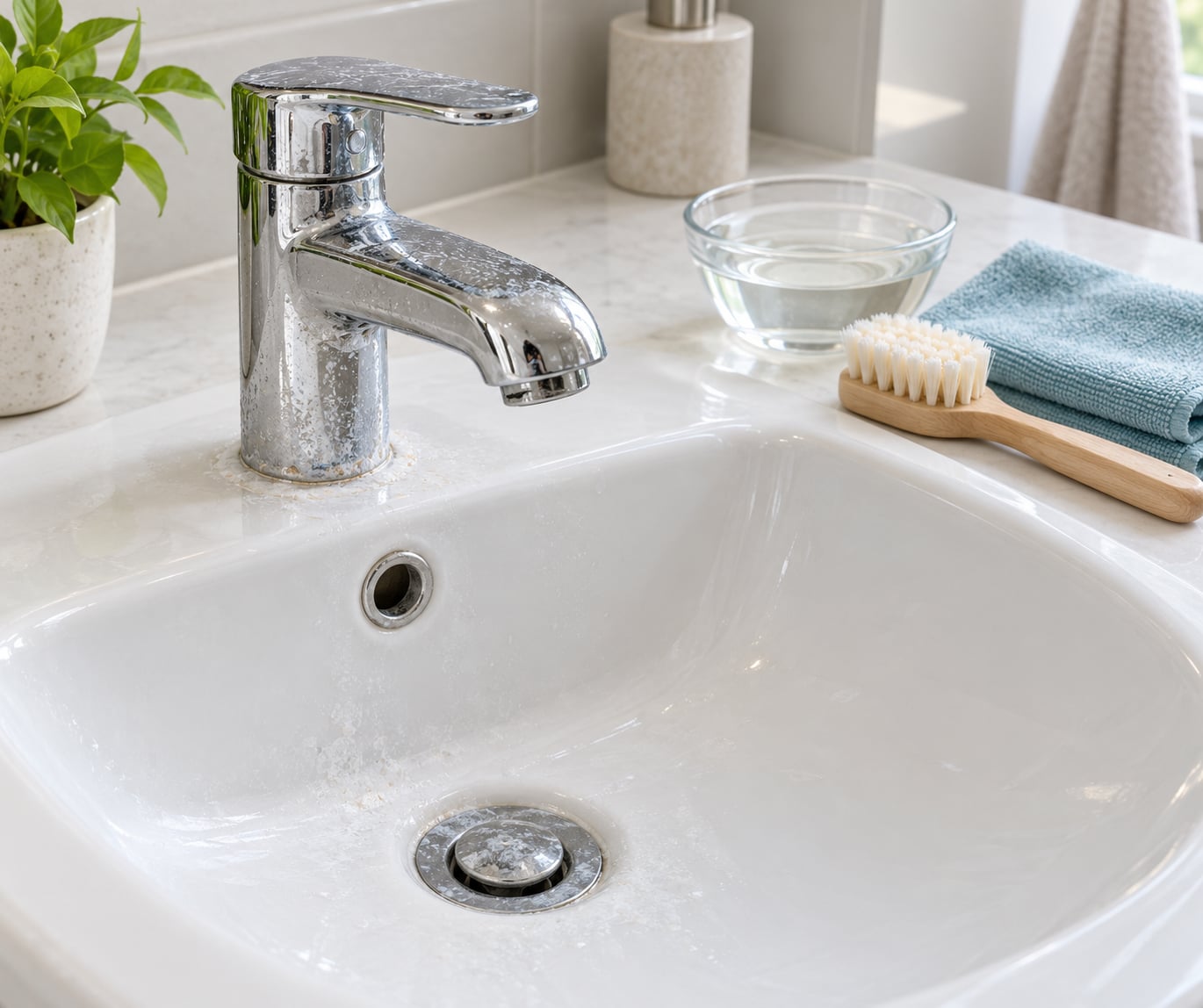
Hard water stains are mineral deposits, mostly calcium carbonate, left behind when water carrying dissolved minerals evaporates on a surface. An acid dissolves that deposit, which is why white vinegar works on most of them, and most light jobs take about twenty minutes of actual work plus waiting time. The only thing that decides whether you succeed is matching the method to the surface, because the same acid that clears a shower door will etch a marble countertop.
Here is how I would do it: work out what the surface is made of, try the gentlest acid that is safe on it, give the solution real contact time, then scrub lightly and rinse. If you have already tried vinegar and nothing happened, there is a reason for that, and I cover it below.
Table of Contents
- What You Need
- How to Remove Hard Water Stains Step by Step
- Method 1: Use Vinegar for Light Mineral Deposits
- Method 2: Use Baking Soda for Gentle Scrubbing
- Method 3: Use Citric Acid for Stubborn Deposits
- Method 4: Use a Commercial Mineral Deposit Remover
- Method 5: Use a Specialized Tool for Tight or Delicate Areas
- Common Mistakes When Removing Hard Water Stains
- How to Prevent Hard Water Stains from Returning
- Frequently Asked Questions
- What causes hard water stains on showers and sinks?
- Can I use vinegar to remove hard water stains?
- How do I remove hard water stains from natural stone?
- What is the best way to clean limescale from a faucet?
- How can I stop hard water stains from coming back?
- The Best First Step for Hard Water Stains
What You Need
The supplies are ordinary, and most people already own most of them. Gather what your chosen method needs rather than buying anything new.
- Rubber or nitrile gloves — for any acid method, and for the kettle and toilet work where you are close to the deposit for a while.
- Spray bottle and a second cloth for rinsing — dirty solution running across a clean area just moves the problem around.
- Old toothbrush or soft nylon brush — the single most useful tool here, because most stains live in seams, hinges and aerators rather than on flat panels.
- Microfiber cloth — for the final dry. Drying is what stops the deposit from forming again in the same spot.
- White vinegar — the workhorse. Warm it first; the reaction is faster and you get a real margin on thick scale.
- Baking soda — for a gentle alkaline paste on surfaces too soft for scrubbing, and for lifting what acid has already loosened.
- Citric acid powder — a stronger, more targeted acid than vinegar, useful on limescale in kettles, washing machines and shower heads.
- A commercial mineral deposit remover — for stubborn toilet bowls and heavily scaled fixtures. Follow its label dwell time, which is usually longer than the vinegar equivalent.
- Small plastic detail brush, laminate scraper or pumice stone — tight or delicate areas, used with restraint.
- Ventilation — open a window or run the extractor. Never mix an acid cleaner with bleach or with ammonia; the combination releases toxic gas.
How to Remove Hard Water Stains Step by Step
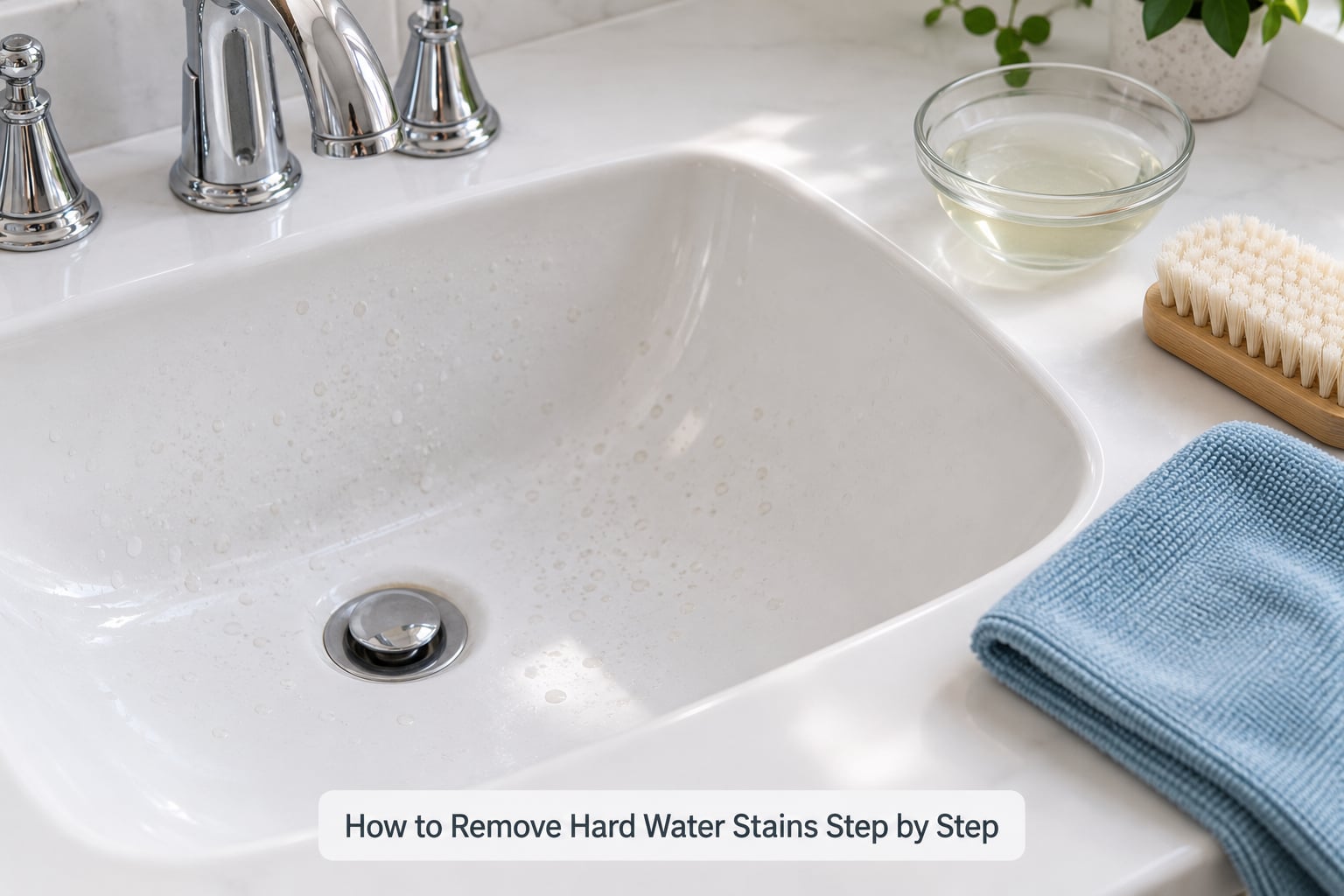
Start at the top of the fixture and work downward, always. Runoff carries loosened minerals onto the lower section, and people who clean bottom-up keep redepositing what they just removed. Before anything else, do the fingernail test: run a fingernail across the mark. If it catches on something, the deposit is still sitting on the surface and it will lift. If the nail passes over smooth glass and the haze is still there, the surface itself has been etched, and no cleaner on your shelf will restore it.
Method 1: Use Vinegar for Light Mineral Deposits
Vinegar is roughly five percent acetic acid, and that is enough to break light scale on glass, chrome, porcelain, tile and enamel. Warm it in the microwave for 30 seconds or in a pan of hot water until it feels hot rather than boiling, then dilute with one part vinegar to three parts warm water for moderate build-up, or use it straight for heavier deposits.
Spray it on and let it dwell 15 to 30 minutes. Do not wipe it off early, and never let it dry on the surface; if it evaporates you leave concentrate behind, which is worse than the original film. For vertical surfaces such as a glass shower door, wet a paper towel with the solution and press it against the glass so the acid stays in continuous contact instead of running down. Several people who posted about this on r/CleaningTips reported the paper-towel wrap as the thing that finally moved their stains after endless spraying.
Scrub with a soft sponge or non-scratch pad in the direction of the surface, using an old toothbrush along the door track, the faucet base and the hinges. Rinse with warm water and dry on a microfiber cloth.
Stay away with vinegar on natural stone. Marble, travertine and limestone are calcium-based, so the acid dissolves the countertop itself and leaves a dull etch that cannot be polished out. Skip it on tinted glass and on plated chrome where the plating is worn through, and use it cautiously on sealed grout, since it can work under a worn seal.
Method 2: Use Baking Soda for Gentle Scrubbing
Baking soda is mildly alkaline, so it cannot dissolve limescale on its own — it removes no hardness from water and it will not clear a mineral deposit by itself. What it does well is lift residue that acid has already loosened and give you a non-scratching abrasive for soft surfaces and glass.
Mix baking soda with just enough water to make a thick paste. Spread it with your fingers or a plastic spatula, work it in with light pressure, and let it sit for 10 to 15 minutes. Keep the strokes short and change direction; long aggressive scrubbing is what leaves micro-scratches that catch light later and make glass look permanently cloudy. Rinse with plain warm water, which also removes the paste residue, then dry.
This is the safest method on glass shower doors, acrylic, and polished chrome, and it pairs well with vinegar used earlier in the same session rather than at the same time. One warning about soap scum, which is often mistaken for limescale: soap scum is greasy, dark at the edges, and sits on the surface. It responds to an alkaline cleaner or a degreaser, not to acid. Dryer sheets and squeegees tackle scum, not mineral scale.
Method 3: Use Citric Acid for Stubborn Deposits
Citric acid is a stronger, more targeted acid than vinegar, which makes it the better choice for thick limescale inside kettles, shower heads and washing machine drums where vinegar has stopped doing much.
For a kettle, bring the water to a simmer with nothing in it, turn off the heat, and stir in one to two tablespoons of citric acid powder per litre. Leave it to work for an hour or overnight, then boil once more and rinse twice with clear water. For a removable shower head, soak it in warm water with two tablespoons per litre for an hour, then flush it through. For vertical glass and fixtures, dissolve the powder in warm water at roughly one tablespoon per cup, apply, and allow 20 to 30 minutes.
Citric acid is still an acid. Keep it off natural stone, off unfinished metals, and off any surface you have not tested. Wear gloves, and rinse thoroughly rather than assuming a light rinse is enough.
Method 4: Use a Commercial Mineral Deposit Remover
A labelled limescale remover is the right call when acid dwell time alone has stopped helping, particularly on a toilet bowl or a heavily scaled tap. These products are stronger and more alkaline-leaning than household vinegar, which is exactly why they need their own instructions.
Read the label and use its dilution and dwell time rather than your own judgment, since the formulations differ. Test a small hidden area first and leave it wet for the full label time before deciding. Apply under the rim and into the base of the fixture, let it work, then scrub with a stiff nylon brush or a non-scratch pad. Rinse or neutralise exactly as the manufacturer specifies — some require a second plain-water rinse because the residue itself will spot the surface if left behind.
Ventilate the room while you work and keep the product away from children and pets. If the fixture is plated chrome with visible pitting, cleaning will not restore it; the plating is already gone.
Method 5: Use a Specialized Tool for Tight or Delicate Areas
Small spaces need small tools, and this is where most people give up because a sponge cannot get into the geometry. A plastic detail brush, an old toothbrush, or a laminate scraper lifted at roughly a 45-degree angle will handle faucet aerators, shower head nozzles, hinge points and narrow grout lines that a cloth never reaches.
A laminate scraper is fine on glass and tile, but draw it in one direction only and keep it flat, because a scraper tilted sideways will gouge grout. A pumice stone is the strongest option for non-glass surfaces such as porcelain and tile, used wet and with light pressure. A melamine sponge works but is slow; Wirecutter reported it as effective after a couple of minutes of work while being clearly slower than chemical methods, so reach for it on light haze rather than thick scale.
What not to use: steel wool and green or grey scouring pads on glass, chrome and any polished surface. They scratch, and on stainless they leave metallic residue that rusts and stains permanently.
Common Mistakes When Removing Hard Water Stains
Assuming every surface is glass or ceramic. Marble, travertine, limestone, some natural travertine-look tiles, tinted glass and worn chrome plating all behave differently. Check what the surface is before you pick a cleaner, not after.
Mixing incompatible cleaners. Vinegar with bleach, or any acid with ammonia, releases toxic gas. Use one product at a time, rinse the surface fully, and only then reach for the next. If you want the dish-soap-and-vinegar combination people ask about often, the soap is not what removes the deposit — it lowers surface tension so the acid spreads and wets the scale. The vinegar is doing the dissolving, so apply it, let it dwell, then scrub.
Leaving the cleaner too long on the wrong material. Dwell time is the whole trick on glass and the entire hazard on stone. Twenty to thirty minutes on glass; on natural stone, no acid at any duration.
Pressing harder instead of waiting longer. Force scratches glass and wears chrome; patience does not. If the deposit has not moved after a proper dwell, add mechanical action or escalate to a stronger product rather than more pressure.
Forgetting to rinse. Acid left on a surface keeps working after you stop watching it. Rinse with warm water and dry fully.
Cleaning bottom-up. You will push dirty solution over clean surfaces. Work top-down and rinse as you descend.
How to Prevent Hard Water Stains from Returning
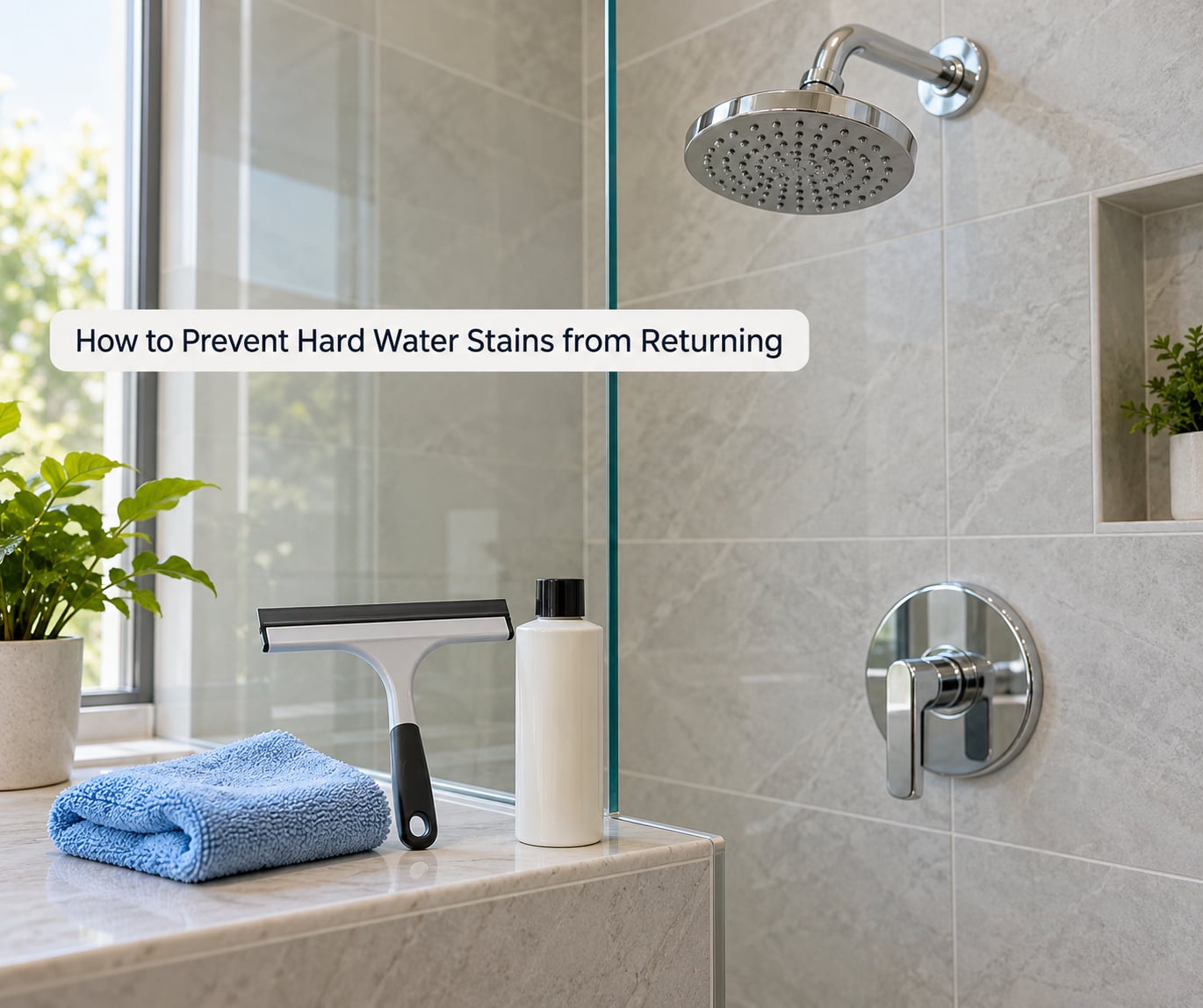
Prevention is about stopping water from evaporating on a surface in the first place. Stains can only form where water sits and dries, so the highest-value habit is a thirty-second one: squeegee the glass and wipe the fixtures dry after each use. That is the whole difference between a shower you wipe down once a month and one that never needs it.
Beyond that habit, work down this list in order and stop where the problem stops.
- Weekly wipe-down — a light vinegar spray on chrome and glass, left for a few minutes then rinsed, keeps early deposits from ever hardening.
- Dry the fixtures — a microfiber cloth on tap handles and spout faces after use, since those collect water and drip.
- Ventilate the bathroom — an extractor fan or an open door cuts humidity, so less water lingers on glass and tile.
- Look for leaks — a dripping tap or a running toilet is a mineral source you can shut off entirely.
- Protect natural stone — use only a pH-neutral stone cleaner, and reseal according to the manufacturer’s schedule so the stone stops absorbing water.
- Consider a shower filter or a water softener in severe areas — a filter helps at the shower, and a softener treats the whole house. Both are worth it when the same ring reappears every couple of weeks no matter how you clean.
If your toilet water line returns within days every time, that is a habit and hardware problem rather than a cleaning one, and no amount of scrubbing changes it permanently.
Frequently Asked Questions
What causes hard water stains on showers and sinks?
Hard water contains a high concentration of dissolved calcium and magnesium. When that water evaporates on a surface, the minerals are left behind as a chalky deposit that hardens and bonds to the glass, tile or porcelain. That deposit is limescale, and it builds fastest wherever water sits and dries: shower glass, the water line in a toilet bowl, faucet bases and kettle elements. Iron in the water produces a separate rust-coloured stain, which needs a different approach.
Can I use vinegar to remove hard water stains?
Yes, on most glass, chrome, porcelain, tile and enamel surfaces. Warm the vinegar, dilute one part to three parts of water for moderate build-up, apply it, and give it 15 to 30 minutes before scrubbing gently. Never let it dry on the surface. Do not use vinegar on marble, travertine or limestone, because those surfaces are calcium-based and the acid will etch them permanently, and avoid mixing it with bleach or ammonia.
How do I remove hard water stains from natural stone?
Keep acids away from it entirely. Marble, travertine and limestone are calcium-based, so vinegar and lemon dissolve the stone itself rather than just the deposit, leaving a dull etch that no amount of polishing will remove. Use a pH-neutral stone cleaner instead, applied to a soft cloth rather than sprayed, and work gently with a soft brush. Re-seal the stone on the schedule the manufacturer specifies, and for deep build-up use a stone-safe descaler tested on a hidden corner first.
What is the best way to clean limescale from a faucet?
Remove the aerator if it unscrews and soak it in warm vinegar or a citric acid solution for an hour, then flush it through. For the body of the tap, warm vinegar sprayed on and left for 15 to 30 minutes, then worked into the base and around the handle with an old toothbrush, is usually enough. Finish with a rinse and a microfiber cloth so you leave no spots of your own. Plated chrome with existing pitting will not recover, no matter what you use.
How can I stop hard water stains from coming back?
Squeegee the glass and wipe the fixtures dry after every use. That single habit removes the drying stage that creates the stain, and it matters far more than any deep clean. On top of it, do a light weekly vinegar wipe on glass and chrome, run the bathroom extractor or open a door to cut humidity, fix any dripping tap or running toilet, and reseal natural stone on schedule. In severely hard areas, a shower filter or a whole-house water softener is the only thing that changes the underlying water.
The Best First Step for Hard Water Stains
Identify the surface before you identify the product. Test the gentlest thing that is safe on it, work from the least visible area outward so you can check your result, give it real contact time, then rinse and dry properly. Escalate only if the deposit is still there afterwards — and if a fingernail catches on the mark or the mark survives a proper dwell time on non-stone material, it may be etched into the surface rather than sitting on it, and no home method will bring that back.
Start with the least aggressive method that could work, on the least visible part of the fixture, and give it more time rather than more pressure.