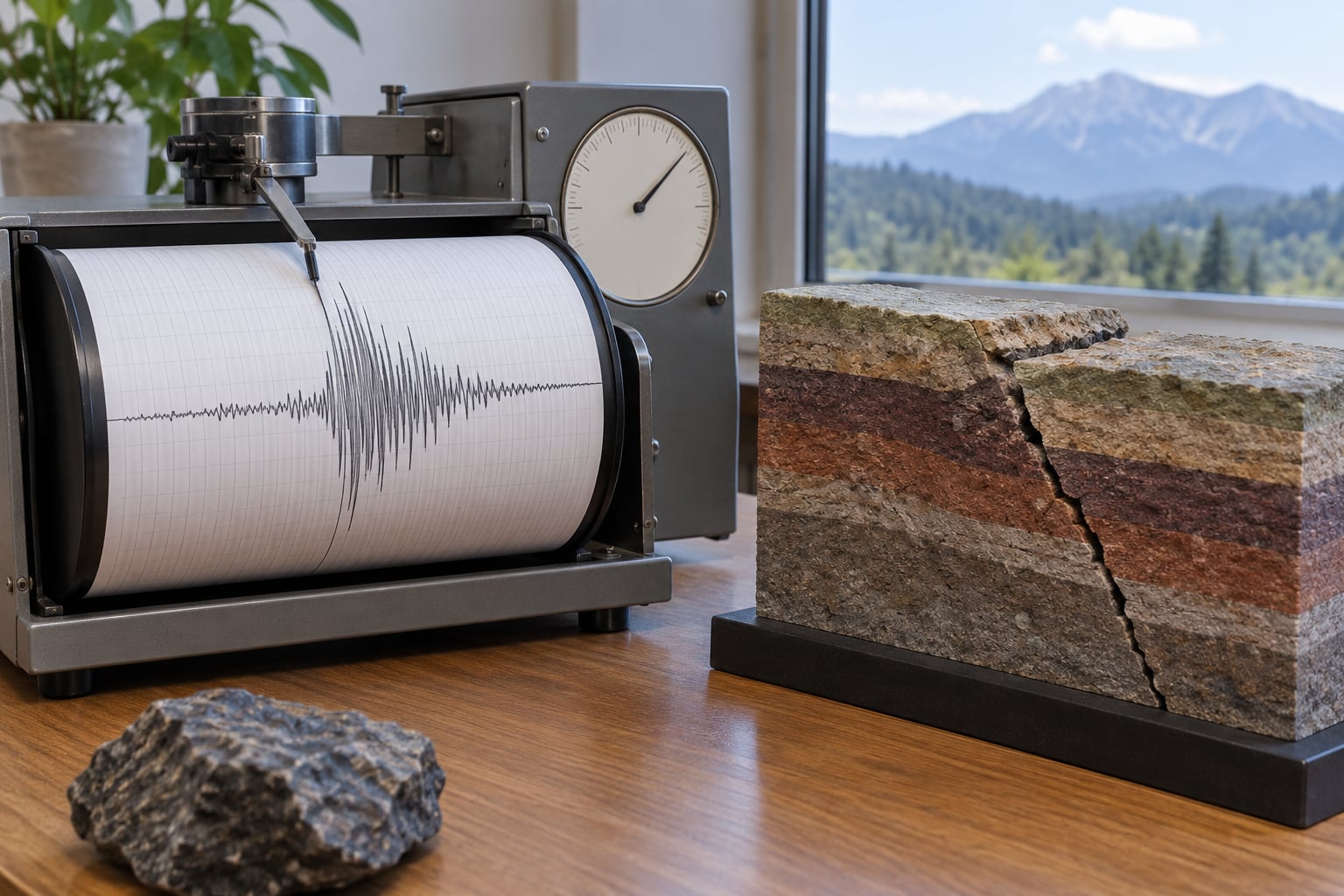
Earthquake magnitude is measured from the ground motion recorded by seismographs. Scientists convert that recording into the seismic moment, the rock rigidity multiplied by the ruptured fault area and the average slip, then express it as a single number on the moment magnitude scale. One event, one magnitude, every location.
That last part trips people up. The same quake can rattle one town to MMI VIII while barely touching a city a hundred kilometres away, and neither place has its own magnitude. The number describes the event. The shaking describes the place.
Below is how the measurement works step by step, which scales exist and what each one is good for, and how to read a headline number without getting caught out.
Reviewed and updated for 2026.
Table of Contents
- How Earthquake Magnitude Is Measured
- What Is Earthquake Magnitude?
- How Do You Measure Magnitude From a Seismogram?
- How Do Seismologists Turn Ground Motion Into a Number?
- Which Earthquake Scales Are Used?
- What Is the Difference Between Magnitude and Intensity?
- Why Can an Earthquake’s Magnitude Change After the First Report?
- What Magnitude Numbers Mean for Ground Shaking and Damage
- What Measurements Are Needed to Calculate Earthquake Magnitude?
- How Do Scientists Measure Earthquakes Too Small to Feel?
- Frequently Asked Questions
- How do you measure magnitude?
- What is the difference between earthquake magnitude and intensity?
- How much stronger is a magnitude 5.0 earthquake than a magnitude 4.0?
- How bad is a magnitude 2.5 earthquake?
- Is magnitude 9.9 possible?
- How do you identify P and S waves on a seismograph?
- Conclusion
How Earthquake Magnitude Is Measured
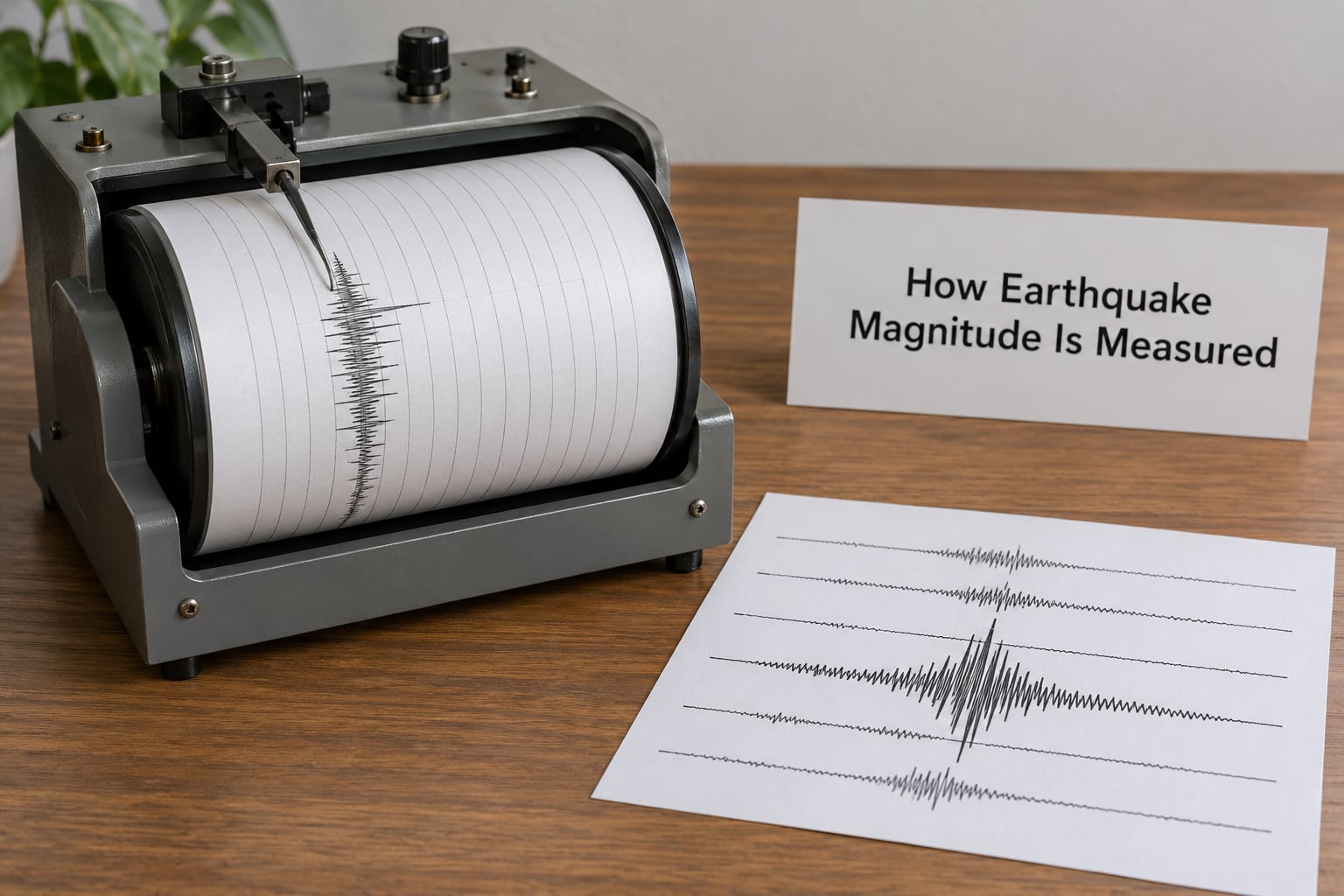
How earthquake magnitude is measured comes down to three things: a rupture underground, a set of instruments that record the waves it sends out, and a set of standard formulas that turn those recordings into a comparable number.
The rupture happens on a fault plane at depth. Shear stress builds until the rock breaks, and the two sides of the fault slide past each other. That sudden slip radiates seismic waves in every direction, from compression waves that arrive first to long surface waves that roll along the ground.
Seismographs at stations around the world record that motion as a trace called a seismogram. Early instruments did this on rotating drums with a pen; modern stations use broadband sensors that capture a very wide range of ground velocities and feed the data to a network in near real time.
The agency that owns the data — the USGS National Earthquake Information Center, the Pacific Northwest Seismic Network, a regional network like the one covering Japan or Turkey — then computes a magnitude from the trace. In the first minutes that happens automatically. A reviewer checks it later and the number can be adjusted.
What Is Earthquake Magnitude?
Magnitude is a single, dimensionless number describing how much energy the earthquake released at its source. It does not describe the ground movement you felt at your house, and it carries no unit of force or energy once the logarithm is taken.
The underlying quantity is the seismic moment, written M0. It is the product of three measurable things:
- The shear modulus, meaning the rigidity of the rock
- The rupture area, the length times the width of the broken fault patch
- The average slip, how far the two sides moved past each other during the event
Those three multiply out to a value in newton-metres, which is a measure of the work the fault did. M0 is the physically meaningful number; the magnitude scale is a convenient way of saying it out loud.
Two useful vocabulary points. The hypocentre, or focus, is the point inside the earth where the rupture starts. The epicentre is the spot on the surface directly above it. Reports quote both depth and epicentre location because distance from that point drives how strongly the quake is felt.
How Do You Measure Magnitude From a Seismogram?
Older scales measure amplitude. Richter’s local magnitude read the maximum height of the trace on a Wood-Anderson torsion seismograph, corrected for distance from the epicentre. Modern scales measure size through the fault itself, because amplitude saturates for large events.
One practical way to picture it: a magnitude 7 earthquake is not seven times a magnitude 6. Wave amplitude grows about ten times per whole step, and energy grows roughly 32 times. A 0.1 step adds about 40 percent more energy.
How Do Seismologists Turn Ground Motion Into a Number?
This is the pipeline, from the first tremor in the fault to the number that appears on the USGS website. Six steps, and most of the uncertainty lives in the last two.
- The fault ruptures. Slip propagates along the fault plane for seconds to minutes, and the rupture front may travel in one direction faster than in the other.
- Seismic waves radiate outward. Compressional P waves, shear S waves and surface waves leave the source, losing energy as they spread and as they reflect off layers inside the earth.
- Stations record seismograms. Every station within range produces a trace. Nearby stations see the arrival in seconds; teleseismic stations on the other side of the planet still see a small long-period signal.
- Arrival times get picked. Analysts or software mark the P and S arrivals on each trace. The difference between the two arrival times gives distance, and enough distances from different stations give the epicentre and depth by triangulation.
- The moment is computed. In the field or automatically, the amplitude and period of the waves are used to model the source, then the fault area and slip are inverted to obtain M0. In the minutes after a big event this is a rapid estimate based on a limited set of stations.
- The number is published and revised. The network reports a preliminary magnitude within minutes. Once more stations report and an analyst reviews the traces, the value can shift by a few tenths of a unit in either direction.
Step six is why you will see a headline number change hours after a quake. More data, better geometry and a proper review are simply better information than the fast first guess.
Which Earthquake Scales Are Used?
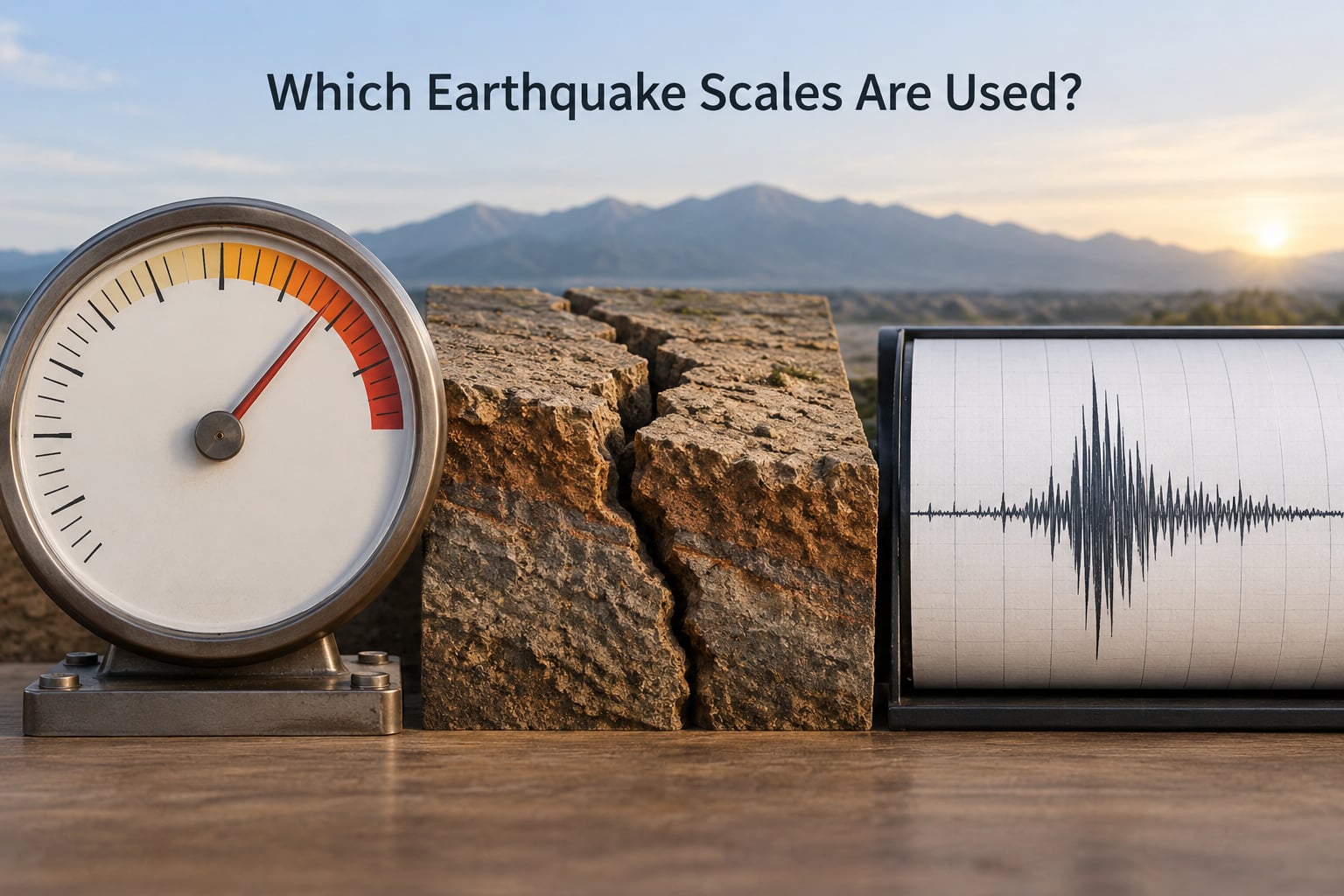
Four magnitude scales and one intensity scale cover almost all the reporting you will meet. Each was built for a different range of earthquake sizes, and each has a limit where it stops being trustworthy.
| Scale | What it measures | Typical range | Main limitation |
|---|---|---|---|
| Local magnitude (ML), Richter | Peak amplitude of the trace on a standard seismograph, corrected for distance | Below about 6.5 to 7 | Saturates. Very large quakes all look the same size on the trace |
| Body-wave magnitude (Mb) | Amplitude of short-period P waves | About 5 to 7 | Depends on depth and on how the station sits in the crust |
| Surface-wave magnitude (Ms) | Amplitude of 20-second surface waves | About 5 to 8 | Saturates too, and needs an ocean station for a reliable measurement |
| Moment magnitude (Mw) | Seismic moment: rigidity times rupture area times slip | All sizes, the international standard | Requires a large, well-recorded event. Harder to compute fast for small quakes |
| Modified Mercalli Intensity (MMI) | Observed effects and damage at a specific place | I to XII | Not a measurement of the quake. Describes a location, not the event |
Charles Richter published the local magnitude scale in 1935, working with Beno Gutenberg at Caltech, and calibrated it against a reference earthquake about 100 km away. It was the first scale that let people compare quakes across regions, and it is still the right tool for small local events.
The problem showed up with great earthquakes. Once the trace amplitude stops growing, two different giant quakes produce nearly identical records and nearly identical numbers. Richter’s scale ran out of room around magnitude 7 on most networks.
Hiroo Kanamori and Thomas Hanks developed the moment magnitude scale in the late 1970s, calibrated so it agrees with local magnitude across the range where local magnitude still works. The USGS adopted it for routine reporting in the early 1990s, and it has been the worldwide reporting standard since.
What Is the Difference Between Magnitude and Intensity?
Magnitude is a property of the earthquake. Intensity is a property of a place on the ground at a moment in time. A single event has one magnitude and as many intensities as there are places you could stand.
Caltech’s comparison is simple: one light bulb at varying brightness versus how brightly it lights every room. The bulb has a single wattage. The room near it is bright, the hallway is dim.
| Magnitude | Intensity | |
|---|---|---|
| Describes | The size of the earthquake at its source | The shaking felt at one location |
| Values per event | One principal value | Many, one per place |
| How it is measured | Instruments and geological modelling | Instrumentally with ShakeMap, or by describing what people felt and what broke |
| Scale | Moment magnitude, logarithmic | Modified Mercalli I to XII, not logarithmic |
| Changes if you move | No | Yes, and it falls off with distance |
The Modified Mercalli Intensity scale runs from I, which people barely notice, through III, felt indoors like a passing truck, V, enough to wake people up, VII, where dishes break and horses are uneasy, VIII, where heavy furniture moves and chimneys crack, to X and above, where buildings are thrown out of square and landslides are triggered.
Earthquakes can have a high magnitude and low intensity, or the reverse. The 1960 Agadir earthquake in Morocco was roughly magnitude 5.9, a moderate event on the global scale, yet it killed thousands because the old city sat on soft coastal ground that amplified the shaking. The 2023 Morocco earthquake was larger at about 6.8 and its worst intensity hit populated areas with stiffer ground.
If you felt a quake, your local intensity is the number that describes your experience, and no amount of arguing about the magnitude changes what happened in your street.
Why Can an Earthquake’s Magnitude Change After the First Report?
A revision is normal, not a correction of an error. Networks publish fast so that emergency services and the public have something to act on, then refine it. The reasons a value moves are mostly these.
- Automatic versus reviewed estimates. The first alert runs on an algorithm with partial data. A human review uses the full set of traces and can land a few tenths away in either direction.
- More stations reporting. A magnitude computed from four stations near the rupture is genuinely less certain than one computed from forty stations spread across the region.
- Site corrections. Soft sediment or bedrock under a station changes the amplitude that reaches the sensor, so each station needs its own correction before the readings are averaged.
- Rupture directivity. When slip races toward one side of the fault, stations on that side record much larger shaking than stations on the other side. Picking the wrong stations biases the estimate.
- Different networks, different answers. A regional network and the USGS routinely publish slightly different values for the same quake because they use different station sets, different methods and different depth assumptions. A difference of roughly half a magnitude unit is common and not a scandal.
What agencies do not do is revise to improve headlines. Revisions are signed off by the reviewing analyst and posted with a revision history, which you can check on any USGS event page.
What Magnitude Numbers Mean for Ground Shaking and Damage
The scale is logarithmic because earthquake energy spans an enormous range. Seismologists convert to energy with the relation that a whole step releases about 32 times more energy, and a magnitude 7 therefore moves roughly 1,000 times as much rock as a magnitude 5.
For scale, about one earthquake in ten reaches magnitude 5, and only around twenty a year reach magnitude 7. The largest ever instrumentally recorded was the 1960 Valdivia earthquake in Chile at about 9.5.
| Magnitude | Roughly felt as | Typical effects |
|---|---|---|
| Below 2.0 | Nothing at all | Detected only by instruments |
| 2.0 to 2.9 | Rarely noticed | Detected locally, felt only in favourable conditions |
| 3.0 to 3.9 | Like distant traffic | Often felt, nothing breaks |
| 4.0 to 4.9 | Felt by most people indoors | Rattling dishes, swinging lights |
| 5.0 to 5.9 | Felt by nearly everyone awake | Furniture moves, minor damage in vulnerable buildings |
| 6.0 to 6.9 | Felt strongly indoors and outdoors | Damage to poorly built structures, plaster and chimneys fail |
| 7.0 to 7.9 | Hard to stand, heavy objects shift | Serious structural damage, ground cracking, landslides |
| 8.0 and above | Total disruption over a wide area | Widespread collapse, ground deformation over hundreds of kilometres |
Judged on real effects, a magnitude 2.5 earthquake is barely noticeable. Almost nobody feels it, nothing gets damaged, and it registers on local instruments only. People ask because the number sounds alarming without context; a 2.5 releases roughly a thousandth of the energy of a magnitude 5.5.
And this is the part headlines get wrong. Magnitude alone does not tell you the damage. Depth, distance from the epicentre, local soil, building quality and how long the shaking lasts all matter, often more than the number itself.
What Measurements Are Needed to Calculate Earthquake Magnitude?
To compute a magnitude you need a waveform, a position and some geometry. The essentials are the peak amplitude and dominant period on the seismogram, the P and S arrival times, the coordinates and depth of each station, the type of wave being measured, and for moment magnitude the fault geometry and slip.
Arrival times do double duty. The gap between the P wave and the S wave grows with distance, because the shear wave travels more slowly through rock, and that gap is what tells the analyst how far away the earthquake was. Use enough stations and the source location falls out of geometry.
Reading a trace follows the same order of arrival:
- P wave first. Compressional, fastest, usually a small sharp upward blip.
- S wave next. Shear, slower, arrives with much larger amplitude, and moves particles side to side rather than along the direction of travel.
- Surface waves last. Rayleigh and Love waves roll along the ground, produce the biggest amplitudes, and travel more slowly still.
The P-to-S interval, multiplied by roughly eight kilometres per second, gives a quick rough distance estimate. It is one of the first things student seismologists learn and one of the fastest ways to read a waveform.
How Do Scientists Measure Earthquakes Too Small to Feel?
Small earthquakes are recorded as long as they are bigger than the noise floor of the instrument, which in a quiet vault can be extraordinarily low. Away from cities, a modern station can register events far below anything a person would notice.
Improving the signal is as important as improving the sensor. Operators remove the background hum of pumps, traffic and wind, then search across all station channels at once. A signal too faint to see on one trace often becomes obvious once several nearby stations are stacked together.
Networks are also getting denser and cheaper. Distributed Acoustic Sensing turns ordinary fibre-optic cable running along a railway or a power line into a thousand sensing points at once. Schools and businesses host small accelerometer arrays on roofs and walls. And citizen reports through Did You Feel It? feeds felt-intensity observations back into ShakeMap, the USGS product that turns station data into a map of shaking across a region.
Because the scale is logarithmic, the small end has room too. Magnitudes can be negative, in the sense that a recording can be smaller than the reference event the scale was calibrated against, and local networks routinely catalogue events below 1.0. At the top, magnitude 9.9 and even 10 are within the arithmetic reach of the scale; the question is whether the planet’s fault systems can produce them.
Frequently Asked Questions
How do you measure magnitude?
Seismologists read seismograms recorded by seismographs, identify the P wave, S wave and surface wave arrivals, and use their amplitudes and timing to estimate the rupture. The seismic moment is calculated as rock rigidity times fault rupture area times average slip, then converted to a single dimensionless moment magnitude number on a logarithmic scale.
What is the difference between earthquake magnitude and intensity?
Magnitude describes the size of the earthquake itself, with one principal value per event. Intensity describes the shaking felt at a particular location, so one earthquake produces many intensity values. The Modified Mercalli Intensity scale runs from I to XII and varies with distance, depth and local ground conditions.
How much stronger is a magnitude 5.0 earthquake than a magnitude 4.0?
The scale is logarithmic, so one whole step multiplies wave amplitude by about ten and released energy by roughly 32. A magnitude 5.0 releases about 32 times more energy than a 4.0, and a magnitude 7 releases about a thousand times more than a magnitude 5. A 0.1 step adds roughly 40 percent more energy.
How bad is a magnitude 2.5 earthquake?
A magnitude 2.5 is minor. Most people feel nothing, nothing gets damaged, and only nearby instruments record it. It releases about a thousandth of the energy of a magnitude 5.5 earthquake. Seismologists commonly report events of this size, which is why small tremors show up in local news without causing any real consequences.
Is magnitude 9.9 possible?
Nothing in the moment magnitude formula prevents it. The scale is logarithmic with no hard ceiling, and the largest earthquake ever instrumentally recorded, the 1960 Valdivia event in Chile, measured about 9.5. Reaching 9.9 or 10 would require a rupture roughly two to three times larger than 9.5, and geologists debate whether any fault system can generate one.
How do you identify P and S waves on a seismograph?
Look for the first small sharp motion on the trace, which is the compressional P wave and arrives first. Follow it with the larger, slower arrival of the shear S wave. Multiply the gap between the two by roughly eight kilometres per second for an approximate distance to the epicentre. Surface waves follow last and show the largest amplitudes.
If you want one more thing to hold on to, it is this: the magnitude is a calculated estimate, not a direct reading off a dial. Instruments supply the numbers, geology supplies the model, and the result is standardized so that two quakes on opposite sides of the world can be compared with the same yardstick.
Conclusion
If earthquake magnitude is measured from the seismic moment, which is rock rigidity multiplied by rupture area multiplied by slip, converted through a logarithm into the moment magnitude number that agencies publish. That value belongs to the event and does not change with where you stand. Intensity belongs to your street, and it depends on distance, depth and ground conditions. When a magnitude is revised, extra stations and analyst review have improved the estimate. When you read the number in the news, read the local intensity and the damage reports beside it.