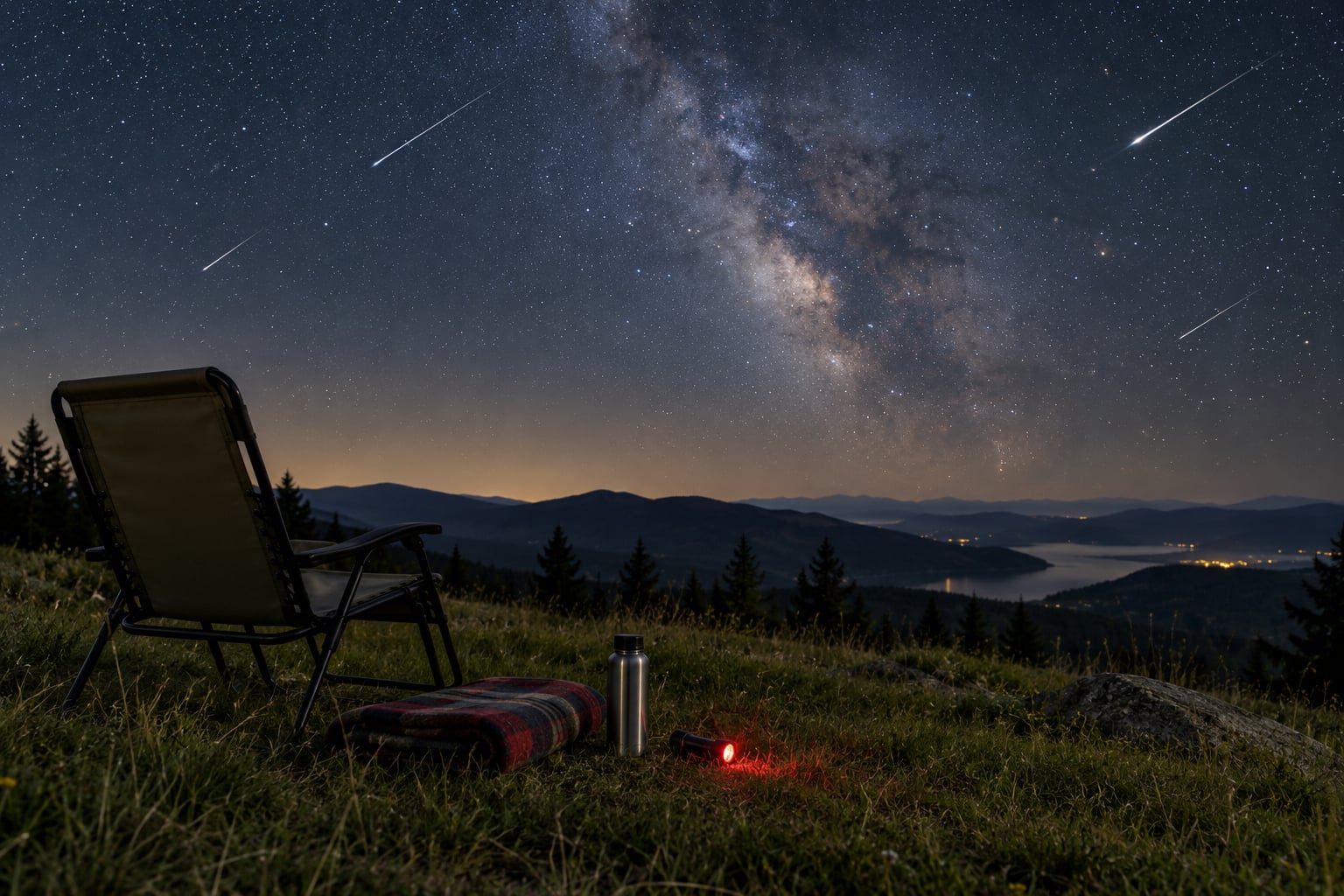
To watch a meteor shower, you need a dark open sky, a reclining chair or blanket, warm layers, and about an hour of patience after dark. No telescope is involved, because meteors are far too faint and fast for one to help. The three things that decide your night are timing, darkness, and moonlight.
That is the honest version. Most guides sell you a zenithal hourly rate of 100 and imply you will see 100 streaks. You probably won’t. A typical backyard session on a peak night with a bright moon yields a handful of fireballs. Travel away from city glow on a clear night with a thin moon and the same session can produce a steady trickle worth staying up for.
Below is the whole process, in order: what to bring, how to pick the date and hour, how to find a site, how to look, and how long to stay out. It works for beginners and for people who have done it a hundred times.
Table of Contents
- What You Need
- How to Watch a Meteor Shower: Step-by-Step
- Choose the Best Date and Time to Watch a Meteor Shower
- Find a Dark, Open Location
- Check the Weather and Sky Conditions
- Get Comfortable and Protect Your Night Vision
- Look in the Right Direction
- Watch, Count, and Record
- How to Photograph a Meteor Shower With a Phone
- Common Mistakes
- Frequently Asked Questions
- Which way do I face to see the meteor shower tonight?
- What time is the best time to view a meteor shower tonight?
- Do I need a telescope to see a meteor shower?
- Can you see a meteor shower from a city or suburb?
- How long should I watch a meteor shower for?
- What should I do if clouds block the meteor shower?
- Conclusion
What You Need
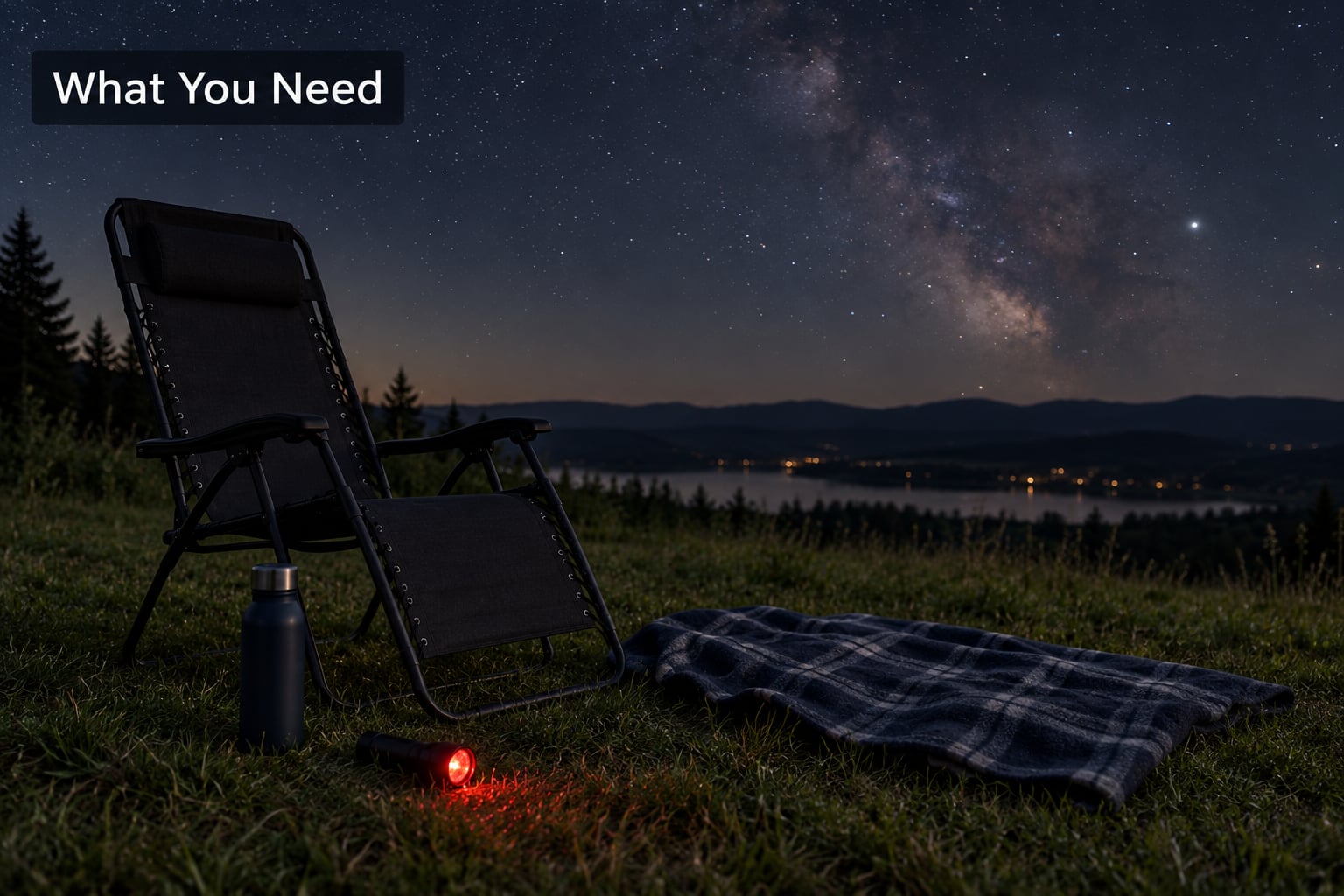
None of this is specialised equipment. The whole kit fits in a backpack and most of it is about staying comfortable for a couple of hours while your neck points at the sky.
- A dark viewing location. A field, a park away from streetlights, a rural road with good sightlines, or a certified dark sky park.
- Warm layers. October nights get cold fast, and sitting still makes it colder. A blanket beats a thick coat once you are lying down.
- A reclining chair or a thick blanket. Looking straight up for an hour gives you a stiff neck. McDonald Observatory and other outreach programmes recommend a reclined position for exactly this reason.
- A weather check. Cloud cover is the single biggest reason planned sessions fail.
- A red-light flashlight. Red preserves the dark adaptation your eyes just built. A phone flashlight undoes it in one second.
- Water and a warm drink. Caffeine-free is the better choice after midnight.
- Optional: binoculars and a phone tripod. Binoculars help you spot faint meteors and zoom in on a persistent train. A tripod steadies a camera for long exposures.
- Bug spray, if it is summer. Mosquitoes are the most common complaint in humid regions.
How to Watch a Meteor Shower: Step-by-Step
Choose the Best Date and Time to Watch a Meteor Shower
Every shower has an activity window and a peak night. Start at the American Meteor Society shower calendar, which lists peak times in UTC, moon illumination at the peak, and the constellation the radiant sits in. EarthSky publishes a companion year-long guide with the same information in plain language.
The best hours are almost always the hours after midnight. Two reasons drive that. First, the radiant of most showers sits high in the sky after midnight and low or below the horizon before it, so you are looking at more sky. Second, the air is calmer and often clearer in the small hours, so meteors punch through instead of glowing faintly near the horizon.
Moonlight is the other factor and it is badly explained in most general guides. A bright moon washes out faint meteors almost as effectively as city light, because your eyes stop noticing the low-contrast ones. New moon or a thin crescent is ideal. A full moon in the same sky as the radiant can cut your counts by more than half.
Here are the major annual showers and when they peak. The dates fall on roughly the same nights each year.
| Shower | Peak night | Radiant in | Approx. ZHR |
|---|---|---|---|
| Quadrantids | Early January | Boötes | 110 |
| Lyrids | April 22–23 | Lyra | 18 |
| Eta Aquariids | May 6–7 | Aquarius | 50 |
| Delta Aquariids | July 30 | Aquarius | 25 |
| Perseids | August 12–13 | Perseus | 100 |
| Draconids | October 8 | Draco | 10 |
| Orionids | October 21–22 | Orion | 20 |
| Leonids | November 17–18 | Leo | 15 |
| Northern Taurids | November 4–6 | Taurus | 5 |
| Geminids | December 13–14 | Gemini | 150 |
| Ursids | December 21–22 | Ursa Minor | 10 |
Zenithal hourly rate, or ZHR, is the number quoted everywhere, and it is worth understanding what it actually means. It is the rate a skilled observer would see under perfect dark skies with the radiant overhead. Nobody gets that number in a suburban driveway.
Here is a more honest set of expectations for a peak night.
| Viewing site | Moon phase | What you will probably see |
|---|---|---|
| City centre, bright | Any | A few fireballs an hour, sporadic ones mostly |
| Suburban backyard | New or thin crescent | 5 to 15 meteors an hour |
| Suburban backyard | Bright moon up | 2 to 5, mostly fireballs |
| Dark sky site | New or thin crescent | 40 to 100 an hour at a strong peak |
The Perseids and Geminids are the most reliable for casual viewers because their peaks are broad rather than a single night. The Leonids are the classic disappointment, since they stay quiet most years and only produce a genuine storm rarely. The Taurids produce slow, spectacular fireballs at a low overall rate.
Find a Dark, Open Location
Light pollution is the biggest lever you control. It removes the faint meteors first and the fireballs last, which is why city observers tend to see nothing but occasional bright ones.
Check a light pollution map before you drive anywhere, and look for dark blue or black on the scale rather than yellow and orange. The Bortle scale runs from 1, a pristine sky, to 9, an inner-city sky. Anything at 4 or below is a good night. Your own backyard can work at Bortle 4 on a still, moonless night with lights off inside the house.
Once you are there, the site matters as much as the darkness. You want an open horizon with no tree line, no buildings and no unshielded lamps in your field of view. Face away from the brightest light source, turn off your porch light, and put your phone in airplane mode so it stops glowing from your pocket.
International Dark-Sky Parks and Dark Sky Reserves are the certified options and they are worth the trip. Regular observers report a real jump in counts once you leave the suburbs, sometimes several times as many visible meteors in the same hour.
Check the Weather and Sky Conditions
Clouds are the number one cause of ruined nights, and they are also the thing nobody controls. Any forecast app gives you cloud cover and hourly timing, so the process is simple: check it in the afternoon, check it again an hour before you leave, and go anyway if the second check looks better.
You are really looking for two things, not just cloud. Cover matters most, because even thin high cloud will hide faint meteors. Transparency matters too: on a dry night after a cold front passes, the air is clear and you see more. Nights shortly after rain or with high humidity often produce hazy, washed-out skies even when the forecast shows few clouds.
Check when the moon sets. A shower that peaks before moonrise is worth a short trip. A shower that peaks at 4 a.m. with a full moon rising at 2 a.m. is not. The AMS calendar lists moon illumination percentage and rise times for each peak night, which settles the question in a few seconds.
Get Comfortable and Protect Your Night Vision
Lie back. Standing and crouching works for ten minutes and then becomes miserable. A reclining chair, a garden lounger or a blanket on the ground means your neck stays relaxed and you can watch for two hours without thinking about it.
Give your eyes 20 to 30 minutes to dark-adapt, and protect that investment. A white phone screen resets the clock. Red light does not. Before you settle in, set your phone brightness low, switch it to night or dark mode, and put it face down.
McDonald Observatory suggests a quick field test for whether your site is dark enough: after your eyes adapt, you should be able to find the Little Dipper, seven faint stars in Ursa Minor, without optical help. If the smallest of them is missing, there is more sky glow than you want, and moving to a darker spot or shielding nearby lights will pay off.
Dress for stillness rather than for walking around. Sit still for two hours and you will be colder than you expect, even in summer, because your body heat goes into a blanket and a cold sky instead of into movement.
Look in the Right Direction
Find the radiant. It is the point in the sky the meteors appear to streak out from, and it always sits inside the constellation named for the shower. Find that constellation first, using a star map app, and the radiant is somewhere in the middle of it.
Then do the opposite of what most people expect. Do not stare at the radiant. Observers recommend looking about 45 degrees away from it, roughly halfway between the radiant and the zenith, and scanning a wide area. Meteors with paths that fan out from the radiant enter your view faster and are harder to catch. Ones arriving from the side travel slowly across your field of vision and are far easier to notice.
Settle facing 40 to 60 degrees off the radiant, at an altitude of roughly halfway between the horizon and directly overhead. Let your eyes move slowly rather than fixing them in one spot. A wide, relaxed gaze catches faint meteors that a focused stare slides right past.
Watch, Count, and Record
A meteor looks like a brief streak of light, usually a fraction of a second long, that seems to come from one shared point in the sky. Sporadic meteors appear anywhere and at random. Shower members trace back to the radiant.
The brighter ones are called fireballs, and a fireball bright enough to light up the ground is a bolide. Occasionally a fireball leaves a persistent train, a glowing line of ionised gas that hangs in the sky for seconds. Binoculars pointed at a train are one of the real pleasures of the night.
Stay out for at least an hour before judging the session. Rates ramp up slowly as the radiant rises, and the first fifteen minutes are the worst for counting. Short trips produce disappointing numbers and false conclusions about the night.
Then write down what you saw: the date, your start and end times, your location, the shower you were targeting, your rough count by hour, and anything unusual. Fireballs and trains are worth reporting to the American Meteor Society, and there are public counters that take counts from casual observers as citizen science.
How to Photograph a Meteor Shower With a Phone
Phone meteor photography is possible, and most failures come from settings rather than camera quality. Switch the phone into manual or pro mode, set the exposure to the longest shutter the night sky allows at ISO 1600 to 3200, and focus to infinity. Mount it on a tripod or lean it against something solid, then point it 40 degrees or so from the radiant.
Start a timed exposure or interval sequence and leave it alone. Touching the screen or moving the phone creates a black frame. Review afterwards and keep the frames with streaks. Longer exposures are more likely to catch something, so a ten-second setting is a reasonable starting point when the sky is truly dark.
Common Mistakes
Choosing a bright location. Staying home because driving feels like effort is the most common reason for a flat night. Obscuring a lamp with a coat helps a little; a two-hour drive to a dark site helps a lot more.
Looking straight at the radiant. Meteors crossing your field of vision sideways are far easier to catch than ones aimed at you. Move your gaze 40 to 60 degrees off the radiant.
Arriving late. The first half hour after you settle is the weakest of the session. If you can only manage an hour, spend it in the darkest, best-placed part of it rather than starting at sunset.
Using a phone flashlight. White light destroys dark adaptation instantly, and the recovery takes another 20 minutes. Use red light, cover the screen, or use a dim headlamp.
Expecting the advertised rate. ZHR is a ceiling under ideal conditions, not a promise. Judging a shower by the number in a headline is how a great night feels like a failure.
Leaving the sky too soon. Hour-long sessions are too short for most showers. Longer and slower is the standard advice.
Putting a telescope on a meteor. Narrow fields of view catch meteors by accident, not design. It is the one piece of equipment worth leaving at home.
Ignoring comfort. Cold, mosquitoes and a stiff neck end sessions early more often than clouds do. Bring the blanket, the chair and the bug spray.
Frequently Asked Questions
Which way do I face to see the meteor shower tonight?
Find the constellation named for the shower, such as Orion for the Orionids, and treat the middle of it as the radiant. Then face 40 to 60 degrees away from that point, at about half the height between the horizon and the zenith. Meteors crossing the sky sideways are much easier to catch than ones travelling toward you from the radiant, so scanning a wide area beats staring at one spot.
What time is the best time to view a meteor shower tonight?
After midnight through the hour before dawn is the strongest window for most showers. The radiant sits higher in the sky during those hours, and the air is usually calmer and clearer. If your shower peaks in the evening, start anyway and stay out, because rates climb as the radiant rises. Check the American Meteor Society calendar for peak times in UTC and the moon set time for your location.
Do I need a telescope to see a meteor shower?
No. Meteors are fast, faint and spread across the whole sky, so a telescope narrows the view exactly where you do not need it. Binoculars are more useful, mainly for looking closely at a fireball and its persistent train. Your unaided eyes, given about 20 minutes to adjust to the dark, are the instrument that matters most.
Can you see a meteor shower from a city or suburb?
You will see some, but far fewer. Light pollution removes the faint meteors first and the bright fireballs last, so city observers usually catch occasional fireballs rather than a shower. A suburban backyard with the house lights off, a clear horizon and a moonless night can produce 5 to 15 an hour at a strong peak. Travelling to a dark sky site is the single biggest improvement available.
How long should I watch a meteor shower for?
At least an hour, and two to three hours if you can manage it. Rates build gradually as the radiant climbs, so the opening fifteen minutes are the weakest part of the night. Staying out past midnight and into the pre-dawn hours adds most of the meteors you will count. Short sessions tend to end before the shower has really started.
What should I do if clouds block the meteor shower?
Check the hourly forecast an hour before you leave and go anyway if it looks better, since conditions often shift. If the night stays socked in, watch the next night instead, as most showers have activity periods that extend well beyond the peak. When nothing clears nearby, a live stream from a dark sky site shows you real footage, though it is no substitute for standing under it.
Conclusion
Start with three things tonight: check the peak date and moon phase on the American Meteor Society calendar, pick the darkest open spot you can reach in under an hour, and look at the hourly cloud forecast shortly before you leave. Then lie back facing 40 degrees off the radiant, keep white light out of your eyes, and stay out for at least an hour after midnight.
Keep expectations realistic. A good night means a fireball every few minutes, not the headline number. Watch on the night before and the night after the peak too, since most showers are still active then.