
A mortgage estimate is a three-page form that shows the rate, the terms, every fee the lender expects you to pay, and the cash you will hand over at closing. You read it in three passes: page 1 for the loan terms and the rate lock, page 2 for the fee breakdown where box D holds the number that actually matters, and page 3 for the annual percentage rate and the penalty disclosures. Set aside an hour with a calculator and two or three competing estimates if you have them, because the advertised rate is only one line on a page that can move the cost of the loan by tens of thousands of dollars.
The Consumer Financial Protection Bureau’s rules, known as TRID, require a lender to hand you this form within three business days of taking your application. It is a disclosure, not a contract, and it is not approval. Those rules are a US standard, and the equivalent paperwork in other countries follows a different structure, so check what your own lender is required to hand you. More on that below.
Table of Contents
- What You Need
- Step-by-Step
- 1. Start With the Loan Estimate Summary
- 2. Check the Purchase Price and Property Information
- 3. Review the Interest Rate and Loan Terms
- 4. Understand the Estimated Closing Costs
- 5. Check Cash to Close and Payment-to-Income Ratio
- 6. Compare the Estimate With Other Loan Options
- 7. Ask Questions and Track Changes
- Common Mistakes
- Frequently Asked Questions
- Does a mortgage estimate mean I am approved?
- How long is a mortgage estimate good for?
- Can my closing costs go up after the estimate?
- What is the difference between a Loan Estimate and a Closing Disclosure?
- How many lenders should I send a loan estimate request to?
- What is box D on a loan estimate?
- Conclusion
What You Need
You cannot check a document you do not have, and you cannot compare a loan you have not quoted. Before you start, gather five things.
- The full three-page estimate, not the summary. Many lenders send a one-page cover sheet first. The fee breakdown on page 2 is where the work is.
- Your purchase contract or refinance terms. You need the agreed price, your down payment, and the closing date written down somewhere.
- Comparable sales for the property. Two or three recent sales on the same street or in the same neighborhood give you something to check the lender’s estimated value against.
- Estimates from other lenders. Ask for at least two more inside the shopping window, usually 14 to 45 days before closing depending on the loan type. Different lenders on the same day, the same loan amount, and the same credit scenario is the only fair comparison.
- A spreadsheet. One tab per lender, one row per fee line. This is the step people skip and the step that saves money.
Step-by-Step
1. Start With the Loan Estimate Summary
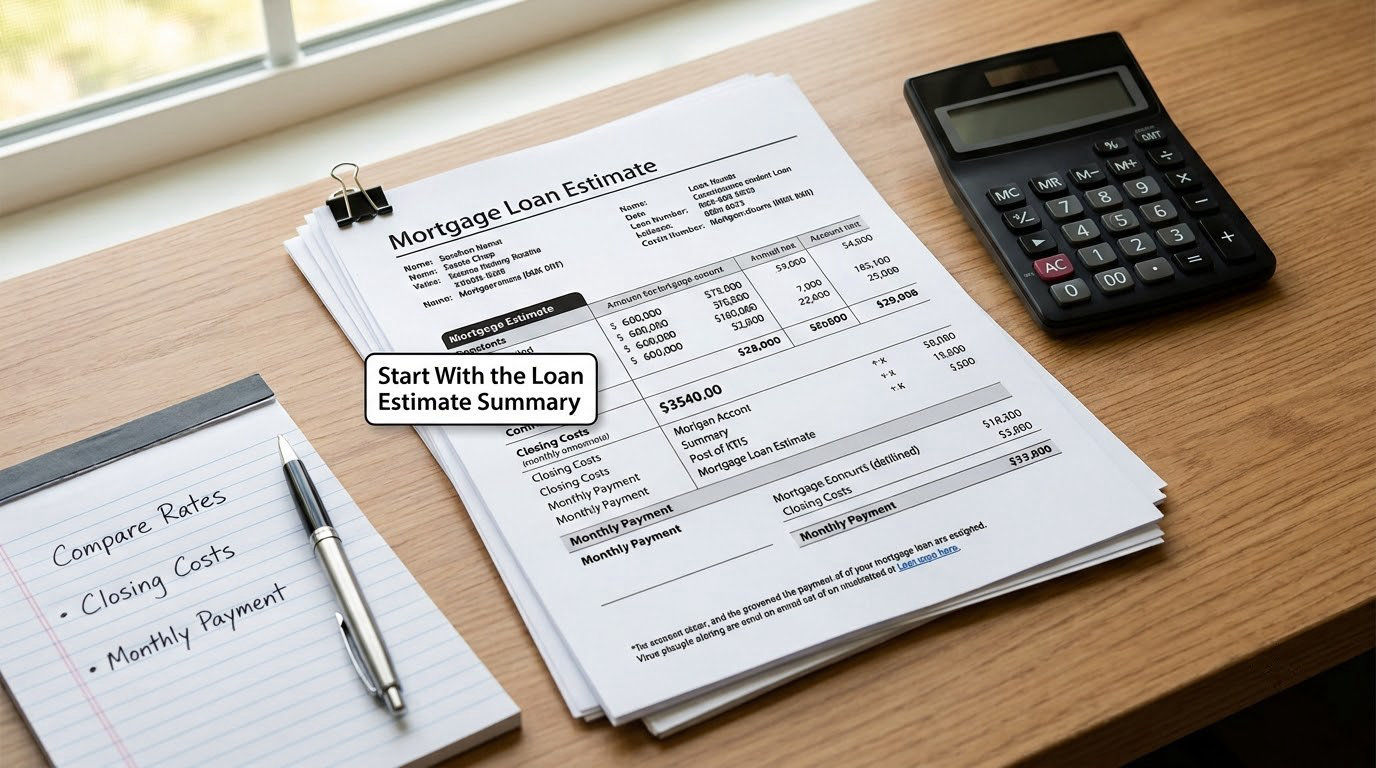
Start at the top of page 1 and confirm the basics before you look at any number with a dollar sign in it. Check the property address, the borrower names, the loan purpose, and the date. If your offer has a closing date three weeks out and the estimate is dated today, the rates on this page may not survive until closing.
Learning how to read a mortgage estimate without being overwhelmed comes down to reading it in the order the numbers build on each other: terms first, then fees, then the summary figure at the bottom. A consistent estimate should show a loan amount that matches your contract price minus your down payment, and a cash-to-close figure that equals your down payment plus the total of the closing costs plus any prepaid items.
If those three numbers do not reconcile, stop there. An arithmetic mismatch usually means a fee is missing or an assumption was left at zero.
2. Check the Purchase Price and Property Information
Confirm that the purchase price on page 1 matches the price in your signed contract to the dollar. Then find the estimated value the lender is using and compare it against recent comparable sales.
This is the field most borrowers never check, and it matters more than it looks. The property value drives the loan-to-value ratio, and the loan-to-value ratio drives the rate you are quoted. A value set 15 percent too low can push you into a higher price band, which means a worse rate on the entire loan. If the value looks low, ask for the appraisal or an automated valuation review and send your own comps with the sales price, distance from the subject, and square footage.
Also check the occupancy box. Owner-occupied and second-home or investment properties get different rates, different reserves, and in some cases different loan programs entirely.
3. Review the Interest Rate and Loan Terms
Read the interest rate, then read what is attached to it. A lender will quote you a rate that assumes a certain number of discount points, and a discount point is one percent of the loan amount paid at closing to buy that rate down. On a 400,000 dollar loan, one point is 4,000 dollars.
Points and origination are not the same thing, even when a lender says they are. Points buy a lower rate. An origination charge is a fee for making the loan, often expressed as a percentage of the loan amount, and it buys you nothing you can see on the payment line. Borrowers get these two confused constantly, and buyers regularly discover mid-contract that a lender had folded them together.
Then check the lock. The rate is only guaranteed for the length of the lock period, and that period is set by your closing date, not by how good the rate looks today. A fifteen-day lock is fine when you close in three weeks and painful when your contract has five weeks of escrow left in it. Rate lock, like everything else here, varies by lender and loan type, so confirm it in writing.
4. Understand the Estimated Closing Costs
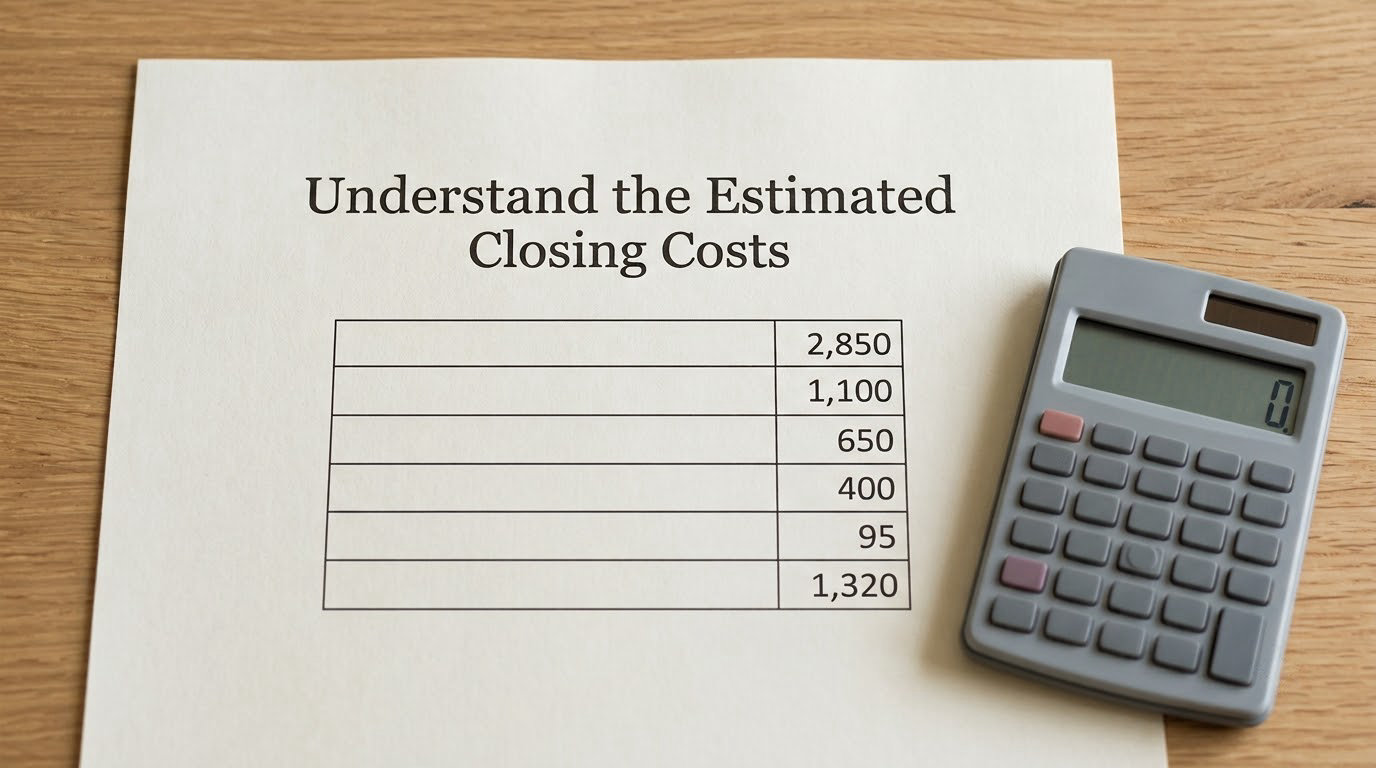
Page 2 is the longest page and the one that decides whether a low rate was worth taking. It groups costs into lettered sections, and each section tells you something different about who controls the number. Here is the field map, section by section.
| Where it sits | What it is | What to verify |
|---|---|---|
| Section A, Origination Charges | The lender’s own fees: origination, underwriting, application, admin, mortgage recording | Whether each is negotiable and whether the same fee appears twice under a different label |
| Section B, Services You Cannot Shop For | Third-party services the lender already chose, such as the appraisal and most title services | That a written list of provider choices is attached, so you may switch to a provider you picked |
| Section C, Services You CAN Shop For | Title search, title insurance, settlement agent fees, survey, pest inspection | Get two or three written quotes; these are the fees where shopping actually pays |
| Section D, Total Loan Costs | All lender charges plus the services you cannot shop for, minus any lender credit | Compare this number across lenders, not the rate |
| Section E, Taxes and Insurance | Property taxes and homeowners insurance for the coming year | The insurance quote is often a placeholder until the binder is issued |
| Section F, Loan Fees and Prepaid Items | Prepaid interest, lender fees not already counted, and the first year of escrow reserves | How many days of prepaid interest you are charged; check it against your actual closing date |
| Section G, Initial Escrow Payments | The monthly escrow deposit, plus a lump sum if your lender requires reserves | Whether the reserve is required at all and how many months it covers |
Box D is the honest headline number. The interest rate alone tells you nothing about whether a loan is cheap, and the total closing costs at the bottom of the page include the borrower’s own down payment, which is not a cost at all. Compare box D, then compare rate separately.
Two more details catch people. Lender credit is a real line item: a lender can waive some of its own fees to offset a higher rate or cover your closing costs, and it appears in Section D as a reduction. And a Loan Estimate is not a blank check on fees. Title services in Section C are genuinely shoppable, while Section A fees are usually fixed, which is exactly the frustration that shows up in every borrower forum thread on this topic.
5. Check Cash to Close and Payment-to-Income Ratio
At the bottom of page 1, estimated cash to close adds your down payment, your closing costs, and your prepaid items. That total is the number your bank balance has to cover, and it is the number most first-time buyers underestimate.
Sections F and G are your own money held in escrow, not lender profit. When you compare two lenders, exclude them from the lender comparison and look at them separately as a liquidity question, because you get them back at the end of the year.
Divide the projected total monthly payment by your gross monthly income for a front-end ratio, then add up your other monthly debts for the back-end ratio. Conventional lenders generally want to stay under 28 and 36 percent, though loan programs and compensating factors can move those numbers. If your estimate pushes you over, ask what the lender could do: a slightly higher rate can lower the payment, and so can lender credit applied toward the loan.
6. Compare the Estimate With Other Loan Options
Line up every estimate in the same order: rate, points, box D, APR, cash to close, and lock length. Anything you cannot place in one of those six columns is not being quoted the same way as the others.
Here is how it works in practice. Suppose one lender quotes 6.25 percent on a 400,000 dollar loan with box D costs of 14,000 dollars, and another quotes 6.625 percent with box D costs of 3,000 dollars. The second option saves about 11,000 dollars today but costs roughly 70 dollars more per month. Divide 11,000 by 70 and you get a break-even of roughly 157 months. If you expect to keep the loan beyond that, the higher rate with low costs wins. If you might sell or refinance inside four years, the upfront savings win. That calculation takes two minutes and settles arguments no one can win by talking.
When a quote looks better than the market, slow down and check the assumptions behind it: a lower appraisal, a shorter lock, a cash-out refinance on a property you are not buying yet, or an assumption about occupancy that will not survive underwriting.
7. Ask Questions and Track Changes
Write down every assumption you are unsure of and ask before you sign anything. Good questions sound like this: what is the origination fee based on, is this fee negotiable, how many days of prepaid interest am I being charged and why, what is the appraisal fee, and who is my settlement agent.
Keep each new version. Compare revised estimates line by line rather than skimming for the new bottom-line number, and note which assumption changed. Fees for services in Sections B and C generally cannot increase beyond an aggregate cap of 10 percent, with an exception for a changed circumstance, a lender-scheduled service timing, or a buyer’s purchase of a point or credit.
Know what changes between this form and the Closing Disclosure you sign at least three business days before closing.
| Item | Can it move between estimate and closing? |
|---|---|
| Interest rate and monthly payment | Only if the lock expired or you agreed to a float-down or renegotiation |
| Prepaid interest and escrow reserves | Yes, based on the actual closing date and the real tax and insurance figures |
| Title, settlement, and other shoppable fees | Up to the 10 percent aggregate cap, unless a changed circumstance applies |
| Property taxes and homeowners insurance | Yes, once the insurance binder and the tax bill arrive |
| Lender fees in Section A | Not without your consent |
If you receive your estimate after signing a contract, say so. The three-business-day rule is aimed at exactly that situation, and a lender that missed the window has a disclosure problem you can raise directly.
Common Mistakes
Most of the confusion on this form comes from a short list of repeated misreads. Each of these has a fix you can apply today.
- Treating the rate as the price. The fix: compare box D and APR first, rate second.
- Comparing total closing costs. That figure includes your down payment, so it is not a lender fee. Compare box D instead.
- Counting Sections F and G as lender costs. They are your own funds in escrow. Look at them as a cash requirement, not a price.
- Assuming points and origination are the same. Points change your rate; origination is a fee for making the loan.
- Not shopping Section C. Title and settlement services are meant to be compared. Buyers routinely save hundreds by picking their own title company.
- Reading box D and skipping the cash-to-close figure. The payment is only half of what leaving your account costs you.
- Ignoring the estimated value. A low value inflates your loan-to-value ratio and costs you money on the entire loan.
- Treating the estimate as approval. It is a disclosure of what the lender expects to offer, not a decision. The underwriter has not seen your file yet.
- Waiting too long to compare. If you shop outside the window or after your lock has been set, you may be comparing against stale rates.
- Assuming fees are frozen at the estimate. Prepaid interest, escrow, taxes, and insurance all move with the real closing date.
Frequently Asked Questions
Does a mortgage estimate mean I am approved?
No. A Loan Estimate shows what the lender expects to offer if you decide to move forward, based on the application and property so far. Approval happens later, during underwriting, when the lender verifies your income, assets, credit, and the property’s value. Do not spend money on an earnest money deposit or waive a home inspection contingency on the strength of a Loan Estimate.
How long is a mortgage estimate good for?
A rate is firm only for the length of the lock period printed on page 1, commonly 15 to 45 days depending on the lender and loan type. Closing cost figures for services you cannot shop for are generally committed within 10 percent until closing. Because lock length is usually driven by your closing date, an estimate received six weeks out can be stale by the time you sign.
Can my closing costs go up after the estimate?
Yes, partly. Prepaid interest, escrow reserves, property taxes, and homeowners insurance are calculated from your real closing date and the actual bills, so they shift as those numbers come in. Fees for services you cannot shop for are generally capped at a 10 percent aggregate increase, and a changed circumstance can override that cap. Lender fees you have not agreed to change should not move.
What is the difference between a Loan Estimate and a Closing Disclosure?
The Loan Estimate comes early, within three business days of your application, and projects your terms and costs. The Closing Disclosure comes at least three business days before closing and states the actual figures. Compare them line by line and ask about every difference larger than a rounding error, especially anything in Section A.
How many lenders should I send a loan estimate request to?
Three is the practical minimum: your current lender plus two others you found yourself. Request them for the same loan amount, the same down payment, and the same credit scenario, all inside the same shopping window. Mortgage inquiries within that window are generally treated as one inquiry for credit scoring purposes, so shopping does not work against you.
What is box D on a loan estimate?
Box D is Total Loan Costs. It adds up every charge in Section A plus the services you cannot shop for in Section B, then subtracts any lender credit. It excludes fees you can shop for and excludes your down payment, which is why it is the number to use when comparing lenders and why it is often far lower than the total closing costs printed at the bottom of page 2.
Conclusion
Start with box D and the estimated value on page 1, then work outward to the fee sections on page 2 and the disclosures on page 3. If you do one thing after reading this, pull two more estimates for the identical loan and put them in one spreadsheet with the same columns.
Every figure on a Loan Estimate is an expectation built on assumptions about the property, the calendar, and your credit, and those assumptions can move. Verify your financing terms and your cash requirements with a licensed loan officer before you sign anything, and treat the closing disclosure as the document that decides what you actually pay.