Mortgage points are optional fees you pay your lender at closing that buy down your interest rate for the life of the loan. One point costs 1 percent of the loan amount, and each point typically cuts the note rate by roughly 0.25 percentage points, so you pay more today to pay less every month for the next thirty years.
Updated October 2026. Rates, lender pricing and loan rules shift with the market and with the borrower, so treat every number below as an illustration of the mechanics rather than a quote.
Points only make sense if the savings survive long enough to matter. That is why the whole topic comes down to one number: your break-even point.
Table of Contents
- What Are Mortgage Points?
- How mortgage points work in plain numbers
- How Mortgage Points Affect Your Interest Rate
- How much do 2 points lower your mortgage?
- Why a lower rate is not automatically a lower cost
- What Mortgage Points Cost
- How to Calculate the Break-Even Point
- How to Compare Points With a Lower Loan Amount
- When Paying for Mortgage Points May Make Sense
- When Skipping Mortgage Points May Be Better
- Questions to Ask a Mortgage Lender About Points
- Frequently Asked Questions
- Are mortgage points required?
- How much does one mortgage point cost?
- Do mortgage points always reduce the interest rate?
- How long does it take mortgage points to pay off?
- Can mortgage points be refunded or credited at closing?
- Is it better to pay mortgage points or keep cash for the down payment?
- Conclusion
What Are Mortgage Points?
In the plainest terms, a point is prepaid interest. You hand the lender cash at closing and they write a lower rate into your note, the legal document that governs the loan. That lower rate, called the note rate, then drives your monthly payment and your total interest for every remaining payment of the loan.
How mortgage points work in plain numbers
On a 400,000 USD loan, one point costs 4,000 USD and typically moves the note rate from 6.5 percent to about 6.25 percent. Two points cost 8,000 USD and typically land near 6.0 percent. The payment falls from about 2,528 USD to roughly 2,398 USD, a saving near 130 USD a month before taxes, insurance and escrow.
Here is the correction that confuses a lot of first-time buyers: one point does not equal one percentage point off your rate. Points are priced as a percentage of the loan; the rate reduction they buy is a separate, smaller number set by each lender’s pricing grid. A lender quoting 0.25 percentage points, or 25 basis points, per point is typical. Another lender may quote 0.125 on a 30-year loan and 0.375 on a 15-year loan, and some will decline to sell points on a specific file at all.
There are four things people lump together under the word points, and they behave differently:
- Discount points are the ones that buy the rate reduction. This is what most people mean when they say points, and it is the only type covered by the rest of this guide.
- Origination points are a fee for making and processing the loan. They buy you nothing in the way of a better rate, which is why two competing quotes can both list points while meaning completely different things.
- Lender credits run the other direction. The lender accepts a higher rate and gives you money back at closing to cover some of your other closing costs.
- Negative points are lender credits expressed in point form, where accepting a higher rate funds part of your closing costs.
How Mortgage Points Affect Your Interest Rate
Buying points lowers the rate you are quoted, which lowers the monthly payment and the total interest charged across the life of the loan. On a 30-year fixed mortgage, one point at a quarter-point reduction on a 400,000 USD loan cuts roughly 65 USD a month and around 23,000 USD in lifetime interest. Two points roughly double both figures.
Because each point costs 1 percent of the loan but buys only about a quarter of a percentage point of rate, every extra point you buy gets slightly worse value. That pattern is why plenty of borrowers who want points stop at one or two rather than paying for three or four.
The reduction is not fixed, and this is the part most articles skip. It varies by lender, by loan type, by credit tier and by what the lender is trying to win business with that week. A lender with a high cost of funding may price points better than a lender competing aggressively on rate. Always read the specific reduction off the Loan Estimate rather than assuming it.
How much do 2 points lower your mortgage?
Two points typically buy about half a percentage point of rate: a 6.5 percent quote drops to roughly 6.0 percent, and a 7 percent quote to about 6.5 percent. On a 400,000 USD 30-year loan, that moves the payment from about 2,528 USD to about 2,398 USD, saving roughly 130 USD a month for an 8,000 USD upfront cost.
Because the cost and the savings scale together, the break-even period for two points usually lands near the break-even for one. On that loan, roughly 62 months either way.
Why a lower rate is not automatically a lower cost
The Loan Estimate carries both the note rate and the annual percentage rate. APR rolls points and most other closing costs into the rate so two offers can be compared on one number. A quote with points can show a lower note rate but the same or a higher APR than a zero-point quote, which tells you the points never earned their money.
What Mortgage Points Cost
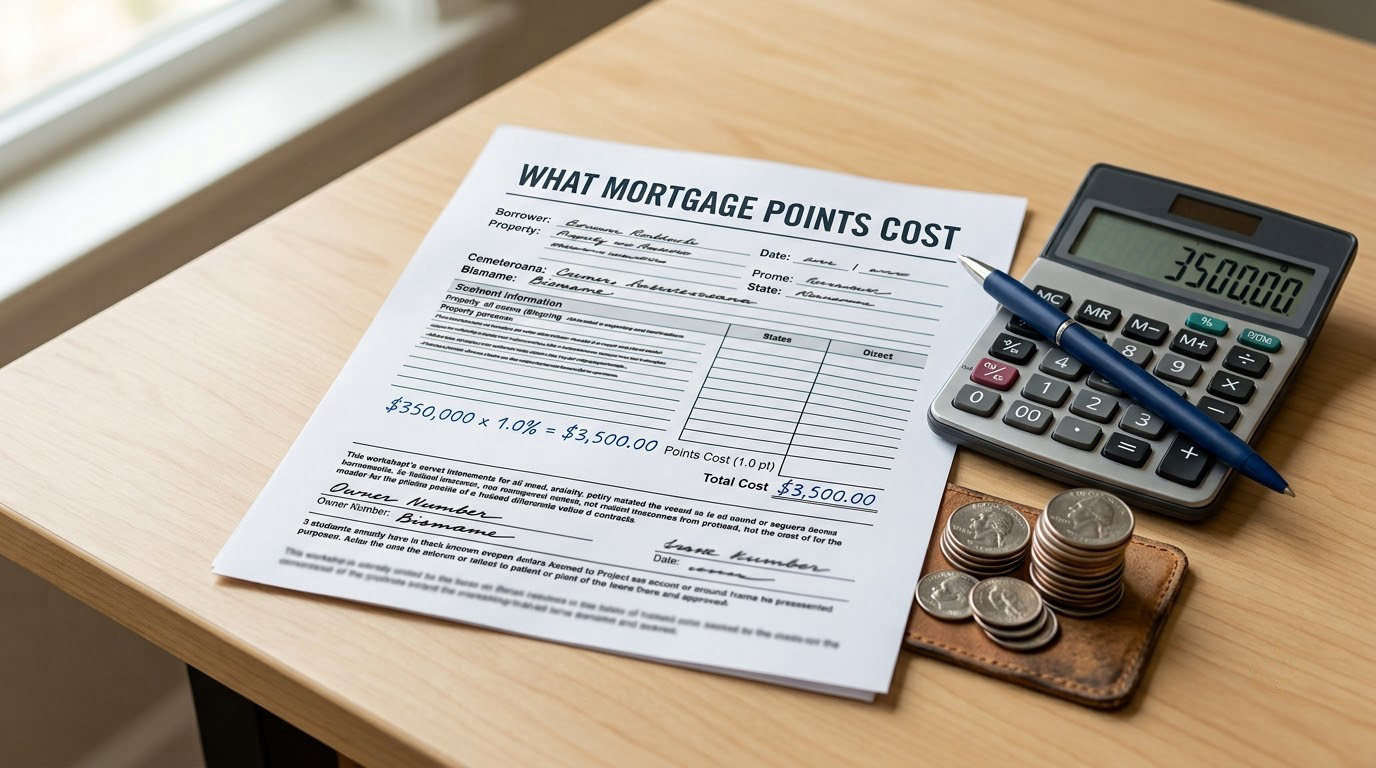
One discount point is 1 percent of the loan amount. On a 300,000 USD loan that is 3,000 USD; on a 400,000 USD loan, 4,000 USD; on a 500,000 USD loan, 5,000 USD. Partial points work too, so a lender may sell 0.375 or 0.625 of a point rather than only whole numbers.
| Points bought | 300,000 USD loan | 400,000 USD loan | 500,000 USD loan |
|---|---|---|---|
| 0 points | 0 USD | 0 USD | 0 USD |
| 1 point | 3,000 USD | 4,000 USD | 5,000 USD |
| 2 points | 6,000 USD | 8,000 USD | 10,000 USD |
| 3 points | 9,000 USD | 12,000 USD | 15,000 USD |
Points show up as a line item in Section A of the Loan Estimate, usually labelled discount points, and they count toward cash to close. You can pay them in cash, have the lender finance them by adding them to the loan balance, or accept a seller concession toward them. Financing looks easy on the payment but you are still repaying the fee plus interest on it, so read the full Loan Estimate before agreeing.
Federal rules cap lender-provided credits at 3 percent of the loan amount for most conventional loans, which is where negative points come up. Sellers also routinely contribute toward points, and those concessions are usually limited to around 6 percent of the purchase price on conventional loans.
On a purchase of the home you will live in, discount points are generally deductible on Schedule A in the year you pay them, subject to itemising and to the acquisition indebtedness limit. Points paid on a refinance are usually not deducted in one lump sum; they are amortized across the loan term unless you elect to itemize in the first year. Talk to a tax professional in your own situation.
How to Calculate the Break-Even Point
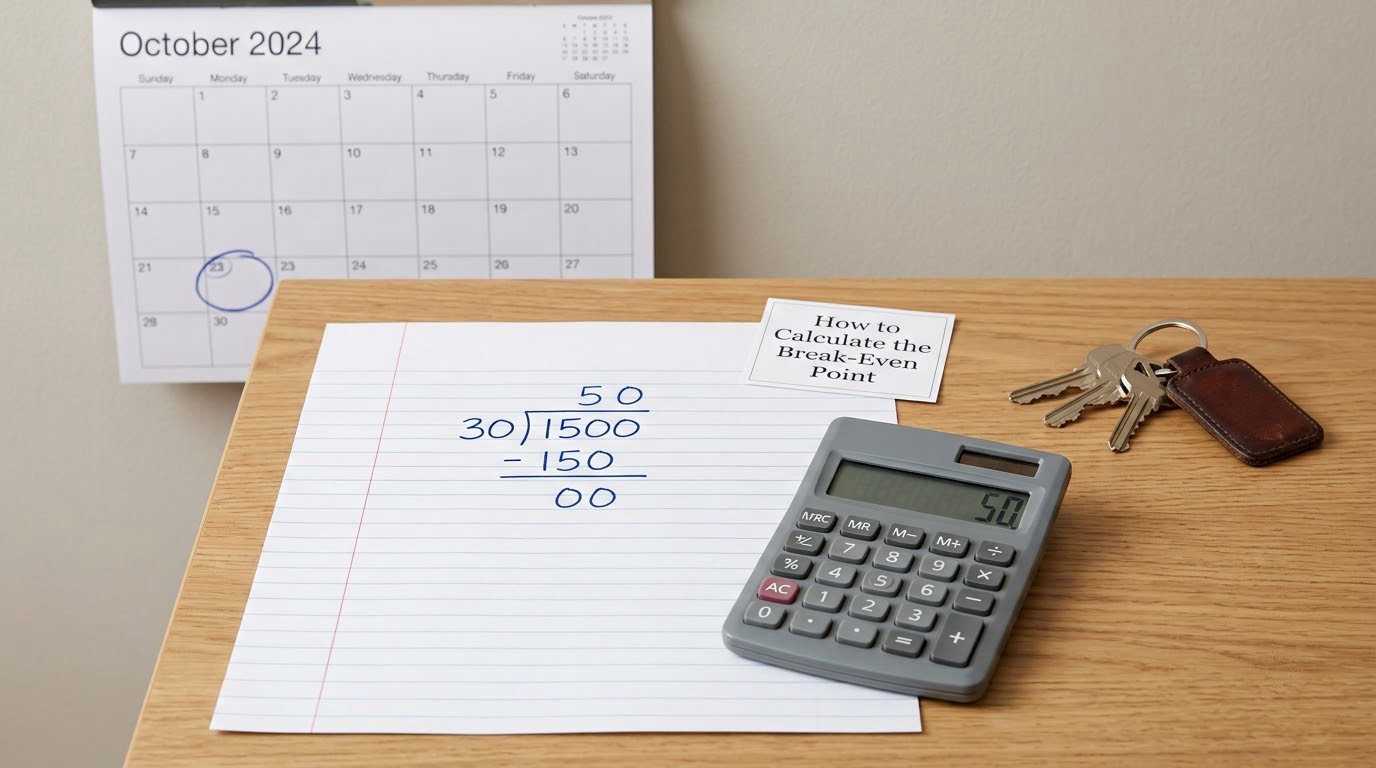
Break-even is the month where the cash you spent on points equals the payments you have saved. Four steps, and you can do it on paper.
- Total your upfront cost. Multiply the loan amount by 0.01 for each whole point, then add any partial point. Ignore origination points and third-party fees, since those buy you no rate reduction.
- Find your payment without points and your payment with points, principal and interest only, using the same term and the same tax and insurance assumptions for both.
- Subtract to get the monthly saving. Round it down rather than up, so the result is conservative.
- Divide upfront cost by monthly saving to get the number of months to break even. Convert it to years and compare it to how long you plan to keep the loan.
Worked example on a 400,000 USD 30-year fixed loan quoted at 6.5 percent with one point:
- Upfront cost: 1 percent of 400,000 USD = 4,000 USD
- Payment at 6.5 percent, no points: about 2,528 USD
- Payment at 6.25 percent, one point: about 2,463 USD
- Monthly saving: about 65 USD
- Break-even: 4,000 USD divided by 65 USD = about 62 months, or 5 years and 2 months
Now do the step that almost nobody does. After 62 months you have kept about 4,030 USD in lower payments and still owe roughly 8,000 USD in points. Over the full 30 years that single point saves on the order of 23,000 USD. So the same loan looks clearly positive if you stay ten years, obviously poor if you sell in four, and borderline at five.
One more thing worth internalising: points are not an asset. If you sell the home or refinance before break-even, you do not get 4,000 USD back at closing. In a refinance you may be able to credit remaining points toward the new loan’s closing costs, but only within the same lender and often only at their discretion. Selling the house simply forfeits them.
How to Compare Points With a Lower Loan Amount
Points are never compared against zero points only. Cash spent on points is cash not spent on a larger down payment, a smaller loan or simply staying in your account, and on most loans that is the comparison that matters.
A larger down payment shrinks the loan, which lowers both the payment and the total interest, and you avoid mortgage insurance once you reach the usual 20 percent equity threshold. The cash you would have spent on points can produce part of that down payment instead. On some loan programs the points cannot be financed at all, and on VA loans the borrower usually has to cover them at closing, which puts them straight into competition with your down payment.
Keeping the cash has its own return. If you hold it in an account earning a few percent while the mortgage costs 6.5 percent, you are not losing much to inflation. Compare the after-tax return on that cash against the interest rate you avoid, and remember the point buy is locked to your specific loan and specific rate, while the cash stays yours.
For shorter holds the arithmetic is more forgiving. Over five years, principal payments you never had to make because you kept the cash can outweigh the interest the points saved. That is the honest version of the advice that points only pay off if you stay in the home a long time.
When Paying for Mortgage Points May Make Sense
Points tend to fit when the plan is long and the numbers are stable. If your break-even is around five years and you have no intention of moving before year ten, the spread of outcomes is wide and the downside is only the delay.
They also suit a borrower who has reserves that are genuinely spare. Paying points out of money earmarked for the down payment or for a few months of expenses buys a rate reduction while quietly raising the risk of the purchase itself. Retirement and predictable income is the friendliest case: a fixed payment is easier to live with than one that shrinks, and no raise has to absorb it.
Finally, points can make arithmetic sense when a lender offers a small number of points for a generous rate cut. Borrowers describe this pattern often: half a point or three eighths that removes a quarter point or more is a better deal than two full points, because the value of each point falls as you buy more. Ask for the point and rate combinations side by side rather than accepting a package.
When Skipping Mortgage Points May Be Better
Short timelines are the clearest case for skipping. If a move, a career change or a planned refinance in the next three years is on the table, the points are a sunk cost on day one. The break-even calculation is not a guarantee of a gain, it is a measurement of when the bet starts working.
A 15-year mortgage rarely benefits. With only half the term, the total interest available to save is far smaller, so break-even periods look long even when the monthly saving is decent.
Expectations matter too. If rates fall and you plan to refinance, points paid today may be partially credited, but a lower note rate is a liability when the market is moving down. In a falling rate environment, keeping cash and refinancing later often beats locking in a permanently lower rate. The same logic runs the other way: in a high-rate market with no relief in sight, a buydown buys predictable savings.
Borrowers with irregular income, self-employment or thin reserves often do better protecting liquidity than buying rate reduction. And if your real goal is paying the loan off faster, extra principal payments shorten the term without the upfront cost of points. The popular 3-7-3 shortcut, paying an extra 3 percent in year one, 7 percent in year two and 3 percent in year three, cuts years off the payoff for far less cash than points cost.
Questions to Ask a Mortgage Lender About Points
Walk into the conversation with these and the answers will tell you everything.
- Exactly what rate does each point cost me on this loan, in writing, and is that rate specific to my credit tier?
- What will my payment be at zero, one and two points, principal and interest only, so I can compare like for like?
- Which fees on the Loan Estimate are discount points and which are origination or third-party fees? Only one of those buys a lower rate.
- What APR results from each combination, and at what point does the APR stop improving?
- What is my break-even month for each option, and how does it compare with my expected holding period?
- Can the points be financed, seller-concessed or credited, and does my loan type restrict any of those?
- Is there a prepayment penalty, and on a refinance would unused points be credited toward my new closing costs?
The comparison itself matters as much as the questions. Ask two or three lenders for Loan Estimates that show different point and price combinations rather than one quote each, then line up the same line items across all three. That is the only way to see whether a lender’s points are genuinely better priced or just bundled with fees.
Frequently Asked Questions
Are mortgage points required?
No. Points are optional on virtually every conventional loan, and most lenders quote a competitive rate with no points at all. You can also decline a lender’s suggested points and buy a smaller number instead, such as half a point. What you are not allowed to skip is the fees tied to the loan itself, such as origination or third-party charges, which exist whether or not you buy rate reduction.
How much does one mortgage point cost?
One point costs 1 percent of the loan amount. That is 3,000 USD on a 300,000 USD mortgage, 4,000 USD on a 400,000 USD loan and 5,000 USD on a 500,000 USD loan. Partial points are common, so a lender may quote 0.375, 0.625 or 0.75 of a point, priced at the same rate. Points normally appear in Section A of the Loan Estimate and count toward your cash to close.
Do mortgage points always reduce the interest rate?
Only discount points do. Origination points are a lender fee for processing the loan and buy no rate reduction, which is why two quotes can both list points while describing different things. The size of a discount point’s rate cut is not fixed either. Roughly 0.25 percentage points, or 25 basis points, per point is common on 30-year loans, but each lender sets its own grid based on cost of funds, loan type and credit tier.
How long does it take mortgage points to pay off?
Divide the total upfront cost by the monthly payment saving. On a 400,000 USD 30-year loan at 6.5 percent, one point costs 4,000 USD and saves about 65 USD a month, so break-even arrives near 62 months, a little over five years. The figure is only meaningful next to your holding period. Sell or refinance before break-even and the points are simply gone, with no refund at closing.
Can mortgage points be refunded or credited at closing?
Generally no. Discount points are a one-time cost at closing and are not a recoverable asset, so selling the house before break-even means you never recoup them. On a refinance, some lenders will credit unused points toward the new loan’s closing costs, but that is discretionary, limited to the same lender, and often capped. In a purchase, only seller concessions or lender credits offset points at closing, and those are limits that apply.
Is it better to pay mortgage points or keep cash for the down payment?
If the cash would grow your down payment meaningfully, keep it. A larger down payment lowers the loan, reduces total interest and often removes mortgage insurance once you reach the usual 20 percent equity mark, and a weak down payment can sink a purchase outright. Points only win when you can genuinely afford them without touching reserves and you expect to stay well past break-even, typically ten years or more.
Conclusion
The decision comes down to three numbers: what a point costs you, what rate reduction the lender actually writes, and how long you will keep the loan. Get those three, divide the upfront cost by the monthly saving, and you have your break-even month.
Then compare that month to your holding period and to what else the cash could do. If the break-even lands well inside a plan you are confident about, and the cash is genuinely spare, points are a reasonable way to buy a lower payment. If the cash belongs to your down payment or your emergency fund, keep it and take the higher rate. Start by reading the discount point figure and the rate on two or three Loan Estimates, then run the arithmetic on your own numbers.