If you need to dispute a landlord withholding a deposit, the process is a documented escalation: check your state’s deadline, collect proof of the deposit and the condition of the unit, request an itemized list of deductions in writing, send a formal demand, and escalate to mediation or small claims only if the landlord stalls or refuses. Most tenants lose deposits because they never put a claim in writing, or because they miss the deadline without realising one existed.
This guide is general information, not legal advice. Deposit rules differ by country, state and even city, and they change from year to year, so confirm the current statute where you live before you file anything or sign anything.
Here is the short version, and the rest of the guide walks through each step.
- Find your state’s return deadline and the statute behind it. Several states cut off the landlord’s right to keep anything if the deadline passes.
- Pull together your lease, payment records, dated photos, inspection reports and every message you exchanged with the landlord.
- Ask for an itemized statement of deductions in writing, with the amounts and the receipts behind them.
- Send a formal written demand by certified mail with a return receipt, quoting your statute and setting a response date.
- Escalate through mediation or legal aid first, then small claims, and keep every record of delivery and response.
Table of Contents
- What You Need
- How to Dispute a Landlord Withholding a Deposit: Step-by-Step
- 1. Review Your Lease and Local Deadline
- 2. Document the Deposit and Condition of the Rental
- 3. Ask the Landlord for an Itemized Deductions List
- 4. Challenge Unsupported or Excessive Deductions
- 5. Send a Formal Written Demand
- 6. Escalate Through the Appropriate Channel
- 7. Keep Records Until the Matter Is Resolved
- Common Mistakes
- Frequently Asked Questions
- How long does a landlord have to return a security deposit?
- What if the landlord does not provide an itemized deduction list?
- Can I take a landlord to small claims court for my deposit?
- Can a landlord charge for ordinary wear and tear?
- What should I do if I do not have a written lease?
- Conclusion
What You Need
The strength of a deposit dispute comes down to what you can prove, and most of that proof is easier to gather before you move out than after. Gather these items before you send a single message.
- The signed lease. It sets the deposit amount, the deductions a landlord may make, the notice address, and any clause about the move-out inspection.
- Proof you paid. Bank statements, money order stubs, card receipts or your online payment history showing every deposit payment.
- Move-in and move-out condition evidence. Dated photographs, a video walkthrough, any inspection report either side signed, and written messages about existing damage.
- Written correspondence. Emails, texts and letters, exported and dated. Screenshots lose context, so keep the original message thread.
- The landlord’s current contact details. A mailing address, an email and a phone number. Note that the address in the lease is often not where the landlord actually receives mail.
- Your state’s statute and deadline. Search your state or province name with “security deposit statute” and note the return deadline and the itemized-list requirement.
- A timeline. Move-out date, the date you asked for the deposit, the date the deadline passed, and every date you contacted the landlord.
Two things go missing most often. First, the move-in condition report: if nobody wrote one down, your dated photos become the main defence. Second, the mailing address. Certified mail sent to the address in the lease regularly comes back marked recipient unknown, and a landlord sitting on an undeliverable notice can stall a dispute for weeks while insisting they were never told.
How to Dispute a Landlord Withholding a Deposit: Step-by-Step
1. Review Your Lease and Local Deadline
Read the lease before you do anything else, then look up the statute. You are looking for five things: the deposit amount, what the lease allows the landlord to deduct, how notice must be delivered, the move-out date, and the deadline for you to raise a dispute yourself.
- New York: 14 days to return the balance with an itemized statement, under General Obligations Law 7-108.
- California: 21 days, under Civil Code 1950.5.
- Texas: 30 days, under Property Code 92.019.
- Florida: 30 days, under Statutes 83.05(3).
- Colorado: 30 days, under Rev. Stat. 13-40-104.
That list is a starting point, not a complete one, and deadlines vary a great deal. Some states shorten the deadline when the tenant moves out for reasons such as eviction or a failed drug test, and a few set no statutory deadline at all. Treat the statute itself as the only authority, and check whether your city adds rules on top of it.
Notice the direction of travel in these laws. New York’s 14-day rule is the sharpest example: a landlord who fails to return the deposit or provide an itemized statement within that window can forfeit the right to retain any part of it. That deadline is the single most useful fact in most deposit disputes, and most tenants never learn it existed until months after they moved.
2. Document the Deposit and Condition of the Rental
Build one folder and one timeline. Every item in it gets a date. The aim is a clean sequence that shows the landlord received money from you and that the condition at move-out was documented.
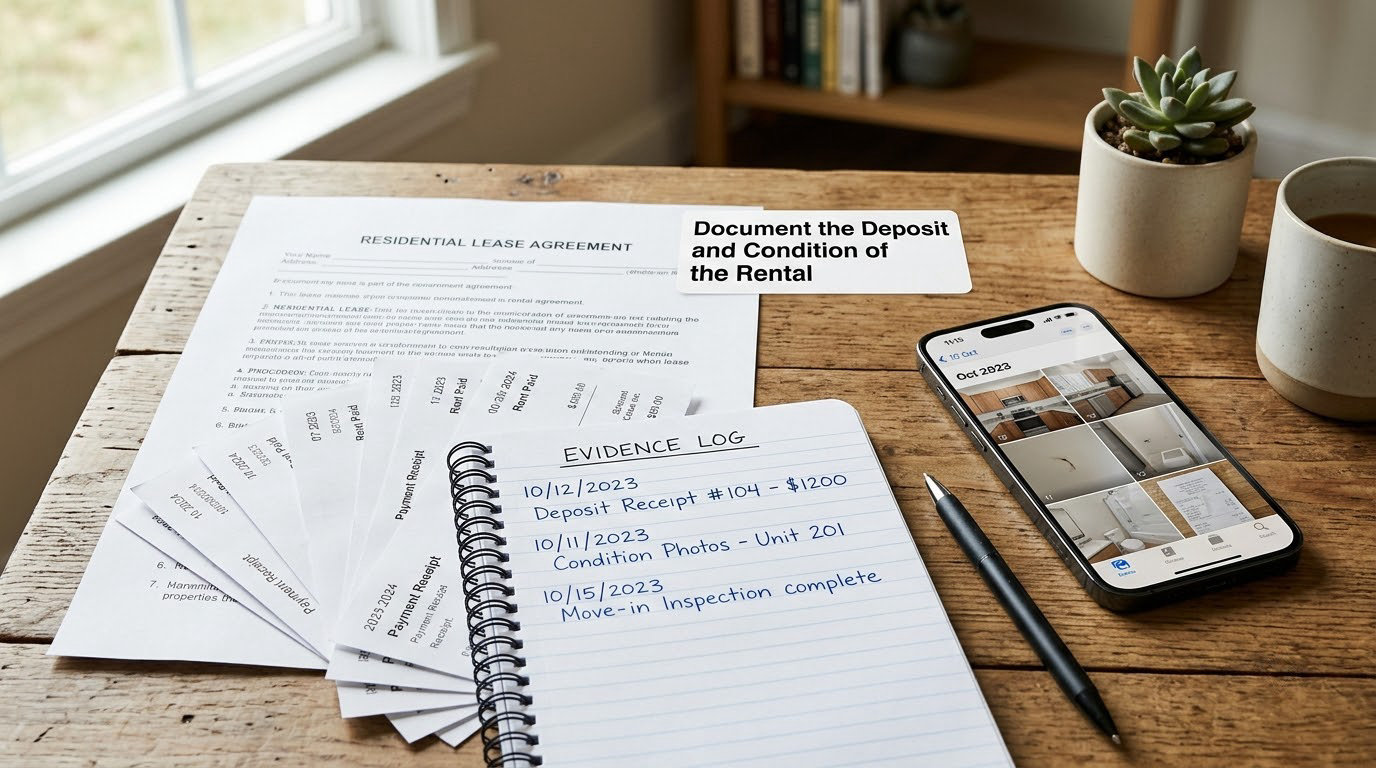
Photograph the unit yourself at move-out even if the landlord walked you through it, and hold on to your move-in photos. Scuffs on a wall, faded paint, small nail holes, a worn carpet in a hallway and a lightly marked appliance are the classic normal wear and tear items that tenants get charged for, and side-by-side dated photos are the cheapest way to rebut them.
Save the electronic versions, not just screenshots. Export your email as a single file with headers so the dates survive, and keep your text thread intact. If you photographed damage and told the landlord about it at move-in, save that message now, because a dated complaint is the strongest proof that the damage was not yours.
The most common shape of this dispute is a property manager holding back a large share of a deposit with no explanation attached. An itemized notice that arrives with no context is usually what triggers the whole conflict, so read it line by line before you react.
3. Ask the Landlord for an Itemized Deductions List
Most states require the landlord to return the balance along with an itemized statement of deductions, and many require it to be sent within the same deadline as the refund. If you received nothing, or a vague summary that just totals up, ask properly in writing.
A request that works in five lines:
Hello [name]. I moved out on [date] and my tenancy ended on that date. My security deposit was [amount], paid on [dates]. I have not received a refund, or I received a statement totalling [amount] without an itemized breakdown.
Under [your state statute and section], you are required to return the balance along with an itemized statement of deductions. Please send me: the amount deducted for each item, the date the damage or cleanliness issue was noticed, and an invoice or receipt supporting each charge. Please also confirm the date the balance will be paid.
Please reply in writing to this message. Thank you.
Keep the tone flat and administrative. You are not accusing anyone of anything, you are asking for the paperwork the law already expects. Ask for invoices rather than arguing about cost, because an unsupported charge is far easier to challenge than a receipt you are arguing is too high.
Florida is strict here, and the practical advice converges on the same move: send by certified mail and make the landlord justify each deduction line by line. One point keeps coming up across states — once the statutory window has passed, a court can penalize the landlord, sometimes at twice the deposit, which is why the calendar matters more than the argument.
4. Challenge Unsupported or Excessive Deductions
Take the itemized list apart and test each line against three things: your lease, your move-in evidence, and what the law treats as normal wear and tear.
- No evidence attached. If the landlord cannot produce a receipt, invoice or dated photograph, the deduction is the easiest one to challenge. Ask for it by name in your reply.
- Damage you documented at move-in. A wall scuff or a scratched door that appears in your move-in photos cannot be deducted at move-out. Quote the date and refer to the photo set.
- Ordinary aging. Faded paint, minor marks, worn carpet in a traffic area, small nail holes and a slightly worn appliance are the textbook definition of wear and tear in most state statutes. A landlord cannot charge you for the unit simply ageing while you lived there.
- Cleaning above ordinary turnover. A fixed cleaning charge is lawful in some states, but the number should reflect a normal turnover clean. Unusually large cleaning deductions with no receipt are common in disputes and are worth requesting evidence for.
- Rules you were never told about. A deduction for an HOA violation, a pet policy or a house rule the landlord never mentioned during the tenancy is a legitimate thing to contest. Alleged violations that go unraised for the whole tenancy, and deductions tied to house rules you never saw, show up often enough to be worth asking about directly.
Write your correction as a factual correction, not an accusation. Something like “this wall mark appears in my move-in photos dated [date], so I am not treating it as damage” is far harder for a landlord to argue with than a claim that the deductions are dishonest. If they are dishonest, that is a courtroom conclusion, not a letter.
5. Send a Formal Written Demand
Once the itemized request has gone unanswered, or the list is clearly wrong, escalate to a demand letter. This is the document that shows a judge you were reasonable and serious before you filed.
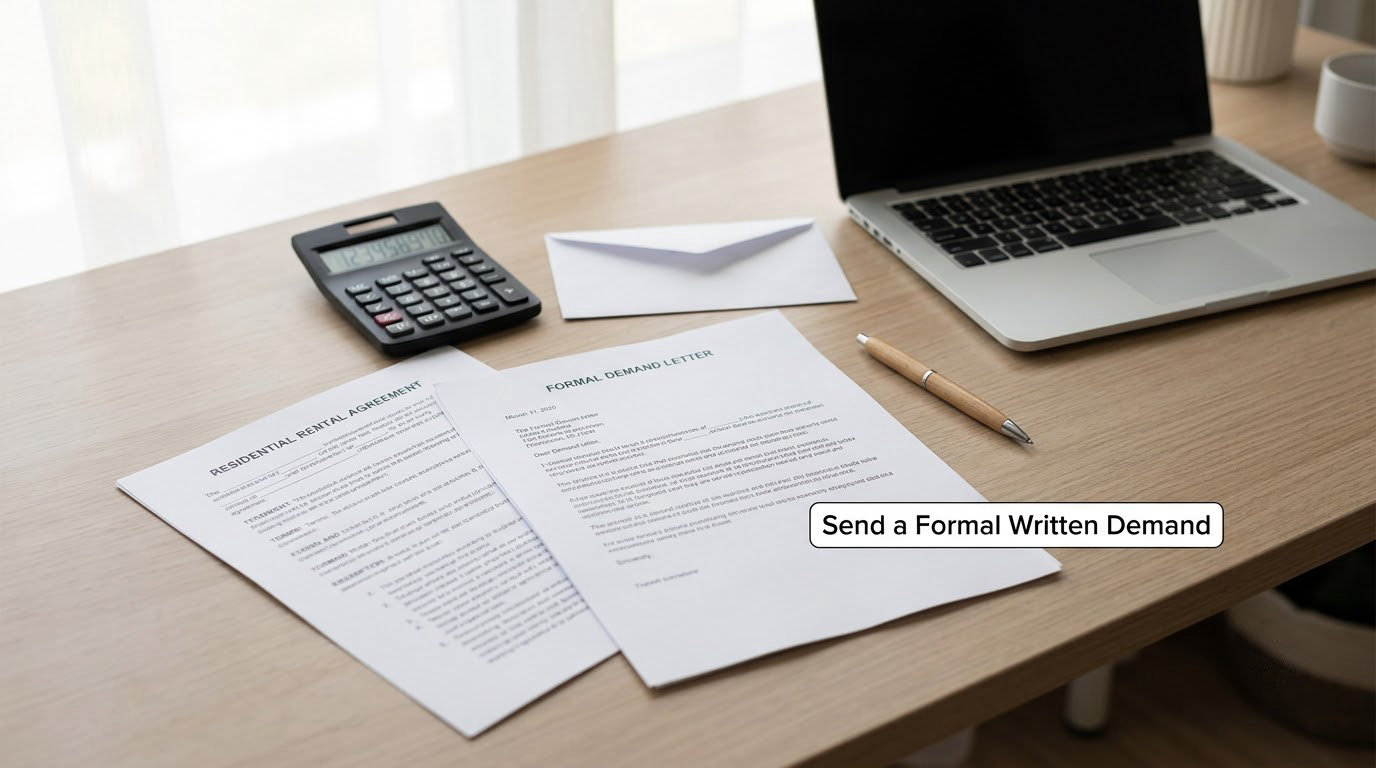
A demand letter needs six parts: the disputed amount, the amount you accept is genuinely owed, the legal basis, a specific response deadline, the resolution you want, and what you will do next if the deadline passes without an answer.
- The facts. Tenancy dates, the deposit amount, the date you moved out, the date the statutory deadline passed.
- The money. The deposit held, the total deducted, and the amount you are claiming back.
- The law. Name the statute and section, and what it requires the landlord to do.
- The deadline you already passed. State the date the landlord’s obligation expired. Where the statute forfeits the right to retain funds after that date, say so plainly.
- What you want. Payment of a specific amount by a specific date, plus an itemized statement for any deduction you accept.
- The next step. Mediation, legal aid or a small claims filing, described as a lawful option rather than a threat.
Send it by certified mail with return receipt requested, and also email a copy the same day. Where the lease lists a notice address, send there as well as to any address you have used successfully since. If the certified copy comes back marked recipient unknown, send a duplicate first-class copy right behind it, and ask the county clerk about proper service methods when you file.
Do not demand a specific multiple of the deposit unless your statute provides for statutory or punitive damages and you understand how those are claimed. New York’s General Obligations Law, for instance, allows punitive damages of up to twice the deposit where the landlord’s conduct was willful or malicious. Referencing that possibility is fine. Presenting it as an established entitlement is not.
6. Escalate Through the Appropriate Channel
Small claims is not the only option, and it should not be the first one. The options below run from free to expensive.
- A tenant rights organization or local housing agency. Many neighbourhoods have a tenants’ union or a legal clinic that will review your letter for free, usually before you file anything.
- Free legal aid. Legal aid societies funded through the Legal Services Corporation take deposit and eviction matters, though capacity varies and they often prioritise housing cases with an eviction date attached.
- Your state attorney general or consumer protection office. They cannot usually recover your individual deposit, but a pattern of complaints in the same building can prompt action.
- Mediation. Many courts offer a mediator for small claims at low or no cost, and a neutral often gets a landlord to produce receipts they would rather not show a judge.
- Small claims court. This is where most deposit disputes end. Filing is usually straightforward and the caps are designed for amounts like a deposit, but fees, caps and procedure are set locally, so check your county court’s own instructions before you file.
- A consultation with a tenant attorney. Worth it when the amount is significant, when the landlord has a pattern, or when your lease has unusual terms.
Most tenants can handle a deposit claim alone. Small claims is designed for exactly this, evidence is usually simple, and the process is a short hearing rather than a full trial. A rent-withholding counterclaim, where you also held back rent over repairs, complicates things considerably and is a good reason to get advice first.
7. Keep Records Until the Matter Is Resolved
Disputes stall because nobody tracked the dates. Keep a running log with every delivery confirmation, every response and every date, and diarise the deadlines your own state gives you.
Read any settlement agreement before signing it. Watch for language that releases the landlord from all claims relating to the tenancy, because a release signed in exchange for a partial refund can close the door on the rest. If the terms are unclear, ask for time or ask a lawyer to read it.
If a refund arrives after you have filed, tell the court promptly and withdraw the case if the settlement covers it, so you are not charged further fees. Keep proof of every payment, including a stop-payment fee if the landlord deducted one, since those are often the cheapest point of agreement in a whole dispute.
Common Mistakes
Almost every forfeited deposit traces back to one of these. Each one has a straightforward fix.
- Relying on a phone call. Verbal exchanges are hard to prove and usually do not satisfy a notice requirement. Fix: follow up the call with an email confirming exactly what was said.
- Accepting a vague deduction. “Cleaning and repairs” with a single total gives you nothing to challenge. Fix: ask for the breakdown before responding to the amount.
- Missing the deadline. Some states give you a short window to object, and missing it can weaken or end the claim. Fix: diarise the deadline the day you move out.
- Withholding rent to make a point. It converts a deposit dispute into a breach of the lease and puts you on the wrong side of the easiest case in court. Fix: keep paying rent and pursue the deposit on its own.
- Making threats. Statements about reviews, reporting or damage rarely help and can shift the tone of the whole exchange. Fix: state your facts, your deadline and the lawful next step.
- Sending the letter to a bad address. A returned notice can cost you weeks. Fix: send to the lease address and to any address you have used successfully, by both certified and ordinary mail.
- Filing in the wrong place. Venue rules vary and mistakes get cases dismissed or moved. Fix: read your local court’s filing instructions and ask the clerk what is required.
- Signing a release too early. Fix: read every clause, and never accept language that waives claims you have not yet raised.
The hardest one to fix is not a mistake in the dispute at all. It is waiting. The reason given most often for never pursuing a withheld deposit is effort, plus a belief it would not be worth it. For a dispute of a few hundred dollars, the letter is a single evening of work, and it works more often than tenants expect.
Frequently Asked Questions
How long does a landlord have to return a security deposit?
It depends on where you live. New York allows 14 days under General Obligations Law 7-108, California 21 days under Civil Code 1950.5, and Texas, Florida and Colorado generally allow 30 days. Some states set no deadline at all, and a few shorten the period for certain move-outs. Check your state’s statute before assuming you are late, and note that missing the deadline can strip the landlord of the right to keep anything.
What if the landlord does not provide an itemized deduction list?
Most deposit statutes require the balance to be returned with an itemized statement of deductions, and the itemized list usually shares the same deadline as the refund. Send a written request naming the statute and asking for each amount, the date the issue was noticed, and a receipt or invoice. If no list arrives, that missing paperwork is often the strongest point in your case, particularly in states where the deadline has already passed.
Can I take a landlord to small claims court for my deposit?
Yes, in most states, and deposit claims are one of the most common small claims matters. The filing process is usually simple and you can represent yourself. Filing fees, judgment caps and timelines are set locally, so check your county court’s instructions first. Bring your lease, payment records, photos, the itemized request you sent and proof of delivery. Some states also allow statutory damages on top of the amount withheld.
Can a landlord charge for ordinary wear and tear?
No. Nearly every state statute excludes normal wear and tear from lawful deductions, which generally covers faded paint, minor scuffs, small nail holes, worn carpet in traffic areas and an appliance that shows ordinary use. A landlord may charge for cleaning beyond a standard turnover clean in some states, and for damage beyond normal ageing. Your move-in photos are the best way to show that a mark existed before you arrived.
What should I do if I do not have a written lease?
Start with what exists: texts, emails, payment records, a signed form or a copy you photographed. The absence of a full written lease does not erase a tenancy in most places, and courts treat the payment history and the landlord’s own documents as evidence of the terms. Ask the landlord in writing to confirm the deposit amount and the deduction, and ask a local tenant rights organisation or legal aid office how your state treats an oral agreement before you file.
Conclusion
To dispute a landlord withholding a deposit, do four things this week. Collect your lease, payment records, dated photos and message history into one folder. Look up your state’s return deadline and the statute behind it, because that deadline is often the strongest fact you have. Request an itemized list of deductions in writing, quoting the statute and asking for receipts. Then, if the landlord does not answer or the deductions do not hold up, send a formal demand by certified mail with a set response date.
Escalate only after that, through a tenant rights organisation, legal aid, mediation or small claims. And keep rent separate from the dispute the whole way through, because a deposit claim is easy to win and much harder to win if it is tangled up with a breach of the lease.