
Payroll tax withholding is the money an employer deducts from each paycheck and pays over to the IRS, and usually to a state tax agency, on the employee’s behalf. The employee tells the employer what to withhold on Form W-4, the payroll system works out an estimated amount, and the employer deposits that money and reports it. Here is how the whole loop actually runs, from the election form to the year-end reconciliation.
Updated for 2026. This is general information about how the U.S. payroll system works, not tax or legal advice. Thresholds, rates and deposit rules change from year to year and vary by state, so confirm the current figures on the IRS site before you rely on them.
The single idea that makes the rest click: withholding is an estimate. Nobody knows your final tax bill in March, so the system takes a running guess based on your projected annual income and spreads it across your pay periods. Get the guess right and you finish the year close to even. Guess too high and you hand the government an interest-free loan for most of the year. Guess too low and you owe money in April, sometimes with a penalty on top.
Table of Contents
- What Is Payroll Tax Withholding?
- How Payroll Tax Withholding Works Step by Step
- A worked example for one biweekly paycheck
- What Taxes Are Withheld from an Employee’s Paycheck?
- How the Employee’s Withholding Election Affects the Amount
- What Is the Difference Between Withholding and the Tax You Owe?
- How Employers Deposit and Report Withheld Taxes
- Common Payroll Tax Withholding Mistakes
- Frequently Asked Questions
- Can my employer change my W-4 without telling me?
- What if my employer messed up my withholding?
- What if my employer did not withhold enough taxes from my paycheck?
- What percentage of my paycheck should be withheld for taxes?
- Do withholding allowances still exist on Form W-4?
- What happens if I have two jobs?
- Conclusion
What Is Payroll Tax Withholding?
Withholding is the portion of a paycheck removed before the employee is paid, sent by the employer to the tax authorities. Two parties are involved and they have different jobs. The employee provides instructions; the employer withholds, deposits and reports the money.
On the employee side, the Form W-4 tells payroll how much to hold back. On the employer side, the business is legally responsible for taking the right amount out, depositing it on schedule and reporting the totals accurately. An employer that fails to deposit withheld trust fund money can face personal liability under the Trust Fund Recovery Penalty, so this is not bookkeeping housekeeping to skip.
What is withheld is not the same as what is owed. The final bill is settled at tax time after the IRS has your full year of income, deductions and credits. Withholding is simply the prepayment mechanism.
How Payroll Tax Withholding Works Step by Step
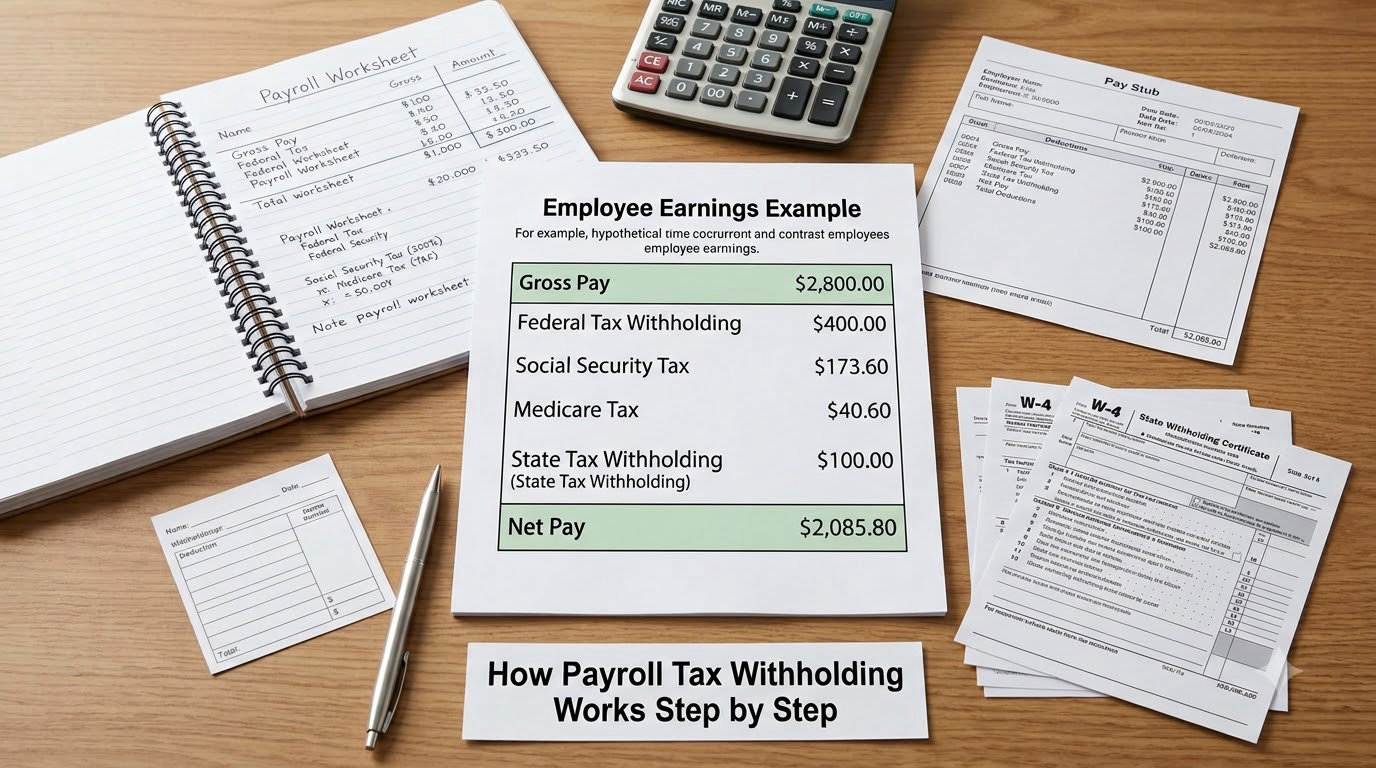
The mechanics run in five steps, and each one produces a record the next step depends on.
- Collect the election. The employee submits a signed Form W-4, usually with the offer letter or during onboarding. Some states and localities require their own election form as well.
- Work out taxable wages. The payroll system starts with gross pay for the period and removes pre-tax items such as a qualifying retirement contribution or a pre-tax health plan premium. What remains is taxable wages for federal income tax purposes.
- Apply the tables. The system projects the employee’s full-year earnings from those taxable wages, adds non-payroll income reported on the W-4, works out the estimated annual tax, and divides it by the number of pay periods.
- Deduct and deposit. The amount comes off the paycheck, and the employer sends the collected taxes to the IRS and the state on a deposit schedule set by how much the business owes.
- Report. Totals go to the employee on Form W-2 at year end and to the IRS on the quarterly Form 941. Those two documents are what the IRS reconciles against what you actually paid.
A worked example for one biweekly paycheck
Take a worker paid a biweekly gross wage of 2,500 dollars who contributes 125 dollars to a 401(k). Taxable wages become 2,375 dollars. Here is how the deduction list on the pay stub builds up.
| Line item | Amount (USD) | What it is |
|---|---|---|
| Gross pay | 2,500.00 | Everything earned before any deduction |
| 401(k) pre-tax | 125.00 | Reduces taxable wages, not take-home pay |
| Taxable wages | 2,375.00 | Base for income tax withholding |
| Federal income tax | 431.62 | Estimated based on the W-4 and annualized income |
| Social Security (employee) | 147.25 | Applies only up to an annual wage cap |
| Medicare | 34.44 | No wage cap, different rates for higher earners |
| State income tax | 118.75 | Depends on where the work is performed |
| Net pay | 1,642.94 | What actually reaches the bank account |
Multiply that by 26 for the year and you have the amount that should roughly match the W-2 the employee receives in January. If it does not, something is wrong somewhere in the loop.
What Taxes Are Withheld from an Employee’s Paycheck?
Five different items show up on a typical pay stub, and people regularly mistake them for each other. Two are taxes the employee pays; one is paid by both; two are employer-only obligations that never touch the paycheck.
| Tax | Who pays it | Basis | Cap or limit |
|---|---|---|---|
| Federal income tax | Employee | Taxable wages after pre-tax deductions | None |
| Social Security | Employee and employer, matching amounts | Wages up to an annual wage base | Yes, a wage base set each year |
| Medicare | Employee and employer, matching amounts | All wages | No, but an additional rate applies above a wage threshold |
| FUTA and SUI | Employer only | Wages, generally up to a wage base | Yes |
| State and local income tax | Employee | Wages, rules set by the jurisdiction where work happens | Varies by state and city |
Social Security and Medicare together are FICA. Because the employee share is not income tax, a refund of it does not depend on your final tax bracket or deductions. A W-2 employee who never gets a refund still received their full share of those two taxes back in their own money.
Garnishments, child support orders and court-ordered deductions can also appear on the same pay stub. They are not taxes, and they stack on top of the withholding in a fixed order set by federal law, which is why a pay stub suddenly looks smaller after a legal order arrives.
How the Employee’s Withholding Election Affects the Amount
The W-4 is the only lever the employee really has, and each of its sections changes a different part of the calculation.
| W-4 entry | What it changes |
|---|---|
| Step 1: filing status | Which standard deduction and rate schedule the estimate uses; single generally withholds more than married filing jointly or head of household |
| Step 2: multiple jobs or spouse works | Lets the employee direct the employer to account for income that employer cannot see |
| Step 3: dependents | Credits that reduce the estimated annual tax |
| Step 4: other income | Side income or a second job, added into the annual estimate |
| Step 5: deductions | Adjustments beyond the standard deduction, such as student loan interest |
| Step 6: extra withholding per pay period | A flat dollar amount added every pay period regardless of income |
One warning, because most of what still ranks online is out of date: the allowance system is gone. Before 2020, employees claimed allowances to shelter part of their wages. The current Form W-4 replaced allowances with credits and deductions from the Tax Cuts and Jobs Act, and any article telling you how many allowances to claim is describing a form the IRS no longer uses.
Claiming a lower amount on the W-4 does not flag anyone. The IRS treats the form as the employee’s estimate and applies the same thresholds whether the entry is high or low.
What Is the Difference Between Withholding and the Tax You Owe?
Withholding is a payment made throughout the year against a tax that is only calculated once, at tax time. What you owe, or get back, depends on everything the system could not know in March: deductions you took, credits you qualified for, income outside the payroll system and changes you made to your situation partway through the year.
This is the root of nearly every complaint about a paycheck changing mid-year. The payroll system annualizes. It takes taxable wages for the period, multiplies them by the number of periods in the year and treats that as your projected annual income. A raise in October, a second job that starts in July, a bonus or a mid-year change of filing status all change the projection, and the projected tax is spread evenly across the remaining periods.
A large refund is not a bonus. It is your own money handed back without interest after you had no use for it. The better target is a small refund, ideally a few hundred dollars, which means slightly over-withholding.
How Employers Deposit and Report Withheld Taxes
Withheld funds are not the employer’s money to hold. They sit in a trust fund account until deposited, and the deposit frequency depends on the size of the employer’s total liability: larger businesses deposit more often, and those below a stated threshold can use a reduced schedule or, in some cases, pay quarterly instead. Because those figures are indexed and revised, read the current IRS deposit schedule rather than an old blog post.
There is no rule that lets an employer skip the deposit until a round number accumulates, and the widely repeated 600 dollar threshold is a confusion with an unrelated collection rule. If the money has been withheld, it gets deposited on schedule.
Three records carry the whole loop. Payroll register data shows what was withheld each period. The deposit confirmations prove it reached the IRS. Form 941 reports the quarter, and Form W-2 reports the year to both employee and IRS. When the numbers disagree, the deposit records are what settles the argument.
If withholding was calculated incorrectly, the fix follows a path. Raise it with payroll first, then the payroll provider if the employer outsources, and ask for the correction in writing. If the error ran through a filed quarter, the employer corrects it on the relevant Form 941. If the year is already closed, the correction moves to the following year’s return, which is why it is worth catching early.
Common Payroll Tax Withholding Mistakes
These are the errors that show up again and again, each with the correction that actually resolves it.
- Using outdated withholding tables. Tables are reissued annually and some systems stay on an old release. Update the tax tables in the payroll system and confirm the effective date stamped on them.
- Treating gross pay as taxable wages. Pre-tax retirement contributions and qualifying health premiums come out first. Using gross instead of taxable wages produces over-withholding that shows up as an unexpectedly large refund.
- Assuming one W-4 describes the whole household. Each employer sees only its own employee. Income from a second job or a spouse’s wages has to be declared on the form by hand.
- Missing a work location change. State withholding follows where the work is performed, not where the company is based. A remote employee who moves needs a new state election.
- Failing to reconcile deposits. Compare total withheld on payroll registers against deposit confirmations and the amounts on Form 941. Drift that is never checked grows every quarter.
- Advising employees on their personal tax situation. The employer’s job is to apply the employee’s election accurately. Answering what they should claim is advice, and it is advice the payroll team is not positioned to give.
- Failing to withhold at all. Some employers mistakenly treat an employee as exempt. Withholding is not optional once a W-4 is on file, and the unpaid amount becomes a personal liability of the responsible people at the business.
Frequently Asked Questions
Can my employer change my W-4 without telling me?
No. The employer has to follow the election form the employee submitted, and changing it requires a new signed form. An employer cannot raise your withholding to cover someone else’s default or a new hire’s paperwork gap. If a deduction you never asked for appears on the stub, ask payroll for a copy of the W-4 on file and the effective date they used.
What if my employer messed up my withholding?
Ask payroll in writing for the W-4 on file, the tax table version used and the year-to-date totals. Compare the year-to-date withholding on your stub against what your Form W-2 later reports. If the error ran through a filed quarter, the employer corrects it on that Form 941. If the year is already filed, the correction carries into the next year’s return, so keep your own records from the start.
What if my employer did not withhold enough taxes from my paycheck?
You remain responsible for the full amount of tax on your income, so an employer shortfall does not shield you. To recover, request more withholding on your W-4 starting as soon as you can, use the extra withholding field for a flat amount per pay period, and keep paying estimated quarterly tax if the gap looks large. At tax time, withholding from more than one job or employer is combined on the return, which is where a shortfall typically becomes visible.
What percentage of my paycheck should be withheld for taxes?
There is no set percentage, because withholding is an annual estimate divided across pay periods rather than a flat rate. The right figure depends on your projected annual income, filing status, pre-tax deductions and any income outside payroll. Run the IRS Tax Withholding Estimator each time your situation changes and aim to owe a small amount rather than to collect a large refund.
Do withholding allowances still exist on Form W-4?
No. Allowances were removed from the form and replaced by credits and deductions entries. Any page still explaining how many allowances to claim describes a form the IRS retired, and following it can produce more or less withholding than you expect. Check that the guidance you are reading uses the current four-step form before changing anything based on it.
What happens if I have two jobs?
Neither employer knows about the other, so each withholds as if the job were your only income, and the total is usually short. On the W-4 for the job you expect to pay less, use the multiple-jobs section to report the other income. Do the same on the second job’s form. The alternative is leaving the smaller job’s election and sending the extra withholding to the larger one.
Conclusion
Payroll tax withholding is a five-step chain: the W-4 sets the direction, the payroll system turns it into an estimated annual tax, the pay stub shows the deduction, the employer deposits and reports it, and the year-end Form W-2 closes the loop. It works well when the estimate matches reality and quietly fails when it does not.
Start with four checks: pull the current W-4 on file for every employee, confirm the payroll system is running the current tax tables, reconcile deposit totals against the quarter’s withholding, and verify that the tax year on your reporting matches the year the data covers. Then re-run the IRS Tax Withholding Estimator yourself after any life change that shifts income, so the estimate stops being a guess.