
A tax refund is the difference between the total tax you paid during the year and the total tax you actually owe. If you paid more than you owed, you get the difference back. Knowing how a tax refund is calculated comes down to one formula, and once you see where each number comes from, the arithmetic stops being mysterious.
Most of the confusion starts one step earlier. People look at their paycheck, see a line for tax taken out, and treat that number as the government holding their money indefinitely. It is not. Withholding is an estimate your employer makes each pay period, and the refund is the correction of that estimate once the year closes.
Editorial note: this explainer was written and reviewed by the entodonoticias.com Money and Economy desk, last reviewed in October 2026. Tax rules and dollar figures change every year, so confirm current numbers on IRS.gov. This is general information, not tax advice.
Table of Contents
- What Is a Tax Refund?
- The Formula for Calculating Your Tax Refund
- How to Calculate Taxable Income
- Step 1: Add Up Your Income
- Step 2: Subtract Deductions and Adjustments
- Step 3: Apply the Correct Tax Rates and Credits
- Step 4: Compare the Result With Your Payments
- Why Refund Amounts Vary
- Check the Refund on an Official Tax Return
- Common Tax Refund Mistakes
- Frequently Asked Questions
- Why did I get a larger refund than I expected?
- Can I get a tax refund if I did not have taxes withheld?
- Do tax credits change the amount of my refund?
- Why might a tax refund be delayed?
- Should I adjust my withholding after receiving a refund?
- Can a tax preparer tell me exactly how my refund was calculated?
- Conclusion
What Is a Tax Refund?
A tax refund is money returned to you because the tax you paid exceeded the tax you owed on your income after deductions and credits. The amount comes from overpaid tax, which in plain terms is tax you paid in advance and did not owe.
Four things people mix up when they hear the word refund:
- It is not a bonus. You earned it. It is your own money that the tax agency collected and then returned.
- It is not the same as a tax credit. A credit reduces the tax you owe, and it flows into the refund calculation rather than sitting beside it.
- It is not the same as a deduction. A deduction lowers the income that gets taxed, which then lowers the tax owed.
- A big refund is a warning sign, not a windfall. It usually means more was withheld from your paycheck than the law required.
Think of the refund as a correction slip. Your employer guessed in January, adjusted the guess each pay period, and the final return settles the account.
The Formula for Calculating Your Tax Refund
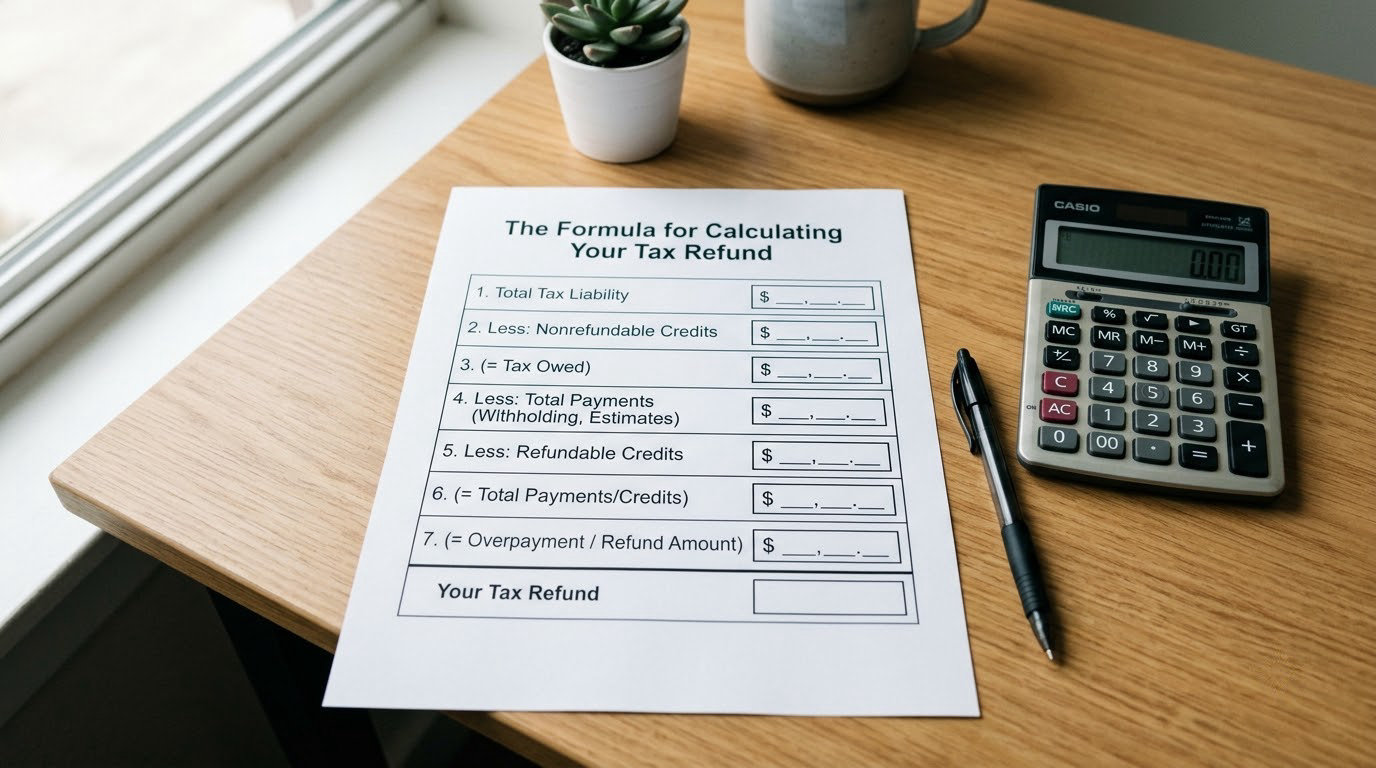
The formula in one line:
Refund = total tax paid during the year minus total tax you actually owe
Total tax paid is your federal income tax withheld from every paycheck plus any estimated quarterly payments you made. Total tax you owe is the bracket-based tax on your taxable income, minus credits. Subtract the second from the first and the result is your refund.
If the result is negative, you owe a balance due instead. The sign flips, the mechanic does not.
Here is the formula applied to a fictional filer, so you can see every number. Jordan is single, earns $92,400 for the year, has no dependents, and takes the standard deduction rather than itemizing.
| Line | Amount |
|---|---|
| Total income (wages, plus interest and other income) | $92,400 |
| Less adjustments to reach adjusted gross income | -$7,400 |
| Adjusted gross income | $85,000 |
| Less standard deduction | -$15,000 |
| Taxable income | $70,000 |
| Tax from bracket table on $70,000 | $10,314 |
| Less tax credits | $0 |
| Total tax owed | $10,314 |
| Federal income tax withheld from paychecks | $12,600 |
| Tax refund | $2,286 |
Bracket thresholds and standard deduction amounts are set by the IRS and are adjusted for inflation, so treat those two figures as placeholders and look up the current year’s published numbers before you run your own version. The arithmetic does not change: $12,600 minus $10,314 is $2,286.
Nobody’s situation is this tidy. A second job, a spouse’s income, a 1099, or a home purchase all add lines rather than removing them.
How to Calculate Taxable Income
Taxable income is the number the tax brackets are applied to, and it is not the same as your paycheck. Three figures sit between what you earned and what gets taxed.
| Figure | What it includes | What it excludes |
|---|---|---|
| Gross income | Everything you earned before any adjustments | Nothing is excluded at this stage |
| Adjusted gross income (AGI) | Gross income after certain above-the-line adjustments | Standard or itemized deductions are not yet applied |
| Taxable income | AGI after either the standard deduction or your itemized deductions | Credits, which are applied later, to the tax itself |
In one sentence: taxable income equals total income minus adjustments minus deductions. Most errors in a hand calculation happen because one of these three numbers is substituted for another.
Adjustments are specific items the IRS lists, such as certain retirement account contributions, deductible parts of self-employment tax, and some moving expenses for members of the armed forces. Deductions are the larger, more familiar set.
Step 1: Add Up Your Income
Start with every dollar of income you received, not just your salary. Common categories on a US return include wages from a Form W-2, freelance or contract income reported on a Form 1099-NEC, interest and dividends, retirement distributions, capital gains, rental income, and unemployment compensation. Some of these arrive with no withholding at all.
Then reconcile your total against the documents. If your total income is off by even a few hundred dollars, every downstream number drifts.
What to check on a Form W-2, box by box:
- Box 1, wages, tips, other compensation your total gross pay before anything was withheld.
- Box 2, federal income tax withheld the amount removed from your paychecks across the year. This is the number that becomes part of total tax paid.
- Box 3 and Box 5, Social Security wages a cap can apply, and those figures are not the same as Box 1.
- Box 12 codes elective deferrals, employer contributions, and other items that affect the return.
That Box 2 mistake is common. People read the wages figure, assume that is what was taken out, and then wonder why the arithmetic will not reconcile.
Step 2: Subtract Deductions and Adjustments
Deductions come in two forms. The standard deduction is a set amount that reduces taxable income without itemizing a single receipt. Itemized deductions apply when your eligible expenses, listed on Schedule A, add up to more than the standard amount.
You claim one or the other, never both. Most people take the standard deduction because itemizing only pays off with large mortgage interest, state and local taxes, charitable giving, or medical expenses above the applicable floor.
The standard deduction is set by the IRS and rises with inflation each year. In the last published set of figures the agency set it at $15,000 for single filers and married filing separately, $22,500 for head of household, and $30,000 for married filing jointly and qualifying surviving spouses. Every later year is adjusted again, so check the current figure rather than reusing an old number.
Credits work differently from deductions, and the distinction matters for how the calculation reads:
| Deductions | Tax credits | |
|---|---|---|
| What they reduce | The income that is taxed | The tax that is owed |
| Effect | Pushes you into lower brackets | Reduces the bill dollar for dollar |
| Refundable | Not applicable | Some are, and can push a figure below zero and create a refund |
| Examples | Standard deduction, itemized deductions, retirement contributions | Child Tax Credit, Earned Income Tax Credit, child and dependent care credit |
That last row in the credits column explains a specific kind of surprise. A refundable credit such as the Earned Income Tax Credit can be paid out even if the calculated tax was already zero.
Step 3: Apply the Correct Tax Rates and Credits
Once you have taxable income, the tax is not a flat percentage. It is progressive: each slice of income is taxed at its own rate, and only the slice that falls into a bracket gets that bracket’s rate.
This is where the marginal rate comes from, and it explains a feeling people often describe as the calculation being unfair. The marginal rate is the rate on your last dollar of income. The effective rate is your total tax divided by your total taxable income, and it is always lower because your first dollars are taxed at the lowest rate.
Which bracket table applies depends entirely on your filing status, which you either choose or qualify for:
| Filing status | Who qualifies | Standard deduction (last published figures) |
|---|---|---|
| Single | One unmarried person | $15,000 |
| Married filing jointly | Married couples combining income | $30,000 |
| Married filing separately | Married couples keeping income separate | $15,000 |
| Head of household | Unmarried, paid more than half the cost of keeping up a home, with a qualifying person such as a dependent child | $22,500 |
| Qualifying surviving spouse | A surviving spouse with a dependent child or qualifying relative in the home | $30,000 |
Married filing jointly usually produces the lower total, which is why couples are surprised when a marriage reduces one person’s refund. Two incomes on one return can push the combined taxable income into a higher bracket than either person occupied alone, and the second salary is also the second salary.
After the bracket math, credits are subtracted from the resulting tax. Nonrefundable credits stop at zero. Refundable ones keep going, and the excess becomes part of your refund.
Step 4: Compare the Result With Your Payments
This is the final subtraction, and the one that produces the number people actually read on their return. Take your total tax owed and compare it with everything you already paid the IRS for that year.
Total tax paid is the sum of federal income tax withheld across all W-2s plus any estimated quarterly payments. Freelancers and self-employed people normally have no withholding, so their payments are the quarterly estimates, and a year of strong income with a missed estimate is the usual cause of an unexpected balance due.
| Comparison | Result |
|---|---|
| Payments exceed total tax owed | Refund, equal to the difference |
| Payments match total tax owed | No refund, no balance due |
| Payments fall short of total tax owed | Balance due, owed by the filing deadline |
An extension to file is not an extension to pay. That distinction catches people every year who assume filing later buys more time to settle a balance.
If your withholding was set well, this step returns a small number, which is the goal. A small refund means your paycheck was close to correct.
Why Refund Amounts Vary
Two people earning the same salary can finish thousands of dollars apart, and the gap almost always comes from the inputs rather than from the formula. Here is what moves the number:
- Withholding settings. A larger refund usually means more was taken out than required, often from an outdated Form W-4 left in place after a raise, a marriage, a birth, or a second job.
- Income other than wages. Interest, dividends, and capital gains carry no withholding at all, so they add to the bill with nothing already paid against them.
- Filing status. The same income produces different tax under each bracket table, and a change mid-year changes the whole calculation.
- Deductions. A large medical year, a home purchase, or a big charitable year can push itemized deductions past the standard amount.
- Credits. A credit applied correctly can move the figure, and refundable credits can create a refund where none was expected.
- Life events. Marriage, a new child, retirement, or moving to a lower income bracket all reset what a reasonable payment should look like.
And the most common complaint, the refund that shrank even though nothing changed: income crossed a bracket threshold or a deduction phase-out limit, a second job added a second stream of unadjusted income, a capital gain arrived, or a law change altered the rules you used last year. A refund is a snapshot of one year’s arithmetic, so any line in that arithmetic can move without your life moving.
Check the Refund on an Official Tax Return
You do not need a third-party tool to verify the figure. Your completed return already shows it, and the IRS publishes its own free estimator and refund tracker.
Where the numbers live on a US federal return:
- Form 1040, total income the sum of every income line, before adjustments.
- Form 1040, adjusted gross income total income after the adjustments.
- Form 1040, taxable income AGI after the standard deduction or the Schedule A itemized total.
- Form 1040, tax and credits the bracket-based tax, then credits applied, ending at total tax.
- Form 1040, payments section withholding from your W-2s plus estimated tax payments.
- Form 1040, refund line payments minus total tax. A negative amount here is the balance due.
The IRS Tax Withholding Estimator at IRS.gov estimates what your new Form W-4 should claim for next year, and the IRS Where’s My Refund tool tracks a filed return. Timing expectations are roughly three weeks for an e-filed return and considerably longer for a mailed one, and a return under review can take longer still.
State refunds are calculated separately. Your state return has its own rates, deductions, and credits, so the state amount is not a percentage of the federal one.
Common Tax Refund Mistakes
Almost every hand calculation error comes from one of these four:
Using gross income where taxable income belongs. Gross pay is the starting point, never the taxed amount. Skipping the adjustment and deduction steps inflates the tax and shrinks the refund by hundreds of dollars.
Claiming deductions you are not entitled to. Itemizing below the standard deduction amount reduces the refund rather than raising it. You get the larger of the two, not both.
Overlooking credits. The Child Tax Credit, the Earned Income Tax Credit, the child and dependent care credit, and education credits are claimed on the return, and skipping them leaves money on the table.
Comparing the wrong payment totals. Withholding from one job is not the whole picture. Every employer withholds separately, and estimated payments count too.
One more worth naming: treating a large refund as proof of a good outcome. If $4,000 comes back, roughly $4,000 more than necessary came out of your paychecks during the year. Fix that next year on your Form W-4 instead of treating the return as a windfall.
Frequently Asked Questions
Why did I get a larger refund than I expected?
Usually because more was withheld from your paycheck than you actually owed, often after a raise, a second job, or an outdated Form W-4. Refundable credits can add to it, as can deductions you nearly forgot to claim. A large refund is not extra money; it is your own money returned, and the right fix is to lower next year’s withholding rather than enjoy the return.
Can I get a tax refund if I did not have taxes withheld?
Yes, if you are owed more tax than you paid. Most payments to the IRS arrive as withholding taken from a paycheck, but self-employed people and others without an employer pay through estimated quarterly payments, and those count the same way. Filing without paying anything simply means the whole amount owed becomes a balance due.
Do tax credits change the amount of my refund?
They change the tax you owe, which changes the difference between tax owed and tax paid. A credit reduces the liability dollar for dollar, so a larger credit means a smaller balance due or a larger refund. Refundable credits go further: they can pay out even when the calculated tax was already zero.
Why might a tax refund be delayed?
E-filed returns are typically processed in about three weeks, and mailed returns take longer, so filing method is the first factor. Returns under manual review, returns with errors, identity verification steps, and offsets for past-due debts all add time. The IRS Where’s My Refund tool shows the current status of a filed return.
Should I adjust my withholding after receiving a refund?
If the refund was large, yes. Update your Form W-4 with your employer so next year’s paycheck withholds closer to the correct amount, and the IRS Tax Withholding Estimator on IRS.gov calculates what to enter. If you received a small refund, your withholding is already about right and a change would only move the problem to a balance due.
Can a tax preparer tell me exactly how my refund was calculated?
Yes, and any paid preparer should show you the line-by-line figures behind the number: total income, adjusted gross income, taxable income, tax from the bracket table, credits applied, and total payments. If they will not explain the math behind the figure they are handing you, that is worth questioning before you pay the fee.
Conclusion
Start with the return total: take your total tax paid from your W-2s and estimated payments, subtract the tax you owe on taxable income after deductions and credits, and whatever remains is your refund. Then reconcile your income and payment totals against the source documents, because that is where mistakes surface.
If you received a large refund, fix next year’s withholding on your Form W-4 using the IRS Tax Withholding Estimator instead of chasing a bigger number next April. For your own situation, check the current figures on IRS.gov or speak with a qualified tax professional, because rules and amounts differ by country and by state.