Vaccines are approved for public use by an independent regulator that reviews laboratory, clinical trial and manufacturing evidence before deciding whether the vaccine can be given to the public. In the United States that is the FDA, and a separate public health body then decides how the vaccine is recommended and delivered.
That second part surprises most readers. FDA authorization and public use are two different decisions made by two different agencies, and a vaccine can clear the first without appearing on a state immunization schedule for months.
This guide walks through how vaccines are approved for public use, from early laboratory research to the safety monitoring that continues long after a first dose is given. It is general information about the regulatory process, not personal medical advice.
Table of Contents
- How Vaccines Are Approved for Public Use
- Who Reviews and Authorizes Vaccines?
- What Happens Before a Vaccine Is Submitted for Approval?
- How the Clinical Trial Evidence Is Evaluated
- What Happens During the Regulatory Review?
- What Does Authorization Mean for the Public?
- How Is a Vaccine Monitored After Approval?
- Why Does the Process Take Time?
- Can a Vaccine Be Changed or Withdrawn After Approval?
- What Misconceptions Should Readers Avoid?
- Frequently Asked Questions
- Do health regulators guarantee that a vaccine has no side effects?
- Who decides whether a vaccine can be used by the public?
- How long does vaccine approval usually take?
- What is the difference between vaccine approval and emergency use authorization?
- What evidence do regulators need to approve a vaccine?
- Can a vaccine be taken off the market after it is approved?
- Conclusion
How Vaccines Are Approved for Public Use
The short answer: a developer assembles evidence from laboratory work, staged human clinical trials and manufacturing quality controls, then submits it to a regulator. Regulators review the data, inspect the facilities where the vaccine is made, and issue either full approval or an emergency use authorization based on whether benefits outweigh risks for the intended use.
Separately, a public health committee makes a recommendation about who should receive it, and state and local health departments decide how it reaches people.
| Decision | Who makes it | What it means |
|---|---|---|
| Can the vaccine be marketed? | FDA, through its Center for Biologics Evaluation and Research | The regulator has judged the evidence sufficient for the labeled use |
| Who should receive it? | CDC’s Advisory Committee on Immunization Practices (ACIP) | A recommendation, often folded into the routine schedule |
| How is it delivered? | State and local health departments, pharmacies, clinics | Ordering, funding, storage and administration |
Some countries run a single body for all three functions. Others, like the US, split them, which is why the same vaccine can be licensed in one country and sitting in a cold chain awaiting a schedule decision in another.
Who Reviews and Authorizes Vaccines?
Four groups have a formal role in the US, and none of them is the manufacturer.
The sponsor. Usually a pharmaceutical or biotech company, the sponsor designs the studies, runs them, pays for them and files the application. The FDA does not run the trials and does not get to choose the endpoints the sponsor is judged against.
Independent data monitoring committees. Large Phase III trials include a separate group of clinicians and statisticians who look at unblinded safety data while the trial is still running. They can recommend stopping early if a clear harm appears, which protects participants during the trial itself rather than after it.
The FDA review team. Reviewers at CBER, the center that handles vaccines, read the full dataset themselves: individual adverse event listings, statistical analyses, laboratory assays and the chemistry, manufacturing and controls data. They also inspect the plants making the doses.
Advisory committees. VRBPAC, the Vaccines and Related Biological Products Advisory Committee, is an outside panel of clinicians and scientists who meet in public and vote on whether the data support a recommendation. ACIP, at CDC, votes separately on who should get the vaccine and how it fits into the schedule.
Outside the US, the European Medicines Agency handles the EU, the UK’s MHRA covers the UK, and Health Canada reviews for Canada. Many lower- and middle-income countries rely on WHO prequalification, which assesses a vaccine so it can be purchased through global health programmes.
What Happens Before a Vaccine Is Submitted for Approval?
The path runs from basic laboratory science to a large efficacy trial, and the earliest stages can end the project entirely.
Exploratory research. Scientists identify what protects against a disease, a pathogen, a surface protein or a vector. Most candidates never leave this stage, and failures here are common rather than scandalous.
Preclinical work. Candidate vaccines are tested in cells and animals to see whether they produce an immune response and whether they cause harm. Regulators look closely at the design of these studies, because the animal model shapes the later human plan.
Phase I. A small group, usually tens of adults, receives the vaccine. The main questions are tolerability, dose range and whether an immune response appears at all.
Phase II. Hundreds of participants, sometimes including people from the groups the vaccine is meant to protect. Researchers refine the dose and start tracking side effects over weeks to months.
Phase III. Tens of thousands of people, often randomized and double-blind, with a placebo group for comparison. This is where effectiveness against actual disease is measured under ordinary conditions.
Alongside the trials, the developer assembles chemistry, manufacturing and controls data: how the seed strain grows, how purity is verified, how stability is confirmed, and how each batch is tested before release. A vaccine that works in a trial but cannot be made consistently at scale is not approvable.
| Stage | Typical group size | Main question |
|---|---|---|
| Preclinical | Cells and animals | Does it produce immunity, and at what cost in harm? |
| Phase I | Tens | Is it tolerated, and what dose works? |
| Phase II | Hundreds | Does it work in the people who need it? |
| Phase III | Tens of thousands | How much does it reduce real disease? |
How the Clinical Trial Evidence Is Evaluated

Regulators read the evidence against a benefit-risk standard that most readers have never seen written down.
Effectiveness is measured against a placebo group, not against nothing. Reviewers check the trial size, whether the results would still hold up by chance, whether the confidence intervals are narrow enough to be meaningful, and whether the endpoints counted were pre-specified before the trial began.
Safety is assessed from adverse event data across every participant, not just the events the sponsor chose to highlight. Reviewers also look at subgroups, because a vaccine that works well in adults may produce a weaker response in older adults or children, and a label has to reflect that.
Then there is immunogenicity, the immune response itself. Because lab tests measure antibodies or T-cell responses far faster than real-world disease outcomes, regulators often accept an immune marker as a stand-in, while being explicit that the duration of protection is still unknown.
Reviewers are candid about the limits. A trial that enrolled mostly healthy adults tells them less about pregnant people, immunocompromised patients and children, and the application has to say so rather than imply otherwise.
What Happens During the Regulatory Review?
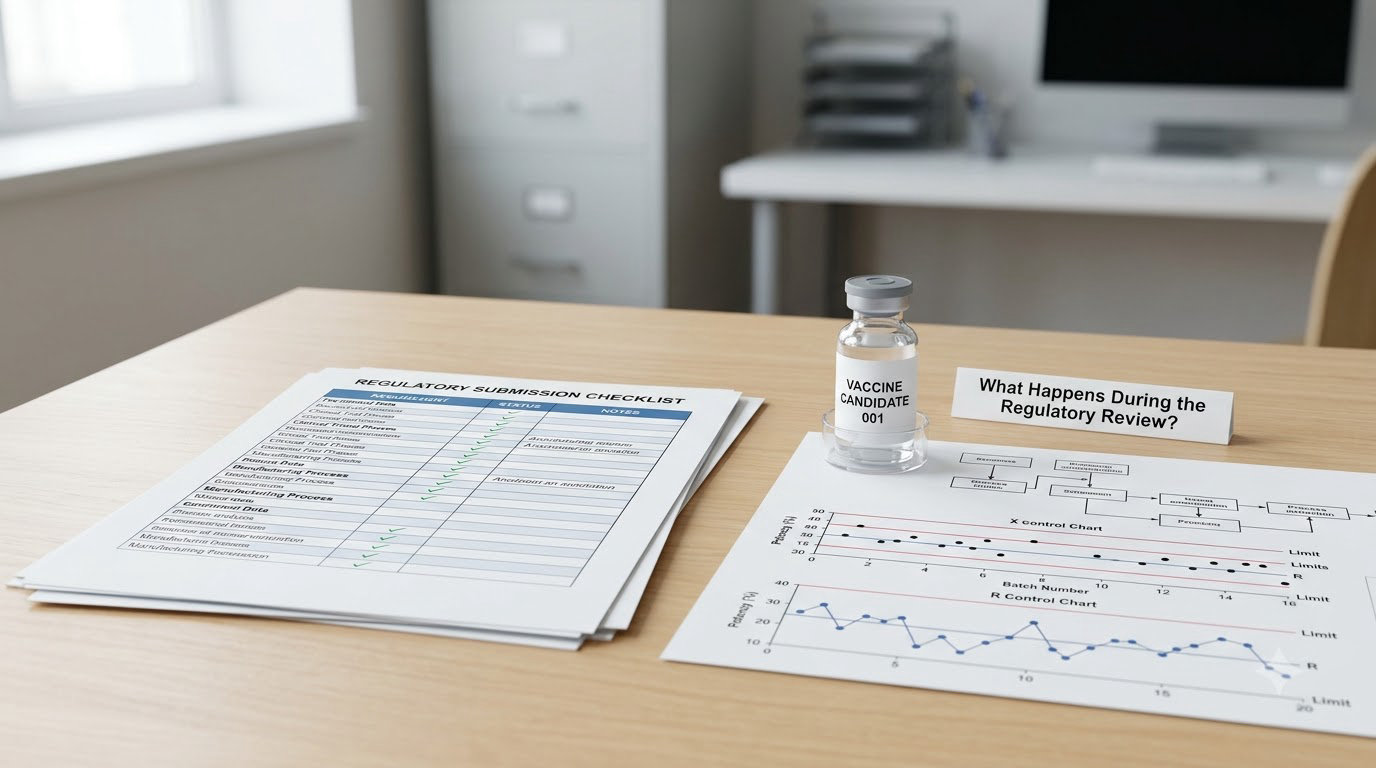
Submission is the start of a conversation rather than the finish line.
The sponsor files a biologics license application, or a BLA, a document that in practice runs to tens of thousands of pages covering clinical data, chemistry, manufacturing and controls, and proposed labelling. Reviewers read it, and they visit the manufacturing sites to see whether the facility produces the same thing the dossier describes.
Regulators send questions back to the sponsor, sometimes thousands of them, and the sponsor answers with supporting data. If something is missing, the review clock stops until it arrives. Meeting minutes and guidance documents from this stage are public, which is why they come up so often in skeptical forum threads.
The application then goes to an open advisory committee meeting. The sponsor presents, outside experts ask questions in public, and the panel votes. The vote is a recommendation, and the agency decides independently, but a split vote usually means more scrutiny before a decision.
Finally the regulator issues an outcome: approval with a defined label, a request for more data, or a refusal with reasoning. Each year after that can bring a supplement that widens the label, for example adding an age group, a booster dose or a new formulation for a circulating strain.
What Does Authorization Mean for the Public?
Not all authorization means the same thing, and the vocabulary causes more confusion than anything else on this topic.
Full approval, sometimes called licensure, means the regulator concluded the evidence is sufficient for the labeled use. An emergency use authorization is different: during a declared emergency it can allow a product whose benefits are still being demonstrated, on a lower evidentiary threshold, and it can be withdrawn later. A vaccine in an EUA does not have a lower quality standard for manufacturing, but it does have less complete clinical follow-up.
A third category, marketing authorization outside the US, works through the same broad standard under a different legal framework. And in every country there is a fourth step the reader rarely sees: a public health recommendation on who should actually receive it.
| Feature | Full approval | Emergency use authorization |
|---|---|---|
| Basis | Benefits outweigh risks on completed evidence | May rely on interim data during a declared emergency |
| Clinical follow-up | Longer follow-up after full immunization | Follow-up continues after the decision |
| Manufacturing standard | Full | Full |
| Duration | Ongoing, can be amended or withdrawn | Limited to the emergency declaration |
| Who recommends use | Public health authority, separately | Public health authority, separately |
One thing worth stating plainly, since forum discussions keep circling it: the COVID-19 vaccines most widely used in the US held emergency use authorizations for years, and the leading mRNA products later converted to full approval. Authorizations were not quietly upgraded without review, and they were not permanent either.
How Is a Vaccine Monitored After Approval?
Approval is not the end of the safety question. It is where real-world data starts accumulating, because trials include tens of thousands of people and the public includes everyone.
Monitoring runs on two tracks. Passive reporting lets anyone, including clinicians and patients, report a suspected adverse event to a national system. Because reporting is voluntary and unverified, the raw numbers overstate how often a problem actually occurs, which is exactly why regulators look at rates, not totals.
Active surveillance goes further: researchers pull records directly from hospitals, insurers and health systems to check real events against real-world data. For several vaccines the US runs linked databases linking immunization records to clinical records, which can pick up both rare side effects and reduced effectiveness.
When a signal appears, the response is proportional. Regulators may query the manufacturer, request more data, ask for a label update, examine a specific lot, or restrict a subgroup. A rare side effect showing up once in a few hundred thousand doses is the kind of signal that only becomes visible at population scale, which is an argument for monitoring decades rather than months.
Why Does the Process Take Time?
Traditional vaccine development typically runs a decade or more from discovery to approval, and each part of that timeline has a reason.
Enrollment is slow. Recruiting enough volunteers for a Phase III trial that can detect a meaningful difference against placebo means screening large numbers of people, and some will drop out. Follow-up takes longer still, since regulators want to know what happens months after the last dose, not just days.
Manufacturing scale-up is the hidden bottleneck. A formula that works in a two-litre bioreactor has to produce tens of millions of doses with the same purity, and facilities are built and validated along the way.
Evidence itself takes time to produce. The dossier is a snapshot of years of work, and reading it carefully is not the constraint so much as generating it.
Emergency timelines compressed the calendar by overlapping stages, funding trials at risk and accepting interim data under an emergency standard. What did not disappear: the trial phases, the placebo comparison, the safety monitoring and the manufacturing inspection.
Can a Vaccine Be Changed or Withdrawn After Approval?
Yes, and it is not a sign that something went wrong. Authorizations are designed to be revised.
Regulators act on several kinds of new information. A safety signal in one age group may narrow the label. Effectiveness data from a second season may lead to a change in dosing or a new formulation matched to circulating strains. A manufacturing change can require a supplemental review or a fresh inspection, and a manufacturing problem can pause a lot.
Full approval and an EUA can both be suspended or revoked. Revocation of an EUA is generally tied to the end of the emergency declaration or a decision that the product no longer meets its authorization conditions. In practice, most changes are incremental: a booster, a widened age range, an updated strain, a clearer warning in the label.
What Misconceptions Should Readers Avoid?
“Approved means risk-free.” No medicine is risk-free. Approval means the benefits outweigh the risks for the labeled population, and the label is where those risks get described honestly.
“Zero adverse events were reported.” Large trials are powered to detect common reactions, not rare ones. A signal that emerges at one dose in a few hundred thousand people is beyond what any trial could have caught, which is the whole argument for post-approval monitoring.
“Fast approval means the evidence was skipped.” The phase sequence, placebo comparison and manufacturing inspection remain in place. What changed in emergencies was the amount of follow-up accepted at the time of the decision, and that gap is closed afterwards or the authorization lapses.
“Every country uses the same standard.” Standards are broadly similar, but regulators differ in thresholds, follow-up requirements and how long they wait. That is why one vaccine can be licensed in several countries and not yet reviewed in another.
Frequently Asked Questions
Do health regulators guarantee that a vaccine has no side effects?
No. Approval means the benefits outweigh the risks for the labeled group, not that no risk exists. Trials can only detect common reactions reliably, so regulators describe known risks on the label and keep watching for rare ones through post-approval monitoring. A later label change or narrowed recommendation is routine, not an admission of failure.
Who decides whether a vaccine can be used by the public?
Two separate decisions. In the US, the FDA decides whether a vaccine may be marketed, and the CDC’s Advisory Committee on Immunization Practices decides who should receive it and how it fits the schedule. State and local health departments then fund, order and deliver it. Other countries may combine these roles in a single agency.
How long does vaccine approval usually take?
Traditional vaccine development commonly runs a decade or more from discovery to a full approval decision, with several years of follow-up still to come after. Emergency timelines were far shorter because phases overlapped and interim data were accepted under an emergency standard, but the trial sequence and manufacturing review were not removed. Enrollment and follow-up are usually the longest steps.
What is the difference between vaccine approval and emergency use authorization?
Full approval rests on completed evidence and a longer follow-up window after vaccination. An emergency use authorization can be issued during a declared emergency on interim data, while follow-up continues, and it lapses when the declaration ends or its conditions stop being met. Manufacturing standards are the same in both cases. Neither decision tells the public what to do.
What evidence do regulators need to approve a vaccine?
Effectiveness measured against a placebo group, safety data from every trial participant, immune response data, results in priority groups such as older adults and children, statistical analyses with defined endpoints, and full chemistry, manufacturing and controls data showing the product can be made consistently. Regulators inspect the facilities making the doses and may request more data before deciding.
Can a vaccine be taken off the market after it is approved?
Yes. Regulators can narrow a label, restrict a subgroup, suspend a lot, amend an authorization or revoke it entirely if new safety data, a manufacturing problem or reduced effectiveness justifies it. These actions are published, and the same processes work in reverse, allowing a vaccine’s use to expand as evidence builds across more age groups and variants.
Conclusion
What to take away first is that how vaccines are approved for public use is not a single decision but a sequence with different owners at each step. Evidence goes in, an independent regulator weighs it, and public health bodies decide how it reaches people. Approval is a continuing, evidence-based judgment about benefits, risks and manufacturing quality rather than a one-off badge. If you have questions about a vaccine for yourself or your family, a doctor or pharmacist can walk you through your own history and the current guidance, which is worth far more than a general explainer.