Here is the short version of how hurricanes get their names: nothing is invented during the storm. A national weather centre picks the next name off a regional list that was agreed years in advance, and that name is attached as soon as the system reaches tropical storm strength with sustained winds of 39 mph (63 km/h) or more. Everything else about the system, from why some names get retired to why a handful of letters are skipped, follows from that one simple rule.
It is a question that comes up every season, usually from someone who just heard a forecast. Once you see the mechanics, it stops being mysterious.
Table of Contents
- Why Do Hurricanes Have Names?
- How Hurricanes Get Their Names: The Naming Process
- How hurricanes get their names step by step
- Who Chooses the Names?
- How are hurricane names chosen and pronounced?
- Do Hurricanes Use the Same Names Every Year?
- Why Are Some Hurricane Names Retired?
- Frequently Asked Questions
- Do hurricanes get names when they form or when they become storms?
- Are hurricane names chosen randomly?
- Why do hurricane names sometimes sound similar?
- Can a retired hurricane name be used again?
- What happens when a hurricane crosses into another ocean basin?
- Why do we name hurricanes but not tornadoes?
- Conclusion
Why Do Hurricanes Have Names?
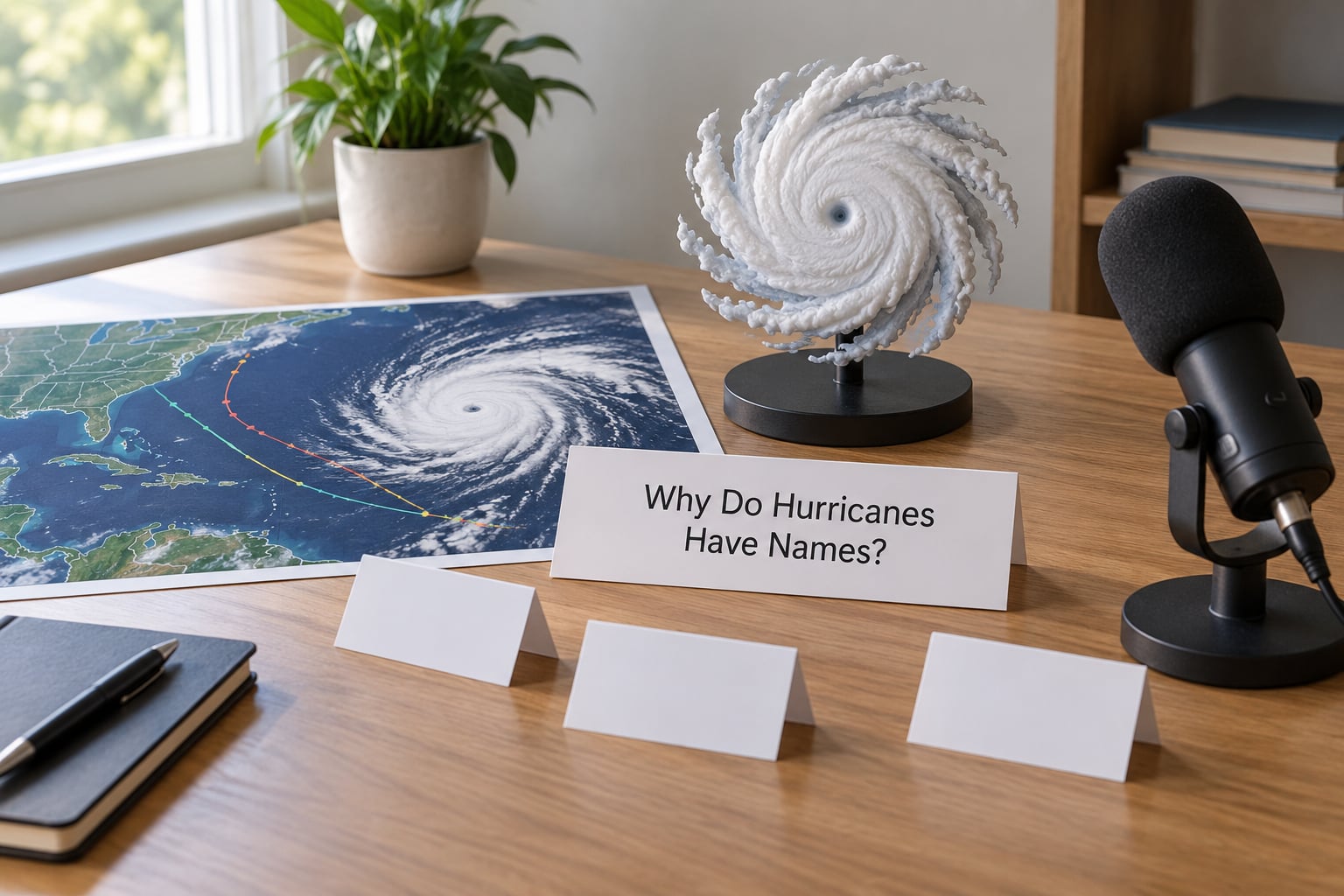
The reason is communication. A numbered designation tells you nothing to repeat on the radio at 2 a.m., and a storm described by coordinates is impossible to remember the next morning. A name is one syllable you can say over an emergency channel, put in a headline, and point at on a television map.
Before naming, several storms could be active at the same time across the Gulf of Mexico, the Caribbean and the open Atlantic. Without names, a bulletin referred to a tropical depression, a developing tropical storm and a decaying one, and listeners had no way to tell which system a warning referred to. Naming removed that ambiguity.
The second reason is historical record keeping. A name becomes the identifier attached to a storm’s entire life: the first advisory, the landfall report, the rainfall totals, the insurance claims and the research papers written years later. Hurricane Katrina is searchable in a way that “the 2005 Category 5 landfall” is not.
Numbers were not enough. Between 1948 and 1952 the US military briefly identified storms with phonetic words, starting with Able, Baker, Charlie and Dog, borrowed from communications training. It proved hard to pass over the radio and harder for foreign forecasters to follow, so the Atlantic settled on short human names in 1953.
How Hurricanes Get Their Names: The Naming Process
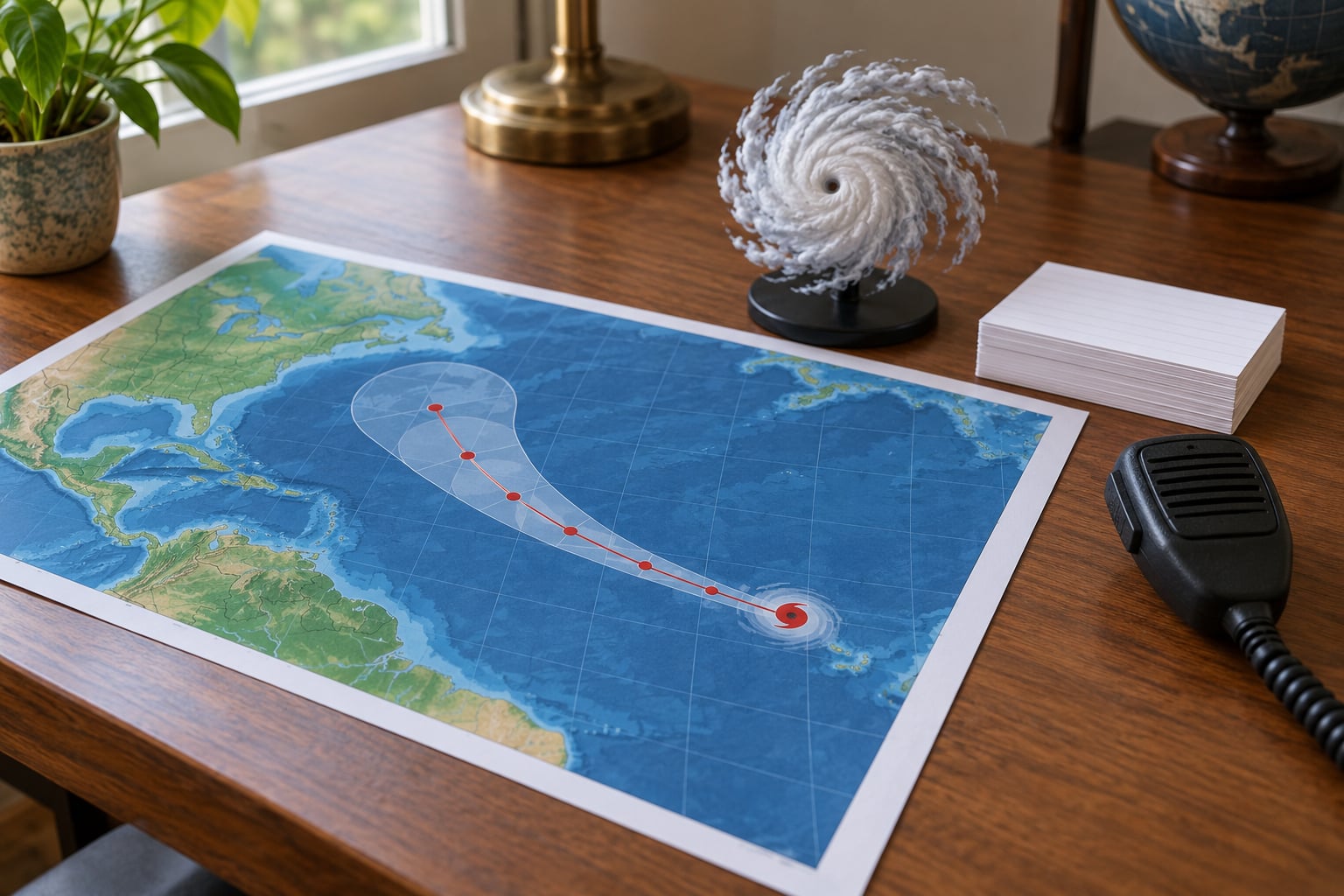
A storm is named when it is designated a tropical storm, which means sustained winds of at least 39 mph. Before that it carries a number, such as Tropical Depression Ten, which exists only so it can be tracked in the forecast product. The moment the centre upgrades it, the number is replaced with a name and stays with the system for its entire life, whether it later reaches hurricane strength or weakens back to a depression.
One thing worth clearing up while we are here: there is no Category 7 hurricane. The Saffir-Simpson scale tops out at Category 5, and no agency has ever assigned a Category 6 or 7. Storms described that way are either exaggerations or misunderstandings of the sustained wind figure.
How hurricanes get their names step by step
- Detection. A disturbance is identified by satellite, radar or ship observation and tracked as a tropical depression.
- Assessment. The forecast centre measures how far the system’s centre is from its circulation and estimates sustained winds. If that estimate reaches 39 mph, the system is called a tropical storm.
- Lookup. The forecaster finds the next unused name on the list for that basin and that year. Nothing about the storm is chosen at this step; the name was fixed in advance.
- Assignment. The name is issued in the advisory, in the forecast discussion and in plain language for media. From that moment it is used consistently in every product and every warning.
- Continuation. The name travels with the system if it crosses a boundary, moves into another basin or merges with another storm. It is not reassigned when the storm weakens.
- Review. After the season, the regional committee decides whether the storm was severe enough for the name to be retired from circulation.
The alphabetical order of names is not random either. Names are issued in alphabetical order for the season, which is a small but real convenience: by mid-season you can tell roughly when a system formed from the first letter of its name alone. If two storms are active and one is being named while the other is still developing, the forecaster simply moves to the next letter.
Who Chooses the Names?
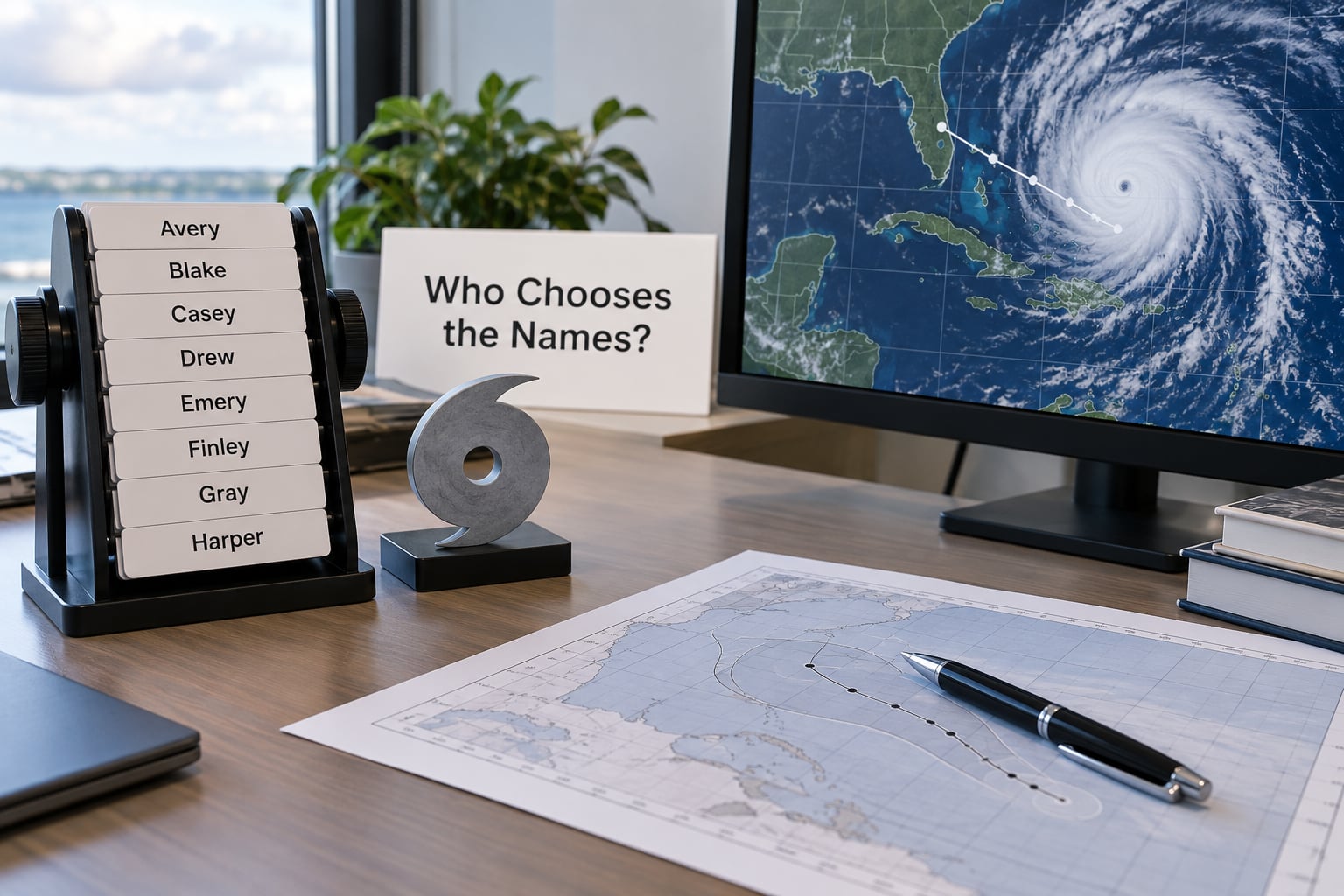
The lists themselves are coordinated internationally by the World Meteorological Organization, a specialised agency of the United Nations. WMO does not run forecasts. It sets the framework and convenes the regional bodies that approve and maintain the name lists.
Each ocean basin has a regional specialised meteorological centre, or RSMC, that actually names storms. The RSMC Miami, operated by the US National Hurricane Center, handles the North Atlantic, including the Caribbean Sea and the Gulf of Mexico. The RSMC Honolulu covers the Central Pacific. The Eastern Pacific falls to the National Hurricane Center’s Pacific hurricane desk. The same pattern repeats worldwide, with centres in Tokyo, New Delhi, La Reunion, Nadi, Wellington, Port Vila, Darwin and Brasilia covering their own basins.
Forecasts are still produced by national weather agencies. A storm in the Caribbean may be tracked by one country’s service and named by another’s, but the naming rule is the same, which is why a name assigned in one basin keeps meaning the same thing everywhere else on the planet.
How are hurricane names chosen and pronounced?
The Regional Association IV Hurricane Committee, which covers North and Central America and the Caribbean, reviews and votes on the Atlantic list. Names are proposed by members at a meeting held roughly every two years, then checked against a set of criteria agreed with the WMO.
A candidate name has to be short and easy to say aloud. It has to be spelled so that a radio listener hears it correctly the first time. Similar-sounding names are rejected to avoid confusion, which is why the committee has paired through several lists before approving one.
Cultural balance matters too. The basin spans places where English, Spanish, French, Dutch and Caribbean Creole are all spoken, so a name that carries an unfortunate meaning in one of those languages does not survive review. In earlier eras the lists leaned heavily on a narrow set of names familiar to forecasters, and the committee has since widened the pool with proposals submitted by Caribbean countries.
Pronunciation is a recurring complaint from the public, and a fair one. Spoken-day names like Joaquin, Isaias and Idalia catch people out. WMO publishes a short guide of pronunciations, and the centres also release a short audio briefing ahead of each season so crews, journalists and broadcasters hear the names spoken correctly.
Do Hurricanes Use the Same Names Every Year?
No. The Atlantic uses six separate lists, each containing 21 names, and the lists rotate in fixed order on a six-year cycle. A storm named from the first list in one year reuses the same name, in the same slot, six years later unless that name has been retired in between.
Twenty-one is a deliberate choice rather than a shortage. The Atlantic season rarely produces enough storms to exhaust a list, and because the list restarts alphabetically each year, a season with 22 storms would still only reach the eleventh letter.
Five letters are left out: Q, U, X, Y and Z. There are not enough common first names starting with those letters, and several U names would be confused with the phrase you use in an emergency. The skip is why an Atlantic season with a lot of activity works its way from A to W.
Each list alternates male and female names in order, a change made in 1979. Before that, Atlantic lists used only women’s names, a practice picked largely because the phonetic list of the 1950s had a large set of easy-to-say female names in it, and forecasters assumed women were the traditional weather watchers. By the late 1970s that reasoning no longer held, and 1979 brought in the first alternating lists. Before 1953 there was no Atlantic naming system at all; military forecasters simply numbered the storms, and the phonetic-word lists used elsewhere were abandoned as hard to pass over the radio.
Each list also alternates Caribbean, French and Spanish heritage names in rotation, which is why a single season can run from Arthur through names that sound nothing alike.
For context, the 2020 Atlantic list ran Arthur, Bertha, Cristobal, Dolly, Edouard, Fay, Gonzalo, Hanna, Isaias, Josephine, Kyle, Laura, Marco, Nina, Omar, Paul, Rebekah, Sebastien, Tanya, Van and Wendy.
If a season somehow used all 21 names, the Atlantic no longer falls back on the Greek alphabet. That approach ran from 2020 and caused real problems: names such as Zeta and Xiota were impossible to say, and one letter sounded like another over radio traffic. Since 2021 the Atlantic has used a supplemental list of the same A-to-W pattern instead. Greek letters are still used in other basins.
Why Are Some Hurricane Names Retired?
A name is retired when the storm carrying it caused such severe damage or loss of life that using it again for an unrelated storm would distress the communities hit. The decision belongs to the regional hurricane committee, and it is a vote, not an automatic trigger.
The usual practice is that a country affected by a particularly deadly storm asks the committee to retire the name. Names retired for significant loss of life include Katrina, which struck the Gulf Coast in 2005, and Maria, which devastated Puerto Rico and the Virgin Islands in 2017. Patricia, the strongest hurricane on record in the Atlantic, and Haiyan’s name in the western Pacific were retired on the same logic, even where the death toll was lower.
Not every destructive storm gets its name retired, which is the part that frustrates people who lost homes. The committee applies a high bar on purpose. Retirement is permanent and there are only a limited number of good candidate names in circulation for each letter, so an over-eager policy would hollow out the lists. Damage alone is not enough; the storm has to be so exceptional that the name itself carries lasting weight. Fabian, which struck Bermuda in 2014, was retired after the affected country’s government asked for it. Dorian, Florence, Michael, Laura, Joaquin and Igor are other modern examples.
Replacement names come from the same committee. Members propose names, and a replacement has to meet the same pronunciation and spelling rules as the original. After Hurricane Sandy, for example, the committee put Selby on the Atlantic list in its place, chosen from the same shortlist of candidates.
You can submit a name yourself. Public suggestions are taken seriously by the committee, and people have asked for replacements to carry names of family members lost to earlier storms. The proposals usually come through a country’s meteorological service rather than from individuals writing directly to the WMO.
Frequently Asked Questions
Do hurricanes get names when they form or when they become storms?
A system gets a name when it is upgraded to tropical storm strength, meaning sustained winds of at least 39 mph (63 km/h). Before that point it is tracked by a number, such as Tropical Depression Ten. Once named, the storm keeps that name for the rest of its life, even if it later strengthens into a hurricane or weakens back to a tropical depression.
Are hurricane names chosen randomly?
No. Names come from pre-approved lists in alphabetical order, so the naming is as mechanical as picking the next card in a sorted deck. Lists rotate every six years, Q, U, X, Y and Z are skipped because usable names are too scarce, and male and female names alternate. Because they are fixed in advance, no negotiation or popularity contest happens while a storm is active.
Why do hurricane names sometimes sound similar?
Different basins run different lists, and no single worldwide pool of names exists. A storm crossing from the Atlantic into the eastern Pacific keeps its original name, while a system forming near the Philippines carries both an international name and a local PAGASA name. The committees also try to avoid near-identical names on one list, but across regions the result is that names can rhyme or sound alike.
Can a retired hurricane name be used again?
No, not for a storm that caused the retirement. The name is removed from circulation permanently and replaced on the same list, so it disappears from future seasons. Names are also retired outside the normal retirement process for other reasons, such as the confusion caused by the Greek alphabet names used in 2020. Retiring a name is one of the few ways the naming system changes at all.
What happens when a hurricane crosses into another ocean basin?
The storm keeps the name it was already given. If a system moves out of the Atlantic and into the eastern Pacific, forecasters there continue calling it by the same name and adopt the tracks issued by the other basin. The exception is the western Pacific, where the Philippines assigns a local PAGASA name to any storm entering the Philippine Area of Responsibility, so one storm can legitimately carry two names at once.
Why do we name hurricanes but not tornadoes?
The difference comes down to lead time and where the damage happens. A tropical cyclone is monitored over open water for days, so forecasters can announce a name before anyone is affected, and a name can be repeated across a wide area. Tornadoes form with very little warning, often on top of the storm that carries them, and are identified by the county or warning area they touch. Naming them would add little and could blur the identity of the larger hurricane.
Conclusion
How hurricanes get their names comes down to a list agreed years before the storm exists. The World Meteorological Organization sets the framework, the regional committee approves the names, and the forecast centre for that basin hands out the next one alphabetically once a system reaches 39 mph sustained winds. A name is retired only when a storm behind it was exceptional enough that no unrelated storm should carry it again.
When a storm is named, act on the name but read the rest of the forecast with it. Use the official name so your messages match what emergency managers are saying, and follow evacuation or shelter guidance from your local authorities, because the name tells you which storm they mean and nothing about what to do about it.