The short answer to how VAR review works in soccer is this: the moment the referee makes a match-changing call, a team of video officials in a room away from the pitch watch the same incident from several camera angles, then either confirm the decision or ask the referee to take another look. If you have ever wondered who actually overturns a goal or a penalty, the answer is the referee, not the video team.
This guide walks through the whole process in plain language, from the categories VAR can review to what happens at the pitch-side monitor. It is written for anyone who has turned on the sound during a review and still had no idea what just happened.
Table of Contents
- What Is VAR in Soccer?
- How VAR Review Works in Soccer: The Main Decisions
- What Happens During a VAR Check?
- When Does VAR Send the Decision to a Review?
- How VAR Decides Whether to Overturn a Decision
- How VAR Reviews Offside Decisions
- Can VAR Give a Penalty or Send a Player Off?
- What Does VAR Overturn Most Often?
- Why Do Some VAR Decisions Cause Confusion?
- What VAR Cannot Do
- Frequently Asked Questions
- Does VAR check every incident in a soccer match?
- Why is a VAR check not always shown on television?
- Can VAR overturn a goal because of an offside error?
- Does VAR award penalties and red cards directly?
- Why can VAR rules feel different from one league to another?
- Conclusion
What Is VAR in Soccer?
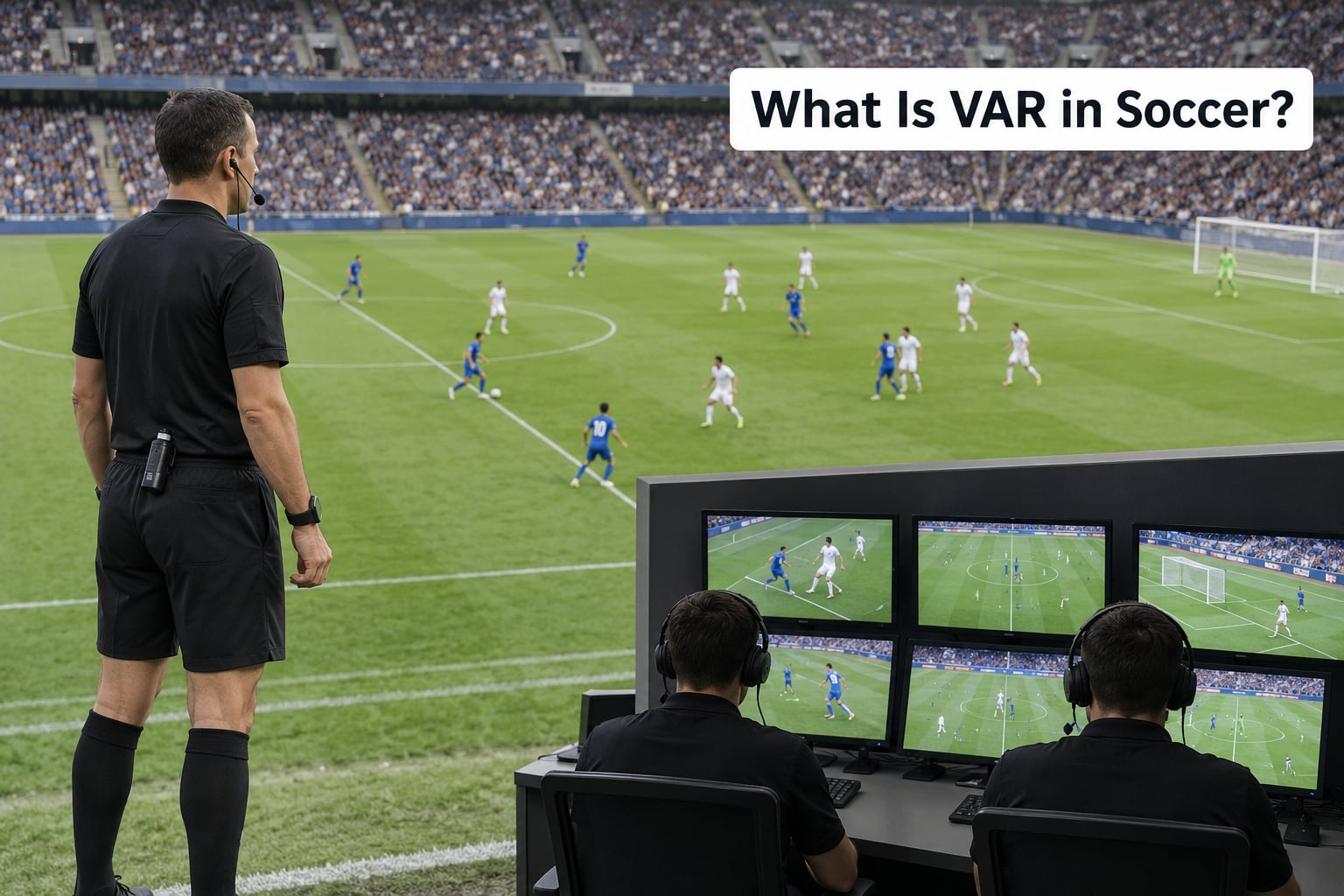
VAR stands for Video Assistant Referee. It is an officiating support system that gives the match referee access to television replays and match data during a game.
The people doing the reviewing sit in a video operation room, usually a room at or near the stadium. The main official there is the VAR, supported by at least one Assistant Video Assistant Referee, who watches the same feeds and helps by checking other angles and the factual data.
Two ideas sit underneath everything VAR does. The first is minimum interference: the fewer decisions the system changes, the better, because the referee is supposed to get it right unaided. The second is that VAR only handles a short list of match-changing incidents. Everything else belongs to the referee on the field.
How VAR Review Works in Soccer: The Main Decisions
VAR review is limited to four categories of decision, and every one of them is a situation where the outcome changes the score or the discipline of a player. Nothing outside this list is eligible.
- Goal or no goal. VAR can check for offside in the build-up, a foul by the scoring team, a handball, or a mistaken identity. The typical outcome is a goal that stands, a goal that is disallowed, or a goal awarded after a review.
- Penalty or no penalty. VAR can check whether a foul happened inside the area, whether the location of the offence was inside, or whether the penalty taker was fouled first. The outcome is a penalty confirmed, a penalty overturned, or a change to a different restart.
- Direct red card. VAR can check whether it was really a serious foul play rather than a yellow-card level challenge. The card is either upheld or downgraded to a yellow.
- Mistaken identity. VAR can check whether the referee booked or sent off the wrong player. The card is moved to the correct player, often alongside an additional caution.
Offside has its own technical layer, which is covered further down. It matters that red card reviews are limited to direct red cards for serious foul play. A second yellow card can be reviewed only in one narrow circumstance, not as a general rule.
What Happens During a VAR Check?
First the referee makes the call on the field. Immediately afterwards, the assistant referee presses the button on the referee’s communication system to signal that the incident may be reviewable.
In the video operation room, the officials look at the relevant replays and the factual match data. They then communicate one of two things back to the referee: that the original decision is correct and the check is complete, or that they recommend an on-field review.
Most of the time, play simply restarts with the original call standing. In MLS, which was one of the first competitions to publish detailed figures, matches averaged 8.9 checks but only 0.36 formal reviews, which tells you how often the check ends the story on its own.
When Does VAR Send the Decision to a Review?
A review is the escalation step. It happens when the video team believes the on-field decision might be clearly and obviously wrong, and the referee then decides whether to accept that recommendation or to look at the evidence himself.
- Check. The video officials look at the incident in real time. Fans see play stop for a few seconds, then the referee signal that the decision stands.
- On-field review. The referee goes to the pitch-side monitor, or to the referee review area on the touchline, with the assistant referee. Fans see the referee draw a rectangle in the air.
- Final announcement. The referee states the outcome and the reason, and play restarts with the correct restart. Fans hear a public announcement over the stadium system, sometimes with a replay shown alongside it.
Two practical notes for viewers. First, most checks never make the broadcast, because the production team does not know about them until the referee signals afterwards. Second, a review does not automatically mean the decision changes; plenty of reviews end with the original call confirmed.
How VAR Decides Whether to Overturn a Decision
The bar for changing anything is deliberately high. The video officials look for a clear and obvious error, meaning an incident the referee should not have got wrong on a first look, judged from the angle the referee had on the pitch.
Factual decisions are handled first, because they do not involve opinion. Where was the foul committed, was the ball over the line, was the defender offside, which player was the one who fouled. If the facts are wrong, the decision changes.
Subjective decisions come next and get far more scrutiny. For a challenge, a push in the box or a tackle on the edge of the area, the question is not whether the video looks better but whether the referee’s original interpretation was clearly wrong. This is why so many fans see reviews that confirm the call they disliked.
VAR referee Pol van Boekel, describing the Sterling penalty decision, said he believed the penalty was harshly judged but had to support the on-field referee, because that is what the global protocol requires. That single line explains most of the frustration supporters have with the system.
Extra evidence available during a review includes additional camera angles, slow motion, and the factual match data such as offside lines or whether a ball went out of play.
How VAR Reviews Offside Decisions
Offside is checked as part of a goal review, which means the officials ask two separate questions: was the attacking player offside, and then did that player become involved in the play.
Being offside alone does not cancel a goal. A player who is offside but stays still and does not interfere with the play, challenge an opponent or play the ball is not involved, and the goal stands.
The relevant window is the attacking phase of play, which runs from the moment the attacking team gained control of the ball until the goal or a restart. Only incidents inside that phase are considered, because the moment a defender deliberately plays the ball or gains control, the phase resets and earlier offside positions become irrelevant.
Major tournaments now use semi-automated offside technology. Cameras above the halfway line and in each penalty area track limb positions frame by frame, and the system draws an offside line at the moment the pass is played. The output is a graphic, not a decision: the system does not decide offside, it only shows where players were.
Confusion here is usually about the rule itself rather than the technology. Newcomers watching a World Cup still say they cannot follow why a goal was disallowed weeks later.
Can VAR Give a Penalty or Send a Player Off?
No. VAR never awards a penalty, never shows a red card and never changes a scoreline. It can only tell the referee that the punishment already given on the field was wrong.
So VAR might recommend that a penalty be cancelled because the foul happened outside the area, or that a red card be downgraded to a yellow. The referee then goes to the monitor, watches the angles and announces the outcome before play restarts.
The referee can accept or reject the recommendation. Rejecting it is rare, and when it happens the protocol usually requires the original referee to explain the reasoning afterwards.
What Does VAR Overturn Most Often?
The commonly reviewed incidents are handball in a build-up, fouls inside the penalty area, mistaken identity, scoring attacks involving offside, and goalkeeper encroachment at a penalty.
What gets overturned is a different story. Changes are far less common than reviews, and the frequency shifts between leagues and seasons as officials and protocols settle. The clearest published figures come from MLS, where 94.4% of decisions were correct without video review and 98.4% were correct with it.
That gap is the honest summary of the whole system. It catches real errors, and most of what it catches are errors in situations where a player or a team is directly affected.
Why Do Some VAR Decisions Cause Confusion?
Mostly because the decision rests on judgement the viewer cannot see. The referee weighs a challenge and reaches one conclusion; VAR sees the same images and is asked to prove that conclusion clearly wrong.
Announcements are the second big complaint, and it is a fair one. Supporters on football forums repeatedly describe the stadium announcement as close to incomprehensible, and a generic line such as a goal being disallowed because a player committed a foul tells you nothing about where the foul happened. Some would rather the broadcast simply showed a replay and a graphic pointing to the spot on the pitch.
Visibility is the third issue. Fans cannot see what is being reviewed, how long it is taking, or what the video officials are looking at, and that opacity breeds distrust even when the call is correct.
Consistency comes up too. Two matches, two similar challenges, two different outcomes, and no way for a viewer to know whether the difference was the incident or the referee. Leagues also differ in how closely they follow the international protocol, so the same type of incident can be treated differently in different competitions.
Rugby gets mentioned here constantly, because fans compare its public review model, where the decision and the reasoning are broadcast, with a football system that keeps most of the reasoning in the officials’ earpiece.
What VAR Cannot Do
VAR does not review every incident, and it never will. A routine foul in midfield, a late challenge, a player shouting at the referee or a debatable tactical choice stay with the on-field officials.
It cannot replace the referee, second-guess the flow of a game, or hand out extra time. It also does not overturn a decision because a different camera angle looks better; a new angle only matters if it shows the original call was clearly wrong.
And it cannot fix the parts of the sport that are not factual at all, such as how a referee applies the laws under pressure in front of a noisy crowd.
Frequently Asked Questions
Does VAR check every incident in a soccer match?
No. VAR only becomes active for four categories: goals or no goals, penalty or no penalty, direct red cards for serious foul play, and mistaken identity. A foul in midfield or a referee decision about effort and pace stays with the on-field officials. Even inside those four categories, most incidents end after a quick check rather than a full review.
Why is a VAR check not always shown on television?
Because checks happen quietly and fast. The assistant referee signals the incident on the communication system, the video officials look at the replays, and the match restarts within seconds. The broadcast only learns about it when the referee makes the check-complete signal afterwards. By then the play is already moving on, so most checks never reach your screen.
Can VAR overturn a goal because of an offside error?
Yes, if the offside player became involved in the play, either by playing the ball, interfering with an opponent, or gaining an advantage from the position. Being offside alone does not cancel a goal, and only incidents from the attacking phase of play are considered. Once a defender deliberately plays the ball, the phase resets and earlier offside positions no longer matter.
Does VAR award penalties and red cards directly?
No, it never does. VAR can only tell the referee that the punishment already given on the field was incorrect, such as a penalty awarded for a foul outside the area or a red card that should have been a yellow. The referee then goes to the pitch-side monitor, makes the decision and announces the outcome before play restarts.
Why can VAR rules feel different from one league to another?
The international protocol sets the framework, but competitions add their own instructions on how strictly to apply it, how many reviews to encourage, and when a referee should use the pitch-side monitor. Officials also differ in how they judge a subjective challenge. On top of that, some competitions apply semi-automated offside technology and others do not, so the same incident can look different in two stadiums.
Conclusion
How VAR review works comes down to a fixed order: a match-changing incident is signalled, checked against replays and match data, and only escalated to an on-field review when the video team believes there is a clear and obvious error. The referee then watches the evidence and makes the call.
When you judge a decision in 2026, watch for three things: which of the four categories the incident falls into, whether the referee went to the monitor or simply signalled that the check was complete, and whether the reason given was a fact or a judgement. That tells you almost everything about what happened.