Voting by mail is simpler than most first-time voters expect, and learning how to vote by mail step by step takes about ten minutes of your attention. You request an official ballot, mark it at home with a black or blue pen, sign the return envelope, and get it back to your election office by mail, at a drop box, or in person. Deadlines and signature rules differ in every state, so confirm the specifics with your official state election office before you start.
Last reviewed: October 2026. Election rules change between cycles, and this one is no different. Treat everything below as the general process, then check the specific instructions your state sends with your ballot.
Table of Contents
- What You Need
- Step-by-Step
- 1. Confirm that mail voting is available and check your eligibility
- 2. Request your mail ballot before the deadline
- 3. Complete the ballot carefully
- 4. Place the completed ballot in the required return envelope
- 5. Meet the return deadline and send the ballot
- 6. Track the ballot and confirm it was counted
- Common Mistakes
- Frequently Asked Questions
- Can I change my vote after I mail my ballot?
- Do I need a witness or notary for every mail ballot?
- Can a postal worker help me complete or return my ballot?
- How do I report that my mail ballot was not counted?
- What should I do if I moved after requesting a ballot?
What You Need
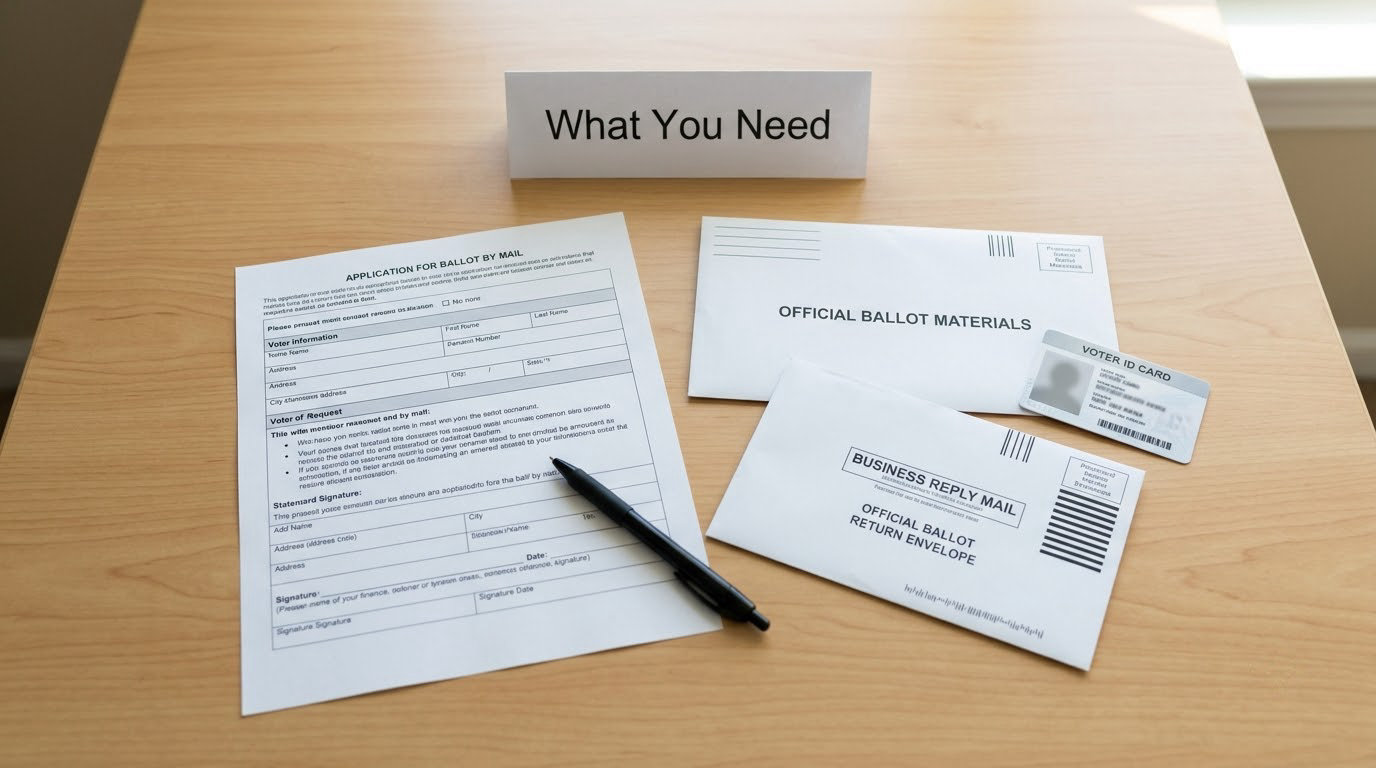
You need a handful of things, and most states mail you the important ones with the ballot. Gather these before you start so nothing bounces back or gets rejected.
- Your voter registration record. Check the name and address on file first, because a mismatch is a common reason a ballot request gets flagged.
- The official ballot and instruction sheet. They arrive together, and the sheet tells you which pen color and marking style your state accepts.
- The official return envelope. Usually printed with a tracking barcode and your voter ID number. Never substitute a plain envelope.
- A secrecy or opacity envelope in the states that use one, which goes inside the signature envelope so your choices stay private.
- A black or blue pen. Ballots marked in pencil, or in a color your scanner is not set up for, can fail to read.
- Your state ID number, or a photocopy of your ID, in the small number of states that attach identification to the ballot rather than to the request.
- Postage, only in states that do not supply a prepaid return envelope. Check yours before you buy a stamp.
- Your state’s ballot tracking page, bookmarked before you request anything, so you can watch the ballot move.
Most states run requests online now, and a printed application is the fallback when you are offline or want a paper trail. Avoid third-party request forms. They are not connected to your election office and the information you type into them can be misused.
Step-by-Step
The process has six stages: confirm you are eligible, request the ballot, complete it, seal and sign it, return it before the deadline, and track it until it is counted. The order matters more than the speed. Follow the instructions supplied by your state election authority above any general guide, including this one.
1. Confirm that mail voting is available and check your eligibility
You confirm mail voting is available in your state and that your registration record is accurate before anything else. Most states fall into one of three groups: automatic mail ballot states that send ballots to every registered voter, no-excuse states where any registered voter can request one without giving a reason, and excuse-required states where you state a qualifying reason such as illness, disability, work, travel, or caregiving.
A small number of states also keep permanent mail-in lists. If you are on one, you may receive ballots automatically without requesting each time, so check your status rather than asking for a second ballot. Military and overseas voters are covered separately by the Uniformed and Overseas Citizens Absentee Voting Act, which sets its own deadlines and uses the Federal Post Card Application.
Use an official lookup such as Can I Vote or VOTE411 to reach your state’s election office, then confirm your registration there. Do that early, because fixing a registration problem is slower than requesting a ballot.
2. Request your mail ballot before the deadline
You request your ballot before your state’s request deadline, which usually falls about a week before Election Day and can fall earlier in some states. Requesting early is the cheapest insurance in the whole process, and most states recommend at least a month of lead time.
Most states let you request online, in person at the county election office, by mail, and in some cases by phone. Your request typically needs your name, date of birth, the address where you are registered, and sometimes the last four digits of your ID or your driver’s license number. You will get a confirmation by mail, email, or text. Keep it, because it is what you show if a ballot goes missing.
Allow roughly a week after your office processes the request for the ballot to reach you, and allow more in rural counties or close to the deadline. If the tracker shows no movement after about ten days, call the election office and ask them to confirm the request. Do not simply send a second one, because duplicate ballots create confusion at signature verification.
3. Complete the ballot carefully
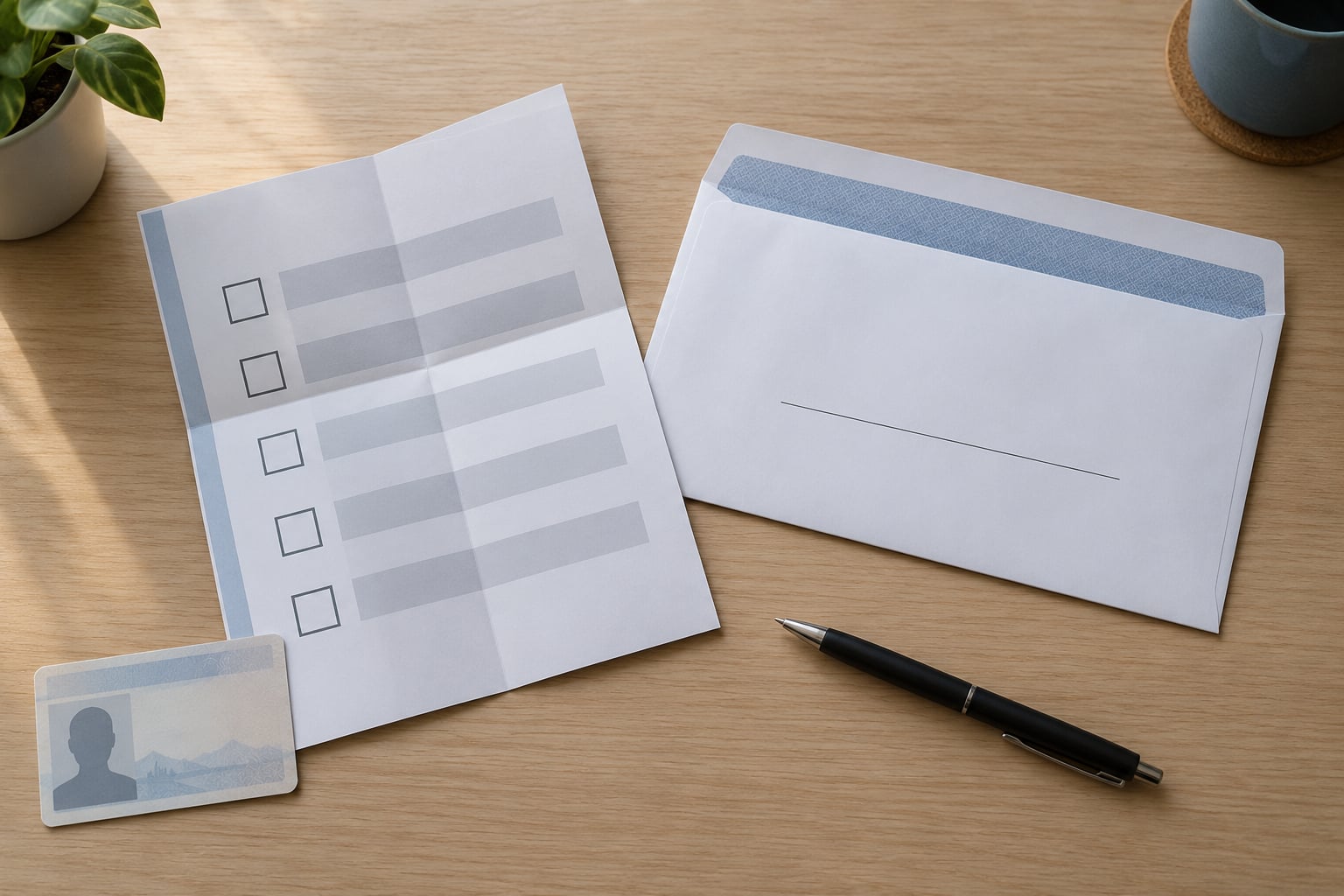
You fill in every contest you care about, follow the marking instructions exactly, and avoid stray marks. Most ballots ask you to fill a bubble completely with the pen you were told to use. Light or partial marks may not register, and marks outside the bubble, crossed-out lines, or notes in the margin can cause a contest to be skipped entirely.
If you make a mistake, request a replacement ballot rather than trying to erase or overwrite. Erasures and correction fluid are common rejection triggers, and a replacement is usually easy to get while your election office is still mailing ballots.
If you are voting a straight ticket, fill the straight-ticket line and stop there. If you are not, leave that line blank and mark each individual contest you want. People ask about this constantly, and leaving the straight-ticket line blank while marking the contests below it is exactly what election officials expect. Research your choices before you sit down, because there is no way to look anything up once the ballot is sealed.
Voters who need assistance marking a ballot may bring a helper, and most states limit assistance to two people who are not the voter. The rules on who may assist and how your choices stay secret differ by state, so check yours rather than assuming.
4. Place the completed ballot in the required return envelope
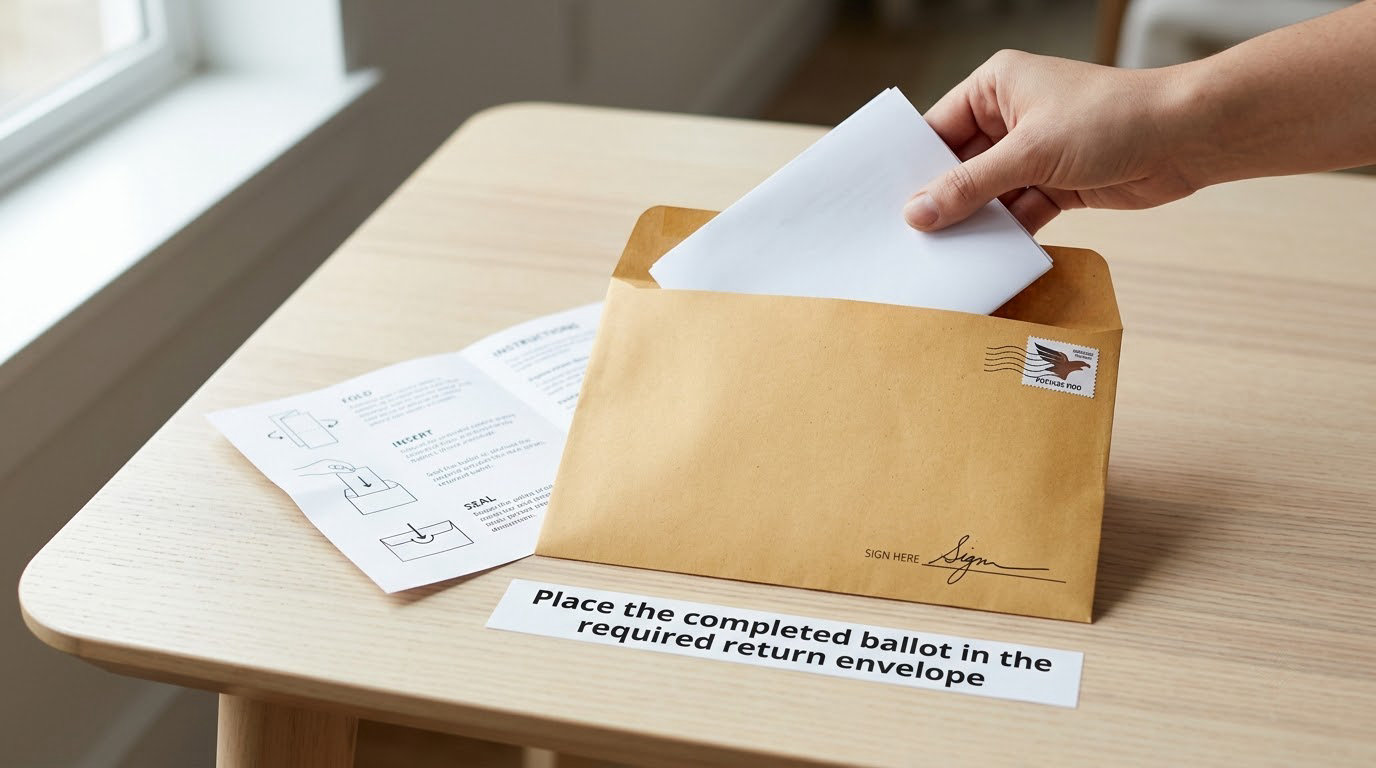
You seal your ballot in the official return envelope and sign the voter declaration on the outside. This is the step that causes the most rejections, and it takes ten seconds.
The declaration is a self-affirmation: you are swearing the ballot is yours and that you marked it yourself. Sign it in ink, on the signature line, the way you signed when you registered, and add the date if the envelope asks for one. If your signature does not match your registration record closely, officials normally send a cure notice instead of discarding your ballot, but curing costs you time, so matching the signature on your record is the safer move.
A small number of states require more than your signature. The National Conference of State Legislatures reported in May 2026 that eight states require a witness signature in addition to the voter’s, among them Alabama, Alaska, Arkansas, Louisiana, Minnesota, North Carolina, South Carolina, and Wisconsin, and three states require notarization: Mississippi, Missouri, and Oklahoma. Arkansas and North Carolina also ask for a copy of voter identification, and Georgia asks for a driver’s license or state ID number. Requirements change, so read your own state’s page instead of assuming you are exempt.
Put the ballot, plus the secrecy envelope where your state uses one, inside the return envelope. Seal it, sign the outside, and complete any witness or notary section before the envelope leaves your hands.
5. Meet the return deadline and send the ballot
You return the ballot before the deadline that applies in your state, and you check whether that deadline is postmarked by or received by.
These are two different tests. Postmarked by means the USPS date marking on your envelope must fall on or before the deadline, even if the ballot arrives days later. Received by means election officials must physically have it in hand by that date, sometimes with a short grace period. If your state counts received by, mailing in the final week is a gamble you do not need to take.
In rough order of speed, your options are an official ballot drop box inside the deadline, hand delivery to a county election office or early voting site, the USPS counter where you can ask for a dated postmark and keep the receipt, and finally your home mailbox, which carries no guaranteed pickup time. Drop boxes are widely used and monitored, but check the hours and location on your state’s site. Military and overseas voters work on the UOCAVA timeline, which allows ballots to be sent up to 45 days before Election Day.
Both Rock the Vote and the League of Women Voters recommend mailing your ballot at least a week before Election Day, and mailing a month ahead removes the timing risk completely. If you are close to the deadline, take it to the post office counter and ask for a manual postmark rather than hoping your carrier picks it up.
6. Track the ballot and confirm it was counted
You track the ballot from the day you mail it until your election office confirms it was accepted.
Most states print a barcode on the return envelope that shows the same stages: ballot mailed, ballot received, signature verified, ballot accepted or flagged. Find the tracker link on your state’s election office site or in the confirmation you received, and check a few days after you return the ballot. Turn on email or text notifications if offered, because a flagged signature is far easier to fix when you hear about it early.
If the tracker never shows the ballot as received, contact the election office. If you are told it was flagged, read the cure notice, sign where indicated, and return it by the state’s cure deadline, which is short and easy to miss. If the ballot was lost or spoiled beyond use, a replacement is usually available while your office is still sending ballots. If the deadline has passed and your ballot was not accepted, ask about casting a provisional ballot in person instead.
Common Mistakes
Mail ballots are rejected for small mechanical reasons far more often than for anything about how you voted. Each of these has a straightforward fix.
- Missing or mismatched signature. Sign the declaration on the signature line in ink, matching how you signed at registration, and date it if the envelope asks for a date.
- Late return. Confirm whether your state counts ballots postmarked by or received by, and use a drop box or hand delivery if it uses received by.
- Wrong envelope. Use the official return envelope that came with your ballot. A plain envelope, or one from a previous election, is usually not processed.
- Unmarked or over-marked contests. Fill bubbles fully, and skip a contest cleanly instead of scribbling, striking through, or writing notes.
- Unofficial forms. Third-party request sites and printed samples from non-government pages can delay or misdirect a request, which costs you time you may not have.
- Missing identification. A few states attach ID to the ballot rather than the request, and that ID is required before the envelope is sealed.
- Duplicate requests. Check your status before submitting another request, so you are not working out which of two ballots to return.
Two habits cover most of that list. Track your ballot from day one, and treat the signature line as the most important square inch on the envelope. If postal timing worries you, returning the ballot a week early removes the single largest risk in the process.
Frequently Asked Questions
Can I change my vote after I mail my ballot?
Once election officials receive your mail ballot, your vote is cast, and changing it means voting again under your state’s rules. Many states let you request a replacement ballot for the same election, and some count a later ballot over an earlier one. If your ballot was never received, you can often vote in person instead. Confirm the replacement and override rules with your state election office before you act.
Do I need a witness or notary for every mail ballot?
No. Most states require only your own signature on the return envelope. A minority require more, such as a witness signature in addition to yours, or notarization. NCSL reported in May 2026 that eight states require a witness signature and three require notarization. Requirements also change for voters who need assistance because of a disability or illness. Check your state election office page rather than a national summary.
Can a postal worker help me complete or return my ballot?
A postal worker can accept your sealed and signed ballot and apply a dated postmark at the counter if you ask for one. They cannot open, mark, or complete your ballot, and they are not election officials. If you need help marking the ballot, use a state-permitted assistant such as a family member instead of asking postal staff. Voting in person with assistance is also available in every state.
How do I report that my mail ballot was not counted?
Start with your state election office rather than a hotline or third-party site, and have your confirmation number or tracking barcode ready. Ask whether the ballot was received, whether the signature was flagged, and whether the cure deadline is still open. If it was not counted and the deadline has passed, ask about casting a provisional ballot at your polling place. Many states publish the reasons ballots were rejected.
What should I do if I moved after requesting a ballot?
Update your registration with your state election office first, then decide what to do with the ballot mailed to your old address. Many states forward a ballot to a new address, but they cannot forward a completed ballot from one household to another. If it never arrived, request a replacement at the new address, which is usually possible while your office is still mailing ballots. Moving within the same county is often simpler, so ask.
If you do one thing today, find your state election office through Can I Vote or VOTE411 and check your registration. Request your ballot as soon as you are eligible, mark it in pen, seal it, sign it, return it a week early, and watch the tracker. Every ballot that gets lost is lost to one small step that felt obvious.