
If you want to know how to budget on an irregular paycheck, plan against your quietest month instead of your best one. Take your lowest reliable net income, cover your fixed bills and taxes from that number, and treat everything above it as money for a future month rather than as new spending power. Setting the system up takes one evening, and keeping it honest takes about ten minutes on each payday. Updated for 2026.
- Budget from your floor, the smallest amount you have actually received in the last 6 to 12 months, not from your average.
- Send 25 to 30 percent of every deposit to a separate tax account before you touch spending money.
- Pay yourself the same fixed salary each month and let everything above it roll into a buffer.
- Review on every payday, so the plan absorbs a small deposit without a scramble.
The reason standard budgeting advice fails here is simple. A monthly budget built on a steady paycheck assumes next month will look like last month, and irregular income punishes anyone who makes that assumption. A 6,200 dollar month followed by a 1,900 dollar month is normal for a freelancer, a commission salesperson, or a tipped server.
None of that is a personal failing. It is a cash flow problem with a well-known fix: decide in advance what a small month looks like, then force every large month to pay for it in advance. Updated for 2026, the method below is what we come back to when income is unpredictable.
Table of Contents
- What You Need
- Step-by-Step: How to Budget on an Irregular Paycheck
- Step 1: Find your baseline number
- Step 2: Split expenses into four buckets
- Step 3: Set aside taxes before you spend anything
- Step 4: Choose a method: zero-based, 50/30/20, or 70-10-10-10
- Step 5: Build the bare-bones baseline budget
- Step 6: Split every deposit the day it lands
- Step 7: Review on every payday
- How to Budget on an Irregular Paycheck in a Low-Income Month
- How to Build a Buffer for Missed or Delayed Pay
- Common Mistakes
- Frequently Asked Questions
- Do I budget on my lowest month or my average?
- Will budgeting work if I have an irregular income?
- How do I budget when I am paid biweekly?
- How do freelancers pay quarterly estimated taxes?
- How much cash should an irregular earner keep on hand?
- How do we budget when only one partner’s income is unstable?
- Conclusion
What You Need
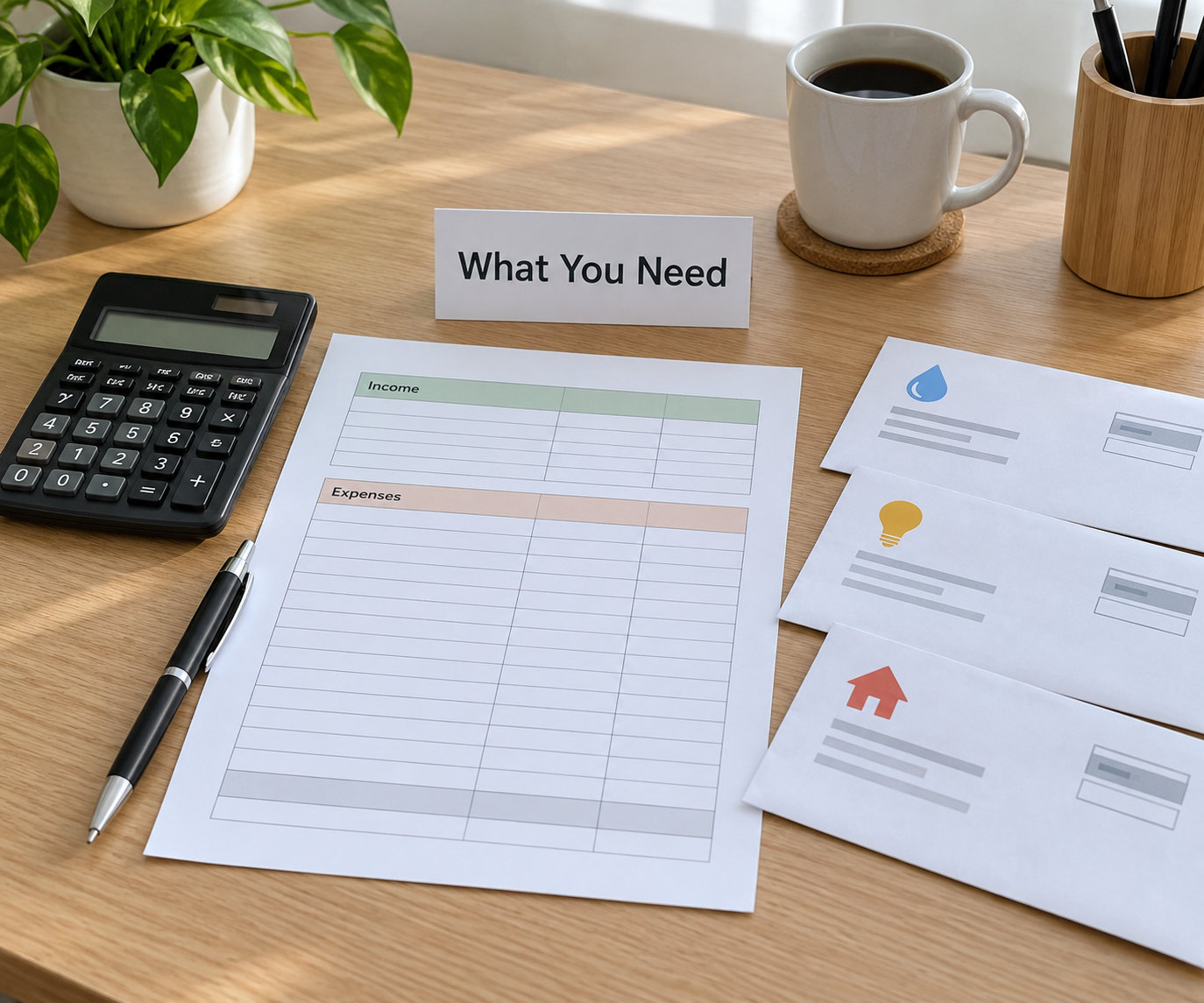
You need an hour, a record of what actually came in, and a place to write the plan down. The documents matter less than having twelve months of them in one view.
Income records. Pull 6 to 12 months of pay stubs, invoices, or deposit records and write down the net amount that landed in your account each time, not the gross amount on the invoice. For a 1099 earner, gross minus expenses minus estimated tax is what you actually spend.
Fixed bills with due dates. Housing, utilities, phone, insurance, subscriptions, minimum debt payments. Note the exact day each one is due, not just the amount, because the whole method runs on dates.
Flexible spending. Groceries, fuel, eating out, clothing, personal spending. These are the lines that flex up when a large deposit lands, and they are the first thing to trim in a small month.
Annual and irregular bills. Car insurance, registration renewals, property tax, school fees, gifts, professional dues, equipment replacements. Divide each by 12 to get a monthly contribution.
Debt balances and minimums. Every account, the minimum payment, the interest rate, and the due date. Variable income makes minimums a fixed commitment you cannot negotiate away.
Your tax obligation. A rough estimate of what you will owe on the year’s income, since that bill arrives whether or not you can afford it.
A holding account. One bank account that collects every payment and pays your bills. Separating income from spending is the single most repeated tip from people who budget this way for years.
A tool. A spreadsheet works. EveryDollar and YNAB both handle uneven income, and most banks have a paycheck calendar view that shows which pay dates fall in which month. Pen and paper is fine too.
Step-by-Step: How to Budget on an Irregular Paycheck
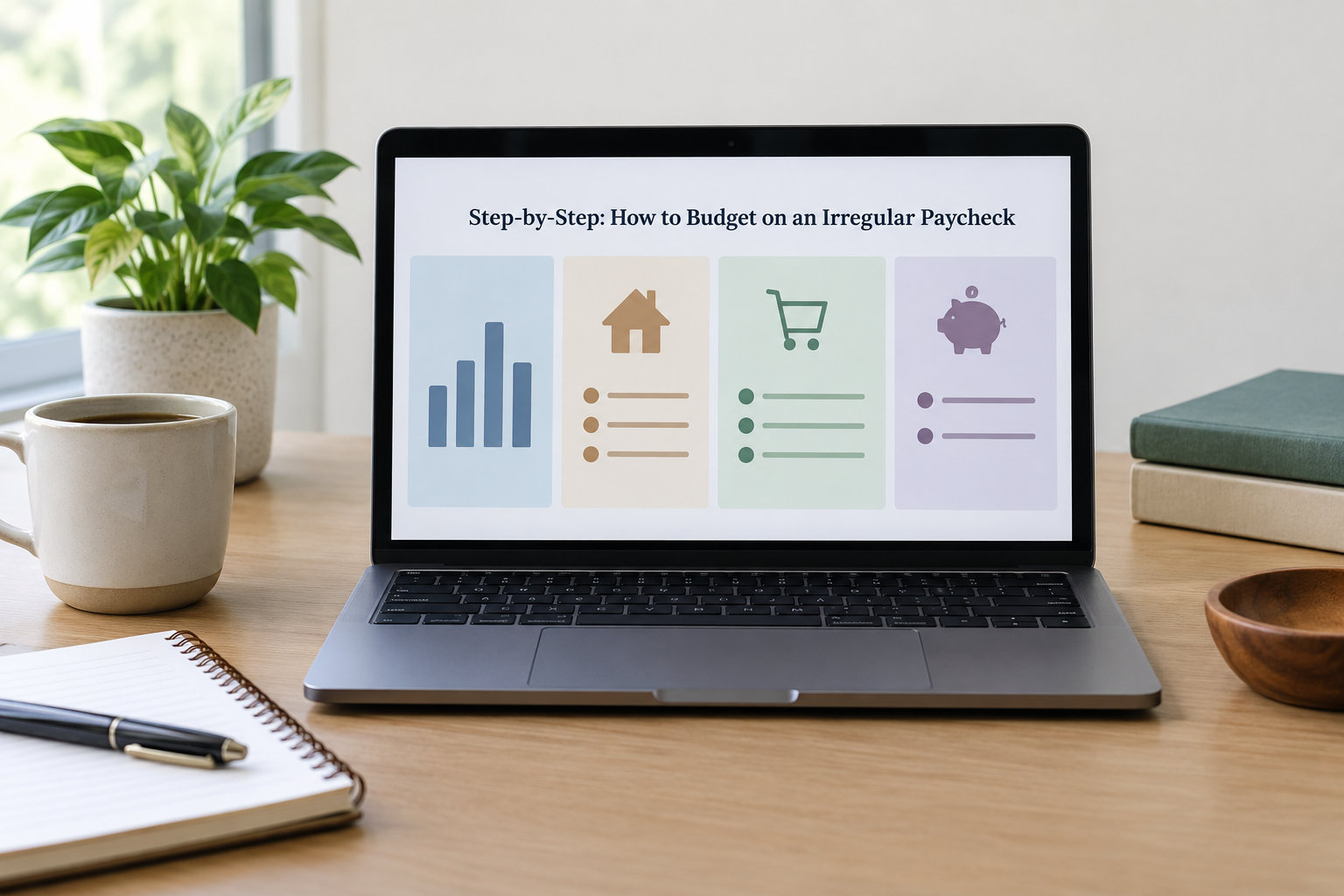
- Pull 6 to 12 months of deposits and find your lowest month.
- List your fixed bills with exact due dates.
- Move annual and irregular bills into sinking funds.
- Set aside 25 to 30 percent for taxes before spending.
- Build a bare-bones baseline budget from what remains.
- Move each deposit into a holding account and pay yourself a fixed salary.
- Review and adjust the plan on every payday.
Here is each step in detail, with a way to know it worked.
Step 1: Find your baseline number
Sort your last 6 to 12 months of deposits and take the smallest one. That is your baseline income, the number your whole plan is built on. If one month was genuinely a disaster, such as a three-week illness or a cancelled project, use the smallest of the remaining months instead.
You will see advice to use your average instead. Average is useful for one purpose only: checking your tax bill and your annual goal. For day-to-day spending, the floor is safer, because the floor is a number that has already happened rather than a number you hope for. When your small months get bigger, raise the baseline. Do not lower it in a good month.
Step 2: Split expenses into four buckets
Sort every line into predictable monthly, variable monthly, annual, or truly irregular. A streaming service is predictable monthly. Groceries are variable monthly. Car insurance is annual. A freelance invoice that may or may not arrive is truly irregular.
The fourth bucket is the one that catches people. A 900 dollar tax bill, a 400 dollar equipment repair, and a 1,200 dollar client project all land in the same month, and a budget that never named them will fail in that month every time.
For annual bills, divide the amount by 12 and set aside that slice every month in a separate sub-account. A 1,440 dollar annual premium becomes 120 a month, which is far easier to absorb than 1,440 in the month it is charged.
Step 3: Set aside taxes before you spend anything
If you receive a 1099 or are paid through an app that does not withhold tax, move 25 to 30 percent of every deposit into a separate savings account the day it lands. That is not optional. Quarterly estimated tax payments are a fixed obligation, and a large deposit followed by an unreserved April is the most common way irregular earners end up borrowing.
Twenty-five percent is a reasonable starting figure. Raise it toward 30 percent if you have big deductible expenses, and lower it only after a professional tells you your real rate, because the threshold for owing tax is based on gross income, not net.
Give this account a name and treat it as money that already belongs to someone else. It is not part of your budget; it is a bill you are holding.
Step 4: Choose a method: zero-based, 50/30/20, or 70-10-10-10
Most irregular earners land on zero-based budgeting, where every dollar gets a job and nothing is left unassigned. It is the best fit because you assign money that actually arrived, rather than percentages of a number you cannot predict.
| Rule | How it works | Fit on an irregular paycheck |
|---|---|---|
| Zero-based | Assign every dollar a category until nothing is unassigned | Best fit. The amount can change every month and the method does not care. |
| 50/30/20 | 50 percent needs, 30 percent wants, 20 percent savings and debt | Workable once your baseline covers the 50 percent needs line. Wants usually get cut first. |
| 70-10-10-10 | 70 needs, 10 savings, 10 debt payoff, 10 giving | Useful if you give regularly or are paying down debt, but the fixed 70 percent needs cap is hard when rent is high. |
If you like a percentage rule, apply it to your baseline number rather than to whatever arrives. A 50/30/20 budget on your floor leaves the surplus untouched, which is exactly the behaviour you want.
Step 5: Build the bare-bones baseline budget
Subtract your fixed bills and your tax set-aside from your baseline income. What remains is the most you can safely spend in your leanest month. That figure is your spending budget, and it should be small enough that you would still recognise your own life at the end of it.
People often build a lean-month budget and then feel embarrassed by it. That reaction is useful information. If your baseline barely covers rent, utilities, food, and minimum debt payments, the real problem is that your fixed costs are above your floor income, and no budgeting system fixes that on its own. Moving, refinancing, or adding income are bigger levers than a spreadsheet.
Step 6: Split every deposit the day it lands
This is the step most guides skip. When a payment arrives, move the money before you spend anything, in the same order every time.
- Tax set-aside, 25 to 30 percent, to the tax account.
- Your fixed monthly pay, at the same amount every month, to cover bills and sinking funds.
- A fixed flexible-spending allowance, the same amount every month, for day-to-day life.
- Everything remaining to the buffer, the next-month fund, or debt payoff.
Worked example. A freelance designer has deposits of 4,200, 5,900, 3,100, 4,700, 6,200 and 3,400 over six months. The floor is 3,100. Fixed bills are 2,450, leaving 650 as the flexible allowance. Here is how two deposits get split:
| Deposit | Tax account (25 percent) | Living pay (fixed) | Flexible | Buffer or debt |
|---|---|---|---|---|
| 4,200 | 1,050 | 2,450 | 650 | 50 |
| 6,200 | 1,550 | 2,450 | 650 | 1,550 |
The lifestyle in both months is identical. That is the whole trick: the surplus waits for you instead of disappearing into a better month.
If transfers can be automated, set them up for the day after payday. Manual transfers fail in the months you need them most, because those are the months you are stressed.
Step 7: Review on every payday
Spend five minutes after each payment: check what actually came in, confirm the tax transfer happened, and look at the buffer balance. If the deposit was lower than planned, pull the difference from the buffer and note it. If it was higher, the allocation does the rest on its own.
Rebuilding the whole budget from scratch each month is why people burn out on this. Adjust the amount you pay yourself, not the entire structure.
How to Budget on an Irregular Paycheck in a Low-Income Month
When a deposit comes in below your baseline, the order of payment matters more than the amounts. In a squeeze, pay in this order:
- Shelter: rent or mortgage, plus utilities needed to keep the home safe and working.
- Food and basic transportation, so you can get to work.
- Minimum payments on every debt, at the minimum, so nothing goes to collections.
- Medical needs: prescriptions, appointments, urgent care.
- Everything else, in the order you choose.
Then work through the list below. The first item is the one that keeps the damage small.
- Dip into the buffer before touching credit. Use the cash you already set aside.
- Call landlords and utility companies early. Most will defer or restructure a payment when you tell them before it is late, and asking in week one is far easier than explaining in week four.
- Pause every subscription and membership for the month. This is usually the fastest 100 to 200 dollars available.
- Delay flexible spending rather than essentials. Cook, consolidate errands, skip the second coffee.
- Take short-term income: a delivery shift, a weekend rental, a small paid task. A few hundred dollars prevents a much larger problem.
- If bills are already 90 days late, contact a nonprofit credit counsellor before applying for a new card. They can often negotiate a rate reduction for a fee far below what a new balance costs you.
Avoid covering recurring bills with revolving credit. A buffer of a few hundred dollars, even an awkward one built slowly, breaks the cycle that turns one small month into a year of interest payments.
How to Build a Buffer for Missed or Delayed Pay
A buffer is not an emergency fund in the traditional sense. It is a working account that absorbs the gap between when a client pays you and when you are paid, or covers a delayed payment. Start with a minimum cushion: one month of bare-bones essentials, which for many people is a few hundred dollars, not several thousand.
To build it, send a fixed share of every large deposit to the buffer before anything else discretionary. Ten percent of each payment is a workable start. Define the floor you will not go below, write that number down, and treat the buffer as unavailable income until it passes the floor for the first time.
Automate the transfer so the buffer grows on good months without a decision in the moment. The order of operations when a large payment lands is taxes, then buffer, then the rest of your spending, and reversing that order is how the surplus gets spent.
Once the one-month cushion holds, keep building toward three to six months of essential expenses, which university extension services and consumer agencies commonly suggest for variable earners. That second stage is what lets you turn down work you do not want, and it is what stops one cancelled project from becoming a debt spiral.
Common Mistakes
Budgeting from your best month. A budget built on 6,200 dollars is not a budget, it is a wish. Fix: budget from the floor, then treat every surplus as a transfer, not as permission.
Spending to match a large deposit. This is the most common failure and the most expensive. The new car, the nicer apartment, the bigger grocery bill all arrive three weeks before the next deposit. Fix: pay yourself the same salary in a big month as in a small one, and let the difference accumulate.
Ignoring quarterly taxes. Income gets averaged in your head and taxes get paid in a panic. Fix: move 25 to 30 percent out on payday, and check the actual number with a tax professional once a year.
Forgetting annual bills until they hit. Car insurance, registration, licences, school costs. Fix: divide by 12 and fund a sinking fund for each one.
Trying to forecast next month’s income. Forecasting a freelancer’s month is imaginary cash flow, and it fails in exactly the months you need it. Fix: plan for your floor and treat anything more as a bonus to the future.
Building a budget with no slack. If your plan has zero margin, the first surprise cancels it. Fix: keep a few hundred dollars in the plan as unassigned cushion, even in a lean month.
Rebuilding everything each payday. Re-doing the plan from scratch is why people quit. Fix: change only the amount you pay yourself, then let the automatic splits do the rest.
Letting one partner absorb all the variability. In a household with one stable income and one erratic one, the erratic half usually funds the buffer for both. Fix: agree on a fixed monthly amount that leaves the variable earner the surplus, and review it every few months.
Two habits make the system easier to live with. Keep a running note of where the money actually goes, since small recurring charges are easy to miss; a daily 4 dollar coffee is roughly 100 a month and about 1,250 a year. And review the plan whenever income or bills change, not on a fixed calendar. A new client, a new lease, a car purchase all reset the maths.
Frequently Asked Questions
Do I budget on my lowest month or my average?
Budget on your lowest reliable month, taken from 6 to 12 months of net deposits. That number has already happened, so you know the bills get covered. Use your average only to estimate annual totals such as your tax bill or a yearly savings goal. If your lowest month was a one-off crisis, use the lowest of the remaining months instead.
Will budgeting work if I have an irregular income?
It works better than a fixed budget, because the plan is built around your actual income instead of an assumed one. The trick is separating your fixed salary from the variable surplus. As long as your floor covers your essentials, a small month costs you nothing but review time. Zero-based budgeting is the format most irregular earners use.
How do I budget when I am paid biweekly?
Biweekly pay is less irregular than it looks, because 26 checks a year averages slightly more than a monthly salary. The catch is months with three paychecks and months with two. Plan on two paychecks a month, treat a third as a bonus, and use a paycheck calendar so you can see which pay dates fall inside which calendar month before the month starts.
How do freelancers pay quarterly estimated taxes?
Set aside 25 to 30 percent of every payment the day it arrives, in a separate account, and pay estimated taxes on the schedule your country requires. Keep a record of what you have set aside so you can compare it with what you actually owe. Because the threshold depends on gross income, ask a tax professional to check your real rate once a year.
How much cash should an irregular earner keep on hand?
Start with a working buffer of one month of bare-bones essentials, which is often a few hundred dollars, and use it for payment gaps rather than for lifestyle spending. Once that floor holds reliably, build toward three to six months of essential expenses. That larger cushion is what gives you room to say no to work you do not want.
How do we budget when only one partner’s income is unstable?
Agree on a fixed monthly household amount that the stable income covers, and let the variable earner keep everything above it, minus a shared percentage for taxes, buffer and debt. This stops the variable income from setting the household standard. Revisit the fixed amount every few months, since a raise on one side often means it can come down.
Conclusion
Start this week with one job: open your last three to six months of bank records and write down every deposit and every bill, in date order. Subtract your fixed costs from the smallest deposit on that list, set aside the tax share, and write down the number that is left as your monthly spending limit. That is the baseline budget, and everything else in this guide is detail hung on it.
Then treat the plan as a living document. A new contract, a cancelled invoice, a lease renewal or a surprise repair should each send you back to the same three columns: what came in, what is committed, what is genuinely yours to spend. Update for 2026 as your income changes, and the budget stops being a source of anxiety and becomes a set of rules you already know.
Further reading: consumer financial education resources from the Consumer Financial Protection Bureau, and budgeting guidance for variable income published by university extension services. Tax rules and thresholds differ by country and change often, so check the details for where you live with a qualified professional.