To understand your electric bill charges, split the line items into three groups: energy (supply) charges for the electricity itself, delivery charges for the poles, wires and grid that bring it to your home, and taxes and fees. Then check the kilowatt-hours and the rate against your meter. A careful first pass takes about twenty minutes.
Bills look complicated because they are not designed to be read end to end. Regulators let utilities recover specific costs through specific line items, so a line that says TDU or fuel adjustment is not a duplicate charge you paid twice. It is a different bucket, billed separately, by design.
Once you know which bucket each line belongs to, you can tell quickly which parts move when you use more electricity and which parts stay flat. That is the whole trick, and it works on regulated and deregulated bills alike.
Table of Contents
- What You Need Before You Start
- Step-by-Step: How to Understand Your Electric Bill Charges
- Start With the Bill Summary at the Top
- Separate Usage Charges From Fixed Fees
- Read Your Meter and Check Your Usage
- Compare Your Rate Plan and Unit Price
- Check Taxes, Credits, and Adjustments
- Verify Errors and Estimate Your Savings
- Is Your Bill Normal? Average Usage Benchmarks by Home Size
- Common Mistakes When Reading Electric Bills
- Frequently Asked Questions
- What does kWh mean on an electric bill?
- Why did my electric bill go up if I did not change anything?
- How do I check whether my meter reading is correct?
- What is the difference between a fixed charge and a usage charge?
- Does a time-of-use electricity rate always save money?
- When should I contact my electric utility about a bill?
- Conclusion
What You Need Before You Start
Gather these five things and the bill stops being a puzzle. Most of them are already sitting in your email inbox or on your kitchen counter.
- The current bill, every page. The interesting detail usually sits on page two, not page one.
- Three earlier bills. You need a trend, not a single month, to tell a spike from a pattern.
- A meter reading. Photograph it with a timestamp so you have proof of the date.
- Your account details. Account number, meter number, and the ESI ID or service address if you have moved recently.
- Your rate plan summary. In deregulated markets this is the Electricity Facts Label, the one-page document that lists the price per kilowatt-hour and every fee in plain print.
- Notes on the household. How many people, electric heat or gas, a well pump, a second fridge, an EV charger, a pool. Usage numbers make no sense without this context.
- A calculator. You will do three divisions and two multiplications.
If you rent, add one more item: confirm which meter belongs to your unit. Apartment residents occasionally get billed against a shared or master meter, and the numbers then look nothing like their own habits.
Step-by-Step: How to Understand Your Electric Bill Charges
Start With the Bill Summary at the Top
Read the summary block before the detail lines, because it tells you what you owe, not what caused it. It should show the billing period start and end dates, the amount due now, any previous balance, payments received, deposits, and the total current charges.
Check the billing period length first. Residential cycles commonly run 28 to 35 days rather than a clean 30, so comparing a 31-day bill with a 29-day bill makes a normal month look like a change in behavior. Normalize when you compare: divide total kilowatt-hours by the number of days in the period, then multiply by 30.
Users on the r/TexasElectricity forum hit this more than almost anything else. One common finding is that a total divided by the kilowatt-hours comes out at 15 cents per kilowatt-hour while the plan advertises a 10 cent energy rate. Nothing is wrong. The advertised rate covers generation only.
Separate Usage Charges From Fixed Fees
Sort every line into one of three buckets: energy, delivery, and taxes and fees. Within those, sort further into fixed fees that do not change with usage and variable fees that scale with it.
| Charge | What it covers | Moves with usage? |
|---|---|---|
| Energy or supply charge | Generating the electricity you consume | Yes |
| Base or customer charge | Fixed monthly cost of having an account and a meter | No |
| Transmission charge | Moving bulk power between regions | Usually yes |
| Distribution (TDU or TDSP) charge | Poles, wires, substations, street lights to your meter | Usually yes |
| Fuel adjustment clause | Pass-through of what generation fuel cost the utility | Yes |
| Public purpose or environmental surcharge | Funding for mandated programs and clean energy funds | Varies |
| Regulatory assessment | The state commission fee | Varies |
| Taxes | State and local taxes on the electricity service | Often yes |
| Metering or transition charge | Installing or operating smart meters, recovery of storm and system costs | Often no |
Here is the arithmetic. Suppose a bill shows 900 kilowatt-hours for the period, an energy rate of 9.5 cents per kilowatt-hour, a base charge of 15 cents per day, delivery charges of 4.2 cents per kilowatt-hour, a fuel adjustment of 1.1 cents per kilowatt-hour, and taxes of 3 cents per kilowatt-hour.
The energy charge is 900 times 0.095. The delivery charge is 900 times 0.042. The fuel adjustment is 900 times 0.011. Add the base charge for the number of days in the period and the tax line, and the whole bill should reconcile to the total. When it does not, the gap is usually a stale account record or a missed credit rather than a meter fault.
Then compute your effective rate: total amount due divided by total kilowatt-hours. That single number is the only fair way to compare a bill against last year’s, against a neighbor’s, or against a plan offer. Rates change constantly across regions as of 2026, so compare your own numbers over time rather than against a headline rate.
Read Your Meter and Check Your Usage
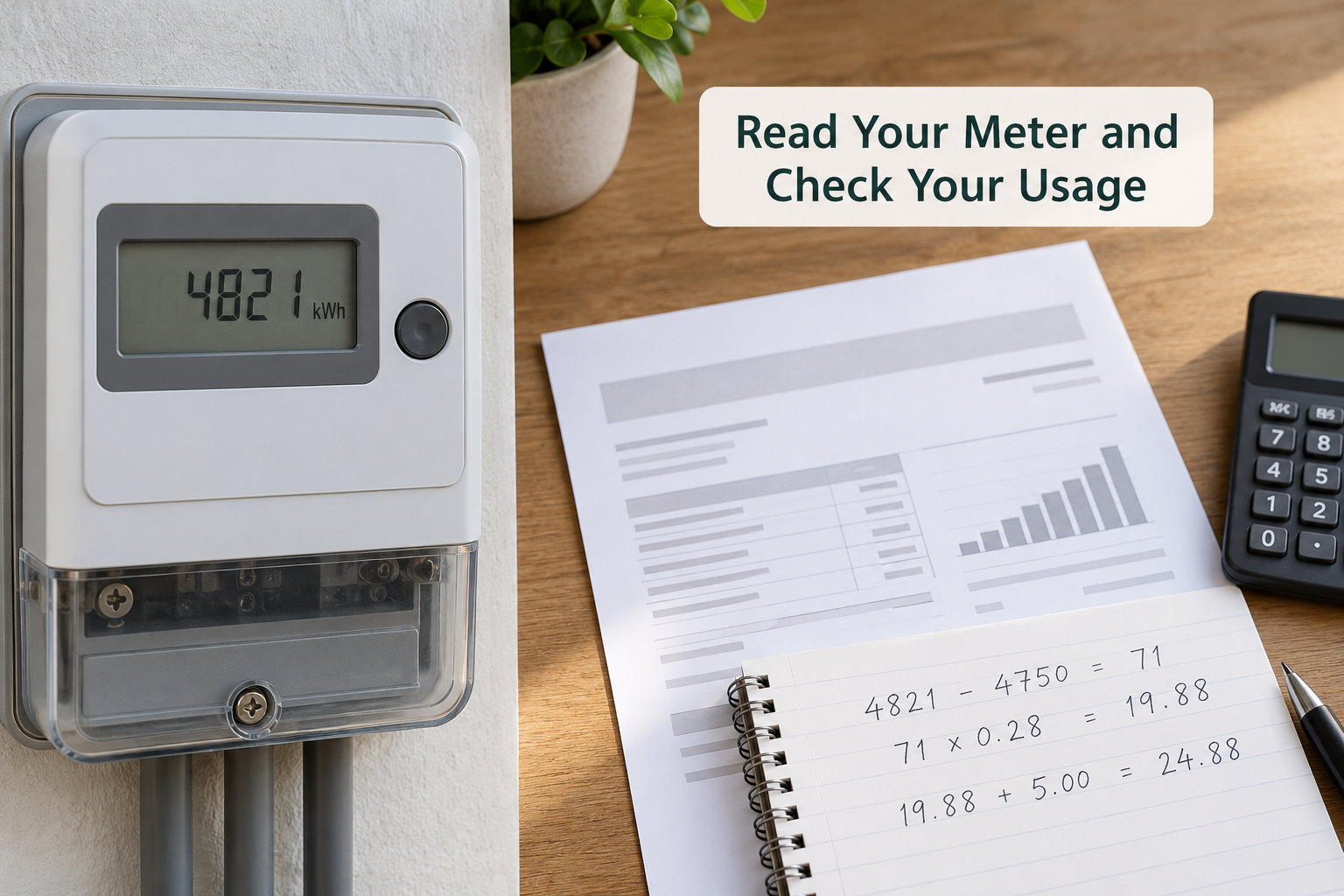
Every bill shows a previous reading, a current reading, and the difference between them. That difference is the kilowatt-hours you were billed for. When the current reading line says estimated rather than actual, the utility guessed, and a guess is worth disputing if the amount is large.
Reading a meter is easy. Digital meters display kilowatt-hours on a small screen or counter. Analog meters use a dial where the position of the pointer between numbers matters more than the number itself: a dial that has passed nine and returned to zero counts as one.
Never open a sealed meter enclosure to look inside. Meter boxes, socket enclosures and panel covers can hold live conductors even when the main breaker is off, and a broken seal can create a billing dispute of its own. If the meter sits inside a locked cabinet, ask the utility or your landlord for the reading, or use the smart meter data in your online account instead.
Now do the check that catches most errors. Take the current reading and subtract the reading printed as previous on the bill. If your number is close to the billed kilowatt-hours, the meter and the bill agree. If the billed kilowatt-hours are far higher, you have either an estimate, a wrong meter on the account, or a billing delay.
Billing delay deserves its own paragraph because it produces surprises that look like theft. If the utility read the meter on the 3rd but billed on the 28th, the reading you take today reflects another month of use. People have checked their online account with every appliance switched off and found the meter still climbing, which is normal. A meter that moves with all loads off points to a wiring issue at the property, and that is a job for a licensed electrician, not for the bill itself.
Compare Your Rate Plan and Unit Price
The unit price is the number you can compare across providers: the total cents per kilowatt-hour for the energy portion of the bill. Find it on the Electricity Facts Label in deregulated markets or in the rate schedule a regulated utility publishes.
Four rate structures cover almost every household plan. A flat or fixed rate charges the same cents per kilowatt-hour at every hour. A tiered rate bills your first block of kilowatt-hours at a lower price and higher usage at a higher price. A time-of-use rate charges a different price by hour, usually with afternoon and early evening peaks costing more. A variable or indexed rate tracks a market index directly.
| Rate structure | How it bills | Works best for |
|---|---|---|
| Flat or fixed | One cents per kilowatt-hour rate, all hours | Households with steady, moderate usage |
| Tiered | Cheaper first block, dearer above it | Households trying to hold usage under a threshold |
| Time-of-use | Different rate by period of day and season | Households that can shift heavy loads off peak |
| Variable or indexed | Rate follows a market index with a cap or floor | Households willing to track prices closely |
Two things catch households out. First, a contract end date. When a fixed plan expires without a new one, service can roll onto a default or holdover rate that is several times higher, sometimes without a clear notice in the mail. Second, the difference between who sets what. The retail electric provider sets the energy rate. The transmission and distribution utility owns the poles and the meter and sets the delivery rate through a state commission. Only the first one is negotiable.
Knowing which company handles what saves an afternoon of misdirected calls. In a regulated market the same utility does both. In a deregulated market you contact the retail electric provider about the energy rate and plan terms, the TDU about the meter, the poles, outages and service, and your state public utility commission about a dispute you cannot settle with either of them.
Check Taxes, Credits, and Adjustments
Some of the total has nothing to do with how much electricity you used. Taxes on the service, regulatory assessments, public purpose charges and environmental surcharges all apply, and several are calculated as a percentage of subtotal rather than a flat fee.
The fuel adjustment clause is worth understanding on its own. It passes through what the utility actually paid for generation fuel, so it rises and falls with wholesale prices. A bill that jumps while your kilowatt-hours stay flat is very often a fuel adjustment or a rate change, not a usage problem.
Credits work differently than people expect. A credit reduces the amount you owe and appears below the subtotal, while a payment is a transaction listed in the summary section. If you see a negative amount on a bill, that is money already on your account, not a refund in progress. Enrollments also change the total quietly: budget billing spreads usage evenly across months, net metering credits what rooftop solar sends back, and demand response programs pay you for short reductions during peak hours.
Verify Errors and Estimate Your Savings
Audit the bill against a checklist. Look for a duplicated charge with the same description and the same amount appearing twice, a billing period that is 28 days where the previous period was 31, a usage figure that is far outside your own range, an account still in an old name after a move, and a credit or program enrollment that stopped billing but never started crediting.
The most common real error is a wrong meter or account identifier on the account, particularly in apartments and after a move. It produces usage from a different property entirely, and it is resolved with a phone call once you have your meter number in hand.
After the audit, estimate what you can actually control. Under a time-of-use rate, running the dishwasher, dryer and oven after dinner moves real money. Setting the thermostat a few degrees and sealing drafts cuts heating load all season. LED bulbs, standby power strips for chargers and cable boxes, and a maintained air conditioner filter address the standby and short-cycling losses that quietly add up in every home.
Is Your Bill Normal? Average Usage Benchmarks by Home Size
Average residential electricity use in the United States runs roughly 800 to 1,000 kilowatt-hours per month for an efficient home and around 1,200 to 1,500 for a larger or older one, before adjusting for climate, fuel type and household size. A 2,000 square foot home in a mild climate sits near the middle of that range; the same square footage with resistance heat or a well pump sits well above it.
Judge your own bill against your own history first and the national average second. The right benchmark question is whether your kilowatt-hours per day changed, not whether your total matches a neighbor in a different climate with a different heating fuel.
Common Mistakes When Reading Electric Bills
Most confusion traces back to a handful of habits. Each has a quick fix.
- Comparing totals instead of rates. A higher total may be a rate change, not more electricity. Divide by kilowatt-hours before you react.
- Ignoring the billing period. Cycles of 28 to 35 days are normal. Normalize to a 30-day month or the comparison is meaningless.
- Assuming a bigger bill means more usage. Fuel adjustments, tax changes, a new base charge and a stale deposit all raise the total with flat usage.
- Reading a credit as a payment. Credits reduce what you owe. Payments appear separately in the account history.
- Blaming the retail provider for a delivery increase. Delivery rates are set through a commission process. Only the energy rate is yours to shop.
- Assuming estimated readings are accurate. An estimate that runs 30 days can be off by a wide margin on a household with a sharp seasonal swing.
- Letting a contract lapse. Check the expiration date on your rate plan and set a reminder two weeks before it.
- Comparing month to month and ignoring weather. Compare cooling degree days and heating degree days alongside kilowatt-hours when your fuel heats water or air.
One habit replaces most of the others. Once you have three months of bills, write the effective rate on the back of each in pencil. A number that moves tells you a rate changed. A number that stays put while kilowatt-hours climb tells you the house is using more. That distinction takes five minutes and settles most arguments.
Frequently Asked Questions
What does kWh mean on an electric bill?
A kilowatt-hour, written kWh, is a unit of energy equal to running a 1,000 watt appliance for one hour. Your bill shows how many kWh your meter recorded between two readings, then multiplies that number by a rate to get the usage charge. A 60 watt LED bulb left on for 10 hours uses 0.6 kWh. The number next to kWh on your bill is your total consumption for the whole period, not a price.
Why did my electric bill go up if I did not change anything?
Usage often stays flat while rates move. Fuel adjustment clauses track generation costs, taxes and regulatory assessments can rise, and a base charge can change under a commission decision. In deregulated markets a plan expiration can quietly move you to a holdover rate several times higher. Check whether your kilowatt-hours changed before assuming anything about your habits, and confirm the rate applied matches your active plan.
How do I check whether my meter reading is correct?
Read the meter and subtract the previous reading printed on the bill. If the difference roughly matches the kilowatt-hours billed, the meter and the bill agree. If the bill used an estimate, compare your own reading against the estimate to show the direction of the error. Photograph your reading with the date visible so you have a record, and never open a sealed meter enclosure to look inside.
What is the difference between a fixed charge and a usage charge?
A usage charge scales with the kilowatt-hours you consume, so it falls when you use less. A fixed charge, often called a base or customer charge, stays the same whether you use 200 kilowatt-hours or 2,000. It covers account servicing, the meter and part of the delivery network. Fixed charges matter most for small households, where they can represent a large share of the total.
Does a time-of-use electricity rate always save money?
No. It rewards shifting flexible loads away from peak hours, which usually means evening chores and running the dishwasher or dryer later at night. A household that works from home, runs central air through hot afternoons and cannot delay laundry often pays more. Run the arithmetic on your own hourly or daily usage history before switching, and check whether the plan has fixed base charges that cancel out the peak savings.
When should I contact my electric utility about a bill?
Call when a charge appears twice with the same description, when usage is far outside your own range, when the billing period is wrong, when the account shows a meter that is not yours, or when a credit stopped crediting. In deregulated markets, contact the retail provider about the energy rate and the TDU about the meter and service. Escalate to your state public utility commission if neither resolves the dispute.
Conclusion
Start with the billing period dates and the current meter reading, then divide the total by kilowatt-hours to get your effective rate. Write that number down with the bill and compare it with the last three months.
If the charge does not reconcile, name the specific line item in your call. Ask whether the reading was estimated, whether the meter number on the account is yours, and which company sets the delivery rate in your area. Those three questions resolve most disputed bills on the first contact.