Gas prices change so often because the gallon you pay for is rebuilt several times a day. Stations buy fuel at wholesale prices that track crude oil futures, then add refining, transport, taxes and their own margin. Every one of those layers moves on its own schedule, and most of them move more than once a week.
That is the honest answer. The less obvious part is which layer is moving, and how much of the swing is your fuel market rather than the oil market. Gasoline prices sit inside a supply chain that turns a barrel of crude into a blend tuned for the season, hauls it hundreds of miles, and competes with other stations within a mile of yours. Nothing in that chain is fixed for long.
Table of Contents
- Why Do Gasoline Prices Change So Frequently?
- What Makes Up the Price at the Pump?
- How the Global Oil Market Affects Local Gas Prices
- Why pump prices can move before crude oil does
- Why Do Gasoline Prices Change So Often by Season?
- Seasonal trends versus sudden spikes
- How Refineries and Pipeline Problems Create Local Changes
- Why Gas Prices Change So Often: Taxes, Credits, and Market Rules
- What Causes Sudden Gas Price Spikes and Quick Drops?
- Can Drivers Do Anything About Gas Price Changes?
- How Often Should You Expect Gas Prices to Change?
- Frequently Asked Questions
- Why can gas prices rise when crude oil prices are falling?
- How often do gas stations normally change their prices?
- Why is gas more expensive in some cities or states than in others?
- Can gasoline prices stay low throughout the year?
- How reliable are forecasts that predict where gas prices will go next?
- What Should Drivers Do First?
Why Do Gasoline Prices Change So Frequently?
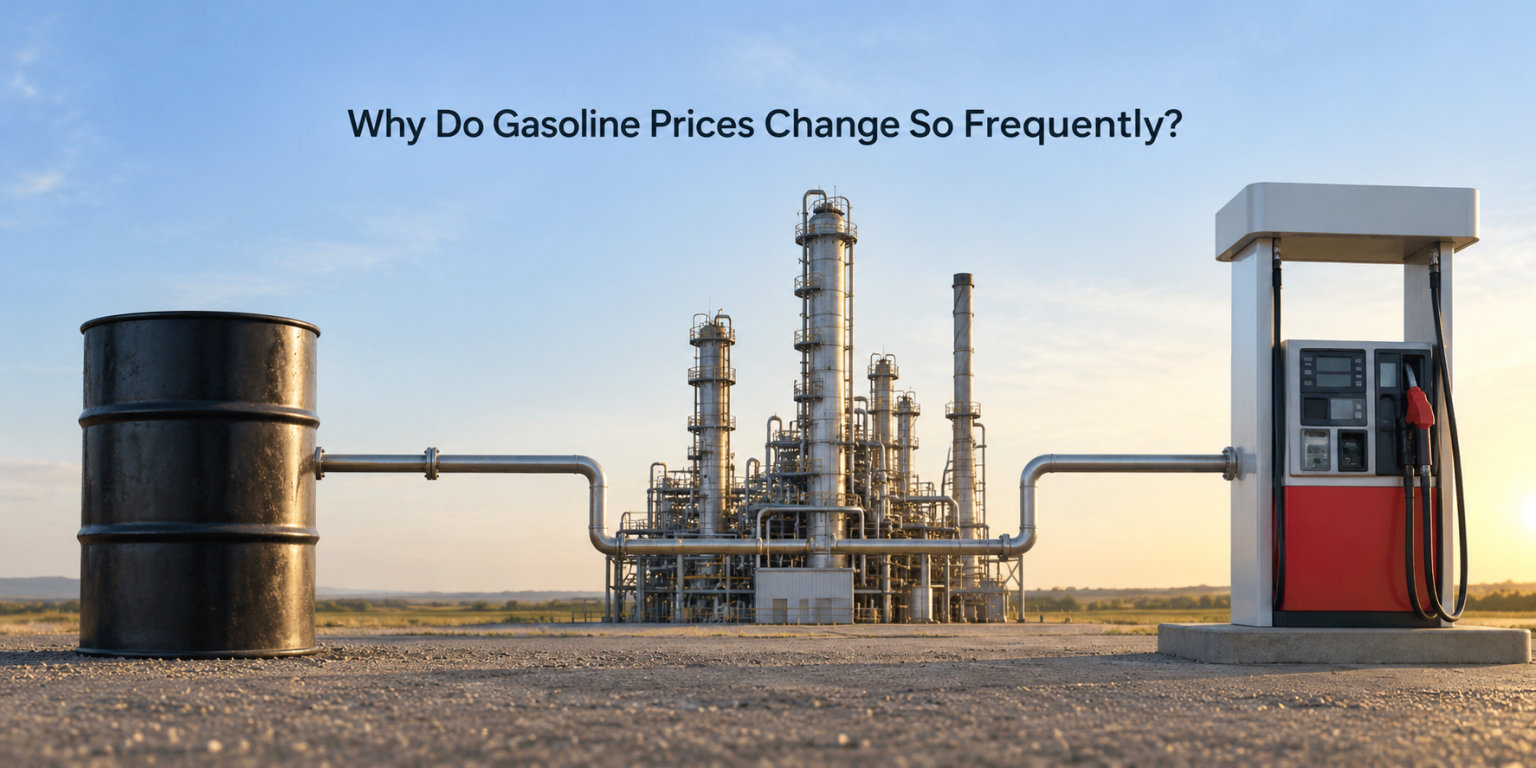
Six drivers explain the bulk of it: crude oil prices, taxes, refining costs and capacity, seasonal demand, supply disruptions, and the local market around each station. Crude oil moves the needle most in dollar terms, but it is far from the only thing reacting.
Think of a pump price as a stack. The crude barrel sits on the bottom, and everything above it — refining, taxes, distribution, the retailer’s margin — gets added on top. When crude drops 40 cents on a Monday, that reduction has to travel through the whole stack before it reaches you, and it may never travel in full.
Meanwhile the top of the stack changes almost hourly. A station two miles away may be running a promotion, sitting next to a full-price grocery fuel court, or dealing with a delivery that arrived late. Identical crude costs, different pump prices.
What Makes Up the Price at the Pump?
Percentages shift with the market, but the rough shares below are typical for the United States and useful for reading a pump price. Every 20 cents added to crude does not become 20 cents at the pump; taxes and fixed costs stay flat, which shrinks the crude share.
| Component | Rough share of retail price | How it moves |
|---|---|---|
| Crude oil | About half | Continuously, with futures markets |
| Refining and blending | Roughly 15 percent | Capacity, outages, seasonal grades |
| Distribution and marketing | Roughly 15 percent | Transport distance, station competition |
| Taxes and fees | Roughly 17 percent | Government decisions, rarely daily |
Outside the US the split looks different, with higher or lower tax takes and different refining economics, so treat these as a reading tool rather than a promise about your own receipt.
How the Global Oil Market Affects Local Gas Prices
Oil is priced globally against benchmarks, and those benchmarks reflect production decisions, inventory levels, currency moves and what traders expect happens next. None of that has to wait for a physical barrel to change hands. Futures contracts trade continuously, and the price on the screen leads the price at the terminal.
Producer decisions feed in here. When a group of oil-exporting countries adjusts its output target, the market reacts to the expectation of more or less supply well before barrels actually move. Exchange rates matter too: oil is priced in dollars, so a weaker dollar tends to make crude more expensive for everyone else.
Inventories are the shock absorber. When stocks build, prices tend to soften; when they draw down faster than expected, prices can jump even while production looks steady. Traders watch those weekly numbers closely, which is why headlines sometimes precede your local move by days.
Why pump prices can move before crude oil does
Wholesale gasoline is not crude. A refinery buys crude weeks before it sells fuel, and the price at the terminal reflects what refiners expect finished product to be worth. When gasoline inventories get tight or a big refinery goes down, wholesale gasoline can rise while crude sits flat for days. Then stations reprice against the higher wholesale number, and you see a pump change with no corresponding crude headline.
Why Do Gasoline Prices Change So Often by Season?
Demand and fuel specifications both follow the calendar. Spring brings road trips and pickups hitting the highway. Summer adds air conditioning load and the busiest driving stretch of the year. Then hurricane season hits Gulf Coast refining, and winter arrives with harder-to-make fuel grades.
Winter gasoline is blended to resist cold-weather starting, and producing it costs more and yields less per barrel. Switching a refinery’s blend specification as the season turns can tighten supply and push wholesale prices up before most drivers notice anything.
Refinery maintenance clusters too. Operators schedule turnarounds, and when several large facilities take downtime in the same window, regional gasoline supply gets tight. Those windows are predictable enough that analysts talk about them months ahead.
Seasonal trends versus sudden spikes
A seasonal trend is slow and boring. Prices drift a few cents a week over weeks, following the calendar. A spike is not on the calendar at all: it arrives when a pipeline shuts, a hurricane takes a region offline, or a conflict closes a shipping route. The tell is speed. If your local price jumped 30 cents overnight with no weather and no holiday, something happened in supply, not in demand.
How Refineries and Pipeline Problems Create Local Changes
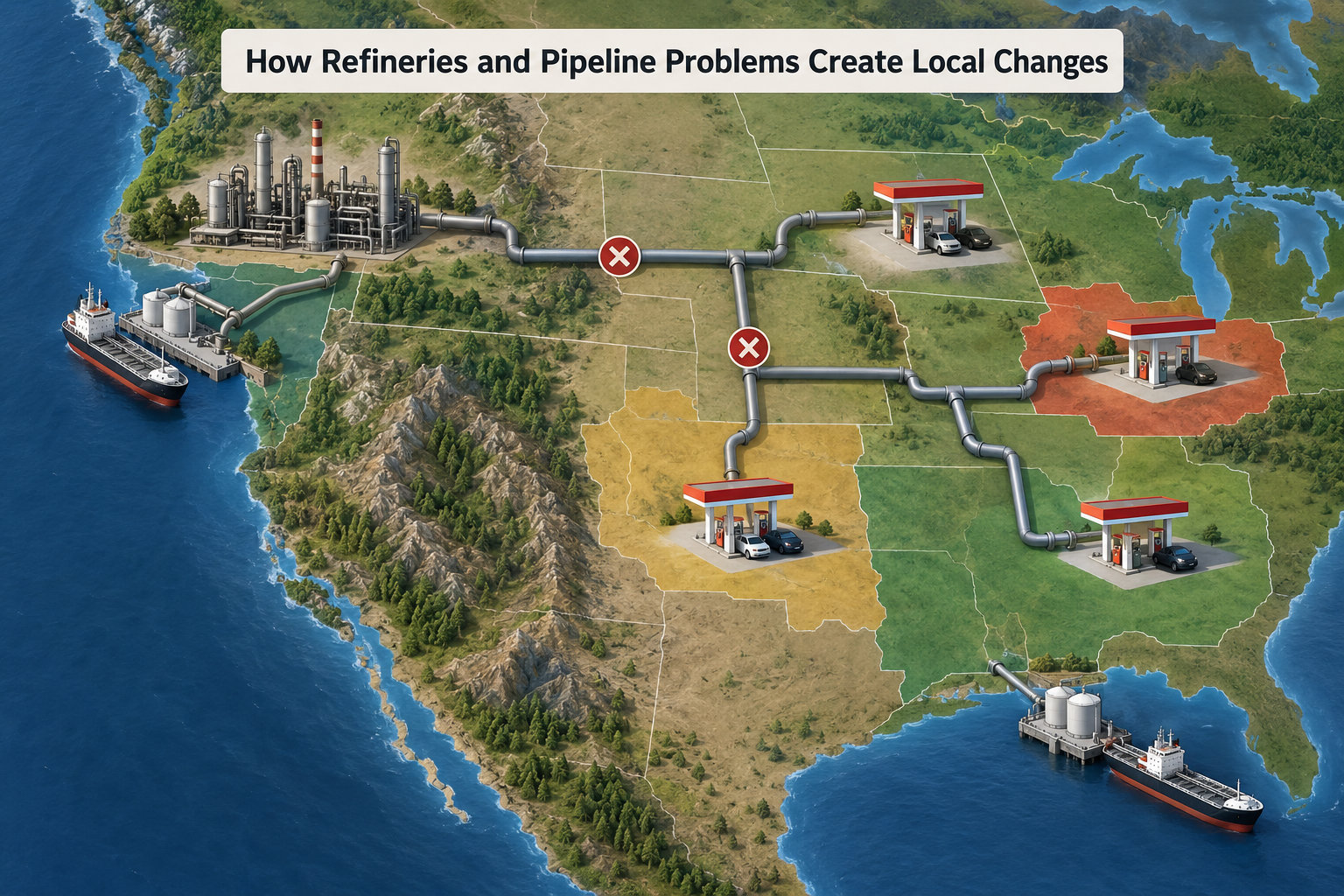
Two markets with the same national crude price can have entirely different pump prices. Refining capacity is concentrated in a handful of regions, and fuel moves out of them by pipeline, ship, rail and truck. When one of those routes is constrained, the shortage shows up where supply is thin, not where the barrels started.
That is why stations on one side of a river or a port boundary can differ sharply. A region with few refineries and a strained pipeline pays import parity plus a scarcity premium. A region sitting on top of Gulf Coast refining usually does not.
Local competition then sets the final layer. A rural station with no competitor nearby has pricing power a busy metro station does not. Volume, brand contracts, and loyalty discounts all feed into the number on the sign, and they change independently of crude.
Why Gas Prices Change So Often: Taxes, Credits, and Market Rules
Taxes are a large, slow-moving slice of the price. The federal rate per gallon is fixed, while state and local rates vary enormously and are set by separate jurisdictions. That variation is the single biggest reason two stations on opposite ends of the same road can never match, even on the same day.
Taxes rarely explain daily movement, though. They do explain level, and level changes when a legislature acts. Some jurisdictions have introduced temporary credits, rebates or suspension periods during price spikes, and those show up as a sudden drop that has nothing to do with oil.
Fuel rules play a similar role. Blend mandates, ethanol requirements, summer volatility specifications and emissions standards all change what a refinery must produce and where. When a rule changes or a region tightens one, the cost of meeting it lands in the local price.
What Causes Sudden Gas Price Spikes and Quick Drops?
Routine adjustment is the baseline. Wholesale moves in small increments through the week, and stations pass most of it through within hours to protect their margin. That is the ordinary churn that makes the price feel unpredictable even in a calm month.
Abrupt moves come from a short list. Geopolitical conflict that threatens production or a shipping chokepoint. A producer group cutting or raising output. Hurricanes, floods or wildfires that shut in Gulf Coast refining. A single large refinery failing and losing capacity for weeks. An inventory report that surprises traders. Heavy speculative activity amplifying all of the above.
Rises are fast and falls are slow, which is why drivers perceive gas prices as unfair. Stations defend margin on the way up because a lower price with thin margin gets bought out. When crude falls, competition forces margin down too, and the discount trickles back slowly.
Can Drivers Do Anything About Gas Price Changes?
You cannot set the crude price, but several things reliably help.
- Compare stations before filling up. A few cents per gallon across two or three nearby options adds up on a full tank.
- Use a fuel price app. It shows the spread in your area, and the spread is usually widest right after a market move.
- Drop a grade when you do not need it. Mid-grade and premium carry a per-gallon adder that does not come back down the same way.
- Refill before the tank is empty, but do not rush. Panic buying turns a small move into a big bill and wastes fuel idling in the lot.
- Combine trips and cut idling. Fuel cost per mile drops fastest when you drive less, not when you hunt for a bargain.
Timing your fill to a local cheap day works for some drivers, based on the daily pattern in their own area. It is not universal, so watch your local prices for a couple of weeks before you build a habit around it.
How Often Should You Expect Gas Prices to Change?
Stations often adjust once a day and sometimes several times. A large chain pulls the overnight wholesale price, sets its margin, and pushes an update to the forecourt sign early in the morning. Independent operators can reprice more freely and more often.
The inputs underneath move less often than the sign. Crude futures trade around the clock but rarely settle on a new level more than a few times a week. Taxes change by legislation. Blends change by season.
So a station changing its price every day is normal operating behaviour, not evidence of a trend. Watch the direction across two weeks rather than day to day. A week of 2-cent changes is noise; four weeks of direction is a market.
Frequently Asked Questions
Why can gas prices rise when crude oil prices are falling?
Because pump prices follow wholesale gasoline, not crude. A refinery outage, a seasonal blend switch or a tight local pipeline can lift finished-fuel prices while crude stays flat. Taxes are also a fixed amount per gallon, so as crude falls they take up a larger share of the price. Stations reprice against the wholesale number within hours.
How often do gas stations normally change their prices?
Most stations set prices once a day in the early morning and update the sign when the wholesale cost moves. Some adjust a second time, and independent operators with fewer nearby competitors may reprice whenever they want. The inputs change far less often than the sign, so a daily change does not mean the market is moving daily.
Why is gas more expensive in some cities or states than in others?
Taxes are the biggest reason, and they are set state by state and sometimes city by city. After that, refining capacity and transport matter: a region far from major refineries pays more to get fuel delivered than one sitting on Gulf Coast supply. Local competition decides the rest, which is why two stations a mile apart can differ by a lot.
Can gasoline prices stay low throughout the year?
Rarely. Every year brings at least a few upward pushes: summer driving demand, a heavier winter blend, hurricane season risk and scheduled refinery maintenance. Prices can stay low in a stretch when supply is plentiful and crude is quiet, but a full year without a noticeable rise would be unusual. The direction of the market changes far more often than the level.
How reliable are forecasts that predict where gas prices will go next?
Forecasts are good at direction over weeks and poor at exact numbers. Weather, refinery outages and producer decisions can arrive without warning and override a projection. Anyone claiming a precise price months out is guessing with extra steps. Treat a forecast as a reason to plan, not a reason to rush to the pump.
What Should Drivers Do First?
Watch the local wholesale market, not a national headline, because the national number rarely describes your area. Compare the stations within a few miles before a fill, keep your tank above a quarter rather than empty, and ignore the urge to top off in a panic. Prices change so often because the chain underneath them changes so often. Your response does not need to be dramatic, just consistent.