An exit poll is a survey of voters conducted as they leave, or exit, their polling place, asking which candidates they actually voted for. Because it records a finished action rather than predicting a future one, it is the fastest large-scale view of how an electorate actually voted, and also the survey most often misread on election night.
Are exit polls accurate? Usually close, and much better than pre-election opinion polls for measuring a vote that has already happened. They are not a prediction, they are not a count, and they cannot detect fraud. The gap between those three facts and what a broadcast sounds like at 6 p.m. is where most of the confusion comes from.
This guide is written for the 2026 midterm cycle. The most recent US national exit poll was conducted during the 2024 presidential election, so any figures quoted below describe the standing method rather than the current field.
Table of Contents
- What Are Exit Polls and How Do They Work?
- Who runs the national exit poll in the United States
- What an exit poll actually asks
- How an exit poll is actually conducted
- How Are Exit Poll Results Estimated?
- Weighting: the step that causes the arguments
- Party identification and the undecided problem
- Why Can Exit Polls Be Wrong?
- Margin of error versus total error
- Documented cases where exit polls missed
- What exit polls cannot do
- What Is the Difference Between Exit Polls and Pre-Election Polls?
- How Do Pollsters Check and Adjust Their Results?
- How Should Readers Interpret an Exit-Poll Number?
- Frequently Asked Questions
- Are exit polls accurate?
- What is the margin of error for an exit poll?
- Who conducts the national exit poll?
- How many voters are surveyed in an exit poll?
- Why do exit poll numbers change during the night?
- Can exit polls be used to detect fraud?
What Are Exit Polls and How Do They Work?
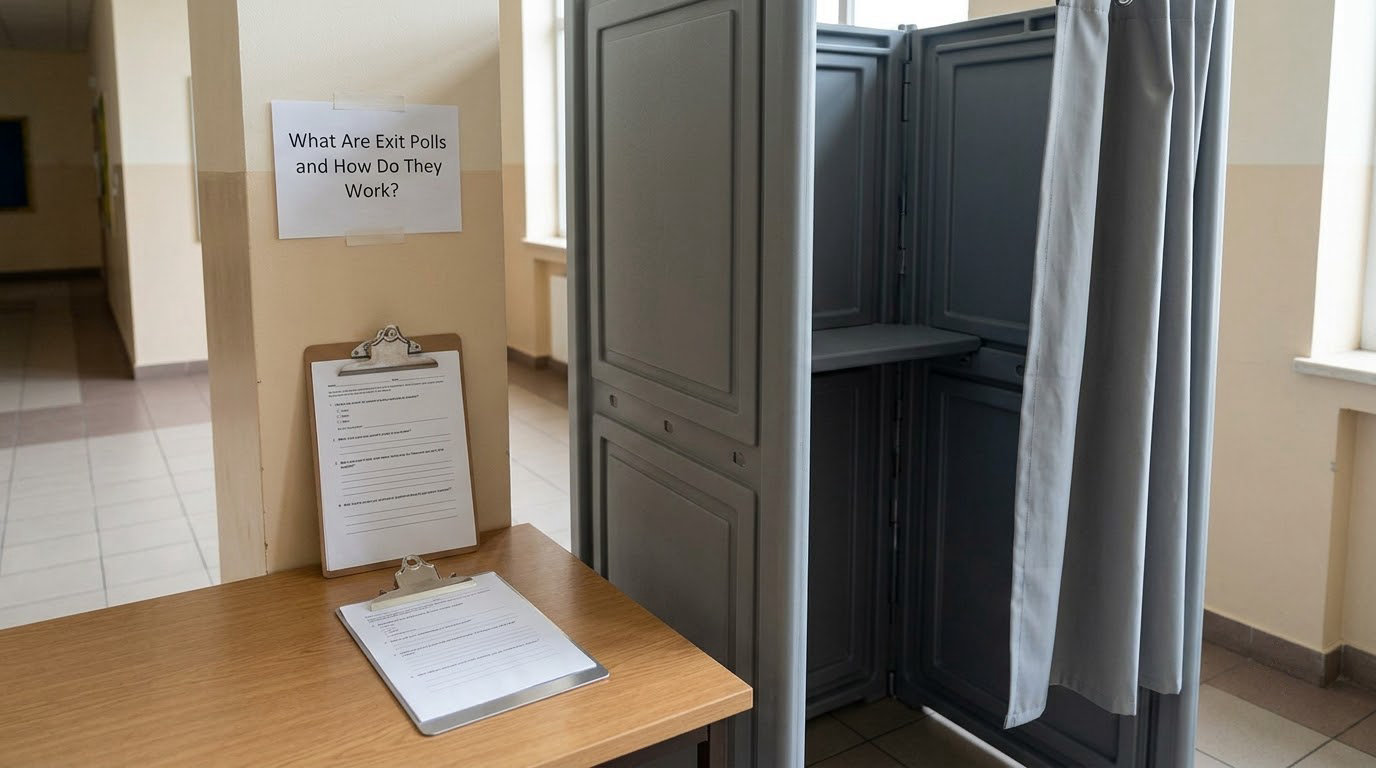
What makes an exit poll different is when it happens. Nobody is asked how they intend to vote. They are asked, minutes after depositing a ballot, what they just did, plus a handful of demographic and issue questions. That makes it the only large national survey of confirmed voters rather than probable ones.
Who runs the national exit poll in the United States
Edison Research conducts the national exit poll on behalf of the National Election Pool, a consortium of ABC, CBS, CNN and NBC. Those four networks share one set of numbers, which is why the four broadcast networks tend to report the same race calls and the same vote splits on election night. Academic researchers and political organisations commission separate state and down-ballot exit polls, often with different questions and different fieldwork.
What an exit poll actually asks
The questionnaire runs 20 to 25 questions and takes about five minutes. It opens with vote choice, including third-party and write-in options, then asks about congressional vote, ballot measures, and a small set of demographics such as age, race, education, income, union membership and party identification. Most questionnaires close with a handful of issue questions that explain why people voted the way they did.
Respondents fill out a paper questionnaire handed to them on a clipboard. There is no interviewer sitting beside them and no name attached to the form, which is the design choice that reduces social pressure to give a socially acceptable answer.
How an exit poll is actually conducted
- Pollsters select polling places. Roughly 600 sites are used nationally, drawn by a probability method that spreads them across regions, urban and rural areas, and type of voting arrangement rather than clustering them where results might arrive fastest.
- Every third or fifth exiting voter is asked. The rule is fixed in advance and mechanical. The interviewer approaches a set number of people leaving the building, in order, and offers each one the questionnaire.
- Refusals are counted, not ignored. The interviewer records how many eligible voters declined. That count is what allows the pollster to estimate what the people who said no would have answered.
- Forms are tabulated on site. Paper questionnaires go into a secure box and are entered by hand into a secure data system as people leave, so data starts flowing during the day rather than after the count.
- Early and mail voters are contacted separately. Because so many people now vote before election day, pollsters build a second sample from voter files, reaching selected voters by telephone, by online questionnaire through email or text, or in person at early voting centres.
- Results are weighted to the electorate. The raw sample is adjusted so the distribution of party identification and other characteristics matches what is believed about voters who actually cast ballots.
- Numbers are released under an embargo. Nothing is published before 5 p.m. ET, and nothing is published as a result before polls close, because a “result” before the voting period ends is not a result.
How Are Exit Poll Results Estimated?
Everything in an exit poll after the fieldwork is estimation. The pollsters have a sample, not the population, and their job is to describe how the whole electorate would have answered if every voter had completed a questionnaire.
| Element | Typical figure |
|---|---|
| National polling locations | About 600 |
| National completed interviews | Around 20,000 |
| Interviews per state poll | Roughly 1,500 to 2,500 |
| Questions asked | 20 to 25 |
| Time to complete | About 5 minutes |
| Margin of sampling error, national vote | About plus or minus 2 percentage points |
| Earliest release time | 5 p.m. ET, after polls close |
Weighting: the step that causes the arguments
Weighting is what separates an estimate from a raw count. Suppose 60 percent of respondents identify as one party and the pollster believes the real electorate was 52 percent that party; every response from the first group is given more weight, and the totals are rescaled until the shares match the assumption.
On election night, some networks also show provisional numbers adjusted toward the count as it comes in from precincts already reporting. That is why a number at 7 p.m. can move when the certified result lands days later. It is not tampering: it is the same weighting logic applied with partial outcome information, and it is disclosed rather than hidden. It is also exactly the behaviour that convinces skeptical viewers the poll was reverse-engineered from a result the pollsters already knew.
Party identification and the undecided problem
Not everyone raised a hand for a candidate. Non-voters are asked which party they identify with, and those answers become the basis for estimating how the undecided broke. This step rests on an assumption about past behaviour in similar elections, which is reasonable in a presidential year and much shakier in a midterm where turnout patterns differ.
Why Can Exit Polls Be Wrong?
The printed margin of error describes only one source of wrongness: the chance that a random sample of 20,000 voters would land a few points away from the population result. The bigger risks sit outside that number.
- Nonresponse bias. The people who hand back a questionnaire are not the same as the people who refuse. Refusal rates vary by age, language, and how the approach was made, and each refusal nudges the estimate in a direction nobody can measure directly.
- Coverage error. Election-day polling locations miss anyone who votes early, by mail, or in a jurisdiction using drop boxes. The phone and online components patch that hole using voter files, but voters with outdated contact records, or who move often, or who simply never answer an unknown number, are still harder to reach.
- Language access. Questionnaires exist in Spanish and a limited set of other languages, and interview practice varies by site. Voters who do not see a questionnaire in a language they read are effectively invisible in the on-site sample.
- Social desirability. Anonymity reduces the pressure to answer politely, and polling place environments are one place where a respondent can be observed. Voters who are first-time, or who fear being identified, may skip the form entirely, which skews the response rate toward established, higher-propensity voters.
- Wrong turnout assumptions. Weighting depends on an estimate of who actually voted. In a year unlike the last one, that estimate is wrong, and every other adjustment inherits the mistake.
- Late deciders. Undecideds are distributed using past patterns. When undecideds break differently, as they tend to in unexpected results, the final estimate swings with them.
- Small subgroups. The national margin of error of roughly plus or minus 2 points does not apply to a cross-tab. A party share among one demographic group in one state can have a margin wide enough to include a very different story, and newspapers still print it as if it were solid.
- Election-day shocks. A candidate dropping out, a major speech, a scandal, or a voting-machine problem can move late voters after the sample was already taken.
Margin of error versus total error
Statistics researchers such as Shirani-Mehra and Gelman have argued that polling misses break down into bias and variance, and that bias is the larger share. Voters explaining this on statistical forums tend to land on the same point: the number that gets published describes variance and quietly omits bias, so it flatters the poll.
Documented cases where exit polls missed
| Election | What happened |
|---|---|
| UK general election, 1992 | The exit poll projected a hung parliament with Labour as the largest party. Conservatives actually won a 367-seat majority, 41 seats more than projected. Tactical voting by Labour supporters switching to the Conservatives was the main explanation. |
| US, Wisconsin recall election, 2016 | Exit polling pointed toward Scott Walker, who did win, but overstated his lead; the actual margin was under one point. Several race calls built on those numbers were corrected. |
| UK general election, 2019 | The exit poll reported a Conservative majority in the mid-300s. The final result was 365 seats, an 80-seat majority, a reasonable but noticeably different picture from the first version broadcast. |
| US presidential election, 2020 | Exit polls are widely analysed as overstating support for the Democratic candidate by a few points nationally and more in some states. Mail voters were harder to reach, and they were also harder to reach in ways correlated with how they voted. |
| India, general elections, 2024 | National exit polls correctly identified the governing coalition as the largest bloc but underestimated opposition gains in several states, where regional parties performed well beyond their predicted share. |
What exit polls cannot do
Three claims show up constantly and all three are false. Exit polls do not predict winners, because by the time they run the votes are already cast. They do not certify results, because certified results come from counting ballots. And they do not detect fraud, because the questionnaire asks voters how they voted, not whether their ballot was counted, and a corrupted count would not change how a person describes their own vote.
What Is the Difference Between Exit Polls and Pre-Election Polls?
Readers often treat every poll as the same instrument. They are not, and the difference explains most of the disappointment people feel about polling.
| Factor | Exit poll | Pre-election opinion poll | Phone poll | Precinct count |
|---|---|---|---|---|
| When it happens | As voters leave on election day | Days or weeks beforehand | Before, during or after | As ballots are counted |
| Who is surveyed | Voters who say they just voted | Registered or likely voters | Adults or registered voters | Nobody, it counts ballots |
| What it measures | A completed vote | An intention to vote | Opinion or intention | The official outcome |
| Known voter status | Confirmed for early and mail voters, self-reported on site | Often modelled | Rarely | Not applicable |
| Typical margin of error | About plus or minus 2 points nationally | About plus or minus 2 to 3 points | Varies widely | None, it is a count |
| What it is good for | Explaining how groups voted | Tracking the campaign | Cheap trend tracking | Deciding the winner |
An exit poll can be closer to the electorate than an opinion poll and still be wrong, because it inherits every bias in who answers the knock on the door. The pre-election poll at least has the honesty of being a forecast.
How Do Pollsters Check and Adjust Their Results?
Pollsters compare their weighted exit poll results against actual vote totals in states where the count finishes quickly, which is the standard calibration check. Divergences feed into the next cycle’s weighting decisions.
Internal quality controls include verifying that every sampled site followed the every-nth-voter rule, tracking refusal rates site by site to catch locations where the interviewer was too aggressive or the queue was unrepresentative, and re-examining the weighting when party identification comes back far from the pre-election baseline. Questionnaire wording is also reviewed against what worked in past cycles, since a single ambiguous item can shift an estimate by a point or more.
None of that makes the estimate better than the assumptions inside it. A weight correction can only remove a bias you already know about, and the analysts doing the correcting are making judgements about people they will never meet.
How Should Readers Interpret an Exit-Poll Number?
- Read the final weighted set, not the first raw feed. Numbers at 6 p.m. are provisional and will move as weighting and precinct results come in.
- Check the margin of error before reacting. In a race decided by one or two points, the estimate is not distinguishable from the other candidate on sampling grounds alone.
- Treat a percentage as a percentage. “54 percent of voters” describes the sample, not a vote total, and it says nothing about turnout.
- Be sceptical of small cross-tabs. Party share among one small group in one state carries an error range far wider than the national figure.
- Watch the methodology label. If a number is described as an estimate, a projection, or an adjusted figure, it is not a count.
- Wait for certified results. In close races that becomes days after election night, sometimes weeks.
A useful habit is to treat the exit poll as an explanation of the vote rather than a forecast of it. The vote share comes from the count; the exit poll’s value is telling you which age groups, which education levels and which issues moved, and how confident anyone should be about the margin.
Frequently Asked Questions
Are exit polls accurate?
Exit polls are usually within a few points of the final result and are far more reliable than pre-election opinion polls, because they survey people who have just voted. Their accuracy depends on who responds rather than only on sample size, so error concentrates among hard-to-reach voters, voters in less commonly offered languages, and mail voters.
What is the margin of error for an exit poll?
The national exit poll publishes a margin of sampling error of roughly plus or minus 2 percentage points at a 95 percent confidence level. That figure covers random sampling variation only. Nonresponse, coverage gaps and weighting assumptions can add error on top, so the published number is a floor rather than a full measure of uncertainty.
Who conducts the national exit poll?
Edison Research runs the US national exit poll for the National Election Pool, a consortium comprising ABC, CBS, CNN and NBC. That shared fieldwork is why those networks publish the same vote estimates on election night. Separate state and down-ballot exit polls are commissioned by individual media organisations and researchers.
How many voters are surveyed in an exit poll?
About 20,000 completed interviews are collected nationally from roughly 600 polling locations, with 20 to 25 questions taking about five minutes each. State exit polls typically use between 1,500 and 2,500 interviews, which is a far smaller sample than the national one and carries a correspondingly wider margin of error.
Why do exit poll numbers change during the night?
Early figures are raw or partly weighted, and they are reweighted as more data arrives and as precinct counts come in, because some precincts report earlier than others. Provisional numbers are never released before polls close. Final weighted figures are the ones designed to be compared against certified results.
Can exit polls be used to detect fraud?
No. Exit poll respondents report how they voted, not whether their ballot was counted. A manipulated count would not change the answer a person gives on a clipboard. Fraud detection rests on ballot accounting, hand counts, audits, risk-limiting audits and court challenges, none of which are part of the exit poll process.
Start with the definition, because it settles most of the argument: an exit poll measures a vote that has already been cast, which is why it is informative and why it can still miss. Next time a network puts a number on screen, ask three things: is it raw or weighted, is it a national or a single state, and how big is the margin of error on that figure. Everything else is commentary.