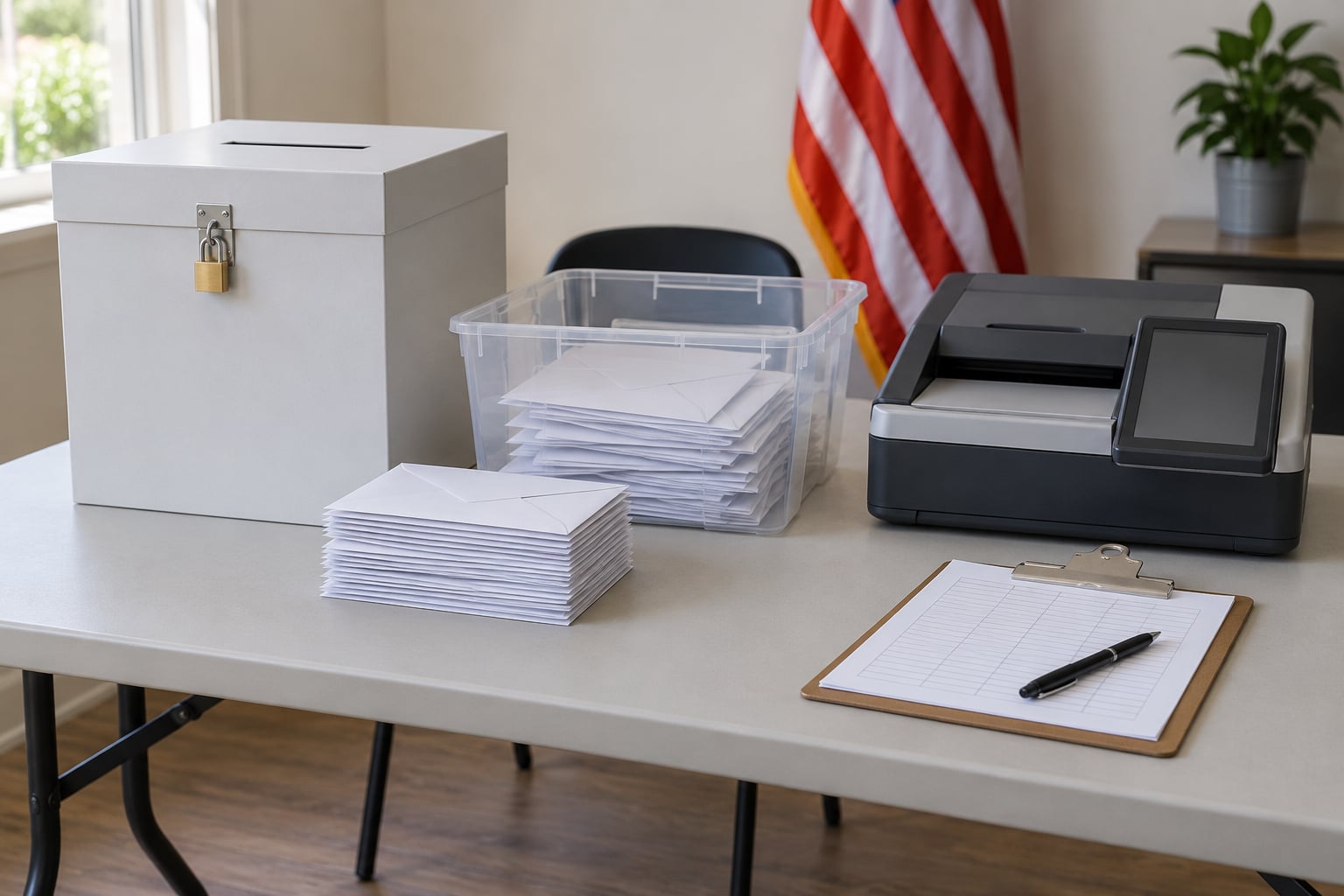
Here is the short version of how election results are counted on election night. Poll workers in each precinct close the polls, feed paper ballots through tabulators or lock them in sealed boxes, and send totals to the county election office, which passes them up to the state. News organizations then publish those partial totals and project a likely winner long before every ballot is counted.
None of that is final. Election Day is the deadline for voting, not for counting.
The example below follows a general election in the United States. Other countries structure things differently, and even inside the US, procedures and timelines differ by state and county.
Table of Contents
- Key Takeaways
- What Happens When Polls Close on Election Night?
- How election results are counted once the polls close
- Poll workers run the first tabulation
- Totals go up the chain
- Results go out as unofficial figures
- Which Ballots Are Counted First?
- Mail-in and absentee ballots
- Early in-person ballots
- Election Day ballots
- Provisional ballots
- Same-day registration and cure activity
- How Are Paper Ballots Verified and Tabulated?
- Is the ballot legitimate?
- Is the ballot complete?
- Is it a duplicate?
- Is the marking readable?
- How Does Electronic Voting Change the Count?
- Optical scan paper ballots
- Touchscreens or electronic ballots
- Hand-marked paper ballots
- When Can a News Organization Call a Winner?
- Collect, then verify
- Model the vote that has not been counted
- Worked example
- Why Do Election Results Change After Election Night?
- Reasons the numbers move
- Post-election terms worth knowing
- Frequently Asked Questions
- Are election results final on election night?
- Why can one candidate lead before all ballots are counted?
- Do mail-in ballots usually get counted first?
- Does a news organization declaring a winner mean the race has been certified?
- Why do some jurisdictions stop counting before the end of the night?
- How long does it take to get official election results?
- What Should Readers Check First?
Key Takeaways
- Polls close at different times in different places. The first polling places close at 7 p.m. Eastern Time, and the last stay open until late evening.
- Results shown on election night are unofficial. They are partial totals updated as jurisdictions report them.
- Ballots are tabulated by poll workers, usually at the precinct or at a county central counting location.
- Counting order varies. Mail-in ballots may be counted before, during, or after Election Day ballots depending on the state.
- “Percent of precincts reporting” is not the same as “percent of the vote counted,” because precincts vary wildly in size.
- A news organization’s winner call is a statistical projection, not an official result.
- The official outcome is set after the canvass and certification, which can take days or weeks.
What Happens When Polls Close on Election Night?
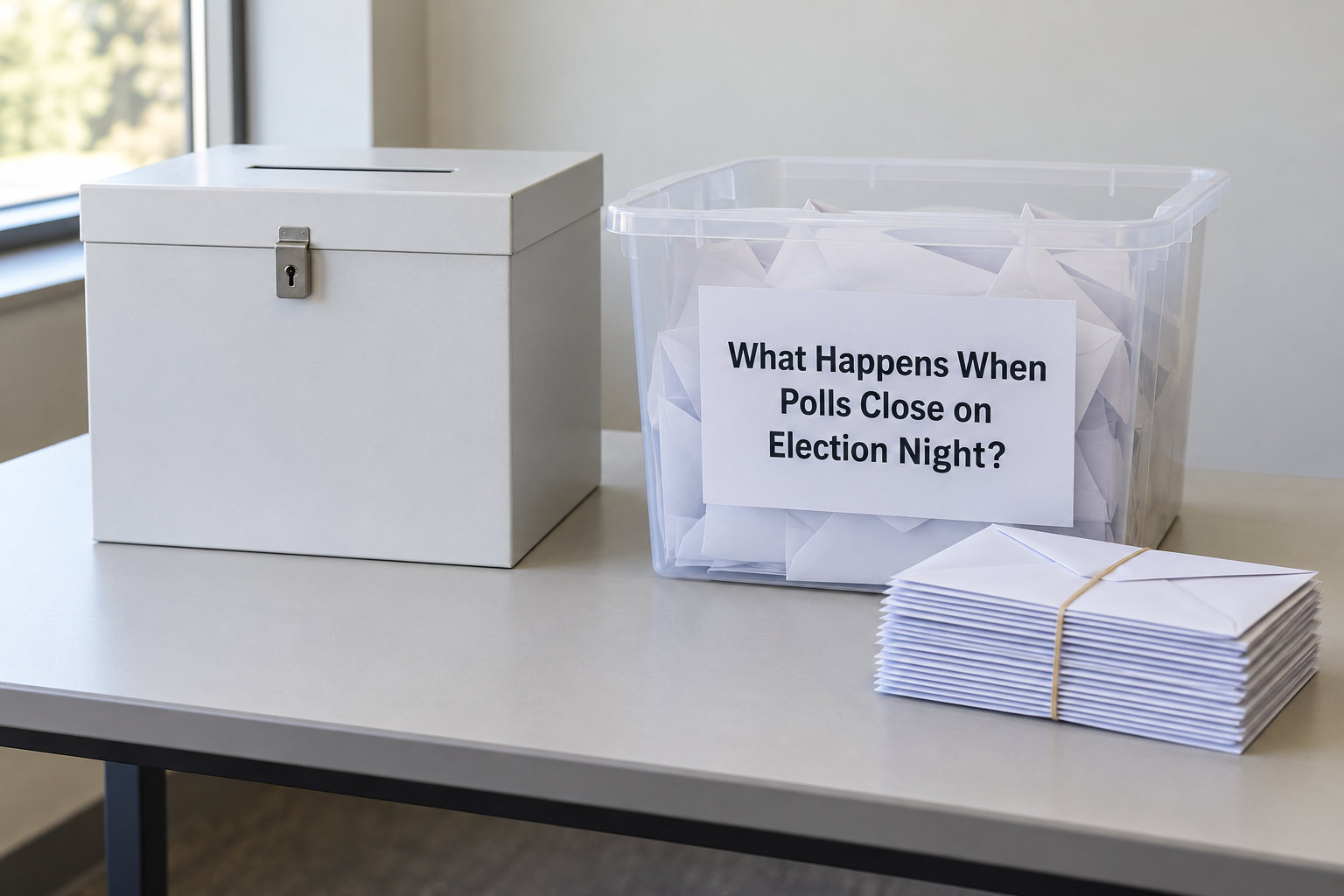
The counting process begins the moment a polling place closes, and it happens in steps that repeat across roughly 100,000 polling places nationwide.
How election results are counted once the polls close
Poll workers close the doors, cover the voting booths, seal the ballot boxes and sign a chain-of-custody form for each box or pail. Each ballot box then goes one of two ways: to a tabulator on site, or to a central counting location.
Poll workers run the first tabulation
Where equipment sits in the polling place, poll workers load ballots into the tabulator and run it. Where it does not, they call a two-person team to collect the sealed boxes and deliver them to the central counting location, usually run by the county.
Totals go up the chain
A precinct’s totals go to the county election office. The county adds them together with other precincts and reports to the state. The state posts the numbers on its official election results page, often called the Election Night Report. No federal agency collects these numbers, which is why every state page looks a little different.
Results go out as unofficial figures
The state page updates as jurisdictions report. Election offices typically mark the numbers unofficial, and they stay that way until the canvass and certification are finished, sometimes a week or two later.
So when you ask how election results are counted on election night, the honest answer is: locally, by named poll workers, in public, with a paper trail. What you see on a screen is a filtered version of that process.
Which Ballots Are Counted First?
There is no single national order, and this is where most confusion starts. Ballots usually enter the count in roughly this sequence, but individual states and counties reorder parts of it.
Mail-in and absentee ballots
Some jurisdictions are allowed to pre-process mail ballots before Election Day, which means opening and signature-checking envelopes ahead of time. Others forbid any handling until the polls close. Even where early processing is allowed, those ballots usually are not added to the reported total until Election Day.
Military and overseas ballots arrive through the postal service, which is why they often post the latest of all. They are legally required to arrive by a set date, but they can reach the election office days afterward.
Early in-person ballots
Voters who vote before Election Day at vote centers or early voting sites cast their ballots into the same kind of scanner as Election Day voters. Those ballots sit in a locked location until the count begins, unless the state permits early counting.
Election Day ballots
In-person ballots are typically tabulated as poll workers close, or as their boxes arrive at the central count. In states where pre-processing is banned, this makes Election Day ballots the first votes reported.
Provisional ballots
A provisional ballot is cast when there is a problem with the voter’s eligibility record, their ID, or the ballot itself. It is set aside, not tallied on election night, and only later resolved. Many provisional ballots are rescued through curing, where the voter fixes the issue before a deadline.
Same-day registration and cure activity
In states with same-day registration, ballots cast at the polling place after registration closes often need extra verification. These show up as provisional ballots and can take days to resolve.
How Are Paper Ballots Verified and Tabulated?
Before a single ballot is read, it passes through checks. The order and wording vary by state, but the same handful of questions comes up again and again.
Is the ballot legitimate?
For mail ballots, workers confirm the outer envelope is signed, that the signature matches the voter registration file, and that the envelope arrived by the deadline. Many jurisdictions also check the postmark and the voter’s date of birth or ID number.
Is the ballot complete?
Workers check that the secrecy envelope is present and properly sealed when the ballot is inside an outer envelope, and that the ballot was returned by one voter, not several.
Is it a duplicate?
Signatures are compared against the file of signatures already received. A duplicate mail ballot is spoiled in favor of the first one received. A voter who casts in person after mailing a ballot also has the mailed ballot set aside.
Is the marking readable?
Optical scanners read pencil or ink marks and register a vote only when the marking falls inside the target area for a candidate. Marks outside it register as an overvote or an undervote rather than picking a candidate for the voter.
Judges from both major parties are commonly present at the central counting location to observe. In many jurisdictions, a voter who asks may observe too. This oversight is deliberate. A count that takes days is slow because it is being checked at every step.
How Does Electronic Voting Change the Count?
Electronic equipment changes the speed and the paperwork, not the underlying principle that a person votes and the vote is recorded. Three setups cover most jurisdictions.
Optical scan paper ballots
A voter marks a paper ballot by hand, and a scanner reads the marks. The scanner produces a running count and stores a cast-vote record. Because the paper ballot remains, most jurisdictions with this system require a post-election audit that re-reads a sample by hand and compares it to the machine tally.
Touchscreens or electronic ballots
Some jurisdictions use touchscreens that record votes electronically without a paper ballot. These systems generate a voter-verified paper record in many cases, and each voter can review their selections before casting. Others rely on paperless systems with voter-verifiable paper audit trails, a printed record that shows what was recorded.
Hand-marked paper ballots
In some places, scanners are not used at all. Workers read marked paper ballots by hand and record the totals on a tally sheet. It is slower, and the count takes longer for that reason alone.
No scanner decides anything on its own. Equipment can reject an unreadable ballot or flag an ambiguous mark, and trained workers resolve those exceptions. A system that cannot be inspected is a different category of concern, and that is why post-election audits and risk-limiting audits exist.
When Can a News Organization Call a Winner?
A news organization calls a race when its decision desk believes the outcome is no longer in doubt, not when the last ballot has been counted. The mechanics are worth understanding, because the number on screen and the call in the chyron are two different things.
Collect, then verify
Major outlets share data through the National Election Pool, with exit poll analysis from Edison Research. Reporters pull vote totals from county and state feeds as they arrive, then check them against the official source before publishing.
Model the vote that has not been counted
The desk looks at which precincts have reported and what share of the vote they hold, then combines that with expected turnout in the precincts still outstanding. Analysts have tracked historical precinct-level voting patterns for years, so they know that a rural county reporting early tends to lean one way and a dense urban county reporting later tends to lean the other.
Worked example
Imagine a hypothetical state with 1,000 precincts. Candidate A is at 45% with 300 precincts reporting, while Candidate B is at 54% with 700 reporting. The raw numbers say B is winning. But if the 300 reporting precincts are small rural ones holding only 5% of the state’s total vote, B’s lead is built on the wrong sample.
The desk would project that A finishes much closer, and the call depends on which estimate the model lands on and how much of the remaining vote could still move. That is the “red to blue” flip people notice on map graphics: the map is not changing, the reporting order is.
Every projection carries a margin of error, and decision desks deliberately isolate their analysts from outside commentary to avoid anchoring. A projection is a well-supported estimate. Certification is a legal act.
Why Do Election Results Change After Election Night?
Because election night shows a partial count, and the official total only exists once the canvass and certification are complete. The stages are different things with different legal weight.
| Stage | What it means | Who issues it | When |
|---|---|---|---|
| Election night returns | Partial totals from jurisdictions that have reported so far | County and state election offices | Election night itself |
| Unofficial results | The full tabulation assembled after most ballots are processed, still subject to checks | State election office | Days after the election |
| Canvass | A review that reconciles ballots, envelopes, equipment totals and voter registration records, resolving discrepancies | County and state election officials | Within days |
| Certification | The legal declaration of the official result by the chief state election official | Secretary of state or equivalent | Days to weeks, by state law |
| Recount | A re-tally triggered automatically by a close margin or requested by a candidate | Jurisdiction running the recount | After certification requests, before certification completes |
Reasons the numbers move
Late-arriving mail ballots and military and overseas ballots post after the initial count. Provisional ballots get resolved, some of them curing and some of them failing. Signature mismatches get cured by voters who received a notice. Audits and recounts re-read ballots and occasionally correct a count.
A recount is worth understanding on its own terms. Many states set an automatic threshold, often around half a percent, where a recount happens without anyone asking. Above that, up to a higher threshold set by state law, a candidate or party can request one. The difference is that an automatic recount usually re-runs the same equipment, while a requested recount may be a full hand count of a race.
Hand counts find different things from machine recounts. Machines catch stray marks and misaligned sheets; human eyes catch problems the scanner handles silently. Recounts rarely change an outcome, but they do sometimes change a margin.
Post-election terms worth knowing
The count. The tabulation of ballots, which happens in stages at different locations.
Informal results. Unofficial totals released before the canvass, updated as more reporting comes in.
Precincts reporting. The share of precincts that have submitted results, which says nothing about what share of the vote those precincts contain.
Expected vote. The share of the total vote the jurisdiction expects to be in the count at that point. Compare it against percent reported to see whether a race is close to where it should be.
Overvote and undervote. An overvote marks more than one option in a race. An undervote leaves it blank. Neither is corrected for the voter.
The canvass. The post-election audit that reconciles ballots, totals and records and produces the unofficial complete result.
Certified results. The result declared official by the chief state election official after the canvass.
Vote margin. The number of votes separating the winner from the runner-up.
Vote differential. The percentage-point gap between the top two candidates.
Ballot cure. A voter’s chance to fix a signature or other defect on a mail ballot before a statutory deadline.
Election Night Report. The official state results page that publishes partial returns on election night.
Frequently Asked Questions
Are election results final on election night?
No. Election night returns are partial totals from jurisdictions that have reported so far, and officials label them unofficial. The full result emerges after the canvass reconciles ballots, envelopes, equipment totals and registration records, and it becomes official when the state’s chief election official certifies it. That can take days or weeks, depending on state law.
Why can one candidate lead before all ballots are counted?
Because precincts report at different speeds, and speed has little to do with population. Small rural precincts often report first, while dense urban precincts with optical scanners report later. If those two groups vote differently, the early leader is leading on a sample that does not represent the state. News models weight precincts by the vote they actually contain, not by counting them evenly.
Do mail-in ballots usually get counted first?
It depends on the state. Some jurisdictions allow mail ballots to be pre-processed before Election Day, which means signatures and envelopes are checked early. Others prohibit any handling before the polls close. Either way, the ballots are usually not added to reported totals until Election Day, and military and overseas ballots frequently post last because they travel through the postal service.
Does a news organization declaring a winner mean the race has been certified?
No. A winner call is a projection based on reported precincts, expected turnout and historical voting patterns. It is a well-informed estimate, and news organizations guard against being wrong. Certification is a separate legal act taken by the state’s chief election official after the canvass. Only then are results official.
Why do some jurisdictions stop counting before the end of the night?
It usually is not a stop so much as a pause between stages. Some jurisdictions count mail ballots before Election Day and report that total at 7 p.m., then update as in-person ballots arrive. Others hit equipment or staffing limits and resume the following morning. Breaking for the night is a scheduling choice, not a sign that ballots were rejected.
How long does it take to get official election results?
Unofficial complete results are often available within a few days of the election. Certification follows on a deadline set by each state, commonly within two weeks, and some states give themselves longer. Recounts, audit requirements and close races can extend the schedule further. The National Conference of State Legislatures tracks certification deadlines state by state.
What Should Readers Check First?
Start by confirming you are on the official page. Your state or county election office is the authoritative source, and vote.gov links to the right one for your address. Aggregator sites and news graphics are useful for context, not for the record.
Then separate what is reported from what is outstanding. Percent of precincts reporting tells you how many polling places have checked in. Percent of vote reported tells you how much of the actual vote is in. Expected vote tells you whether the count is running ahead of or behind schedule. When those three numbers diverge, the reported share is misleading, which is exactly why early leads look strange.
Finally, keep unofficial and official separate in your head. A projected winner is a news organization’s estimate. A certified result is the state’s legal declaration. The gap between them is where most of the frustration on election night comes from, and closing it in advance is as simple as knowing which one you are looking at.
If you cast a mail ballot and want to confirm it arrived, most states run a ballot tracker on the secretary of state’s site. It usually shows whether your ballot was received and, in many states, whether it was accepted or needs curing.
Election night is the deadline for voting. The count is the process of proving what you voted.