Deepfake videos are hard to detect because three things are failing at once. Modern generators no longer leave the clumsy mistakes that made early fakes obvious, human vision is built for social trust rather than forensic analysis, and automated detectors keep chasing generators that have already moved past them. A video can pass all three checks and still be fake.
Last updated: October 2026
That last part surprises people. We expect a video to give itself away, and when it doesn’t we tend to assume we were fooled by something subtle. Usually the explanation is less dramatic: the clip simply doesn’t contain the kind of flaw we were told to look for.
Table of Contents
- Why Deepfake Videos Are Hard to Detect
- What Makes Modern Deepfakes Look Realistic?
- Why AI Detection Tools Do Not Catch Every Fake
- What Visual and Audio Clues Can Still Help?
- How to Check Whether a Video Is Fake
- Why People Believe Deepfakes They Should Question
- Frequently Asked Questions
- How can deepfake videos be detected?
- How accurate is deepfake detection?
- How can you tell if a video is AI generated?
- Can you reliably spot a deepfake just by looking?
- Can deepfakes defeat liveness detection?
- Is creating a deepfake now illegal?
- What Should You Do First?
Why Deepfake Videos Are Hard to Detect
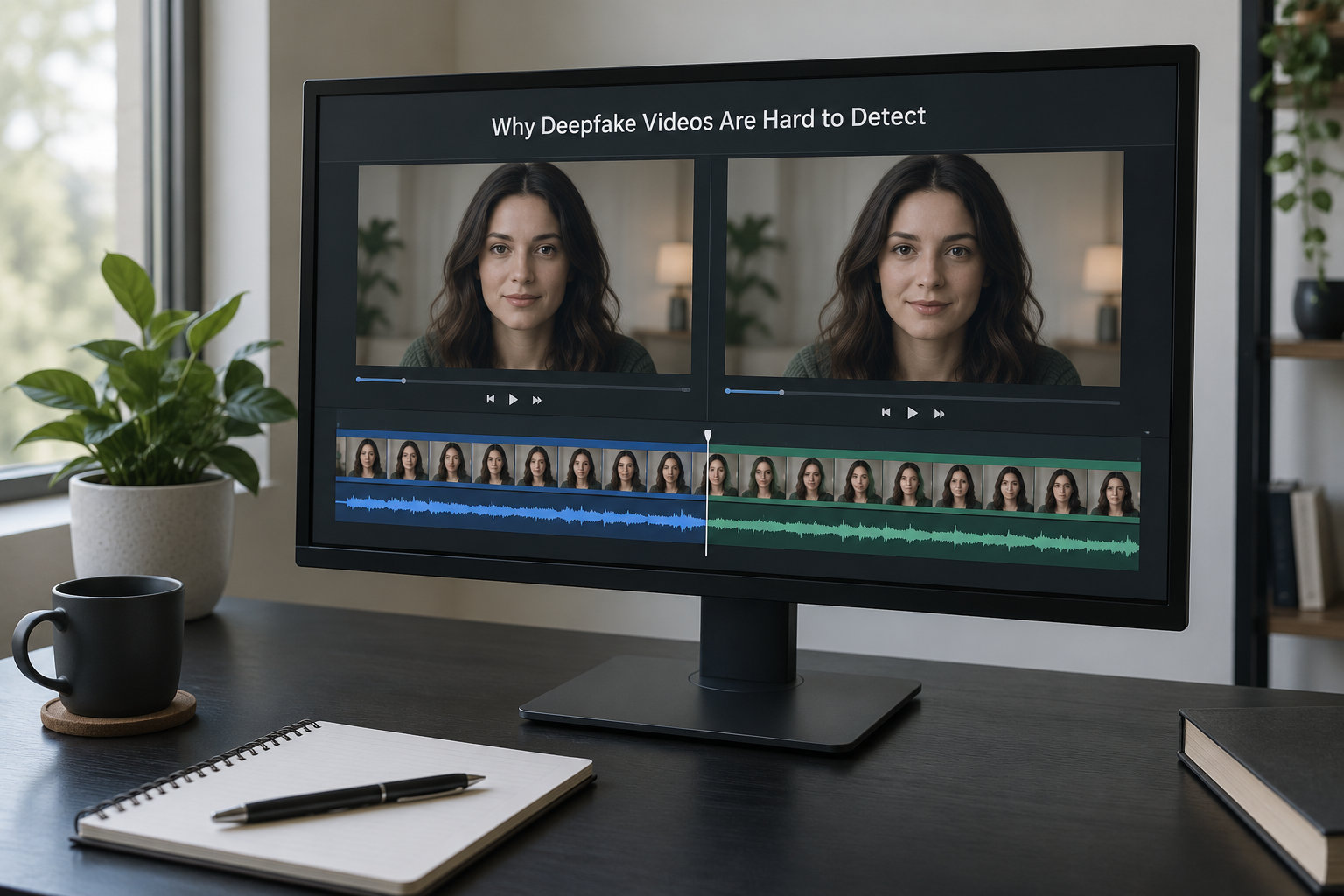
Here is the short version. Deepfakes are hard to detect for five connected reasons.
- The generator models reality, not just faces. Training data has grown to include millions of hours of real video, so the model has internalised how light falls, how skin moves, how speech lines up with mouth shapes. When it makes a mistake, the mistake is a subtle physics error rather than a melted jawline.
- Human beings are not forensic instruments. People are tuned to read intent and familiarity in a face within milliseconds. That shortcut works socially and fails completely when the thing in front of you was synthesised to be socially readable.
- The most reliable artifacts are not visible. Many of the strongest signals live in the frequency domain — the fine grain of detail that a screenshot or a phone screen discards before your eyes ever get a chance to work on it.
- Detectors are tied to specific generators. A model trained to spot the fingerprints of one family of deepfakes degrades quickly against the next family, and attackers test against public detectors just as eagerly as defenders do.
- Compression and re-encoding wash out evidence. By the time a clip reaches you it has been downloaded, cropped, resized, sped up and re-encoded by a messaging app, which alters exactly the low-level patterns a detector leans on.
One measurement frames the whole problem. iProov’s 2025 Threat Intelligence Report put the share of people who reliably tell modern synthetic content from real at 0.1 percent. A meta-analysis spanning 56 published studies put average human accuracy at 55.5 percent, and at 57.3 percent when the material was video specifically. Neither number is a measure of carelessness. They are a measure of how weak the available signals are.
What Makes Modern Deepfakes Look Realistic?
Early face swaps were built on generative adversarial networks, where two neural networks trained against each other. The tell was structural: GAN upsampling left a faint grid of high-frequency noise on flat areas of skin, and a trained analyst could find it. Diffusion models, which generate an image through a denoising process rather than a direct pass, do not share that fingerprint. That single architectural change is why guides written before 2022 keep telling you to search for artifacts that no longer appear.
Around the model, a stack of smaller improvements closes the remaining gaps:
- Reenactment instead of substitution. Instead of pasting one face onto another, the system drives the original face with another person’s expressions, keeping the head, neck and hairline geometry intact.
- Full-body generation. The hard part of a face was always what happens below the chin. Newer models render torso and hands rather than compositing a still image of a body.
- Lighting and colour matching. The model estimates the scene’s light direction and white balance from the frames around the face and matches them, so the pasted-on look that once gave it away is largely gone.
- Lip-sync and audio-visual alignment. Phoneme-to-viseme matching has become good enough that a delayed or mismatched mouth, a classic giveaway, now has to be measured in single frames.
- Voice cloning. A short sample of clean speech is often enough to reproduce a person’s cadence, not just their pitch. Group-IB reported a sharp year-on-year rise in voice-based impersonation attempts, and audio is now the highest-volume category of the crime.
- Post-processing. A final enhancement pass, sometimes with a neural codec, cleans up residual noise. It also removes the compression differences a detector might otherwise key on.
None of this is exotic any more. DeepFaceLive-style tooling runs a face swap on a live video feed in near real time, which is what makes video-conference impersonation a practical fraud route rather than a thought experiment.
Why AI Detection Tools Do Not Catch Every Fake
Detectors work by looking for statistical fingerprints rather than judging a face. They fall into a few families, and each has a ceiling.
| What it checks | What it catches | Main limitation |
|---|---|---|
| Upsampling and high-frequency noise analysis | GAN-era generation artifacts | Weak against diffusion generators, which reconstruct detail differently |
| Temporal consistency and optical flow | Flicker, identity drift across frames, jitter around the jaw | Post-processing and re-encoding smooth the same inconsistencies |
| Physiological signals such as rPPG | The faint blood-flow pulse a real face produces under steady light | Needs stable lighting, enough resolution and a mostly static subject |
| Audio-visual coherence | Lip movement that does not match the phonemes being spoken | Current lip-sync models are trained to do exactly this correctly |
| Provenance such as C2PA content credentials | Authenticity of media captured on a cooperating device | Only applies where the chain exists, and says nothing about re-encoded copies |
Every row in that table has the same problem underneath: the detector knows what the generator used to do badly. When the generator stops doing it, the detector loses its signal without gaining a new one.
That is why the academic numbers and the field numbers differ so much. DeepFake-Eval-2024, an in-the-wild benchmark, found that the academic datasets detectors are trained on are badly out of date and that performance drops once models face real generator output rather than curated samples. A detector’s headline accuracy is usually measured on footage that was compressed in the same way, generated by the same families, and never put through a messaging app.
Two other problems deserve naming. The first is bias: experiments reported in IEEE Security & Privacy found that detection failures were not evenly distributed, with deepfakes of Asian faces proving harder for systems to catch. The second is the consumer experience. Free browser detectors that circulate on social media are triage instruments — useful for flagging a clip for a second look, useless as a verdict. Forum users who test them on mixed real and fake samples keep landing on the same conclusion, and it is worth saying plainly because vendor marketing rarely does.
There is also a category error people make constantly. Intel FakeCatcher and tools like it are detectors, but the real-time deepfake frameworks that get far more attention are generators. A tool that impresses you by swapping your face onto a webcam stream in twenty milliseconds is not evidence that anyone can catch it.
What Visual and Audio Clues Can Still Help?
People still ask for a checklist, so here is one — rated honestly. The value of a clue is not whether it exists but how often it survives contact with a current generator.
| The old clue | Status in 2026 | What to do with it |
|---|---|---|
| Irregular blinking or micro-saccades | Largely obsolete | Blink timing is modelled from real footage. Ignore it. |
| Odd teeth or jaw boundary | Degraded | Still worth a glance on cheap, low-quality fakes |
| Shimmer or blur where a hand passes the face | Degraded | Common in older autoencoder swaps, rarer in diffusion output |
| Mismatched lighting or a shadow the face does not obey | Degraded | Useful when the scene has one clear light source |
| Blurred or shifting background | Useful on mid-quality work | Check whether background text on signs stays legible frame to frame |
| Flat prosody, missing breaths and lip sounds | Still the strongest audio tell | Listen for the small consonant and breath noise real speech always carries |
| Lip-sync lag | Degraded | Only visible if you scrub frame by frame |
The honest framing: absence of a clue proves nothing, and its presence is only weak evidence. And there is a documented trap here. People who memorise the old list start trusting their own judgement, get it wrong more confidently, and end up sharing fakes more aggressively than people who never learned the list at all. Training on features can make global-impression judgements worse, not better.
That faint sense that something is off but you cannot name it is real and worth recording. It is low-signal perception of sub-pixel artifacts, and it is a reason to slow down, not a conclusion.
How to Check Whether a Video Is Fake
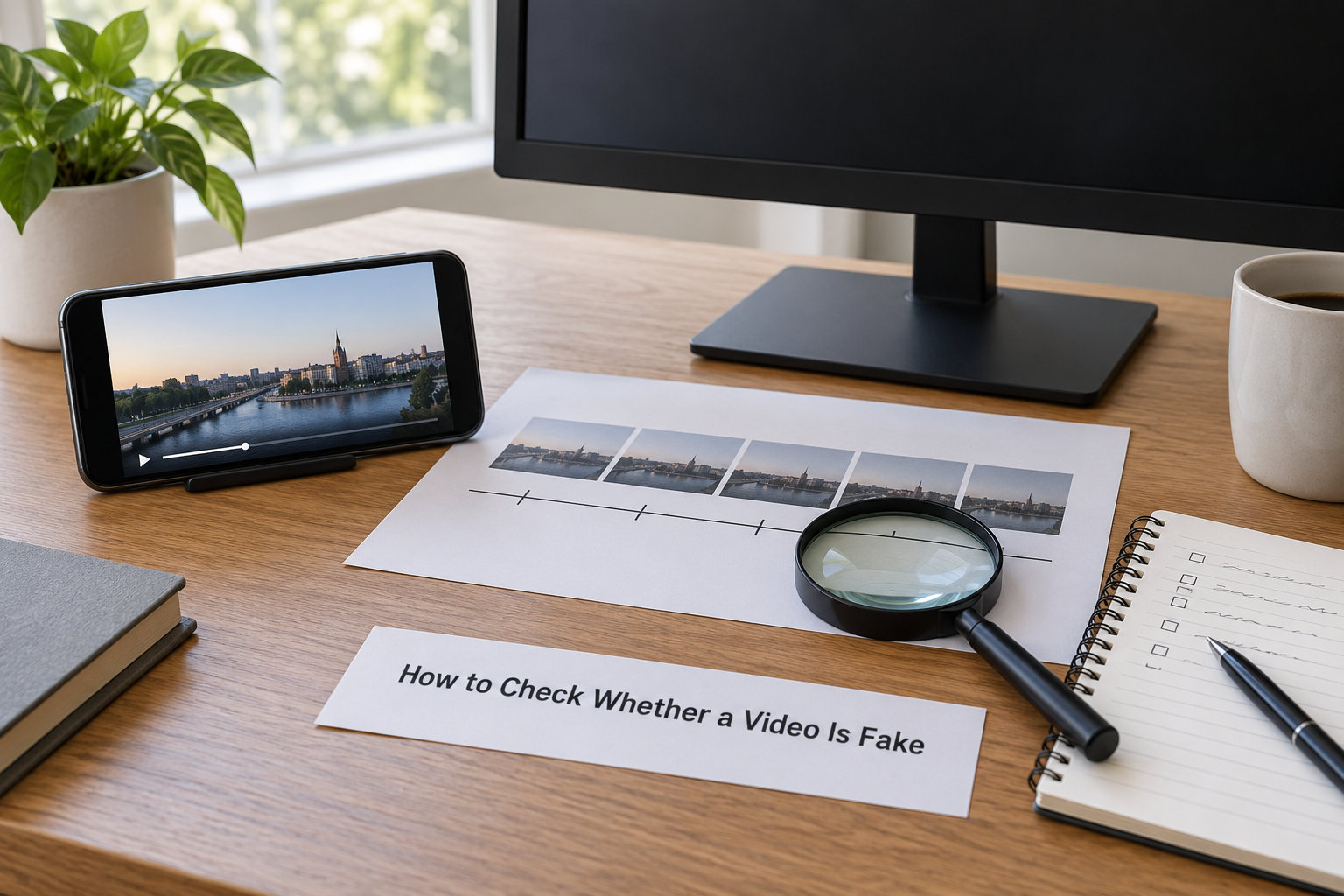
Do not try to solve this with your eyes. Use a process that produces corroboration instead of a hunch.
- Find the earliest version you can. Search for the claim rather than the clip. The version embedded in a news story, the version on a politician’s own channel, or the first post you can trace back through several reposts is worth far more than the version in your feed.
- Check the date and the context. A clip with no publication date, or one that appears months after an event it claims to document, is doing suspicious work. Look at where it is hosted, not just who posted it.
- Compare independent reporting. If outlets describing the same moment describe something the video does not contain, that mismatch matters more than any visual detail.
- Use out-of-band verification. Call the person on a number you already had, or use a phrase only the two of you would know. Forum users report this over and over: it is the check that actually works, because it bypasses the media entirely.
- Run a detector as one signal among several. A flagged result is worth investigating and a clean result is worth very little.
- Do not forward until corroborated. Sharing first and checking second is the failure mode. Once a clip is circulating, the correction travels slower than the original.
If you suspect a deepfake of your own face, the search matters more than the judgement. Look for your likeness on the platforms where synthetic images are most commonly posted, save a copy with its URL and date, and report it. Most platforms now have a specific reporting category for impersonation rather than a general misuse form, and using it routes faster.
Why People Believe Deepfakes They Should Question
Even a perfect detector would not fix belief, because belief is not really about evidence. Four mechanisms do most of the work.
The trust heuristic. People read a familiar face as cooperative and familiar-sounding speech as authentic, because in ordinary life those signals are reliable. Synthetic media is engineered precisely to reproduce the signals, and the shortcut fires before scrutiny starts.
Expectation bias. A clip that arrives with a caption confirming what a viewer already believes is assessed as authentic far more often than the identical clip with a neutral or contradictory caption. The interpretation runs backwards from the evidence.
Inattentional blindness. A face presented at natural size on a phone does not deliver enough data to expose a forged boundary or an inconsistent shadow. The artifact is not hidden from your eyes; it was never encoded for your eyes.
False confidence from training. Once someone learns a checklist, the checklist replaces attention. This is automation bias in a low-stakes costume, and it is the reason the same clip is rejected by an untrained viewer and shared by an expert one.
Add repetition and social proof. A clip seen four times from four accounts reads as corroborated, when in fact four accounts may be one source. In public threads, the second look often destroys confidence in the first impression: people who pass a public deepfake quiz with a handful of questions and zero margin report distrusting their own eyes afterwards.
Frequently Asked Questions
How can deepfake videos be detected?
Detection combines four signal types: high-frequency upsampling artifacts, frame-to-frame inconsistency and identity drift, audio-visual mismatch, and the absence of the faint blood-flow pulse a real face produces. Real-time tools such as Intel FakeCatcher run some of these checks during a live call. In practice detectors are strongest as one input in a verification process, not as a verdict on their own.
How accurate is deepfake detection?
Highly variable, and much lower in the wild than in published demos. Academic benchmarks such as the ones behind FaceForensics++ report strong numbers on curated data, while in-the-wild benchmarks like DeepFake-Eval-2024 show a large drop against current generators. Independent human accuracy averages 55.5 percent across 56 studies, and 57.3 percent for video.
How can you tell if a video is AI generated?
Look for several anomalies rather than one, and weight context above pixels. Check the earliest version, the date, and whether independent coverage matches what the clip shows. Audio tells such as missing breath sounds and flat prosody still outperform most visual cues. Call the person on a number you already had. No single clue proves anything either way.
Can you reliably spot a deepfake just by looking?
No. iProov’s 2025 Threat Intelligence Report found that 0.1 percent of people reliably distinguished modern synthetic content from real footage, and a meta-analysis of 56 studies put average human accuracy at 55.5 percent. Learning the classic cues such as blinking or teeth tends to create false confidence rather than skill, and some published experiments find trained viewers do no better than untrained ones.
Can deepfakes defeat liveness detection?
Yes. Liveness checks that ask for a head turn, a blink, or a spoken phrase are being defeated by real-time face reenactment and voice cloning, which is how a video-conference impersonation scam in Hong Kong cost an engineering firm about 25.6 million Hong Kong dollars in February 2024. Liveness works best as one layer in identity verification, alongside out-of-band contact.
Is creating a deepfake now illegal?
It depends entirely on what it is used for and where you are. Many US states have enacted laws targeting non-consensual intimate imagery, impersonation of public officials and fraud. Federal proposals such as the DEEPFAKES Accountability Act have not passed, and platform obligations still largely rest on Section 230. If you are a victim, the practical route is reporting to the platform and, for imagery abuse, to local law enforcement.
What Should You Do First?
Pause before you share. Tracing a clip back to its first post takes a couple of minutes and tells you more than any amount of frame-scrubbing, and if the people in the video are someone you know, a call to a number you already have settles the question faster than any tool on the internet. The rest is detail.