Here is the short version: a presidential primary is the election where registered voters in each state pick delegates, not a candidate for president. Those delegates gather at the party’s national convention and vote for the nominee who then runs in the general election. Understanding how a presidential primary works means knowing who votes, how votes become delegates, and what happens in a state that holds a caucus instead.
The confusing part is the middle step. Most voters assume their ballot names the nominee, so they assume the party’s leaders quietly decide the winner afterward. They don’t. The step in between is written into state law and party bylaws, and it is where the real rules live.
Below is the whole process in plain language: how candidates get on the ballot, what you do on primary day, how your vote is converted into delegates, and what happens if no one wins a majority.
Table of Contents
- How a Presidential Primary Works From Start to Nominee
- What Is a Presidential Primary?
- Who Runs in a Presidential Primary?
- How Do Candidates Qualify for the Ballot?
- What Happens During a Primary Election?
- How Are Winners and Delegates Selected?
- What Is the Difference Between a Primary, Caucus, and Convention?
- How Does the Republican and Democratic Primary System Differ?
- How a Presidential Primary Works Across the Primary Calendar
- What Happens at the National Convention?
- What Happens If No Candidate Wins the Majority?
- Frequently Asked Questions
- Do primary voters pick the presidential nominee directly?
- What is the difference between a caucus and a primary?
- Can I vote in a presidential primary if I am not registered with a party?
- How many delegates does a candidate need to win the nomination?
- Why do Iowa and New Hampshire vote first?
- What is Super Tuesday?
- What to Take Away From This
How a Presidential Primary Works From Start to Nominee
The entire process has three stages, and every election cycle runs the same three.
- Primaries and caucuses. Voters in each state pick delegates to their party’s national convention, usually from January to June of the election year.
- National conventions. Delegates vote for the party’s presidential nominee, usually in the summer.
- General election. The two nominees face each other in November, and voters pick a president directly through the Electoral College.
Stage one is what most people call “the primaries,” and it is the stage that decides which candidate each party will put forward. A voter never votes for president during that stage. They vote for a slate of delegates, and the delegates do the nominating.
That indirection is the part nobody explains well, so it is worth being blunt about it: your ballot does not name a candidate for president, and your state does not name a nominee. Both jobs belong to the delegates.
What Is a Presidential Primary?
A presidential primary is a state-level election in which voters choose the delegates who will represent their state at their party’s national convention. Those delegates, not the voters, formally choose the party’s nominee for president. The primary decides which candidate faces the other party’s nominee in the general election, but it never picks a president on its own.
There is one important wrinkle. A congressional primary works the way most people expect: you vote for a person, and if they win, they hold the office. A presidential primary is different by design. It was built as a way for rank-and-file party members to pick among several candidates in a system that had previously let party insiders choose nominees at conventions.
Some states never hold a presidential primary at all. Those states hold a caucus instead, which is a party-run meeting where voters pick delegates in person. Iowa is the best-known example, and until 2024 it was the state that opened the presidential contest every cycle.
The term “primary election” is also used for the state and congressional races that run on the same day, and those ballots are entirely separate from the presidential contest. In eleven states the two use different rules, which is a common source of confusion.
Who Runs in a Presidential Primary?
Only declared candidates run, and they run under party labels. The major parties are the only ones that hold presidential primaries at all, so the practical field is the declared Democrats, declared Republicans, and whoever else can collect enough ballot signatures to appear.
Three groups matter for understanding who is actually running.
Declared candidates have formally created a campaign committee, filed with the Federal Election Commission, hired staff, and begun raising money. Filing a Statement of Candidacy with the FEC makes it official, and from there a candidate can raise and spend under federal limits.
Potential candidates are the “maybe” tier. They test a run with fundraising totals and polling rather than a formal declaration, and most of them never file. Several typically emerge early in each cycle, and by the time the first contest is held the field has usually shrunk to a handful.
Independent candidates follow a completely separate path. They collect petition signatures in every state they want to appear on the general-election ballot, and the burden is much heavier than it is inside a party primary.
One more distinction worth knowing: a party can formally suspend or disqualify a candidate without removing their name from the ballot. Votes for a suspended candidate still get counted, and they are often redistributed among the remaining candidates rather than discarded.
How Do Candidates Qualify for the Ballot?
Candidates get on the primary ballot by filing paperwork with the state, and the requirements differ from state to state because the rules come from state law and each party’s own bylaws. Typical requirements include a filing fee, a petition or a set number of voter signatures, and a deadline that can be many months before the vote.
Three things follow from that, and they trip up first-time candidates more than first-time voters.
Deadlines are early. Filing windows often open more than a year before the election and close months before the first contest. A candidate who decides to run after the window has shut is out, regardless of how much support they have.
Thresholds vary enormously. One state may ask for a few thousand signatures at a modest cost, and another may impose a much heavier burden. Those differences shape who bothers to run.
Parties set their own bar. Even where state law sets a low threshold, a party can decide it will only recognize or seat delegates for candidates who meet a higher standard of its own.
That last point explains something that looks odd from the outside. A candidate can be on the ballot, raise money, and poll competitively, and still never win a delegate because the party wrote the allocation rules in advance. The rules were settled long before anybody cast a vote.
What Happens During a Primary Election?
On primary day you go to your usual polling place, or vote early or by mail, and request your party’s ballot. States administer most presidential primaries through their own election offices, which is why primary dates are set by state law and vary so much from one cycle to the next.
What makes primaries different from a general election comes down to one question: whose ballot do you get? That depends on the state’s rules, and the answer falls into three categories.
- Closed primary. Only voters registered with that party can vote. If you are unaffiliated, you cannot vote at all unless you join the party before the deadline.
- Open or partially open primary. Unaffiliated voters can participate, sometimes by choosing a party ballot on election day. In Texas an independent can ask for either party’s ballot. In Florida the contest is closed to unaffiliated voters.
- Partially closed. Voters must have been registered with the party by an earlier cutoff rather than on the day.
According to USAFacts, roughly 44% of states hold primaries that are open or open to unaffiliated voters, about 20% are closed, about 26% fall somewhere in between, and about 10% use other formats including a top-two format.
After polls close, votes are counted like any other election, with one exception. In a majority of states a candidate needs a majority of votes to win. If nobody has it, the state holds a runoff between the top two, sometimes weeks later.
That is a different rule from the general election, where the top candidate takes the state regardless of percentage. It is one of several places where the primary rules diverge from everything else voters know.
How Are Winners and Delegates Selected?
This is the step almost every article skips. Your vote does not directly produce a candidate. It produces a number, and that number is converted into delegates under a formula written before primary day.
There are two formulas in active use.
Proportional allocation splits a state’s delegates across candidates roughly in line with the vote, so a candidate who wins 30 percent of the vote and clears the threshold wins close to 30 percent of the delegates. A threshold applies: on the Democratic side, a candidate must reach 15 percent of the statewide vote to qualify for any delegates, and votes for candidates below that line are discarded rather than redistributed to those above.
Winner-take-all hands the entire state delegation to whoever finishes first. A candidate can win a state with 34 percent of the vote and take every delegate in it. Most Republican contests use a mixture of winner-take-all, proportional, and district-based rules, chosen state by state.
Here is a worked example so the mechanics are concrete. Imagine a state with 100 pledged delegates under a proportional plan with a 15 percent threshold, and these results: candidate A at 32 percent, candidate B at 28 percent, candidate C at 22 percent, candidate D at 11 percent, and candidate E at 7 percent.
D and E fall below the threshold, so their votes are ignored. The remaining 82 points are divided among three candidates, which gives roughly 39 delegates to A, 34 to B, and 27 to C. Under a winner-take-all rule the same votes would send all 100 delegates to A, who had 32 percent. Under a Democratic-style proportional system, D and E’s supporters have no candidate to win with, and their preferences never reach the convention.
Delegates themselves come in two kinds, and the difference shows up at the convention. Pledged delegates are bound to vote for the candidate they were elected to support, and if that candidate withdraws they are usually released at a point where the party rules say so.
Unpledged delegates are not bound. Most are party officials, elected officials, and other party members selected in a separate process. They cannot be pledged through a primary ballot, which is why some candidates campaign for them directly.
A note on terms, because this one causes real confusion. The term “superdelegates” was long used for the Democratic party’s unpledged delegates. Since a 2018 rule change those automatic unpledged delegates no longer vote on the first ballot at the convention if a candidate has already won a majority of the pledged delegates. They still show up in the delegate math and they still matter in a close contest.
What Is the Difference Between a Primary, Caucus, and Convention?
A primary is a secret ballot run by the state, a caucus is a party-run meeting where you pick delegates in person, and a convention is the gathering where those delegates choose the nominee. The first two happen across many states in the winter and spring; the third happens once, in the summer.
| Feature | Primary | Caucus | Convention |
|---|---|---|---|
| Who runs it | State or local election officials | The political party | The political party |
| How you vote | Secret ballot at the polls | In-person meetings and preferences, often across several nights | Each delegate casts a vote for the nominee |
| Who takes part | Voters who meet the state’s party rules | Party members who show up | Credentialed delegates from states and territories |
| Election law applies | Yes | Largely no | No |
| What you produce | Pledged delegates | Delegates, often chosen at a later convention | A party nominee and a party platform |
| When | January to June of the election year | Winter, ahead of the primaries | Summer, after the primary season |
The practical differences matter. In a caucus, attendance is the whole game, and a candidate can do serious damage by organizing well without winning anywhere near a majority of the statewide vote. Iowa’s caucuses became famous for exactly that reason.
States also sometimes mix the two. In 2024 Nevada held a state-run primary for one candidate and party-run caucuses for the others, which made the mechanics genuinely confusing to voters trying to participate.
The National Conference of State Legislatures also notes that in eleven states the presidential primary and the state or congressional primary that runs on the same day use different rules, while in thirty-nine states they match. Of those eleven, three hold party-run presidential contests and seven have a presidential statute that is more restrictive than the one for state primaries. Michigan is unusual in a different way, with rules that differ on privacy and disclosure. If you are registering to vote in one of those states, you have to read two rulebooks.
How Does the Republican and Democratic Primary System Differ?
The two parties structure their nomination contests differently, and the differences are large enough to explain why the same result on primary night can mean different things for each party.
On the Democratic side, allocation is proportional with a 15 percent viability threshold, and delegates are split between congressional district lines and at-large slots so the whole map matters. Many states use a primary that is open or partially open to unaffiliated voters, which tends to bring in voters who have not formally joined the party.
On the Republican side, state parties pick their own method within rules set by the national committee, and the result is a patchwork: some states winner-take-all, some proportional, some district-based. Several states restrict participation to voters who have signed a declaration or paid a fee, and more of them have moved toward closed or partially closed contests.
One recent change is worth knowing because it affects timing. Both national committees now publish an approved primary calendar, and a state that breaks it can face penalties, including the loss of delegates. That gives the national committees real influence over the order states vote in, which is how a party changes a calendar that state law and tradition had built.
None of this is a prediction about who wins either nomination. The rules are the rules regardless of the field, and the same arithmetic produces a decisive sweep in one party and a long, narrow contest in the other.
How a Presidential Primary Works Across the Primary Calendar
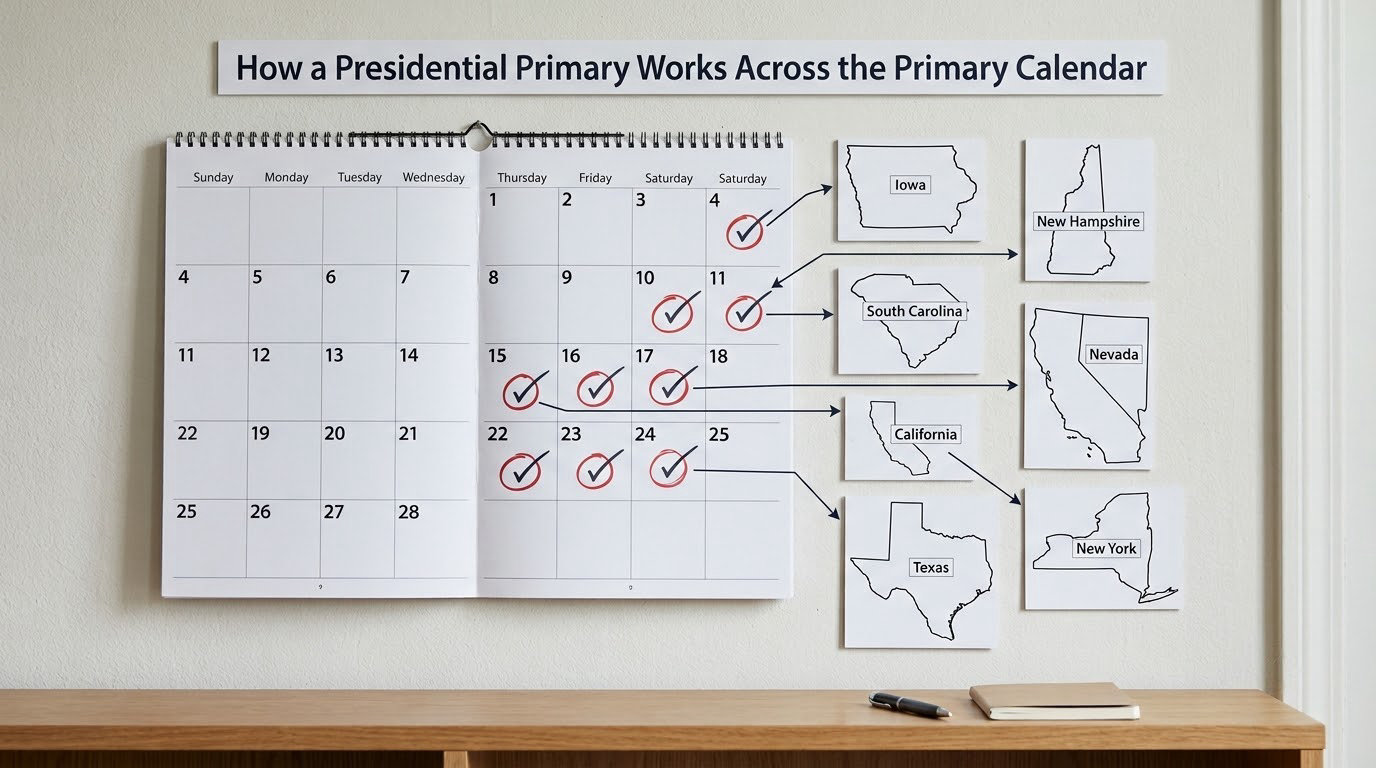
The primary calendar runs roughly from January to June of the election year, and no two states vote on the same schedule. Iowa and New Hampshire have opened the contest for decades, and the rest of the country clusters behind them in a loose sequence that ends with the biggest states voting last.
New Hampshire has held a presidential primary since 1952, and Iowa has held the first caucus event of the cycle since 1988. Both are small states with independent political traditions and strong traditions of local press, which for decades made them effective laboratories for a candidate’s message.
The order is not really about ideology or geography. It is about media: a win in a small state produces headlines and a fundraising surge, and that surge lets a candidate compete in bigger states later. Political scientists call this front-loading.
March brings the biggest single day of the contest. Super Tuesday, when it falls on schedule, is the first Tuesday in March, and a large block of states with large delegate totals vote together. It can end a nomination race or reset it. States that have not voted by then are mostly decorative, and their voters know it, which is a genuinely demoralizing place to be as a first-time voter.
The Democratic and Republican calendars have also stopped matching. In 2024 the Democratic national committee approved a calendar beginning with South Carolina, and Iowa’s delegates were temporarily unbound while the dispute over the order was resolved. Voters in the early states were told they had voted for a winner and then watched the delegate totals move afterward, which is a good illustration of how much of the result is decided by rules rather than by ballots.
By late spring the arithmetic is usually settled. States vote through June, and after that the remaining contests change little because no realistic path to a majority is left. If your state’s primary comes in May or June, your vote still counts, but it may count toward a nomination that is already arithmetically decided.
What Happens at the National Convention?
The national convention is where the delegates chosen in the primaries and caucuses finally vote for a candidate. Each party’s convention is a four-day event, and the first day is procedural: delegates are credentialed, meaning their seats are verified and any disputes over who is entitled to vote are settled, and the party adopts a platform.
The nomination itself happens on a roll call vote, state by state. As each state’s votes are called, the total climbs until one candidate passes the majority threshold set in the party’s rules. That candidate becomes the nominee, the party platform is adopted, and the nomination is formally complete.
By the time the convention happens, the math is usually settled. The event exists to ratify a result that the delegate totals have already decided, not to choose from a genuinely open field. A candidate who has won a majority of the pledged delegates does not need the convention to be told anything, which is why the first ballot is often treated as a formality.
That formality is why conventions moved off national broadcast television decades ago. What remains is a party gathering, and it still draws a large live audience, which matters because the speeches that could build or break a general-election campaign now happen at the convention itself.
What Happens If No Candidate Wins the Majority?
A contested convention is possible under the rules and almost never happens in practice. It requires that no candidate has a majority of the delegates entitled to vote on the first ballot, and the rules for breaking that deadlock vary by party.
At a modern convention the most common path is a negotiated one. Candidates who fall short release or withdraw delegates, and one of them becomes the nominee by accumulation rather than by winning a ballot outright. These deals are worked out in the days before the roll call, and they are the reason a convention can resolve a deadlocked field in a single evening.
The delegates themselves are the battleground in a truly contested convention. Delegates are bound only until their candidate tells them otherwise, and there are well-documented historical cases of delegates switching or voting against instructions when no candidate has a majority. The 1968 Democratic convention in Chicago is the example people still cite, where delegations from several states fought over their own credentials and rules on the convention floor.
Rules written in advance are what keep this from becoming unmanageable. Both parties set credentialing deadlines and dispute procedures precisely so that a contested convention has rules to run on. The delegates may not like the rules, but having rules is what keeps a messy process from becoming a broken one.
Frequently Asked Questions
Do primary voters pick the presidential nominee directly?
No. Voters pick delegates, and the delegates pick the nominee at the party’s national convention. This is the single most common misunderstanding about how a presidential primary works. In a congressional primary you vote for a person and the winner takes office. In a presidential primary you vote for a slate of delegates who are bound to a candidate, and the convention makes the actual nomination.
What is the difference between a caucus and a primary?
A primary is a secret ballot run by state and local election officials. A caucus is a party-run meeting where party members pick delegates in person, often across several nights. Election law largely governs primaries but not caucuses, and turnout in a caucus depends on showing up rather than on finding a polling place. Some states use both.
Can I vote in a presidential primary if I am not registered with a party?
It depends on your state. In closed primaries, no. In open and partially open primaries you can vote, sometimes by choosing a party ballot on election day and sometimes only after registering with the party ahead of a deadline. About 44 percent of states are open or open to unaffiliated voters and about 20 percent are closed, so check your state election office before assuming you are excluded.
How many delegates does a candidate need to win the nomination?
A candidate needs a majority of the delegates entitled to vote on the first ballot, which is usually more than half of the pledged delegates. The exact number depends on how many delegates your state elects and how the party’s rules allocate them. Once a candidate has that majority, automatic unpledged delegates do not vote on the first ballot.
Why do Iowa and New Hampshire vote first?
Tradition, small size, and media attention. New Hampshire has held a presidential primary since 1952 and Iowa has held the opening caucus event since 1988. A win in either state produces national coverage and a fundraising surge that helps a candidate compete in larger states later, which is why the order matters more than population would suggest.
What is Super Tuesday?
Super Tuesday is the day a large block of states with many delegates vote at once, usually the first Tuesday in March. It can decide a nomination outright because it delivers a large share of all available delegates on a single day. Candidates who win it usually secure the nomination, and candidates who lose badly usually drop out, which makes March the pivot point of the season.
Resumen en espanol: En las primariasforderales los votantes eligen delegados, no al candidato a la presidencia. Los delegados se reúnen en la convencion nacional del partido y votan por el candidato nominado. Segun USAFacts, cerca del 44 por ciento de los estados permiten votar en las primarias a los votantes sin afiliacion partidista, y cerca del 20 por ciento son primarias cerradas. Consulte la oficina electoral de su estado para conocer la fecha y las reglas.
What to Take Away From This
Start with your state’s election office rather than a party website. It will tell you your primary date, whether your contest is open or closed, and when your party registration deadline falls, which is the deadline first-time voters miss most often.
Then know the one fact that makes the rest clickable: your ballot picks delegates, those delegates nominate the candidate. Once that lands, the arithmetic in the article above stops being strange.