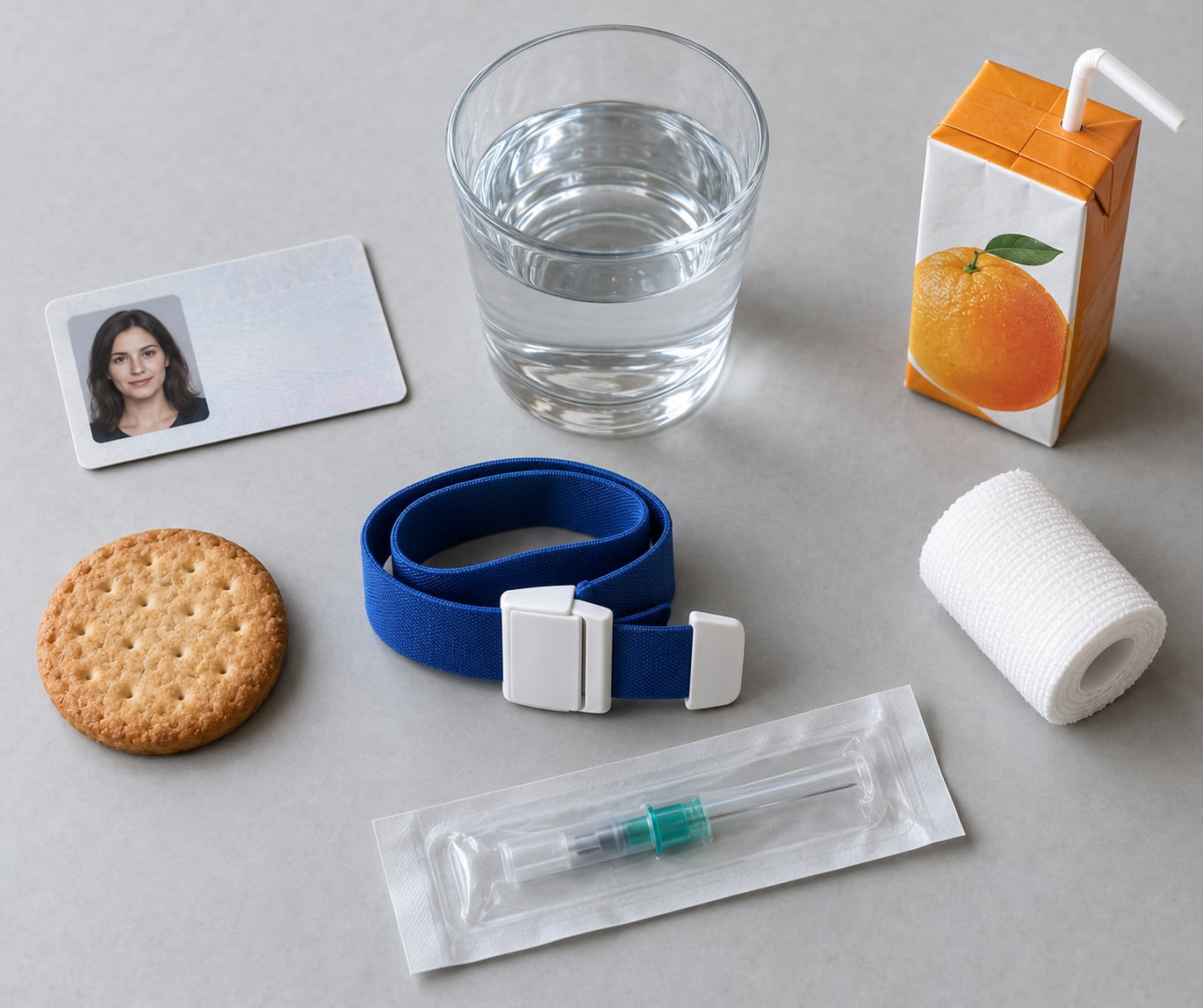
Here is how blood donation works start to finish: you register and show ID, have your temperature, pulse, blood pressure and haemoglobin checked, answer a private health history interview, give about one pint of blood in 8 to 10 minutes, then rest with a snack for around 15 minutes before you leave. Door to door, the whole appointment takes about an hour.
The blood draw is the shortest part of it. Most of your time goes on screening, paperwork and sitting in a refreshment area afterwards, which is deliberate: the screening is what makes the whole system safe.
This is general information about how the process works, not medical advice. Eligibility rules and clinical guidance differ by country and by centre, so check with your own donation centre or a doctor before you book.
Table of Contents
- What Is Blood Donation?
- Can Anyone Donate Blood?
- How Blood Donation Works Start to Finish
- Steps 1 to 4: check-in, screening and the interview
- Steps 5 to 8: the draw, recovery and leaving
- What Happens Before You Give Blood?
- What Happens During the Donation?
- What Happens After You Donate Blood?
- How Is Donated Blood Tested and Stored?
- How Long Does Blood Donation Take?
- How blood donation works start to finish, minute by minute
- Can You Donate Blood More Than Once?
- Frequently Asked Questions
- Is donating blood painful?
- How long after donating blood can I exercise?
- Can I donate blood if I take medication?
- How is my privacy protected during blood donation?
- What should I do if I feel faint after donating blood?
- Start by Checking Your Eligibility
What Is Blood Donation?
Blood donation is a short medical appointment where a trained phlebotomist collects roughly 450 to 500 millilitres of whole blood through a sterile needle in the crook of your elbow. That volume is often called a pint, and it is roughly 8 to 10 percent of an adult’s total blood volume.
Blood cannot be manufactured at scale, so hospitals rely entirely on people turning up. There is no reserve sitting in a warehouse waiting for a mass-casualty event. One donation can end up supporting a trauma patient, a surgery, a cancer treatment, a transplant or a difficult childbirth.
What gets collected depends on the donation type. A whole blood donation gives all the components together, and the centre later separates them in the lab. An apheresis donation puts you on a machine that takes one component and returns the rest of your blood through the same needle, so you give more plasma or platelets than a routine whole blood donation would collect.
Can Anyone Donate Blood?
No, and that is by design. Centres screen every donor against published eligibility rules, and the person making the call is a trained screener, not a volunteer guessing. The main things that can rule you out:
- Age and weight. Most centres ask donors to be 17 or older with a minimum body weight, often around 110 pounds, partly because of how much volume the collection set holds. Rules differ by country.
- Haemoglobin level. The finger-prick test reads your haemoglobin, the oxygen-carrying protein in red cells. Below the centre’s threshold and you are deferred, not rejected forever.
- Recent illness. A fever, a cold you are still fighting, or a stomach bug in the last few weeks usually means waiting.
- Travel. Time spent in areas with malaria risk or certain outbreaks triggers a deferral of weeks to months, depending on the destination and whether you took prophylaxis.
- Medication. Some drugs trigger a deferral, often a temporary one, and the list depends on the centre. Never stop a prescribed medicine to donate without asking the prescriber first.
- Tattoos and piercings. An unrestricted tattoo or piercing usually only defers you for a short period while the site heals, if at all.
- Pregnancy and recent childbirth. Both defer donors, for a set period defined by the centre.
- A transfusion or transplant in your history. This one tends to defer you for months rather than weeks, and it is the question first-time donors worry about most.
One reassurance worth having: almost every deferral is temporary. Forum threads show people turned away, waiting out a period, and coming back later successfully. The exception is a small number of conditions that rule out donation permanently under mainstream guidance such as American Red Cross, NHS Blood and Transplant and WHO recommendations.
Rules vary by country, by region and by centre. Your centre’s own screening decision is the one that counts, and their screener will ask about things this guide cannot cover, including anything about your health you are unsure about.
How Blood Donation Works Start to Finish
Eight steps, in order, at a typical volunteer-run centre. Times vary with the number of donors booked and how busy the day is.
Steps 1 to 4: check-in, screening and the interview
Step 1: Registration and ID. You give your name, contact details and birth date, and you show photo identification. Many centres also ask for a second form of ID, with a bank card, pay stub or library card often accepted. Some systems let you complete an eligibility questionnaire online before you arrive, which shortens step one considerably.
Step 2: The mini-physical. You sit or lie down while a technician takes your pulse, checks your blood pressure and reads your temperature. Then comes a finger prick for haemoglobin.
Step 3: The private health history interview. A trained screener asks about your health, medications, travel and recent procedures. This is a one-to-one conversation away from other donors, and it is confidential. People ask for this specifically in forum threads, because being questioned in front of a queue is one of the deal breakers that stops people coming back.
Step 4: Moving to the donation bed. You take a numbered ticket, lie back on a padded bed or recliner, and get comfortable before anything happens.
Steps 5 to 8: the draw, recovery and leaving
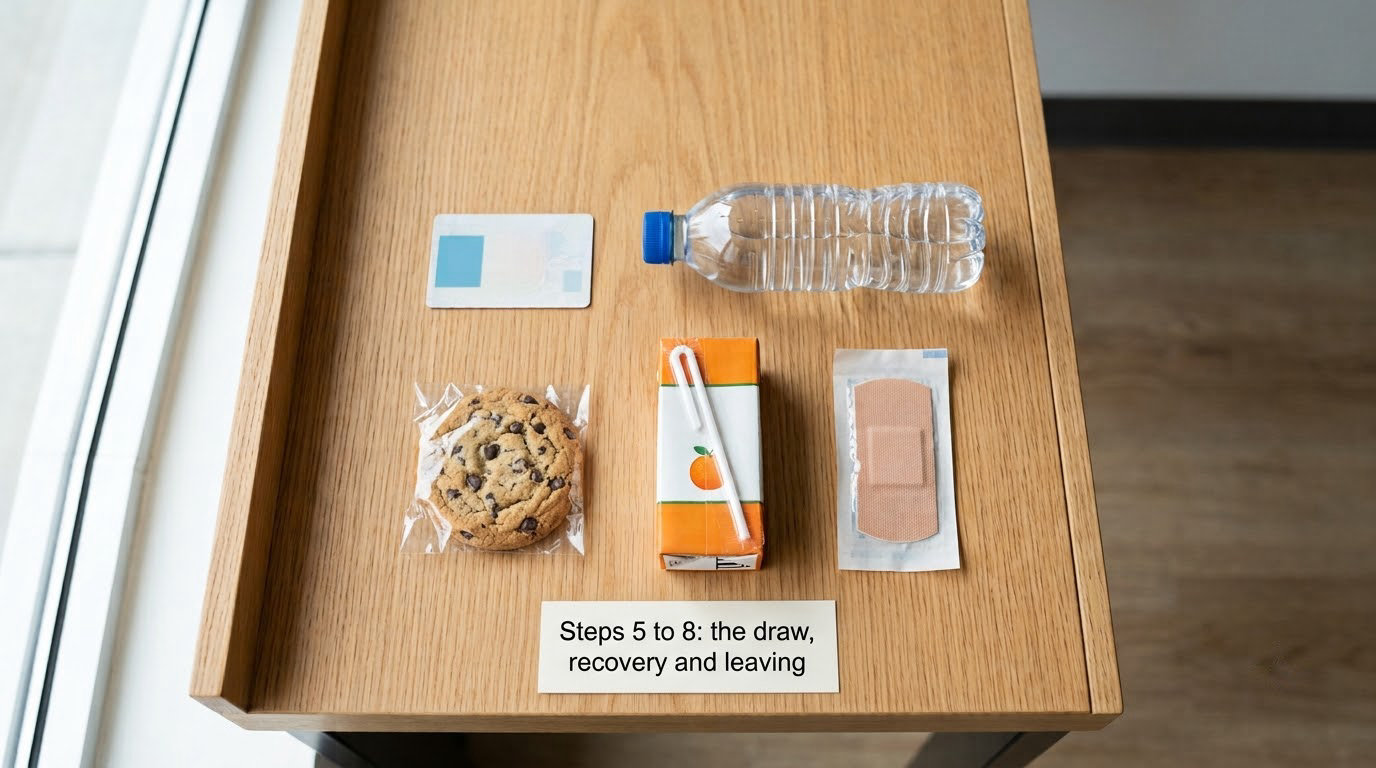
Step 5: Arm preparation and needle placement. The phlebotomist finds a vein in your inner elbow, usually the median cubital vein, cleans the area with antiseptic, applies a tourniquet and slides in a sterile single-use needle. You feel a pinch, a scratch, or a brief sting. That is the part people worry about, and it lasts seconds.
Step 6: The draw. For whole blood, the collection takes 8 to 10 minutes. You may be handed a squeeze device to pump gently every so often: this rhythm keeps blood moving through the tubing and is not optional, it is how the collection is timed. Staff stay within sight and talk you through it.
Step 7: Bandage and observation. The needle comes out, pressure is applied, and a bandage goes on. You move to the refreshment area and sit for about 15 minutes, eating and drinking, while staff watch for reactions before you are cleared to leave.
Step 8: Leaving. You get a record of your donation, often with your blood type and a donor card, and you leave. Nobody follows you into a car park; you drive yourself home like any other errand.
What Happens Before You Give Blood?
Drink water before you go. Being well hydrated is the single most reliable thing you can do to avoid feeling light-headed afterwards, and centres say so constantly for a reason.
Eat a normal meal with some iron in it a couple of hours beforehand: meat, beans, lentils, eggs, or greens with something else. Skip a heavy, high-fat meal right before the appointment, since centres commonly defer donors for eating fatty food in the last few hours.
Sleep, and skip the alcohol for the day. Forum posters report that eating a big breakfast before donating does not reliably prevent a shaky reaction; rest and hydration do more work than food does.
Bring photo ID, and any second ID your centre asks for. Knowing what ID they accept before you travel saves the one thing that would otherwise waste your trip: getting turned away at the desk.
What Happens During the Donation?
The setup is deliberately dull, which is a good sign. The phlebotomist washes their hands, opens a sterile single-use collection kit in front of you, and never reuses a needle. Everything that touches you is single use.
You lie back with your head slightly raised and your arm on a pillow. A cuff inflates on your upper arm to find the vein, then deflates once the needle is in. A dripping sound from the collection bag is normal, and so is a mild cool feeling as the blood leaves your arm.
Some people feel nothing much beyond the pinch. Some get cold, sweaty or light-headed near the end, when the volume is at its lowest. That is a vasovagal response, it is common, and it is not dangerous, but tell the staff immediately rather than trying to sit it out. Staff can pause the draw, put your legs up and give you fluids, and they would always rather hear from you early.
Platelets and plasma take longer because of the machine. A platelet donation runs around two hours with the donor returned to the bed two or three times, while plasma takes roughly 45 minutes.
What Happens After You Donate Blood?
Stay for the full refreshment period, drink the fluid you are offered, and eat something. That 15 minutes is not a courtesy, it is the observation window.
For the rest of the day, take it easy. Skip heavy lifting with that arm for at least a day, ideally a couple, and keep the bandage on for a few hours. A bruise around the needle site is common and fades over a few days; a hard, painful lump in the arm a day later is worth a call to the centre, because that is a different problem.
Get up slowly for the first day if you have been given a fainting spell, and if you drive yourself home, drink water before you set off.
Your body replaces what it lost on its own schedule. Plasma volume comes back within about 48 hours, mostly by pulling fluid back into the circulation. Red cells are slower: roughly four to eight weeks for full replacement. That gap is the reason donation intervals exist and why iron matters between donations.
Call a doctor or your centre if the bruise spreads rapidly, if the arm swells or stiffens, if you have a fever within a few days, or if you feel unwell in a way that does not settle.
How Is Donated Blood Tested and Stored?
Your donation goes to a lab before it goes near a patient. The chain runs the same way for every donation.
- Screening. Every unit is tested for infectious disease markers, including HIV, hepatitis B, hepatitis C and syphilis. Donors who have travelled may also be screened for malaria and West Nile virus depending on where they went.
- Confirmation. The donation is confirmed as the right type and from the right donor. Blood group is re-tested here.
- Separation. The unit goes into a centrifuge and is split into red cells, platelets and plasma. That is why a single whole blood donation can serve several patients.
- Labelling. Each component gets a label with a unique number that links it back to your donation. Your name is not what the hospital sees; the number is.
- Storage. Red cells are refrigerated and used within about 42 days. Platelets last around five to seven days. Plasma is frozen and can be kept for up to a year.
- Distribution. The blood bank stocks inventory by group, then issues units to hospitals, which cross-match them to a patient before transfusion.
ABO and Rh matching works in a way that surprises people: O negative red cells lack A, B and Rh(D) antigens, which makes them the universal red cell donor, while plasma compatibility runs in the opposite direction. A blood bank holds a shelf of these categories, and it is the balance between types that determines whether a hospital can treat a trauma patient in ten minutes or not.
How Long Does Blood Donation Take?
Plan on about an hour on site for a whole blood donation. Plasma and Power Red run longer because the machine does more work; a platelet appointment can run close to two hours.
How blood donation works start to finish, minute by minute
| Stage | What happens | Typical time |
|---|---|---|
| Check-in and ID | Registration, identification, ticket | 5 to 10 minutes |
| Mini-physical | Pulse, blood pressure, temperature | 5 minutes |
| Haemoglobin test | Finger prick, haemoglobin reading | 2 to 3 minutes |
| Health history interview | Private, one-to-one screening | 5 to 10 minutes |
| Moving to the bed | Waiting, then getting comfortable | 5 minutes |
| The draw | Needle in, collection running | 8 to 10 minutes |
| Observation and refreshments | Bandage, food, drink, watched for reactions | 15 minutes |
| Total on site | Arrive to leaving | About 60 minutes |
The journey does not end when you leave. Screening and testing happen first, then separation and labelling, then distribution to a hospital where units are cross-matched to a patient. From arm to transfusion, that is days rather than minutes, and the donor’s part in it is over long before the blood is used.
Can You Donate Blood More Than Once?
Yes. Most healthy donors can give whole blood roughly every eight weeks, and the interval exists because red cells need that long to rebuild. Other donation types carry different rules.
| Donation type | Time on site | Usual interval |
|---|---|---|
| Whole blood | About 8 to 10 minutes of collection | Every 8 weeks |
| Power Red (red cells only) | Around 45 minutes | Every 12 to 16 weeks |
| Plasma | Around 45 minutes | Twice in seven days, then at least 2 days apart |
| Platelets | Close to 2 hours | Every 2 weeks |
Your own recovery can push a date back as easily as the calendar can. Donating while you are tired, dehydrated or still recovering from illness is a bad idea, and if your haemoglobin has dropped across several donations you may be asked to wait until it recovers. Iron-rich foods between donations help, and a doctor or pharmacist is the right person to ask about iron supplements.
Regular donors ask about training, swimming and hard lifting. There is no rule that stops you exercising, but plan the heavy session for another day, and never give blood within a day or two of a competition or an event where being light-headed would be a problem.
One myth worth clearing up, because plasma advertising makes it confusing: donating blood is free and unpaid, and centres do not pay donors for a routine whole blood or platelet donation. Compensated plasma collection is a separate licensed service with its own screening and its own schedule, and it is not what happens when you donate blood at a volunteer-run centre.
Frequently Asked Questions
Is donating blood painful?
Most donors describe a brief pinch or scratch when the needle goes in, which lasts a second or two and then fades. The collection itself is usually dull rather than painful, and many people barely notice it once it has started. A cold or tingly feeling in the arm is normal. If you feel sharp pain at any point, say so straight away: staff can reposition the needle or pause.
How long after donating blood can I exercise?
Light activity is fine the same day. For anything strenuous, wait until the day after, and skip heavy lifting with the arm that was used for at least 24 hours, longer if the site is sore. If you felt faint or weak during the draw, treat the rest of that day as a rest day. If you compete or train hard, put the donation at least a couple of days away from a race or event.
Can I donate blood if I take medication?
It depends on the medicine. Many common drugs, including paracetamol and many antihistamines, do not affect eligibility at all. Others, such as some blood thinners, immunosuppressants, chemotherapy and a handful of others, trigger a deferral that can run from weeks to permanently. Never stop a prescribed medicine to become eligible. Bring the name of anything you take to the screening interview and let the screener decide.
How is my privacy protected during blood donation?
The health history interview is one-to-one and takes place away from other donors, so nobody hears your answers. Your record is kept by the donation service and covered by the privacy rules that apply to healthcare data. If you are donating through a mobile drive, tell the staff at check-in that you would rather not have your eligibility questions asked within earshot of the queue.
What should I do if I feel faint after donating blood?
Sit or lie down straight away, and raise your legs above your heart. Tell staff if you are still at the centre, because they can give you fluids and keep an eye on you. Drink water once you feel able to, and eat something. Fainting after donation is usually a drop in blood pressure and it passes once your body refills, but seek medical advice if it does not settle, or if you fainted during the donation itself.
Start by Checking Your Eligibility
Before anything else, read your centre’s own eligibility rules, because they decide your case, not this guide. Book an appointment if you can, complete the pre-visit questionnaire if the centre offers one, and arrive with water and a normal meal in your stomach.
Ask questions at the screening interview rather than guessing, and answer honestly. Nobody is being tested on your ability to sound healthy, and being deferred now is usually a short wait rather than a closed door.
Then the rest is simple: one appointment, about an hour, one pint, and a bag of biscuits afterwards. That is how blood donation works start to finish, and the reason nobody can manufacture it.