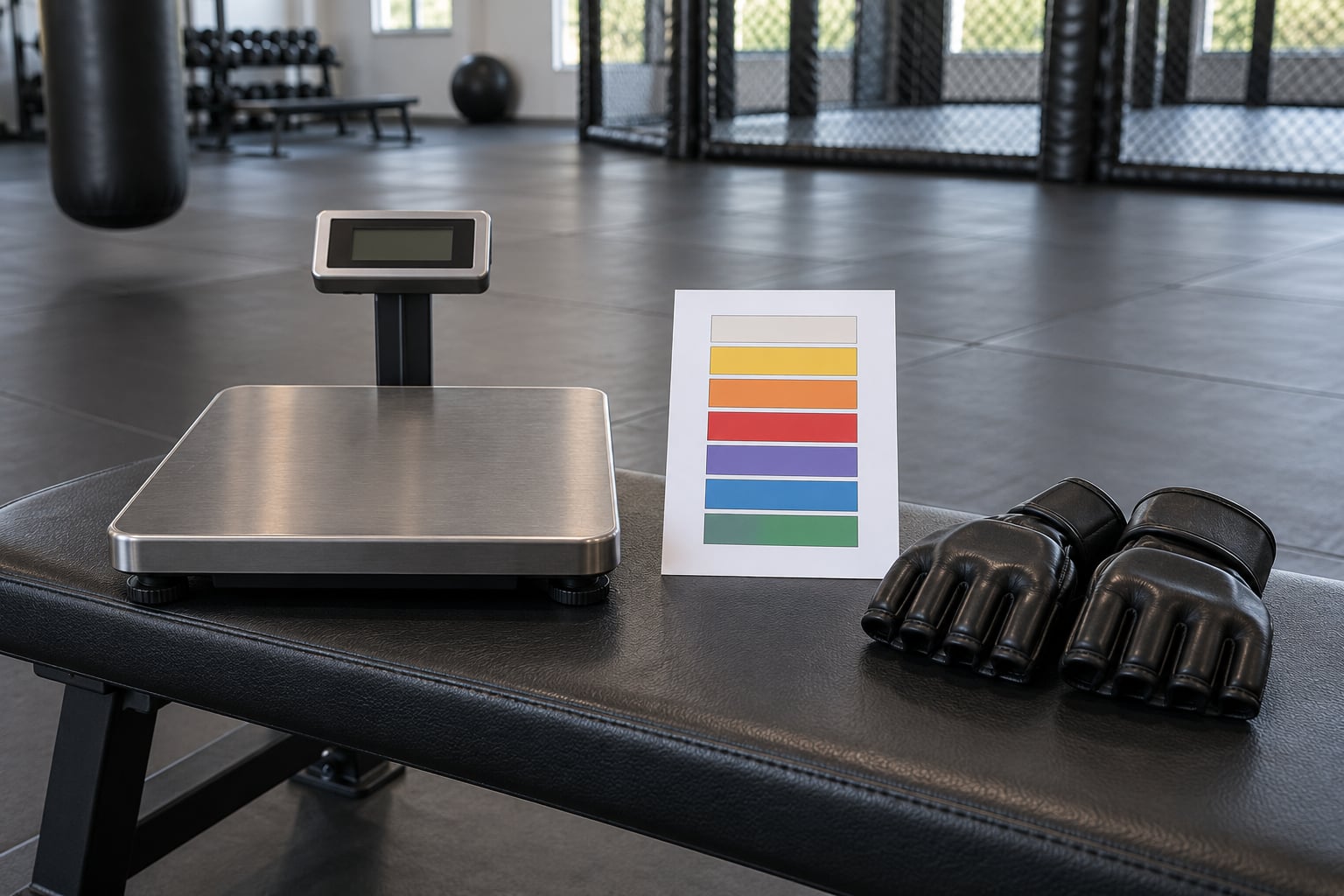
How mixed martial arts weight classes work comes down to one rule: a weight class is a maximum weight a fighter is allowed to weigh, not a weight they are expected to fight at. A promotion assigns every bout to a division, fighters step on a sanctioned scale 24 to 48 hours before the event, and the number on that scale decides whether the fight happens.
That is the whole system in two sentences. The confusing part comes later, when you notice that most fighters step into the octagon weighing far more than their division limit and nobody seems to mind.
Table of Contents
- How MMA Weight Classes Work
- What Is a Weight Limit in MMA?
- Why a division limit is a ceiling and not a target
- Why the limits are set where they are
- Who gets weighed, and what happens over the limit
- How the Major MMA Weight Classes Are Organized
- Men’s MMA weight classes and their limits
- Women’s MMA weight classes and their limits
- Why the ladder is unevenly spaced
- How MMA divisions compare with boxing and Muay Thai
- What the class system does not solve: reach and height
- Why Fighters Cut Weight Before a Fight
- Why fighters don’t just maintain the weight year-round
- Why the practice is contested
- What Happens at MMA Weigh-Ins?
- How mixed martial arts weight classes work on fight night
- What happens when a fighter misses weight
- How Promotions and Sanctioning Bodies Handle Weight Rules
- How Fighters Stay Within a Division Safely
- Frequently Asked Questions
- What are the different weight classes in MMA?
- Why don’t MMA fighters maintain their weight instead of cutting before a fight?
- Why are there weight classes in MMA but no reach classes?
- Which is the hardest weight class in the UFC?
- What happens if an MMA fighter misses weight?
- How long before a fight do fighters weigh in?
- What to Take Away
How MMA Weight Classes Work
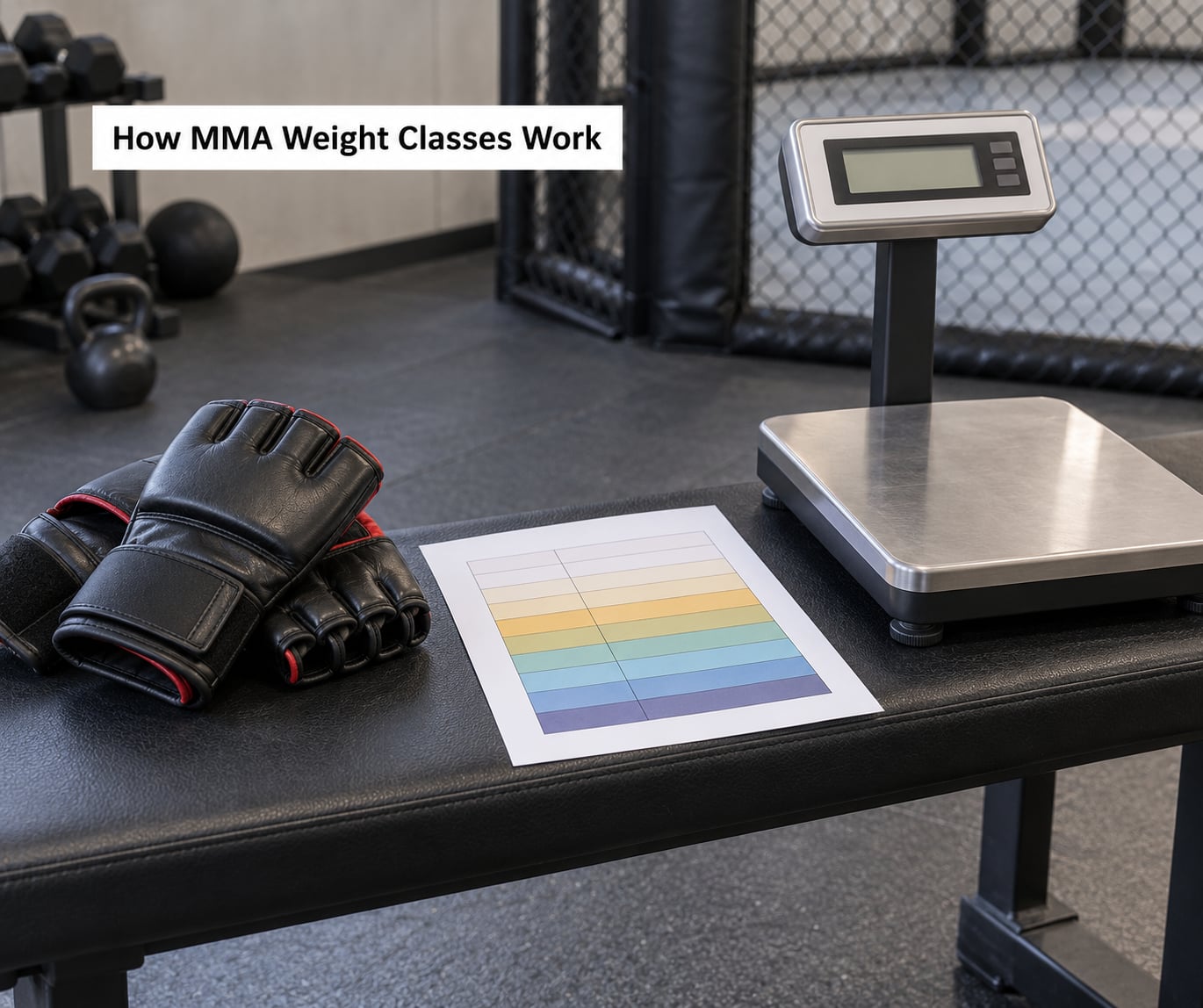
A weight class is a bracket of allowable weight, set by the rules body that sanctions the event, that keeps fighters of similar size matched against each other. It exists so that a 115 lb fighter is not asked to trade punches with a 265 lb one.
Three terms get used interchangeably when they are not quite the same thing. The weight class is the bracket itself, like lightweight. The weight limit is the ceiling inside that bracket, like 155 lb. The weight division is just another word for the same bracket, and nobody in the sport will correct you for using it.
The important structural point is that the limit is a ceiling. Fighters do not aim to weigh exactly the number printed in the division name. They aim to come in under it, and then they put the weight back on between the weigh-in and the fight.
Before regulation, mixed martial arts did not have this structure, and the early events were genuinely dangerous. Size was an open variable, and mismatches were not treated as a medical issue so much as part of the spectacle. Once athletic commissions started licensing the sport, they inherited a fixed list of weight classes from boxing and eventually wrote MMA-specific rules on top of it.
Those rules live in the Unified Rules of Mixed Martial Arts, a shared rulebook that commissions in different states and countries adopt with their own amendments. Promotions write contracts and marketing on top of that, but they do not get to invent a new weight limit for an event.
Here is the short version of the mechanics: a division is assigned when the bout is made, both fighters weigh in on an official scale inside the window set by the commission, the reading is recorded, and a fighter over the limit faces penalties that range from a fine to the bout being cancelled. The fight itself happens hours later, sometimes the next day.
What Is a Weight Limit in MMA?
A weight limit is the highest weight a fighter is permitted to register at the official weigh-in. In pounds in the United States, in kilograms almost everywhere else, and the two are given together in most published rules.
The limits are not averages. Nobody asks a lightweight to weigh 155 lb, only to weigh no more than it. A fighter who walks into the arena at 168 lb and passed the scale at 154 lb did exactly what the rule asked.
Why a division limit is a ceiling and not a target
There is a simple reason. If fighters tried to compete at exactly their division limit, there would be nothing in reserve to cut on weigh-in day. They would arrive on weigh-in day already at the number and have nothing to give back. Holding weight year-round at the limit is close to impossible for most people who also have a job, a training camp and a normal life.
So the practical picture is two numbers for every professional: the weight on the scale, which is a public record, and the weight in the cage, which usually is not published and can be substantially higher.
The gap is uneven across the ladder for a physical reason. A heavyweight walking 30 lb above the limit is carrying frame mass and ordinary body mass. A flyweight cannot do the same trick, because a body that small does not have the water and tissue to give up. That is why heavyweight watch and flyweight watch are the same rules applied to very different bodies.
Why the limits are set where they are
Limits follow two goals that pull against each other. The first is safety: strikes land harder when a bigger person connects with a smaller one, and grappling becomes dangerous well before the size difference becomes absurd. The second is competitive balance: the closer two athletes are in size, the more the outcome depends on skill, conditioning and tactics.
The spacing between divisions reflects that compromise. The gaps are not uniform, and that unevenness is deliberate, because each rung was added when the sport outgrew the rung below it rather than because someone ran the numbers and optimised the ladder.
Who gets weighed, and what happens over the limit
Both fighters on the card are weighed for their division, usually at a scheduled official weigh-in. For a championship bout, the title holder and the challenger are the ones whose readings determine whether the fight is sanctioned as a title fight at all. If the champion is over, the title is typically not at stake on that night.
An over-limit reading starts a process rather than an automatic loss. The usual sequence is a second attempt at the scale, a fine, a requirement to make a further cut under supervision, or the removal of the bout from the card. Which step applies depends on the commission and the promotion’s contract, and the amounts vary widely.
How the Major MMA Weight Classes Are Organized
The standard men’s ladder has nine rungs when strawweight is counted, from 115 lb up to 265 lb. The women’s ladder has five, from 115 lb to 155 lb. Both tables below give pounds and kilograms in the same row, because most people searching for this information want one unit or the other and it saves a conversion.
Men’s MMA weight classes and their limits
| Division | Weight limit | Limit in kilograms | General size profile |
|---|---|---|---|
| Strawweight | 115 lb | 52 kg | The lightest recognised division, smallest athletes in the sport |
| Flyweight | 125 lb | 57 kg | Very light and very fast, with a high knockdown rate |
| Bantamweight | 135 lb | 61 kg | Deep talent pool, quick pace, heavy reliance on grappling |
| Featherweight | 145 lb | 66 kg | Longer bouts, more endurance-focused styles |
| Lightweight | 155 lb | 70 kg | Well-rounded skill, one of the deepest divisions on the ladder |
| Welterweight | 170 lb | 77 kg | Large gap below it, pace and pressure fighting common |
| Middleweight | 185 lb | 84 kg | A second large gap, favours athletes who carry pace well |
| Light heavyweight | 205 lb | 93 kg | Athletes who look and move like smaller fighters |
| Heavyweight | 265 lb | 120 kg | The top rung, where title fights are sometimes negotiated at a lower limit |
Heavyweight is the one class that behaves differently. The ceiling exists, but title fights at the top of the sport have been agreed at a lower number such as 205 lb because a smaller athlete against a larger one is safer and more interesting. That arrangement is negotiated per bout rather than written into the standing limits.
Women’s MMA weight classes and their limits
| Division | Weight limit | Limit in kilograms | Notes |
|---|---|---|---|
| Strawweight | 115 lb | 52 kg | The lightest women’s division and one of the fastest |
| Flyweight | 125 lb | 57 kg | Small athletes with high output and frequent knockouts |
| Bantamweight | 135 lb | 61 kg | Longer fights and a mixed striking and grappling profile |
| Featherweight | 145 lb | 66 kg | Often described as the most complete division in the women’s game |
| Lightweight | 155 lb | 70 kg | The heaviest recognised women’s division |
There is no middleweight, light heavyweight or heavyweight for women in mainstream promotion, and that gap is the most common question fans ask about the ladder. It is a matter of depth of competition rather than rules, so it changes over time.
Why the ladder is unevenly spaced
Read the limits in sequence and the gaps jump around: 10 lb, 10 lb, 10 lb, 10 lb, then 15 lb, 15 lb, 20 lb, then 60 lb at the very top. Uniform spacing would be tidier and would say nothing about what the sport actually needs.
Each division exists because a generation of athletes outgrew the one below it. When several top performers were all competing under the same limit and beating each other regularly, the sport added a new bracket rather than asking the established ones to move up. That is why the biggest gaps sit in the middle of the ladder, where the athlete pool is thickest, and why the top of the ladder is a negotiation rather than a rule.
The uneven spacing has a second effect: each division develops its own style. A 10 lb band at flyweight produces very different incentives from a 20 lb band at middleweight, and neither produces the same fighter.
How MMA divisions compare with boxing and Muay Thai
| Sport | Typical number of divisions | How the structure differs |
|---|---|---|
| MMA | 9 men’s, 5 women’s | Built from a boxing-style backbone with lighter and heavier additions, plus a separate women’s ladder |
| Boxing | Roughly 17 across major bodies | Denser ladder with small steps, which keeps size matches tight in every bracket |
| Muay Thai | About 8 depending on sanctioning body | Traditional ladder, historically named after the Rajadamnern stadium divisions |
| Kickboxing | Varies widely by rule set | Some organisations use four or five divisions and others use a much longer ladder |
MMA has no open-weight era the way boxing did in the 1970s, and no super-fights sanctioned at catch weights in the mainstream. Nearly every professional bout on a major card is attached to a division limit, which is why the class system is so visible in the sport.
What the class system does not solve: reach and height
Weight gets regulated. Reach does not, and it is arguably at least as important in a fight. Two flyweights can differ by eight inches of reach, and a fighter who is heavy for the division can be two or three inches shorter than his opponent while still weighing the same.
There is no reach class in MMA, and no rule prevents that pairing. On fight forums this comes up constantly, usually with the same complaint: the system does nothing about the physical variable that most affects striking distance, while being very precise about the one that affects size.
The standard counter-argument is that reach correlates with height and therefore with weight, so the weight limit is a rough proxy. It is a rough proxy, and it breaks exactly where the division is narrow. A reach advantage also cuts both ways, since a long fighter can be harder to bring down and harder to chase.
For a beginner, the practical read is simpler. A division limit does not promise a fair fight, it only promises a size-bounded one. Everything else in the matchup is up to the fighters.
Why Fighters Cut Weight Before a Fight
Fighters cut weight because competing in a lighter division usually offers more than competing in the one above it. A smaller athlete who steps up often gives up reach, and reach is hard to replace with cardio or grappling. Dropping a division keeps the size advantage on their side.
The part that is not body fat is water. A cut of roughly 8 to 10 percent of body mass, which is where many professional cuts land, is mostly water and glycogen rather than fat. Losing 10 lb of actual fat takes a planned calorie deficit over weeks; losing 10 lb of water can happen in an afternoon, which is why the final stage of a cut looks alarming and is also the part competitors hate.
Because so much of the loss is reversible in roughly a day, the same fighter can weigh in light and fight heavier. This is the whole reason for the rehydration window, and it is also why the number on the scale rarely describes the athletes you see in the cage.
Why fighters don’t just maintain the weight year-round
It gets asked on fight forums constantly, and the honest answer is physiological. Even if a fighter held exactly the limit through a whole camp, there would be nothing left to cut on weigh-in day. The limit is the top of the permitted range, not a comfortable resting state, and trying to live there leaves no margin for the dehydration drop the final step requires.
Cutting is also tied to a specific opponent and a specific date. A fighter’s natural competition weight can sit above one division limit and below the next, and the class above is only taken when the matchup justifies giving up size. Changing division is a decision made per fight, not a permanent move.
Why the practice is contested
There is an active reform debate among fans, coaches and ringside physicians about rapid weight loss, and it is worth saying plainly that not everyone agrees on how serious the issue is or what the fix should be. Ringside physician organisations have published position statements on dehydration and rapid weight loss for years, and commission rules differ in how much latitude they give promotion medical staff.
What is not in dispute is that a body coming back from significant dehydration starts the fight compromised. That is a short-term performance matter, and it is why so much of the criticism of weight cutting focuses on fight night rather than on health policy.
If you are training and thinking about this yourself, treat the health question as something to raise with a doctor rather than something to work out from a forum post. Everything in the next section is general context, not a plan.
What Happens at MMA Weigh-Ins?
How mixed martial arts weight classes work on fight night
The weigh-in happens well before the fight, and the timeline is the part most fans miss. A normal sequence runs like this.
- Check-in the day before or two. Fighters arrive, pass hydration and medical checks, and have their passes checked against the commission’s roster.
- Queued for the scale. Bouts are called in division order, and the fighter steps on a calibrated scale wearing minimal clothing, usually in view of officials.
- Reading taken and recorded. The official number goes on the sheet. If it is at or under the limit, the fighter is done.
- Second chance if over. Most rules allow another attempt within a short window. Stripping down, drinking water and using the restroom are the usual tools.
- Fighter released. A passed fighter leaves the weigh-in area, starts rehydrating and has the rest of the window to recover.
- Face-off or check later. Some events stage the face-off right after the weigh-in, some move the bout several hours forward so both fighters have recovered.
- Second medical check. A commission physician or representative examines both fighters again before they are cleared to compete.
The rehydration window is typically the rest of that day or the following day, and it is not idle time. A fighter who lost 10 lb of water needs to put that back on, and the way it comes back matters. Fluid and carbohydrates do most of the work, and the reintroduction is planned around the fight rather than done by chance.
That is the whole answer to how the classes function on the night: the weigh-in is a legal checkpoint, and the fight happens to two fighters who were cleared at it.
What happens when a fighter misses weight
Missing weight is a process with a set of possible outcomes, not a single punishment. In rough order of how common they are:
- Second attempt at the scale. The first and most common response, granted within a short window.
- Fine. A financial penalty set by the commission or the promotion contract, often applied when a bout goes ahead.
- Requirement to lose more under supervision. Used when the bout is scheduled soon enough to make further weight loss plausible.
- Bout removed from the card. Common when the timing is wrong or the fighter cannot recover in time.
- Title not at stake. If the champion misses, the challenger usually wins an ordinary decision rather than a title.
- Vacated title. Applied in some cases when a champion cannot make the limit.
- No contest. The rarest and most severe outcome, used when the fight happens but one fighter was never properly within the rules.
Which step applies is decided in advance by the commission and the promotion contract, not on the night. Fights over championship weight are among the most-watched and most-debated moments in the sport, because a stripped belt is a visible cost to a promotion.
How Promotions and Sanctioning Bodies Handle Weight Rules
Weight rules come from above the promotion. A commission, a state athletic control board or a national governing body licenses the event, appoints the officials and the physician, and sets the ruleset under which the weigh-in happens. The Unified Rules are the shared template those bodies work from, amended locally.
The promotion’s role is contractual. It decides who fights whom, sets bout contracts with their own weight terms, negotiates exceptions such as a heavyweight title fight at a lower limit, and writes the penalties its own athletes agreed to in advance. It does not set the standard ladder.
Sanctioning bodies sit alongside commissions rather than replacing them. A commission licenses and polices the event within a jurisdiction; a sanctioning organisation supplies a rule set and, for amateur competition, often the weight classes used at regional and national tournaments.
Two things follow from this that are useful to a fan. First, the exact procedures differ by state and by country, so the same mistake can be handled differently on two events. Second, the weight rules say nothing about how good a fight will be. A clean weigh-in is a minimum standard for a sanctioned bout, not a signal that anyone in the cage is going to be worth watching.
How Fighters Stay Within a Division Safely
The following is general context for someone who wants to understand how this is managed, not a plan to follow. Weight management is a health matter, and anyone cutting weight for competition should be working with a doctor and, where possible, a sports dietitian who knows the sport.
The broad principles that come up in any competent approach are these. Change body composition gradually over months rather than days, because the last few pounds are always water and the last few pounds are where the risk lives. Start a camp at a weight you can hold without constant effort, then treat the final week as logistics rather than as a sprint. Keep food and fluid intake steady through training so that a cut does not coincide with illness or an injury.
Dehydration is the part to treat with most caution, because it is the component that produces the fastest results and the least controllable risk. Head dizziness, confusion, cramping and reduced kidney function are all documented consequences of rapid water loss, and they are more dangerous in a sport where someone might get hit. That is why commissions treat rehydration time as a medical protection rather than a formality.
Recovery is part of weight management too. A fighter who has been in a deficit for a long stretch arrives at fight week depleted, and a depleted fighter is more likely to be hurt in training before the event even happens. Amateur competitors regularly describe cutting aggressively with no supervision at all, and it is the least safe way to do it.
What to do if you are new to this: talk to your doctor before you attempt a cut, keep the weight class decision separate from the size decision, and pick a class you can reach in your walking weight rather than one you can reach only by dehydrating. If you have any medical condition or take medication, that conversation is not optional.
Frequently Asked Questions
What are the different weight classes in MMA?
The men’s ladder has nine divisions: strawweight at 115 lb, flyweight at 125 lb, bantamweight at 135 lb, featherweight at 145 lb, lightweight at 155 lb, welterweight at 170 lb, middleweight at 185 lb, light heavyweight at 205 lb and heavyweight at 265 lb. The women’s ladder has five, from strawweight at 115 lb up to lightweight at 155 lb. Each number is a ceiling set by the commission, not a target weight.
Why don’t MMA fighters maintain their weight instead of cutting before a fight?
Because the division limit is a ceiling with nothing left in reserve. If a fighter held exactly the limit through camp there would be no margin for the dehydration the final step of a cut requires. Most cuts also lose water and glycogen rather than fat, which is why the last ten pounds can come off fast and be restored within a day. Cutting is planned per opponent rather than maintained as a permanent state.
Why are there weight classes in MMA but no reach classes?
Weight is the easier variable to regulate, since a scale gives an instant, verifiable number, while reach changes with posture and cannot be measured the same way. Reach also correlates with height and therefore loosely with weight, so it is treated as a rough proxy. The proxy breaks down in narrow divisions, where two fighters at the same weight can differ by several inches of reach.
Which is the hardest weight class in the UFC?
It depends on what you mean by hard. Lightweight and bantamweight are usually called the deepest because so many complete fighters compete there. For pure difficulty of cutting, lighter divisions demand more discipline because there is less body mass to give up. For difficulty of winning, middleweight is often cited because its 20 lb band lets bigger athletes stay at the top without giving up much.
What happens if an MMA fighter misses weight?
The usual order is a second attempt at the scale, then a fine, then a requirement to lose more under supervision if there is time. If none of that works, the bout comes off the card. If a champion misses, the title is usually not at stake, and a vacated belt or a no contest is possible in the most severe cases. The exact penalties are set in advance by the commission and the bout contract.
How long before a fight do fighters weigh in?
Typically 24 to 48 hours before the event. That window exists so a fighter can rehydrate after losing water to make weight, and it is why a bout is often scheduled later in the day than the weigh-in or on the following day. A second medical check normally happens before either fighter is cleared to compete.
What to Take Away
Start with the ceiling idea, because everything else follows from it. A division limit is the most a fighter may weigh on an official scale, not what they weigh in the cage, and most of the confusion on fight nights disappears once that is clear.
From there, the useful pieces are the weigh-in sequence, the rules on missing weight, and the fact that the system regulates weight and ignores reach. If you are training yourself, take the health question to a doctor and not to a forum.