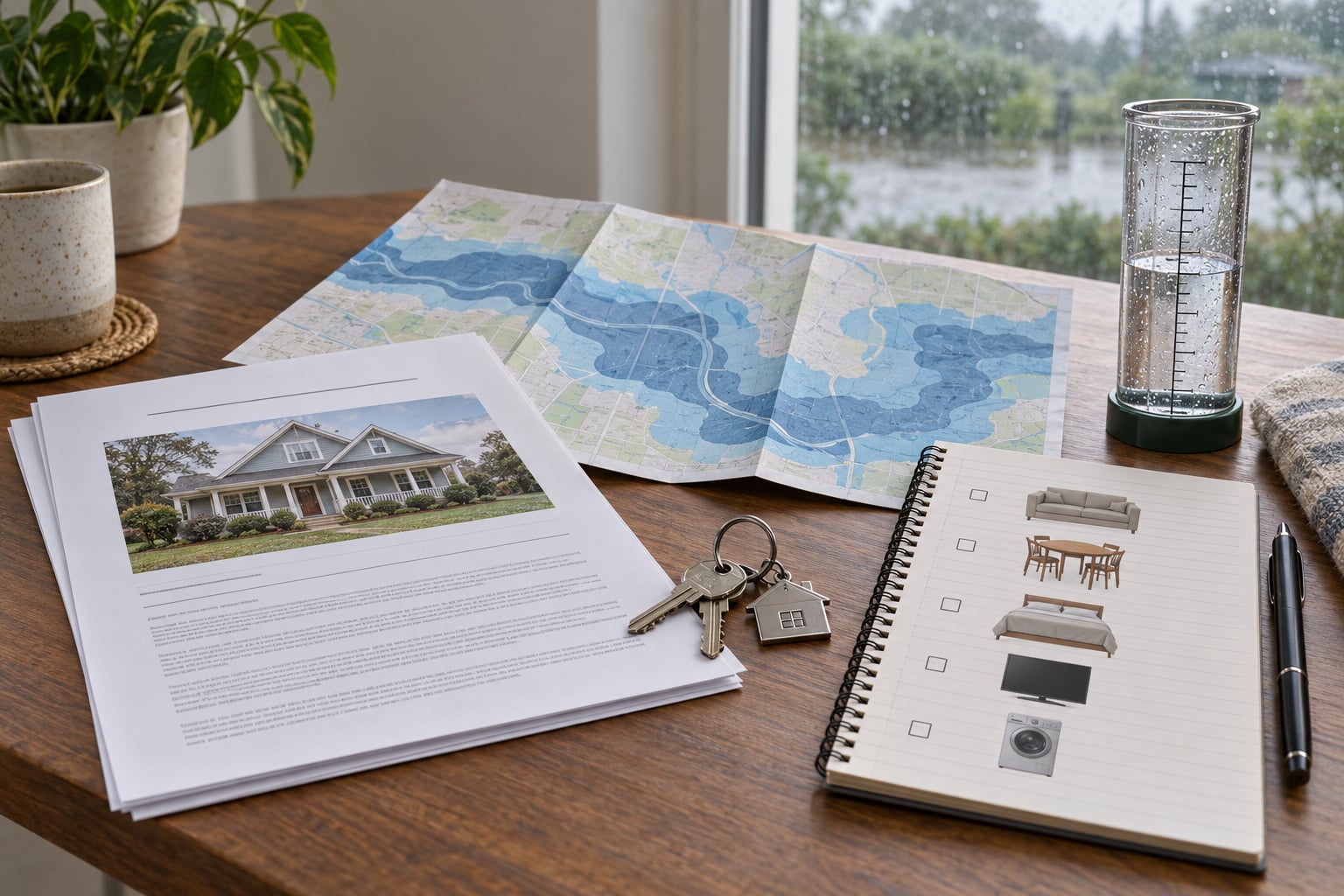
Flood insurance is a separate property policy, and it pays for direct physical damage when water from an outside source — heavy rain, river overflow, storm surge or snowmelt — enters your house or your belongings. Your homeowners policy deliberately leaves that damage out, which surprises more people than any other gap in insurance.
That is the whole puzzle in one line. The difference between the two policies is not how much water there is, it is where the water came from. Water that rose off the ground and came through a door or a low window is flood. Water that leaked through a failed shingle, burst through a pipe, or blew in through a broken window is not.
Below is how the policy actually works: what you buy, what it pays for, what it refuses, what sets the price, and what happens in the first two weeks after the water recedes. Rules and rates vary by country, state, property and insurer, so treat the figures below as the U.S. federal program as it stands today.
Table of Contents
- What Is Flood Insurance and When Do You Need It?
- How Flood Insurance Works: The Basics
- The short version of how flood insurance works
- What Does Flood Insurance Cover?
- What Is Not Covered by Flood Insurance?
- What Determines Flood Insurance Coverage and Cost?
- How Do NFIP and Private Flood Policies Compare?
- How Does the Flood Insurance Claims Process Work?
- How Much Flood Insurance Should You Buy?
- Frequently Asked Questions
- Is flood insurance required by mortgage lenders?
- Does homeowners insurance cover flooding?
- Can renters get flood insurance?
- How long does a flood insurance claim take?
- Can I get flood insurance after a flood has started?
- How can I renew my FEMA flood insurance policy?
- Conclusion
What Is Flood Insurance and When Do You Need It?
Flood insurance covers the damage that happens when a body of water overflows onto land that is normally dry, from a river, a lake, a storm surge, or rainfall that exceeds what drains away. In the United States it is sold either through the National Flood Insurance Program, run by the Federal Emergency Management Agency, or through a private insurer.
You need it if any of these describe you:
- You have a federally backed mortgage on a home in a Special Flood Hazard Area, which is Zone A or Zone V. The lender will require it, and it has to be in force at closing.
- You live within a coastal or tidal zone, where storm surge can push water into a home several blocks from the nearest shoreline.
- Your house sits low, has a basement or a finished lower level, or sits downhill from a slope that funnels runoff toward it.
- Your property flooded before, or the neighborhood drained toward your lot before.
- You rent. A renters policy never touches flood damage, and contents-only flood policies are inexpensive.
Worth repeating: being outside a mapped flood zone is not a safety guarantee. More than a fifth of NFIP claims come from moderate- and low-risk zones, mostly from people who assumed “not in a flood zone” meant “no flood insurance.” One inch of water on the first floor can mean up to USD 25,000 in damage once flooring, drywall, cabinets, baseboards and labor are counted.
How Flood Insurance Works: The Basics
The short version of how flood insurance works
You buy a flood policy as a standalone contract, separate from homeowners or renters insurance. You pay a premium based on where the building sits, how high the first floor is above the base flood elevation, what the building is made of, and how much coverage you buy. When a covered flood causes damage, you report the loss, an adjuster inspects it, you submit a signed Proof of Loss listing the damaged items, and the insurer pays replacement cost for the building and actual cash value for contents, up to your limits, after your deductible.
Three mechanical details catch people out. First, there is a waiting period: NFIP coverage does not start for 30 days after the policy is issued, and the waiting period cannot be waived, shortened or backdated even when a storm is already named. Second, a policy is priced for one year at a time and renews annually. Third, the amount the insurer pays is tied to your coverage limit, not to your loss — buy too little and the shortfall is yours.
There are three broad types of flooding to know. Fluvial is river overflow. Pluvial is flash flooding from rain that the ground and storm drains cannot absorb fast enough. Coastal is storm surge and tidal flooding, which often arrives with a hurricane and overlaps with wind damage in a way that causes real disputes later.
What Does Flood Insurance Cover?
Two separate coverage parts sit on the same policy, and you can buy either one on its own. Building coverage pays to repair or rebuild the structure. Contents coverage pays for your belongings. A landlord or owner with a mortgage generally takes both; a tenant takes contents only.
Building coverage typically includes:
- Repairing or replacing the building itself, back to its pre-loss condition
- Demolition of the damaged structure and clearing of debris, including trees felled by flood or wind during the event
- Emergency measures that protect the property from further damage, such as tarping a roof or pumping standing water
- Rebuilding to pre-flood code rather than merely restoring the old layout, subject to the policy terms
- Cost to prevent further damage after the water leaves
Contents coverage typically includes:
- Personal property anywhere in the home, including a garage, storage unit off site, or items in the basement
- Furniture, appliances, clothing, electronics, documents, and ordinary household goods
- Contents are paid at actual cash value by default, meaning the current value of the item rather than a brand-new one; a replacement cost endorsement upgrades them
- High-value items such as jewelry, art, antiques and collectibles carry sub-limits far below the total contents limit unless separately scheduled
Two more items trip people up. NFIP does not pay additional living expenses so a displaced owner can stay in a hotel; that is a homeowners-policy job, and if you rent it is your landlord’s policy. And mold that grows directly from a covered flood is generally covered, while mold from a slow leak, a sewer backup or a damp basement is not.
To look up where your property actually sits, the FloodSmart flood zone lookup and the FEMA Flood Map Service Center are the authoritative sources. Print the map panel for your address and keep it with your policy documents.
What Is Not Covered by Flood Insurance?
Flood insurance is indemnity insurance tied to one cause of loss: water from an outside source. Everything else falls outside it. The short list is:
- Damage from water that did not come from an outside source, including a burst pipe, a failed sump pump, a washing machine hose, or a roof leak
- Sewer, drain, and water backup through a municipal line or a home’s own drain system, unless the backup is directly caused by a covered flood
- Gradual seepage, saturated groundwater, condensation and dampness that never became a flood
- Damage caused by failure to maintain the property, such as an unrepaired roof or a foundation defect that let water in
- Upgrades and improvements that were not insured, including a new roof, a remodeled kitchen, or a finished basement
- Earthquake, landslide and tsunami, which sit on other policies or programs
- Loss of use and additional living expenses for an owner-occupied home
- Damage that began before the policy or during the 30-day waiting period
- Anything the adjuster identifies as wind, even where wind and flood water mixed in the same room
The last item deserves attention. After a hurricane, insurers regularly reclassify water that entered through a roof gap or a blown-off shingle as wind-driven water rather than flood water, and a mixed-damage claim can be split, reduced, or denied on that basis. Photographs of how the water got in are worth more than almost anything else you can do beforehand.
What Determines Flood Insurance Coverage and Cost?
Price follows risk, and risk is mostly a question of elevation. Under FEMA’s Risk Rating 2.0 methodology, which is how NFIP policies are now rated, the biggest driver is how far your building sits above the base flood elevation, followed by distance to the body of water, flood zone, replacement cost, construction type, occupancy and deductible. Most policyholders saw the switch land as a small monthly change, and FEMA caps the annual increase at 18 percent.
| Variable | How it affects the policy |
|---|---|
| Flood zone (A, AE, V, X, B, C, D) | Determines eligibility, whether a lender requires the policy, and much of the base rate |
| Distance to water | Closer means a higher rate in Risk Rating 2.0 because flooding is likelier to reach the building |
| First-floor height above base flood elevation | Higher floors lower the price noticeably; this is the single most influential input on a private quote |
| Replacement cost of the building | Sets the realistic coverage limit; buying the federal maximum on a small house overpays, buying the maximum on a large house underinsures |
| Construction and occupancy | Single-family owner-occupied rates differ from rentals, seasonal homes, and nonresidential property |
| Deductible amount | NFIP offers several deductible levels; a higher deductible lowers the annual premium |
| Claims history | A past claim can affect renewal pricing, particularly in the private market |
How Do NFIP and Private Flood Policies Compare?
The federal program and the private market cover the same core peril, but they are different products with different trade-offs. The federal policy is broadly available, standardized and predictable. The private policy offers higher limits and cheaper rates on well-elevated homes, at the cost of underwriting discretion and the right to decline renewal.
| Point of comparison | NFIP policy | Private flood policy |
|---|---|---|
| Building coverage limit | Up to USD 250,000 for a residence | Often well above the federal ceiling, into the millions for high-value homes |
| Contents coverage limit | Up to USD 100,000 for a residence | Higher limits available; contents can often be written at replacement cost |
| Waiting period | 30 days, not waivable, not backdated | Often shorter, sometimes none, but still cannot be bound once a storm is forecast |
| Loss of use and additional living expenses | Not provided for an owner-occupied home | Available on some policies |
| Elevation certificate | Required to rate most new and substantially improved buildings in Zone A or V | Routinely required for quoting and for any rate discount |
| Cancellation at renewal | The program itself does not non-renew a policy for risk; nonpayment and misrepresentation remain grounds for cancellation | The insurer may decline to renew, which is the main risk buyers cite |
| Best suited to | Most mortgages, coastal properties, and anyone who wants a policy that will still be there next year | Higher-value homes, renters seeking cheap contents-only cover, and well-elevated properties where private rates beat the federal ones |
A third option sits on top of both: excess flood insurance, sometimes sold as a flood umbrella. It attaches above a primary policy’s limit and pays only if a loss exceeds the underlying coverage. That is the route for a home valued well above the federal building ceiling. A Preferred Risk Policy is a federal option that bundles building and contents for homeowners in lower-risk zones.
How Does the Flood Insurance Claims Process Work?
The claim runs on a fixed sequence, and missing a step is the most common reason owners lose money. Federal policyholders must submit a signed Proof of Loss within 60 days of the loss. Work the order below and document as you go.
- Protect people, then call your insurer. Put safety first, then notify the carrier as soon as it is practical. Do not wait to see how bad it looks.
- Stop further damage. Shut off water and power, pump standing water, throw out soaked carpet and drywall before mold sets in. Keep every receipt; mitigation costs are reimbursable.
- Photograph everything before you move it. Wide shots of each affected room, then close-ups of each damaged item, and video for the flow of water. Note which rooms it reached and how high the water came.
- Keep physical evidence. Set aside a chunk of damaged flooring, drywall and insulation. Adjusters routinely want a sample, and replacing everything before the inspection weakens the claim.
- Do not discard anything until the insurer clears you. Disposing of damaged property too early is a common cause of dispute.
- Schedule the adjuster inspection. Be there, walk the adjuster through how the water entered, and hand over your photos and receipts.
- File the Proof of Loss. List each damaged item or component with the amount you are claiming. Under NFIP this is due within 60 days of the loss.
- Review the settlement and ask about anything missing. Compare the line items against your photographs and inventory. If the cause of loss is written as wind rather than flood, that is the point to challenge.
- Appeal if you disagree. Re-submit with additional evidence, use the adjuster’s supervisor or the program’s reinsurer review process, and keep a written record of every conversation.
Insurers give no fixed payment date, and experienced adjusters say a straightforward federal claim with clean documentation usually moves fastest when it has a single, clear cause of loss. Mixing wind and flood in one room slows everything down.
How Much Flood Insurance Should You Buy?
Buy enough that the limit tracks the value of what you would have to rebuild or replace, not a round number someone recommended. For most homes the rule of thumb is replacement cost: what it would cost today to rebuild to the same standard, which is usually more than the sale price years ago. Mortgage lenders commonly expect coverage of at least about 80 percent of that replacement cost.
Separate the two parts and value them separately. Building coverage should sit at or near full replacement cost. Contents coverage should reflect the value of your actual belongings; a two-bedroom rental and a house full of antiques need very different numbers.
Set the limit before you shop, not after you see the premium. A home whose limit is set at the federal maximum but whose rebuild cost is USD 400,000 is silently underinsured, and an insurer pays only up to the limit plus a limited amount above it. Working the other way, buying the maximum on a modest house is money spent on coverage you do not need.
Deductibles are the lever. The federal program offers several, from around USD 500 up to USD 5,000, and a higher deductible cuts the annual premium. Choose a deductible you could absorb without borrowing, because it comes off every payment and there is no coverage for what you cannot reach.
Frequently Asked Questions
Is flood insurance required by mortgage lenders?
Yes, if you have a federally backed mortgage and the home is in a Special Flood Hazard Area, which is Zone A or Zone V on the Flood Insurance Rate Map. The lender will not close the loan without a policy, and the borrower usually pays the premium. Outside those zones there is no mandate, so the decision is yours.
Does homeowners insurance cover flooding?
No. A standard homeowners policy excludes damage caused by water rising from an outside source, including river overflow, storm surge and rainfall flooding. It does cover water that came from a burst pipe, a failed sump pump or a roof leak, which is the source of most confusion. If you cannot say where the water came from, call the carrier before anyone starts demolition.
Can renters get flood insurance?
Yes, and it is the cheapest way to cover flooding. Renters buy contents-only flood insurance with no building component, protecting furniture, clothing, electronics and documents from an apartment or house they do not own. Renters insurance never covers flood damage, so this is a separate purchase, and contents-only policies usually run a few hundred dollars a year for a typical apartment.
How long does a flood insurance claim take?
No insurer guarantees a payment date. Clean federal claims with a single clear cause of loss and complete documentation usually move fastest, while claims mixing wind and flood damage can stretch out for months as the cause is argued. Report the loss immediately, mitigate further damage, submit the signed Proof of Loss within 60 days for NFIP, and follow up in writing every week or two.
Can I get flood insurance after a flood has started?
No, not once the event begins. NFIP coverage has a 30-day waiting period that cannot be waived or backdated, and private carriers will not bind a policy once a storm is forecast or water is rising. Policies cannot be purchased retroactively after a loss. The one exception is buying before a storm but inside the waiting period, which does not bind coverage until the waiting period ends.
How can I renew my FEMA flood insurance policy?
Your insurer contacts you before the policy anniversary to offer renewal, and the coverage continues without a new waiting period as long as you respond and keep paying. If you cancel and do not renew, there is a 30-day grace period after expiration. Reneging coverage mid-term is harder than it looks, and private carriers can decline to renew a policy the federal program would keep in place.
Conclusion
Start by finding out where your property actually sits. Pull the Flood Insurance Rate Map panel for your address, note your zone and your base flood elevation, and then read your homeowners policy closely enough to know which water it excludes. Compare a federal quote with a private one, set both coverage limits to your replacement cost, and pick a deductible you could pay without borrowing.
Then do the boring part that pays off later: photograph every room, list your belongings with receipts, and know where your policy and map panel are stored outside the house. The waiting period cannot be rushed, so buy before the season rather than during it.