Renters insurance pays for your belongings if they are stolen or damaged, pays for temporary housing if the place becomes unlivable, and covers you if a guest is injured or you damage someone else’s property. It does not cover the building itself, and it comes with limits, deductibles and a long list of exclusions. Here is how each part actually works.
Most people buy the policy without reading past the price. That is fine until a fire takes out a laptop, a ring and three weeks of rent, and the adjuster starts talking about depreciation.
Table of Contents
- What Renters Insurance Actually Covers
- Personal property coverage means your things, wherever they reasonably are
- Personal liability coverage is the part most renters never think about
- Loss of use coverage pays for the months after a fire
- Medical payments coverage is small, specific and often misunderstood
- What Renters Insurance Usually Does Not Cover
- Coverage you can add back with an endorsement
- How Coverage Limits and Deductibles Work
- What Renters Insurance Does Not Cover for Pets
- How to Check Your Coverage Before an Emergency
- What to Do After a Covered Loss
- Frequently Asked Questions
- Does renters insurance cover my belongings?
- Do I need renters insurance if my landlord has insurance?
- Does renters insurance cover flood damage?
- Can renters insurance cover my pet?
- How much renters insurance should I buy?
- Do I need renters insurance for a temporary apartment?
- Conclusion
What Renters Insurance Actually Covers
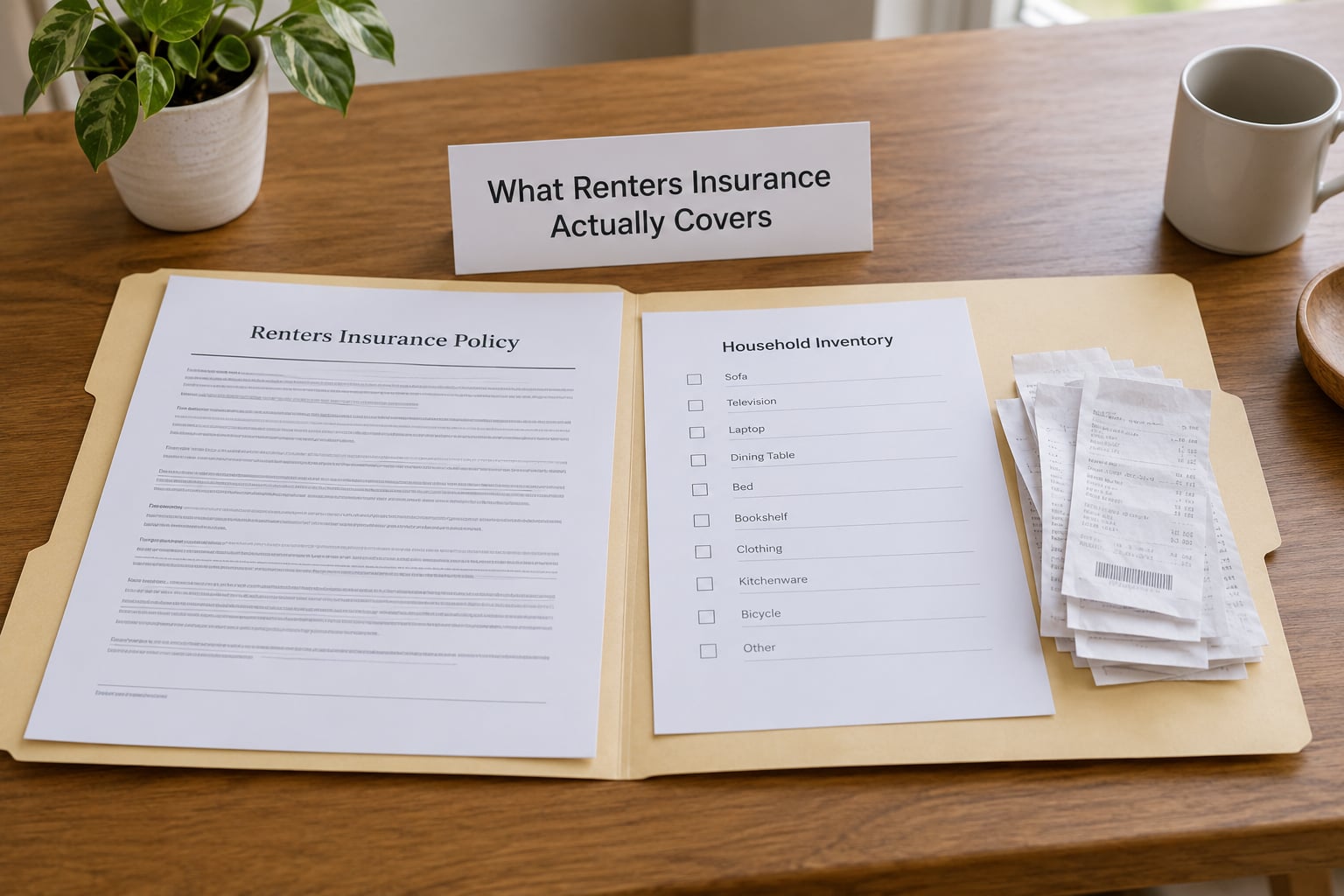
A standard renters policy has four moving parts. Personal property covers your stuff, personal liability covers what you do to other people, loss of use covers where you sleep if the place falls apart, and medical payments handles small injury bills. Everything else is an add-on or a gap.
| Coverage | What it pays for | Common example | Typical limit | Catch to watch |
|---|---|---|---|---|
| Personal property | Your possessions, on-premises and off-premises | Stolen laptop, smoke-damaged couch, bike taken from a rack | Contents limit, often 100,000 dollars | Sub-limits on jewelry, furs, cash and collectibles |
| Personal liability | Injury or property damage you caused, plus legal defense | A guest breaks a wrist on your stairs, a dog gets out | 100,000 to 500,000 dollars, in 100,000 increments | Covers third parties, not your own injuries |
| Loss of use | Extra living expenses when the home is uninhabitable | Fire in the unit, a burst pipe soaking the walls | Often 10 to 30 percent of the contents limit | Only applies after a covered peril, and has a time cap |
| Medical payments | Small medical bills for certain injuries | A visitor sprains an ankle, a household member is hurt | Typically 1,000 to 10,000 dollars | Not health insurance and not for treating you at full cost |
Personal property coverage means your things, wherever they reasonably are
Contents coverage follows your belongings to a college dorm, a rental house, a hotel room on a trip and often a car, as long as the items were stolen from a covered location. A laptop taken from your vehicle at a gym is a common claim, and the surprise for most renters is that it usually works.
Property inside the unit is also covered, plus anything the landlord owns that is in your care, such as a borrowed couch you were storing in the garage.
The catch is how the insurer values the item. Replacement cost pays you what a new one of the same kind costs today. Actual cash value pays replacement cost minus depreciation, and on a three-year-old sofa that gap can be hundreds of dollars. If the value depends on a receipt or a recent quote, keep one.
Personal liability coverage is the part most renters never think about
This is the coverage that pays when someone else gets hurt or something of theirs breaks because of you. A guest trips over a rug, a falling bookshelf lands on a neighbor’s phone, a visitor is bitten by your dog.
Most policies set a liability limit and then pay legal defense costs separately from that limit, which is why a single incident can get expensive fast. Read the declarations page to see whether defense costs sit inside or on top of the limit. It is a meaningful difference at claim time.
Liability also extends to things you do away from home within policy limits, so a soccer ball through a neighbor’s window is usually handled the same way.
Loss of use coverage pays for the months after a fire
If a covered peril makes your place uninhabitable, loss of use, also called additional living expenses, pays the difference between what you were already spending on housing and what you now spend at a hotel, motel or short-term rental. Storage unit fees and the extra cost of eating out because the kitchen is unusable usually count too.
Limits are usually a percentage of the contents limit, and many policies cap the number of months. Insurers also expect you to keep receipts for the temporary place and the higher food bill. Keep them in one folder as you go, because reconstructing a hotel stay six months later is miserable.
Important limit: this coverage triggers only when a peril your policy covers makes the unit unlivable. A landlord’s slow maintenance, a failed heating system in January or a neighbor’s noise are not covered perils.
Medical payments coverage is small, specific and often misunderstood
Medical payments, sometimes called medical payments to others, reimburses minor medical expenses for a limited set of injuries. Depending on the policy that means a visitor or a member of your household who is hurt in the home, and it pays the first bills up to a modest cap.
It is not health insurance, it is not unlimited treatment coverage, and it does not pay your own medical costs after a covered loss. If you want your injuries covered, that belongs to health insurance, or to a policy that names you as a named insured for medical payments.
What Renters Insurance Usually Does Not Cover
The exclusions do more work than the coverage list in practice. These are the gaps renters run into most often, and none of them are covered by a standard HO-4 or renters form:
- Flooding and surge from rising water. You need a separate flood policy, and a burst pipe that bursts on purpose is treated differently from one that fails on its own.
- Earthquake damage. Unavailable on most standard policies unless your carrier sells an endorsement, and it is cheap when it exists.
- Mold, and damage that comes from dampness or poor maintenance over time.
- Wear and tear, mechanical breakdowns, and damage to the building itself.
- Pest infestations, including bed bugs, in most policies.
- Cash, checks, money orders and paper documents. A small cash sub-limit often applies before it drops to nothing.
- Jewelry, furs, watches, cameras and instruments above a sub-limit, often 1,000 to 2,500 dollars per item.
- Your own vehicles, and any liability from driving one.
- Damage you caused on purpose, or damage from an insured who is intoxicated.
- Gradual damage from a leak you were told about and did not fix.
- Property of other people in your care, unless they are listed on the policy.
- Business equipment and income from a home business job.
- Your roommate’s belongings, unless that person is a named insured on the same policy.
- A room you sublet or rent out through a short-term rental platform.
Coverage you can add back with an endorsement
Several gaps are fixable for a few dollars a month. Scheduled personal property lists a specific high-value item by name, serial number and value, and replaces the sub-limit with the amount you stated. Water backup and sump discharge coverage handles the failure most renters never see coming.
Personal property kept in a storage unit is worth asking about explicitly. Many policies cover it only if it is on the premises, and some offer an endorsement for off-site storage. The same question applies to valuables left with a relative or in a locker. If the answer matters to you, get it in writing rather than assuming.
How Coverage Limits and Deductibles Work
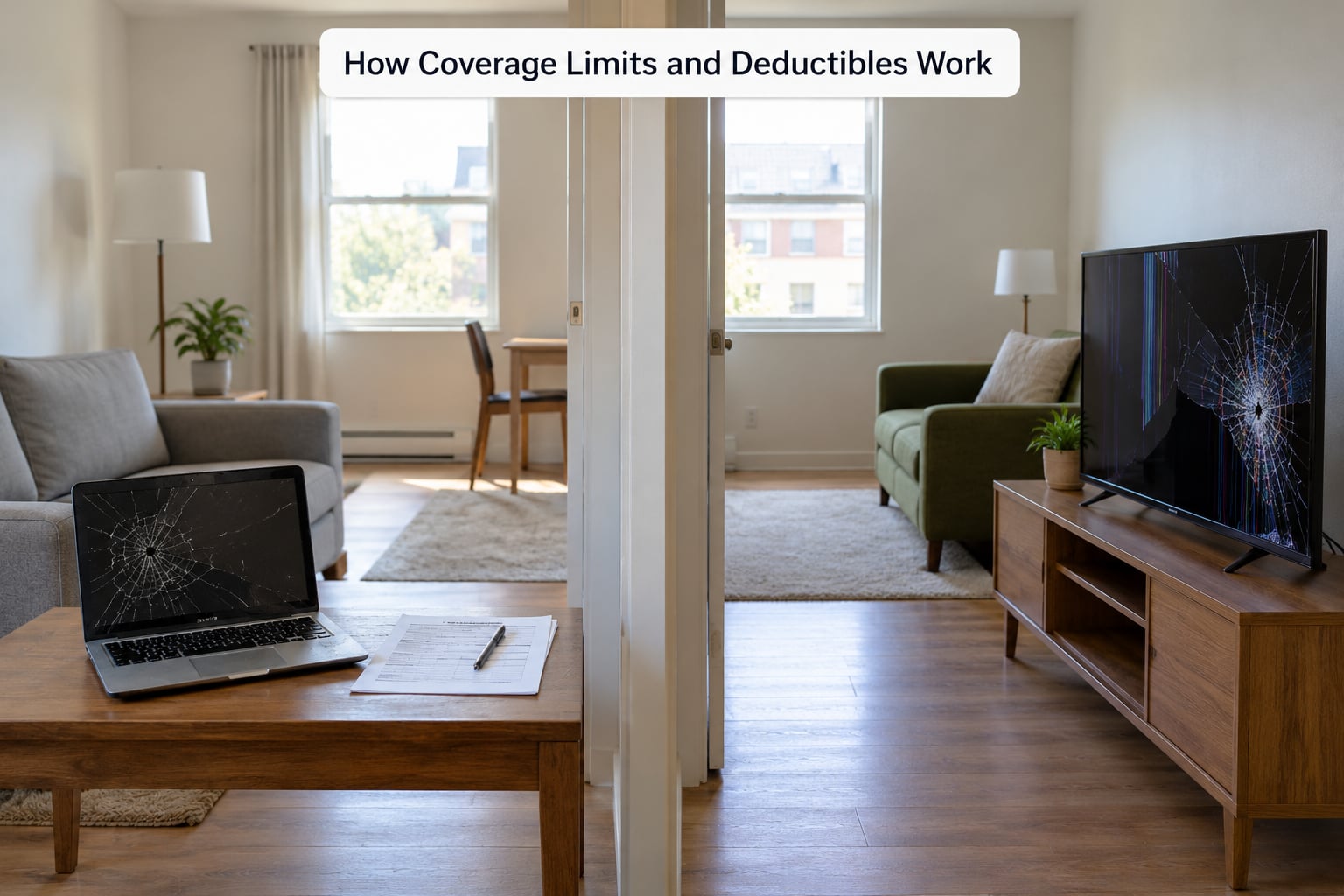
Two numbers decide most claims: how much the insurer will pay and how much you absorb first. Neither is visible from a sample policy online, which is why renters should compare declarations pages.
The contents limit is the maximum for all your personal property combined, not a per-item allowance. If you carry 80,000 dollars of stuff and your limit is 20,000 dollars, everything above 20,000 is yours, and a single fire can burn through that cap in an hour.
Liability limits are offered in round steps, usually 100,000, 300,000, 500,000 and sometimes 1 million dollars. Is 100,000 a lot? It is the common starting point and often adequate, but it is the level most likely to be exhausted by legal defense costs in a serious claim, so bumping to 300,000 costs relatively little and closes the gap.
Loss of use limits often sit as a percentage of the contents limit, and the number of months they run is stated on the declarations page. Deductibles usually apply per claim rather than per item, which means one deductible for a whole kitchen rather than one for each appliance.
| Situation | Replacement cost | Actual cash value |
|---|---|---|
| A 3-year-old 55-inch television retailing at 400 dollars new, 300 dollars used | Insurer pays about 400 dollars minus your deductible | Insurer pays roughly 240 to 300 dollars after depreciation, minus deductible |
| Same claim on a contents policy that says replacement cost | You receive new-item money, then keep the damaged item until the claim closes | Not available on that policy |
| Personal property of others in your care, such as a friend’s laptop | Covered only if scheduled or if the policy lists it | Usually not covered either way |
Some insurers apply an internal limit that caps what any one category pays out, such as 200,000 dollars for furs, fine arts, antiques or collectibles. Read for those sub-limits, not just the headline number.
What Renters Insurance Does Not Cover for Pets
This is the most expensive misunderstanding out there. Vet bills are excluded on nearly every renters policy. Illness, surgery, medications, vaccines, dental work and even euthanasia are not covered, and no endorsement fixes that.
What does get covered is liability, and only in narrow situations. Personal liability pays if your dog bites someone or if your pet damages someone else’s property. If your cat scratches a neighbor’s kid and the neighbor sues, that is inside the liability coverage.
Damage your pet causes to your own rental is a different story. Your dog tears up the carpeting and your landlord charges you for it, that claim lands between two policies, because most renters policies exclude damage caused by an insured’s pet.
Breed restrictions matter more than people expect. Several carriers decline or exclude pit bull type breeds, German Shepherds, Rottweilers and similar dogs, and some will cover them only through a separate canine liability policy. Exotic pets, including large snakes, iguanas and parrots, can be uninsurable through a renters policy altogether.
If you rent and want a dog covered, ask the insurer the specific question, get the answer in writing, and treat a written confirmation as part of moving in. Finding out after the bite is the expensive way.
How to Check Your Coverage Before an Emergency
Ten minutes with the declarations page tells you more than an hour of reading sample forms. The declarations page is the first sheet of your policy and it lists your actual limits, deductibles and endorsements.
Read these seven things on it:
- Contents limit, and whether it is on a replacement cost or actual cash value basis.
- Personal liability limit, and whether legal defense costs fall inside or outside it.
- Loss of use limit and the number of months it runs.
- Deductible amount, and whether it is per occurrence or per claim.
- Medical payments limit.
- List of named insureds, so you can see exactly who is covered.
- Any endorsements or scheduled items listed.
Then build an inventory. Photograph each room, record model numbers and serial numbers, and note the replacement cost of anything over a few hundred dollars. Photos with receipts attached are what turn a disputed claim into a fast one. Store it in the cloud, because a spreadsheet on a laptop that burned down helps nobody.
Compare the inventory total to your contents limit. If the numbers are close, raise the limit. If the gap is large, decide whether to schedule the specific expensive items instead.
Finally, check the dates. Many policies cap coverage at age 65 and some stop entirely after 75 unless you are on a senior policy. If you are close to those lines, ask about it rather than assuming the coverage carries over.
What to Do After a Covered Loss
The order matters more than people expect. Work through these steps in sequence, and take photos before you tidy anything.
- Make sure everyone is safe and call emergency services if there is a fire, gas smell or injury.
- Prevent further damage. Shut off the water, cover a leak, move electronics off a wet floor. Most policies expect you to do this and will reimburse reasonable emergency costs.
- Document everything. Wide photo of each room, close photos of every damaged item, a written list with purchase dates.
- Tell the landlord or property manager the same day, in writing, so you have a timestamp.
- Contact your insurer and ask about a preferred vendor. Do not sign a repair contract or authorize a full cleanout before the adjuster has seen the damage.
- Save every receipt: hotel, storage unit, meals above the normal cost, replacement purchases.
- Keep the damaged items until the claim closes, unless the insurer tells you to discard them.
- Compare repair against replace before you settle. Insurers may repair older items even when a new one is cheaper.
If the claim is denied, the denial letter has to state the reason. Read it against the policy language rather than the summary you remember, and most denials come down to a sub-limit, a missing named insured or a peril that was never covered.
Frequently Asked Questions
Does renters insurance cover my belongings?
Yes, that is the core coverage. Personal property protection pays for your possessions when they are stolen or damaged by a covered peril such as fire, smoke, wind, hail or a burst pipe. Items covered off-premises usually include a dorm room, a rented house, a hotel room and belongings taken from your car. Check sub-limits on jewelry, watches, cash and electronics, because those cap out far below the main contents limit.
Do I need renters insurance if my landlord has insurance?
Yes. Landlord insurance covers the building structure and the landlord’s property, and it is the landlord’s policy. It does not cover your furniture, electronics or clothing, and it usually does not cover your liability when a guest is hurt. That is why nearly every lease requires the tenant to carry a renters policy. Having both is normal and expected, not duplicate coverage.
Does renters insurance cover flood damage?
No. Flooding from rising water is excluded on standard renters policies, and so is storm surge. You need a separate flood policy, which in the US is generally written through the National Flood Insurance Program. Water damage from a burst pipe or a failed appliance is treated differently and is often covered, provided the failure was sudden and you did not know about the problem beforehand.
Can renters insurance cover my pet?
Only the liability side, not the vet bills. Personal liability responds if your pet bites someone or damages someone else’s property. Illness, surgery, medications and routine veterinary care are excluded on nearly every renters policy. Many carriers also exclude certain dog breeds, and exotic pets such as large snakes and iguanas can be impossible to cover, so ask about your specific animal in writing.
How much renters insurance should I buy?
Total the value of what you own, then pick a contents limit at or above that figure and choose replacement cost rather than actual cash value. For liability, 100,000 dollars is a common starting point and 300,000 dollars is a stronger choice if you can. Raise the contents limit if your inventory is higher, and schedule expensive individual items such as a laptop, a camera or jewelry.
Do I need renters insurance for a temporary apartment?
Yes, in most cases. Anything you live in for more than a few days can count as your residence under the policy, and a hotel or short-term rental can leave your belongings with only limited off-premises protection. A renter policy taken out for your main address normally extends to a temporary place if you are living there, but storage units and second homes are often excluded unless you add an endorsement. Ask before you move in.
Conclusion
Start with the declarations page, not the price page. Confirm the contents limit, the liability limit and the deductible, then walk through your rooms with your phone and write down what you actually own.
Where the inventory exceeds the limit or you hold something you cannot replace for a few hundred dollars, schedule it or raise the contents limit. For flooding, earthquakes, storage units or a pet that needs veterinary care, you are looking at a separate policy rather than an endorsement.
Do that once, before you need it. The policy that gets read carefully is the one that pays.